

Summarize This Article With AI
 Try with ChatGPT
 Try with Claude
 Try with AI Mode
For most of SEO’s history, the job was relatively simple. Understand how search engines work, optimize your own site, build some authority, and try to manipulate search rankings just enough to appear above your competitors in traditional search results. If you could win on Google, you could win on organic search. That was the game.
2026 does not look like that world anymore.
Search behavior has shifted dramatically, not just because of AI hype, but because the way people actually discover information has changed. We now live in a world of AI-powered search, AI-generated answers, AI assistants, visual search, video content, social platforms, and discovery engines that surface information before a user ever types the same keyword into Google. Traditional search engines are no longer the only interface for search, and in many cases, they are not even the first one.
Between Google’s AI Overviews, Google’s AI Mode, zero-click search, and the rise of answer engines that generate summaries instead of ranking pages, organic visibility is being redefined in real time.
Brands are no longer competing just for positions in search rankings. They are competing for presence inside AI systems, AI-generated responses, AI citations, and the proprietary data layers that power AI-driven search.
This is where SEO in 2026 becomes fundamentally different from traditional SEO.
Search engine optimization is no longer just about keyword rankings and organic traffic from Google Search Console. It is about how your brand shows up across AI platforms, how your content is interpreted by AI systems, how visible you are in AI search results, and whether your brand exists in the training signals and real expertise that AI assistants trust.
In this article, our team at SEO Sherpa shares their SEO predictions for 2026 across content, technical SEO, outreach, social SEO, local SEO, brand, and partnerships. Each department brings a different lens, but the same underlying reality keeps surfacing.
The future of SEO is not about ranking pages.
It is about building organic visibility across every search environment that exists, and every one that is coming next.
Article Summary
- Traditional search engines will no longer be the primary source of organic visibility, as AI-powered search, discovery engines, and social platforms continue to reshape how people search and consume information.
- AI-generated answers, AI overviews, and AI-driven systems will accelerate zero-click search, reducing direct traffic while increasing the importance of brand visibility inside AI responses.
- Technical SEO will shift from optimizing only for crawlers to optimizing structured data, internal linking, and proprietary data so AI systems can correctly interpret, summarize, and cite content.
- Content strategies will move away from volume-based AI-generated content toward real expertise, original insights, and content designed to influence AI assistants and answer engines.
- Link building and outreach will evolve into authority engineering, focused on trust signals, digital PR, and relevance within real communities, not just backlinks.
- Social SEO and video content will play a central role in search visibility as platforms like YouTube, TikTok, and Instagram become primary discovery engines.
- The brands that win in 2026 will be the ones with integrated, cross-channel SEO strategies that align search behavior, AI systems, brand, content, and digital marketing into a single ecosystem.
#1 Content Marketing: Why the Human Touch Will Become the Real Ranking Factor
If 2024 and 2025 were the years AI went mainstream in content, then 2026 will be the year the industry finally starts dealing with the consequences of that scale.
AI-generated content is no longer a novelty. It’s embedded into every part of modern content workflows, from ideation and research to outlining, writing, optimization, and distribution. Most brands now use AI tools in some form, whether that’s for blog posts, landing pages, product descriptions, or social content. In many cases, entire content engines are already powered by AI systems designed to produce SEO optimized content at speed.

And on the surface, this looks like progress.
Content is cheaper to produce. It’s faster to scale. It’s easier to localize. It’s easier to structure around search intent, same keyword clusters, and long-tail search volume. For search engines and AI platforms, this creates an endless supply of well-formatted, technically sound content that ticks all the traditional SEO boxes.
But it also creates a new problem.
When thousands of brands are using the same AI assistants, the same prompts, the same content frameworks, and the same tone patterns, everything starts to sound the same. Headlines become predictable. Intros feel interchangeable. The emotional layer disappears. And from a user perspective, the experience becomes flat, synthetic, and increasingly untrustworthy.
This is where the next phase of content marketing in SEO starts to diverge from pure automation.
As Amr Hussein, Bilingual SEO Copywriter at SEO Sherpa, predicts:
“Over the past year, AI has dominated almost every conversation around content, search, and digital growth, and naturally, it will continue to shape how we create, scale, and optimize content in 2026.
We will undoubtedly witness even bigger leaps in how AI is used to generate, structure, and deploy content across platforms.However, what I strongly predict will emerge alongside this acceleration is an increasing demand for human touch, especially in copywriting.
Imagine thousands of articles using the same tone, phrasing, headlines, and predictable AI patterns.Wouldn’t that eventually create a deep user need to read something that feels real, relatable, and emotionally resonant?
This is where we’ll see a natural balance form: A powerful reliance on AI for speed and scale, met by an equally strong demand for human-driven creativity shaped by lived experiences, cultural context, emotional intelligence, and real social understanding.
With services like Search Everywhere at SEO Sherpa, optimization will go far beyond simply being present on every platform or ensuring brand discoverability across multiple search ecosystems.In 2026, true content optimization will also mean:Making content easy to read. Easy to digest. Easy to connect with emotionally. And easy to trust.
Of course, this will still involve smart keyword integration and aligning content with high-intent, related search queries for our clients’ products and services.But the real competitive edge will lie in something deeper:Content that doesn’t just rank, but resonates.The human touch in copywriting will become the trust signal.And trust will become one of the strongest ranking currencies in the era of Search Everywhere.”
This prediction reflects one of the biggest shifts happening across AI-driven search and answer engines.
Search engines and AI systems are no longer just ranking pages based on technical signals and keyword usage. They are increasingly trying to infer credibility, usefulness, and real expertise from content itself. That includes how information is explained, how nuanced the perspective is, whether examples feel lived-in or generic, and whether the content demonstrates genuine understanding rather than surface-level summarization.
In a world of AI-generated summaries, AI-generated responses, and AI assistants answering questions directly, content that feels emotionally flat becomes invisible, even if it is technically perfect.
The irony is that the more AI content floods the ecosystem, the more valuable human-driven content becomes.
In 2026, content strategies will not be about choosing between AI or humans. They will be about using AI systems for speed, scale, and structure, while relying on real people to inject emotional intelligence, cultural relevance, and lived experience into the final output. This is what will differentiate content that simply exists from content that actually influences AI visibility, organic visibility, and real user trust.
And as AI platforms continue to evolve, trust will increasingly become the invisible ranking factor behind everything. Not just in traditional search results, but inside AI answers, AI overviews, and generative engine optimization itself.
Because in a search landscape where everything can be generated, the only thing that can’t be faked at scale is human credibility.

#2 Outreach & Link Building: From Backlinks to Authority Engineering
For a long time, link building was treated as a numbers game. Find enough domains. Send enough emails. Secure enough backlinks. Rinse and repeat. As long as links were pointing to your site, search engines rewarded you with better search rankings and increased organic visibility.
That model is already starting to break.

In 2026, off-page SEO is no longer just about accumulating links. It’s about how your brand is represented across the wider digital ecosystem, including news sites, relevant communities, social platforms, podcasts, video content, and even the data sources AI systems rely on to generate answers. Links still matter, but they now sit inside a much broader layer of trust, relevance, and brand authority.
This is where link building starts to look less like a standalone tactic and more like authority engineering.
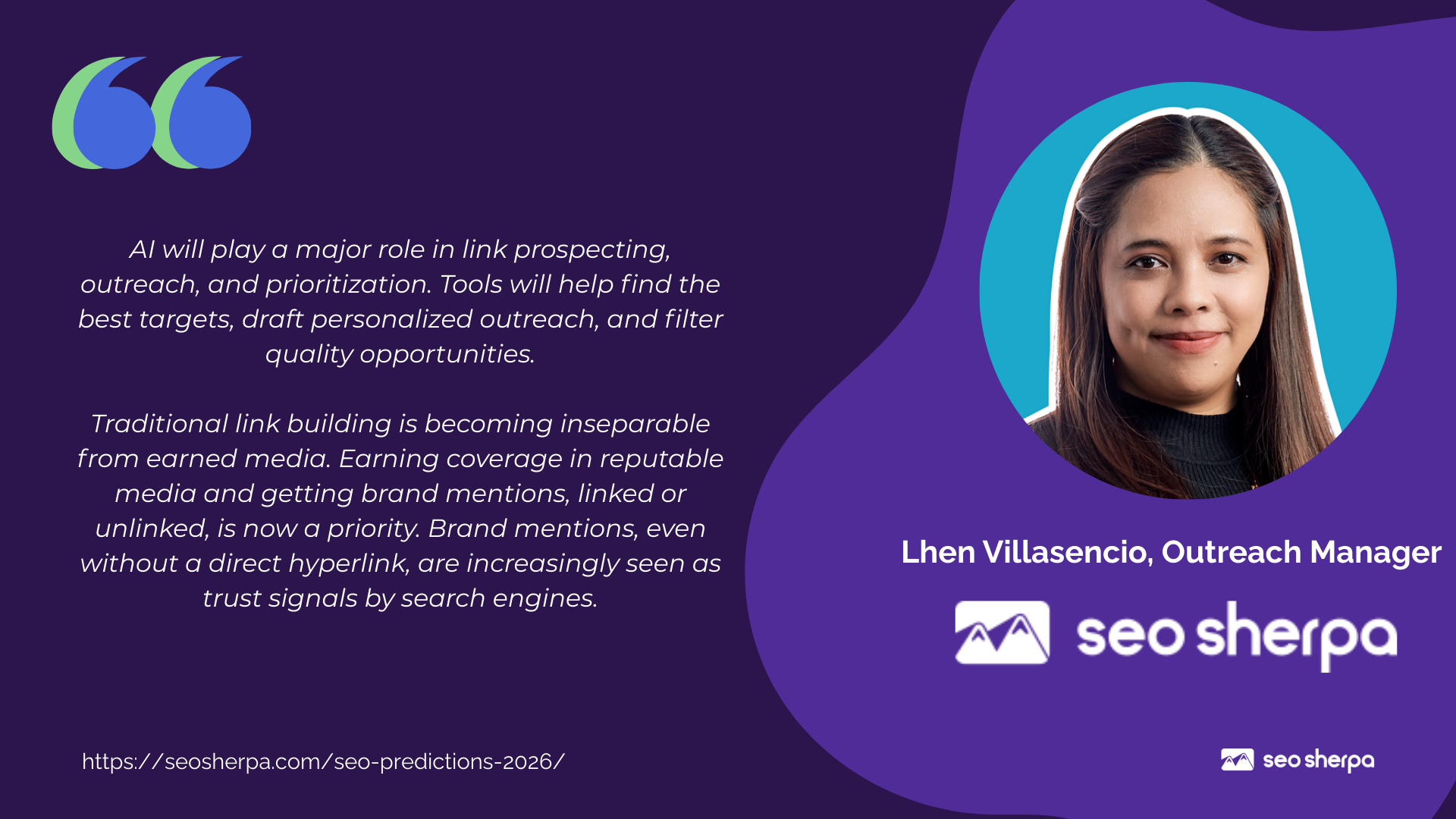
According to Lhen Villasencio, Outreach Manager at SEO Sherpa:
“AI will play a major role in link prospecting, outreach, and prioritization. Tools will help find the best targets, draft personalized outreach, and filter quality opportunities.
Traditional link building is becoming inseparable from earned media. Earning coverage in reputable media and getting brand mentions, linked or unlinked, is now a priority. Brand mentions, even without a direct hyperlink, are increasingly seen as trust signals by search engines.
We also expect link building to become harder and more expensive as competition for quality backlinks grows, requiring higher budgets and better strategy.
The types of content that attract links organically are shifting too. Data-driven research, tools and calculators, podcasts, and videos are far more likely to be shared, referenced, and cited across the web.”
This reflects a much deeper shift happening across AI-driven search and discovery engines.
AI systems do not just crawl the web in the same way traditional search engines do. They learn from brand mentions, co-occurrences, citations, media references, and contextual relationships across thousands of sources. In many cases, an unlinked brand mention in a trusted publication can influence AI-generated responses just as much as a traditional backlink.
From a generative engine optimization perspective, this changes the purpose of outreach entirely.
The goal is no longer just to manipulate search rankings by acquiring links. The goal is to ensure your brand exists within the data ecosystem that AI platforms, AI assistants, and answer engines use to generate summaries, recommendations, and AI search results. That includes media coverage, podcast appearances, expert quotes, branded research, and original assets that get referenced across the web.
AI also reshapes how outreach itself is executed.
In 2026, AI tools will handle much of the heavy lifting in prospecting and prioritization, analysing competitor link profiles, identifying authority gaps, and mapping how off-page signals influence organic visibility across both traditional search and AI-powered search.
But the strategic layer remains human.
Choosing which brands to associate with, which communities to appear in, and which narratives to push cannot be automated without losing relevance and credibility.
At the same time, the economics of link building will continue to shift.
As more brands compete for fewer high-quality opportunities, earned media placements and authoritative mentions will become more expensive, more competitive, and more strategic. Spray-and-pray outreach will disappear. Budget alone will not be enough. Brands will need genuinely valuable assets, real expertise, and stories worth covering.
This is also why multimedia and value-driven content becomes so important.
Data-led studies, proprietary research, interactive tools, podcasts, and video content are not just content formats. They are link magnets, citation sources, and trust anchors inside AI-driven systems. These are the assets that get referenced, summarised, and surfaced inside AI-generated answers and AI summaries.
In 2026, the brands that win off-page SEO will not be the ones with the most backlinks.
They will be the ones whose names appear naturally inside the conversations, media, datasets, and communities that both humans and AI systems rely on to understand the world.
#3 Technical SEO: From Optimization to Machine Understanding
Technical SEO used to be the quiet, invisible layer of search engine optimization. You fixed crawl issues, cleaned up meta tags, improved page speed, submitted sitemaps to Google Search Console, and made sure nothing was blocking search engines from indexing your site. If the technical foundations were solid, everything else could scale on top.
In 2026, technical SEO still matters, but its purpose has fundamentally changed.
It is no longer just about helping traditional search engines crawl and rank pages. It is about helping AI systems understand what your brand is, what each page represents, how topics are structured, and how content should be interpreted inside AI-driven search, AI overviews, and AI-generated answers.
This is where technical SEO becomes less about mechanics and more about meaning.
As Romina Khodr, Senior Bilingual SEO Specialist at SEO Sherpa, explains:
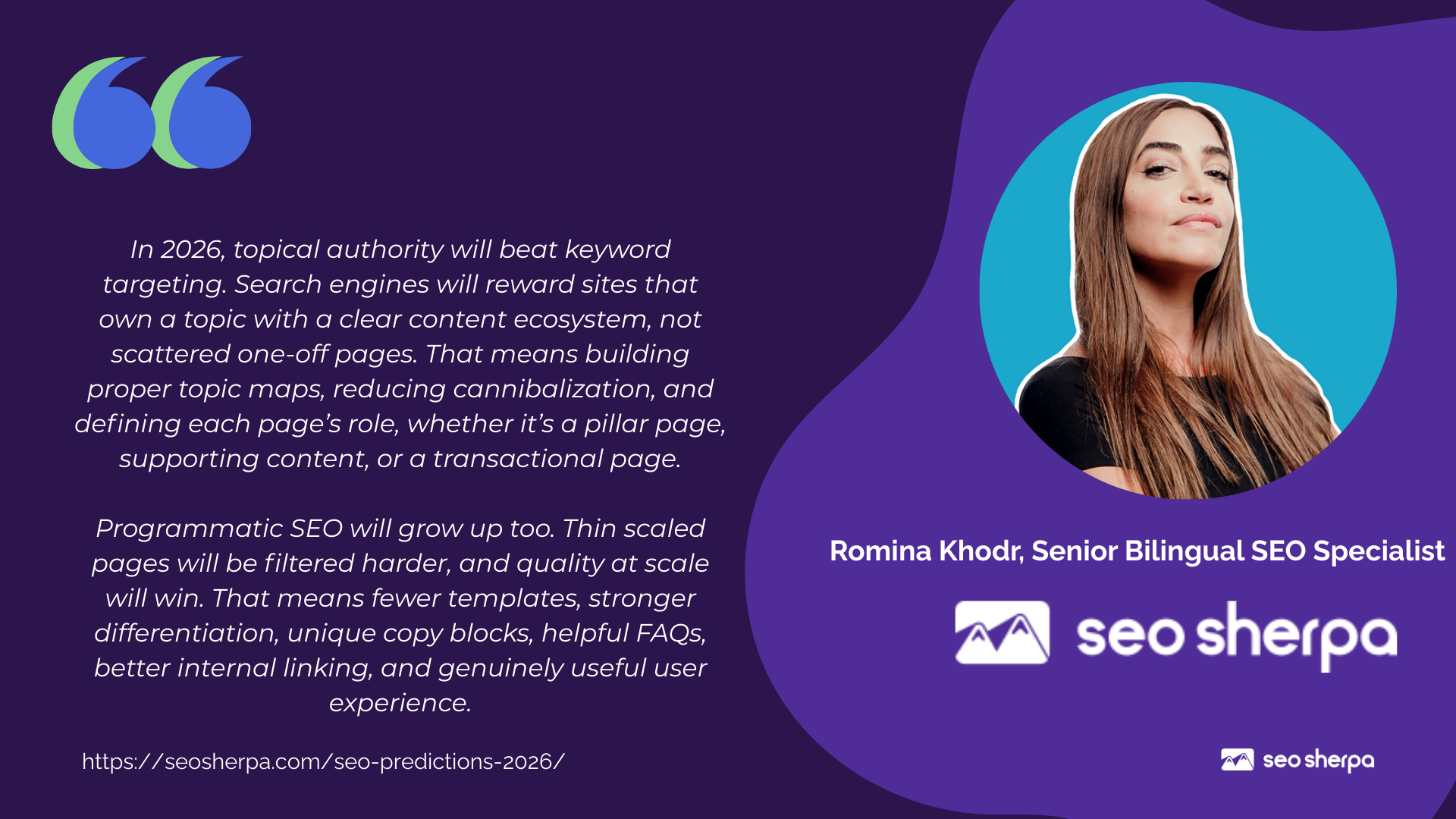
“In 2026, topical authority will beat keyword targeting. Search engines will reward sites that own a topic with a clear content ecosystem, not scattered one-off pages. That means building proper topic maps, reducing cannibalization, and defining each page’s role, whether it’s a pillar page, supporting content, or a transactional page.
Schema will also become less about rich results and more about machine understanding. Structured data will matter for entity clarity and page purpose, especially for AI driven answers. Brands should focus on clean, consistent entity foundations like Organization, Person, and Product or Service schema, rather than overusing advanced markup that doesn’t reflect reality.
We’ll also see digital PR shift from domain authority to relevance. One highly relevant mention can outperform many generic links, especially when it reinforces topical authority and entity credibility in the right niche.Programmatic SEO will grow up too. Thin scaled pages will be filtered harder, and quality at scale will win.
That means fewer templates, stronger differentiation, unique copy blocks, helpful FAQs, better internal linking, and genuinely useful user experience.
SEO and CRO will fully merge. The pages that rank best will also be the best decision pages, with clarity, trust blocks, comparisons, and internal CTAs. Measurement will get messier due to privacy and zero click behavior, so teams will shift toward blended reporting using brand demand trends, qualified leads, and cohort performance rather than pure traffic.
And finally, ASO and SEO will converge. App discovery will depend on store metadata and web authority signals working together, not separately.”
This prediction reflects one of the biggest misunderstandings about SEO in 2026.
Most brands still think of technical SEO as a checklist. Page speed. Mobile. Indexing. Core Web Vitals. But AI powered search does not simply crawl pages and rank them. It tries to understand relationships between entities, topics, brands, authors, products, and services across massive datasets.
That means topical authority becomes the new technical foundation.
Instead of creating hundreds of pages targeting the same keyword from different angles, brands will need to design structured content ecosystems that clearly signal what they are experts in. Pillar pages, supporting content, internal linking, and clean topic hierarchies become machine-readable trust signals for both search engines and AI systems.
Structured data plays a similar role.
In 2026, schema is no longer about chasing featured snippets or visual enhancements in traditional search results. It is about giving AI platforms explicit, consistent information about who you are, what your content represents, and how different entities relate to each other. This directly influences how AI-generated summaries, AI responses, and AI citations are formed.
The same applies to digital PR and off-page technical signals.
When AI systems evaluate relevance, they care less about raw domain metrics and more about contextual authority. Being mentioned in the right places, by the right experts, in the right topical space becomes a stronger signal than generic links from unrelated sites.
Even programmatic SEO changes character.
Scaling pages is no longer enough. Thin templates built purely for search volume will struggle to survive in AI driven systems that can detect duplication, low differentiation, and shallow value. Quality at scale becomes the only viable model, where every programmatic page must offer real information, real structure, and real usefulness for both users and machines.
Perhaps the most important shift is the merging of SEO and conversion optimization.
In a world of zero-click search, AI-generated answers, and reduced organic traffic, ranking alone is no longer the end goal. The pages that perform best will be the ones that help users make decisions, build trust, and move forward. That means clearer messaging, better UX, stronger internal linking, and content that is designed to convert, not just attract.
By 2026, technical SEO is no longer just the foundation of visibility.
It becomes the foundation of understanding, for humans, for search engines, and for AI systems trying to make sense of the entire web.
#4 AEO & GEO: How SEO Expands Beyond Rankings Into AI Answers
For most of SEO’s history, success meant one thing. Ranking pages in traditional search results and driving organic traffic to your own site. Even as algorithms evolved, the core model stayed the same. Optimize content, build authority, improve technical foundations, and climb the SERP.
In 2026, that model still exists.
But it is no longer the full picture.
As AI-powered search and answer engines reshape how people discover information, SEO expands beyond rankings into a more complex realm. Users are no longer just clicking links. They are reading AI-generated summaries, interacting with conversational interfaces, and relying on AI assistants to make decisions for them.
This is where Generative Engine Optimization and Answer Engine Optimization move from experimental tactics to core strategy.
GEO focuses on how content is structured, contextualized, and understood by AI systems so that it can be surfaced within AI-generated answers, AI overviews, and conversational search experiences. AEO focuses on getting directly cited, referenced, and selected by answer engines, not just ranked in traditional search results.
As Tevfik Mert Azizoglu, SEO and AI Lead at SEO Sherpa, explains:
“In 2026, SEO will continue evolving as AI-powered search and answer engines reshape how people discover information. Traditional SEO for rankings remains important, but Generative Engine Optimization will grow in influence, requiring content to be structured and authoritative so AI systems like ChatGPT and Google’s AI Overviews can find and use it.
Answer Engine Optimization will also matter more as brands aim to get directly cited in AI responses and answer features, not just ranked links. Many SEOs have already started developing new methods, analysing hundreds of LLM outputs, adding summarization buttons for ChatGPT and Perplexity, and experimenting with creative tools that are becoming standard in everyone’s toolkit.
In 2026, I expect this kind of creative problem-solving and deeper focus on visibility in LLMs to continue expanding.
At the same time, it will be important to watch how developments in LLM platforms around shopping and ads begin influencing organic results, and to align GEO and AEO strategies with classic SEO to earn both click results and direct answers in AI-driven search.”
This prediction highlights an important reality.
GEO and AEO are not replacing traditional SEO. They are layering on top of it.
Search engines still need structured content, internal linking, topical authority, technical foundations, and real expertise. But AI systems also need content that is machine-readable, contextually clear, and authoritative enough to be trusted as a source for summarization and direct answers.
That changes how content is designed.
Instead of writing purely for rankings, brands now need to think about how AI systems extract meaning from their pages. How easily can an LLM identify the core answer? How clearly is expertise demonstrated? How well is the topic covered within a broader content ecosystem?
This also explains why experimentation becomes such a big part of modern SEO.
Analysing LLM outputs, testing how content appears inside AI platforms, and building features like summarisation buttons are not gimmicks. They are ways of reverse-engineering how AI systems interpret and surface information.
In 2026, the most effective SEO strategies will not choose between rankings and answers.
They will be built to win both.
Because visibility now means being found in search results and being cited in AI responses, being clicked and being summarized, being ranked and being trusted by machines. And the brands that master GEO and AEO alongside classic SEO will control both sides of the search experience.

#5 Social SEO: Why Intent Will Replace Keywords as the Ranking Model
Social platforms used to be treated as distribution channels. You created content, posted it on LinkedIn, TikTok, YouTube, or Instagram, and hoped it would generate engagement, traffic, or brand awareness. Search still belonged to Google. Social belonged to social media.
That separation no longer exists.
In 2026, social platforms are not just content feeds. They are fully-fledged search engines, discovery engines, and in many cases, the first place users go to look for information, recommendations, tutorials, and opinions. For entire generations, TikTok, YouTube, and Reddit already outperform traditional search engines when it comes to learning how to do something, buying a product, or understanding a topic.
But the way these platforms rank content is fundamentally different from traditional SEO.
Social search algorithms are not built around keywords in the same way Google Search is. They rely on massive behavioral datasets, engagement signals, watch time, interaction patterns, and contextual understanding of content. They try to infer what a piece of content is about, who it is for, and why it is useful, rather than simply matching it to a query string.
And this shift will only accelerate.
As Cameron Jackson, Content Manager and Social SEO Lead at SEO Sherpa, predicts:
“I think social platform search algorithms are going to move even further away from the traditional keyword model.
Even now, they rank content mainly by intent and context, but I think it’ll be even more about the purpose and context of the content in 2026 versus 2025 as these channels evolve.
The more data these platforms accrue, the more this will happen.”
This reflects a much deeper change in how search behavior works across social platforms.
When users search on TikTok, YouTube, or Instagram, they are rarely typing in the same keyword they would use on Google. They are exploring problems, ideas, trends, and use cases. They want explanations, demonstrations, and real experiences, not just links to pages. That means social SEO becomes less about optimizing for search volume and more about aligning content with user intent, emotional triggers, and contextual relevance.
In practical terms, this transforms what “SEO optimized” content means on social platforms.
Instead of focusing on the same keyword repeated in captions, hashtags, and titles, brands will need to design content around search intent and content purpose. What question is this video answering? What problem is it solving? What stage of the journey is the user in? Is this content educational, inspirational, comparative, or transactional?
Social SEO in 2026 becomes about building intent libraries, not keyword lists.
Creators and brands will map content to audience needs, behaviors, and motivations, then let the platforms’ AI-driven systems distribute that content to the right users at the right time. The ranking factors become contextual understanding, not exact-match phrasing.
This also explains why video content becomes so dominant in modern search.
Video allows platforms to extract far more signals than text alone. They can analyze audio, visuals, on-screen behavior, engagement patterns, and even facial expressions to infer relevance and usefulness. This gives social platforms a much richer dataset than traditional search engines, which still rely heavily on text-based signals.
From a Search Everywhere Optimization™ perspective, this makes social platforms one of the most important visibility layers in the entire search ecosystem.
Brands that treat social as “promotion” will struggle. Brands that treat social as a primary search channel, designed around intent, context, and content purpose, will become discoverable in places where traditional SEO never reaches.
In 2026, ranking on social will not be about being found for a keyword.
It will be about being understood for a need.

#6 Local SEO: From Maps Listings to AI-Powered Discovery
For most of its existence, Local SEO has been treated as a tactical subset of traditional SEO. Optimize your Google Business Profile, collect reviews, build citations, and try to appear in the local pack. If you ranked in Maps, you won. If you didn’t, you lost.
That mental model is already outdated.
In 2026, local search is no longer about browsing lists of businesses on a map. It is about being recommended by AI systems inside conversational, voice-driven, and AI-powered search experiences. Instead of scrolling through results, users increasingly ask questions like “Where’s the best coffee shop near me?” or “Which dentist is good for nervous patients?” and expect an instant answer.
That shifts the entire purpose of Local SEO.
Rather than optimizing for visibility in a static interface, businesses now need to optimize for understanding. The question is no longer “Can Google find my business?” but “Can AI understand what my business actually offers, who it’s for, and when it should be recommended?”
As Keagan Hartslief, Local SEO Specialist at SEO Sherpa, explains:
“By 2026, Local SEO and Google Business Profiles are expected to evolve from static listings into AI-driven, conversational discovery experiences. As Google continues shifting user interactions toward AI-powered and voice-based search interfaces, local visibility will rely less on traditional browsing and more on how effectively a business can be understood and recommended by AI.
This shift increases the importance of natural, conversational language, making FAQs and chat-style content essential for interpreting real user intent. It also reinforces the growing value of detailed, descriptive reviews and highly specific business information, as these signals help AI better understand services, experiences, and suitability for different users.
Consistency and accuracy across all digital touchpoints will become critical, with even small details contributing to visibility and trust. Beyond factual information, businesses will need to clearly communicate their atmosphere, experience, and overall vibe. In this environment, success in Local SEO will come from being the most relevant and contextually appropriate answer, rather than simply achieving the highest ranking.”
This prediction highlights one of the most important shifts in search behavior at a local level.
AI-driven search does not return ten blue links and let users decide. It tries to act as a personal assistant. That means it needs rich, contextual information about local businesses, not just names, addresses, and categories. It needs to understand what makes one business different from another, who each one is suitable for, and what kind of experience a user is likely to have.
This is why conversational content becomes so powerful for local visibility.
FAQs, natural language descriptions, and chat-style explanations give AI systems far more signal than traditional keyword-stuffed service pages. They help translate real-world human needs into machine-readable intent, which directly influences how AI-generated answers and AI recommendations are formed.
Reviews also evolve in importance.
In 2026, reviews are no longer just social proof for users. They become training data for AI systems. The language customers use to describe a business feeds into how that business is classified, compared, and recommended. Detailed, descriptive reviews help AI understand nuances like atmosphere, customer type, service quality, and emotional experience, all of which influence AI-powered search results.
Consistency across digital touchpoints becomes non-negotiable.
Every profile, listing, page, and mention contributes to the overall entity profile that AI systems build for a local business. Inaccurate hours, mismatched services, vague descriptions, or outdated information introduce confusion into that model, which reduces visibility and trust.
By 2026, Local SEO stops being about ranking higher on a map.
It becomes about being the most relevant answer in a conversation, for both humans and machines.

#7 Search Everywhere Optimization™: Why Integrated Visibility Will Replace Channel-Based SEO
By the time you reach 2026, one thing becomes impossible to ignore.
SEO no longer lives in one place.
It doesn’t live only in Google search results. It doesn’t live only in keyword rankings. And it definitely doesn’t live only on a brand’s own site.
Search now happens across AI platforms, social platforms, video platforms, marketplaces, discovery engines, and conversational interfaces that never show a traditional SERP at all.
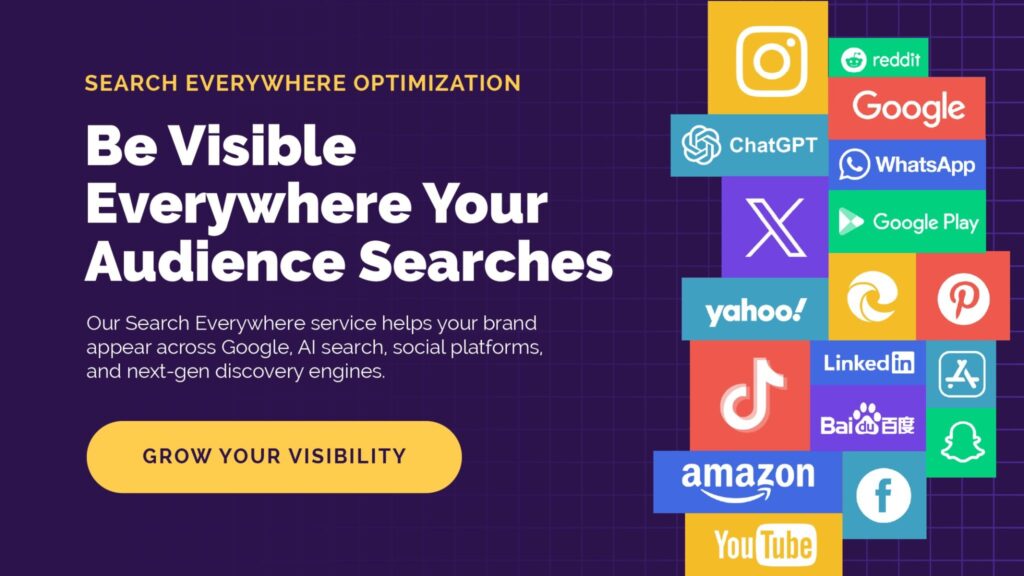
From Google’s AI Mode and AI Overviews, to TikTok search, YouTube SEO, Reddit, AI assistants, and generative answer engines, users are no longer following a linear search journey. They move fluidly between platforms, asking the same question in different formats, expecting consistent answers, consistent brand signals, and consistent experiences.
This is where traditional SEO frameworks start to collapse.
Most SEO strategies are still built around channels. You have a content strategy. A link building strategy. A social strategy. A brand strategy. A technical strategy.
Each one lives in its own silo, owned by different teams, measured by different KPIs, and rarely aligned around the same version of search behavior.
But AI-driven search does not experience your brand in silos.
It experiences your brand as one entity, across every data source it can access.
As Jenny Abouobaia, Owned Media Manager at SEO Sherpa, explains:
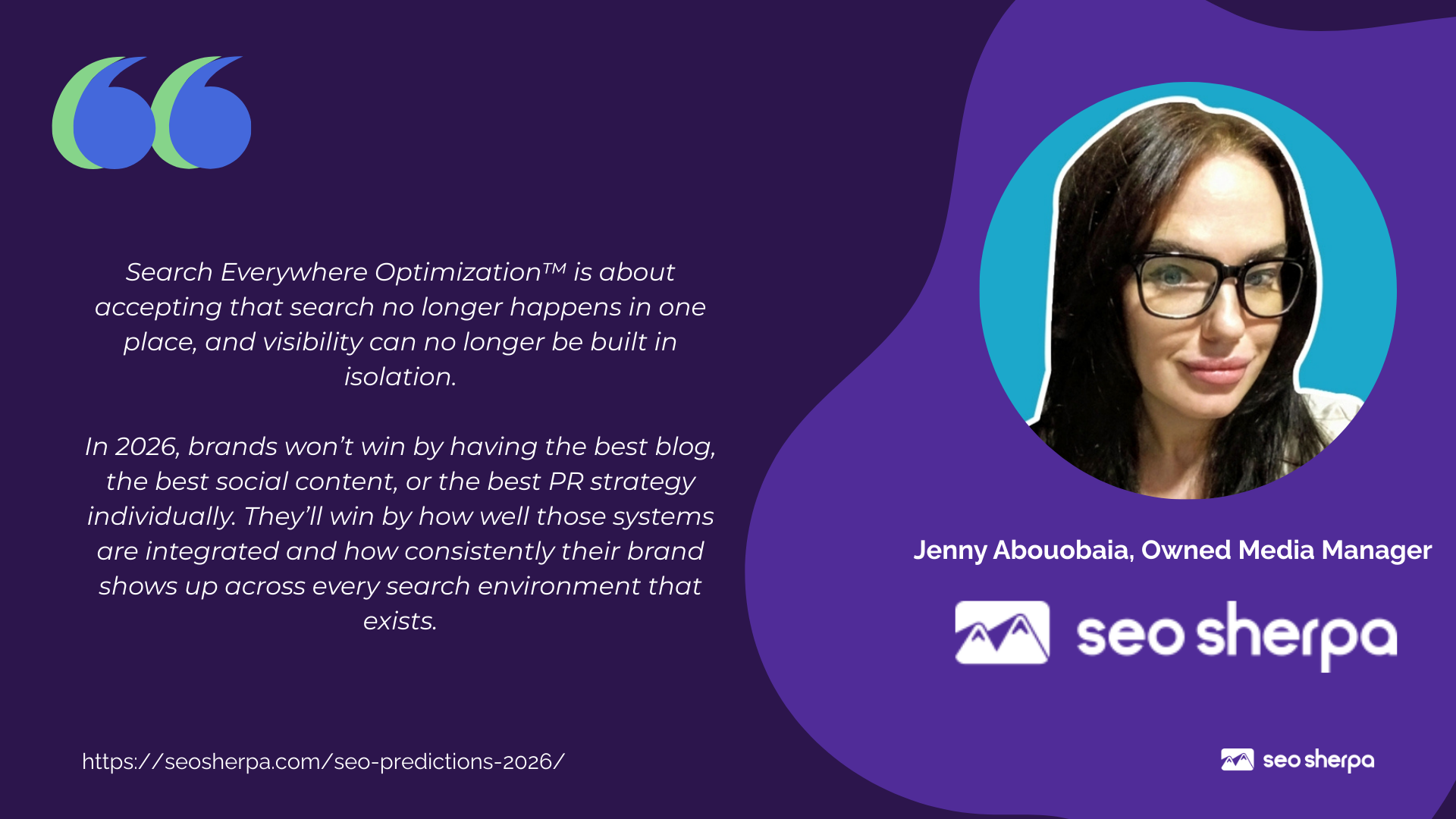
“Search Everywhere Optimization™ is about accepting that search no longer happens in one place, and visibility can no longer be built in isolation.In 2026, brands won’t win by having the best blog, the best social content, or the best PR strategy individually. They’ll win by how well those systems are integrated and how consistently their brand shows up across every search environment that exists.
AI systems don’t see channels. They see entities, relationships, topics, and trust signals. They learn from content, media mentions, social conversations, video, reviews, communities, and proprietary data sources all at once.
That means brands need to move away from channel-based marketing and toward fully integrated search strategies, where SEO, content, social, PR, and brand all operate as one ecosystem.
Search Everywhere Optimization™ isn’t about being present on more platforms. It’s about being understood, recognised, and trusted everywhere search happens, whether that’s on Google, TikTok, YouTube, Reddit, or inside an AI assistant.
In 2026, visibility will belong to the brands that design for systems, not platforms.”
This prediction captures the biggest structural shift happening in search.
AI-powered search does not care whether a signal comes from a blog post, a podcast, a TikTok video, a product review, a Reddit thread, or a media article. It aggregates everything into a single understanding of what a brand represents, what it is known for, and whether it is credible enough to be surfaced inside AI-generated answers.
That means search visibility becomes a systems problem, not a channel problem.
If your content team is publishing one narrative, your PR team is pushing another, your social team is chasing trends, and your SEO team is still optimizing for the same keyword lists from three years ago, AI systems will build a fragmented picture of your brand. And fragmented brands do not get recommended.
In a Search Everywhere Optimization™ world, every output becomes a search signal.
Every article trains AI models. Every social post contributes to entity understanding. Every media mention reinforces topical authority. Every YouTube video becomes a discoverable asset. Every review becomes part of your trust profile.
This is why integrated marketing strategies are no longer a nice-to-have.
They are the only way to remain visible when search no longer has a single interface, a single ranking system, or a single source of truth. Brands that continue to operate in silos will still produce content, still run campaigns, and still report on metrics.
But the brands that actually win in 2026 will be the ones that treat visibility as a unified system, designed for humans and AI at the same time.
#8 Partnerships & Influencer Marketing: Why Collaboration Will Become a Core Search Strategy
For a long time, partnerships lived in a strange grey area.
They sat somewhere between PR, influencer marketing, and brand campaigns. Useful for reach and awareness, but rarely treated as a fundamental part of SEO or organic growth. Link building happened in one lane while Influencer marketing happened in another. Content collaborations were nice extras, not strategic infrastructure.
In 2026, that separation disappears completely.
As search behavior spreads across AI platforms, social platforms, communities, and discovery engines, partnerships become one of the most powerful ways for brands to build authority, relevance, and visibility at scale. Not through forced sponsorships or transactional link swaps, but through genuine collaboration across content, media, and communities.
This is where partner marketing evolves from a tactic into a system.
As Sofiko Saltkhutsishvili, Partnerships Manager at SEO Sherpa, predicts:
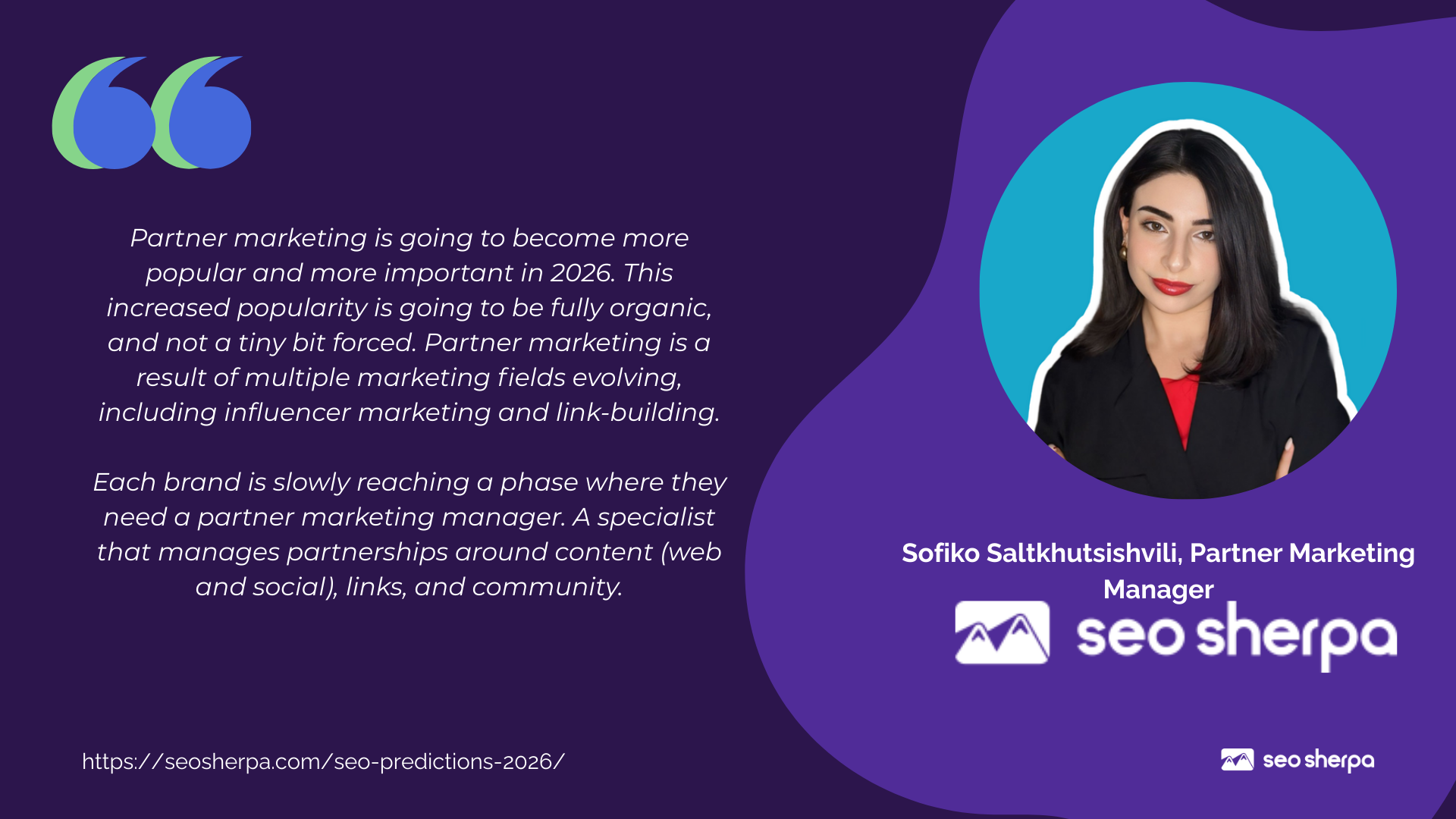
“Partner marketing is going to become more popular and more important in 2026. This increased popularity is going to be fully organic, and not a tiny bit forced. Partner marketing is a result of multiple marketing fields evolving, including influencer marketing and link-building.
Traditional link-building is slowly turning into co-marketing collaborations. Specialists not just exchange links anymore: they do joint webinars, co-authored articles, expert quotes, newsletter mentions, social media mentions, etc.Each brand is slowly reaching a phase where they need a partner marketing manager. A specialist that manages partnerships around content (web and social), links, and community.All the partner marketing initiatives are designed to increase brand authority and visibility. Search Everywhere Optimization™ is the most natural continuation of SEO. Therefore, partnerships done around social media, web, and AI will need work in harmony with each other.
Brand mentions and expert quotes affect Google rankings, YouTube videos show up in AI overviews, Reddit comments show up in ChatGPT.And since the area to cover is so wide now, no brand can develop in isolation. Partner marketing will allow brands to find the right allies in 2026. And whoever chooses collaboration over competition will be a step ahead.”
This prediction captures one of the most important shifts in modern SEO.
Authority is no longer built in isolation.
AI systems do not evaluate brands based only on their own site, their own content, or their own social channels. They evaluate brands based on how often they appear across trusted environments, who they are associated with, and how frequently they are referenced by other credible voices.
That means partnerships become a direct input into AI visibility.
When brands appear in webinars, podcasts, co-authored content, newsletters, YouTube videos, Reddit threads, and expert roundups, they are feeding the exact data layer that AI platforms use to generate answers and recommendations. These collaborations become training signals for AI-driven search, not just marketing exposure.
This also explains why traditional link building starts to fade into the background.
Links still matter, but they become side effects of something bigger. The real value comes from co-marketing ecosystems where brands share audiences, expertise, and credibility. The backlink is no longer the goal. It is the by-product of meaningful collaboration.
In a Search Everywhere Optimization™ world, partnerships are no longer about reach.
They are about relevance.
They determine which brands show up in AI summaries, which experts get cited in AI-generated responses, and which companies become part of the trusted conversational layer across platforms.
And because the surface area of search is now so wide, no brand can realistically compete alone.
The brands that win in 2026 will not be the loudest.
They will be the most connected.
#9 Brand Marketing: Why Emotional Trust Will Outrank Functional Search
For most of SEO’s history, brand was treated as a secondary benefit.
You built brand awareness through campaigns, social media, and advertising, while SEO focused on capturing demand through keywords, search volume, and functional intent.
Brand made people feel something. SEO made people find something.
In 2026, that separation no longer exists.
As AI-generated answers, AI overviews, and zero-click search become the dominant search experiences, users no longer need to visit multiple websites to gather information. The “what” is answered instantly. The role of search shifts from finding facts to resolving uncertainty, confusion, curiosity, and emotional decision-making.
This fundamentally changes what search intent looks like.
Instead of purely functional queries, search behavior becomes increasingly emotional. Users search not just to learn, but to validate, compare, reassure, and make sense of complex choices. And when AI systems remove the friction of clicking, scrolling, and researching, the brands that surface are the ones people already trust.
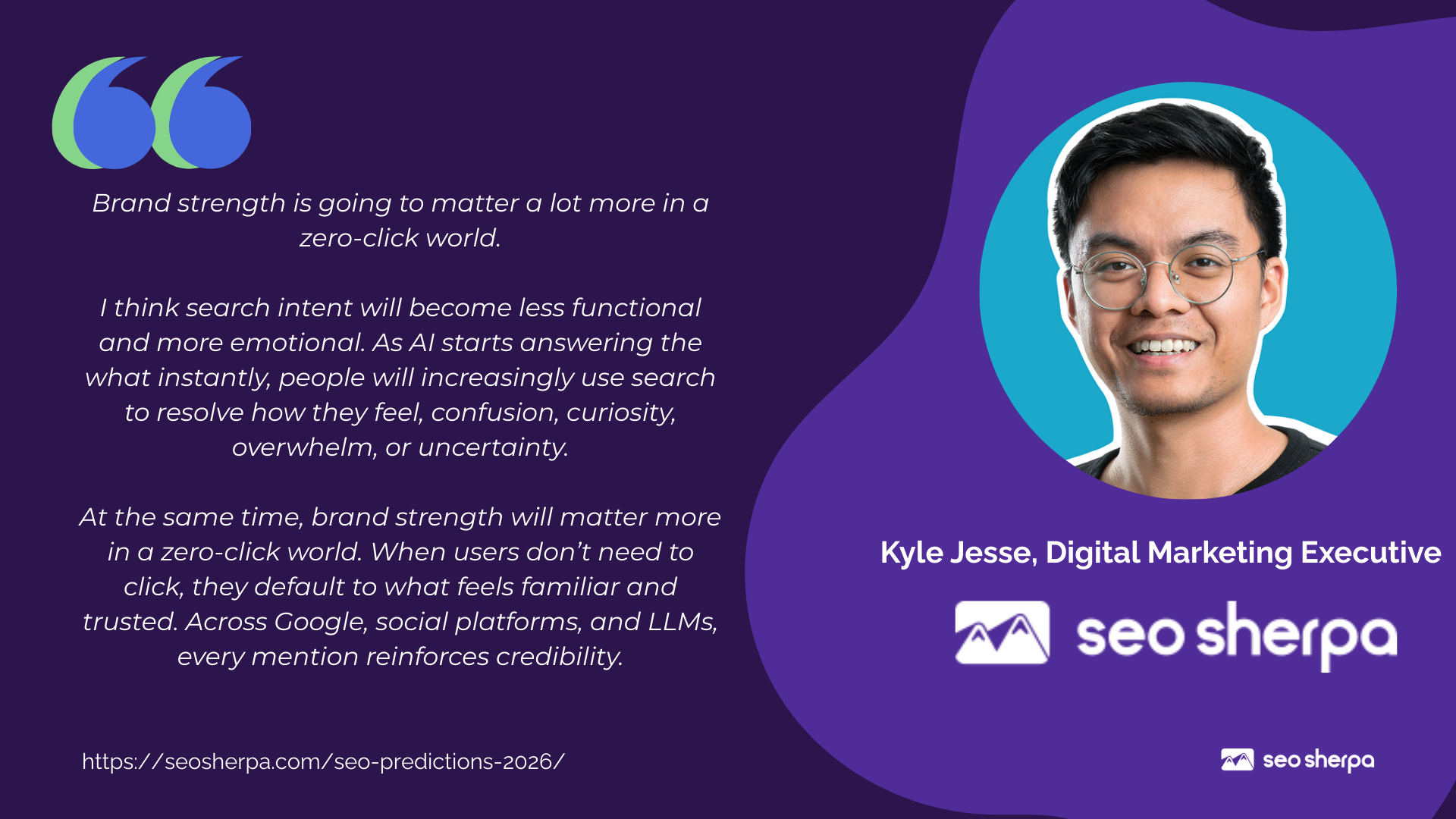
As Kyle Jesse, Digital Marketing Executive on the Brand team at SEO Sherpa, explains:
“Brand strength is going to matter a lot more in a zero-click world.
I think search intent will become less functional and more emotional. As AI starts answering the what instantly, people will increasingly use search to resolve how they feel, confusion, curiosity, overwhelm, or uncertainty.
At the same time, brand strength will matter more in a zero-click world. When users don’t need to click, they default to what feels familiar and trusted. Across Google, social platforms, and LLMs, every mention reinforces credibility.In 2026, winning SEO won’t just be about matching keywords, it’ll be about matching mindset and building a brand people already believe in.”
This prediction exposes one of the most overlooked consequences of AI-powered search.
When users no longer need to browse ten results, compare multiple pages, or manually evaluate sources, the decision-making process becomes psychological rather than analytical. AI systems narrow the field. They summarise. They recommend. They pre-filter options. That leaves users with one core question:
Do I trust this brand?
This is where brand becomes a ranking factor in everything but name.
AI systems do not just evaluate content quality. They evaluate brand credibility across mentions, citations, social presence, reviews, media coverage, and community engagement. The more consistently a brand appears across trusted environments, the more likely it is to be surfaced inside AI-generated responses and AI search results.
In a zero-click world, visibility becomes memory.
If a brand is familiar, it feels safer. If it feels safer, it gets chosen. And if it gets chosen, AI systems reinforce that behavior by surfacing it again.
This creates a powerful feedback loop.
Strong brands become more visible. More visibility builds more trust. More trust increases selection. And increased selection feeds back into AI-driven systems as positive signals.
By 2026, SEO will no longer be about being the best answer on the page.
It will be about being the brand people recognise before the answer is even given.
#10 The Agency Reality Check: What Brands and Agencies Must Get Right in 2026
By 2026, the biggest mistake I still see brands making is treating SEO as a channel, not as a business system.
Most companies are still structured around disconnected teams.
One agency handles SEO. Another runs paid. Another does social. Another manages PR.
Internally, content, brand, partnerships, and growth all operate with different goals, different metrics, and different definitions of success.
That model made sense when search meant Google.
It does not make sense in a world of AI-powered search, AI overviews, discovery engines, social platforms, and generative answer systems that consume everything at once.
From an agency perspective, this forces a fundamental shift.
Agencies can no longer sell isolated services and expect long-term results. Ranking a few pages or increasing organic traffic in one channel does not translate into business growth if the brand is invisible everywhere else people actually search.
The role of a modern agency in 2026 is not to execute tactics.
It is to design integrated systems.
That means building strategies that connect SEO, content, digital PR, social SEO, brand, and conversion optimization into a single visibility engine. Not a campaign. Not a quarterly plan. A living system that evolves with search behavior and adapts to how AI systems interpret brands in real time.
From a brand side, expectations also need to change.
If you are hiring a marketing partner in 2026, you should not be asking how many keywords they can rank or how much traffic they can drive. You should be asking how they build demand, how they increase branded search volume, how they influence AI-generated answers, and how they turn visibility into revenue.
SEO is no longer about being found.
It is about being chosen.
And that requires a level of strategic thinking most agencies are not set up to deliver.
The uncomfortable truth is that many agencies will struggle in this transition. They are built on outdated service models, legacy reporting frameworks, and siloed delivery teams that cannot adapt to Search Everywhere Optimization™. They will continue selling traditional SEO in a world that no longer behaves like traditional search.
The agencies that survive will look very different.
They will invest in data, not just tools. They will build proprietary systems, not just dashboards. They will hire strategists, not just executors. And they will be measured on business outcomes, not vanity metrics.
Because in 2026, visibility without impact is just noise.
Final Thoughts: The Future of SEO Is Already Here
The biggest misconception about SEO in 2026 is that it is something that is about to happen.
It is already happening.
AI-powered search is already changing how users discover information. Zero-click experiences are already reducing organic traffic. Social platforms are already replacing traditional search engines for entire audiences. And AI systems are already deciding which brands deserve to be seen, recommended, and trusted.
The only thing still catching up is how brands and agencies think about SEO.
Search is no longer a destination. It is an ecosystem.
And in that ecosystem, every piece of content, every brand mention, every social post, every review, every media feature, and every technical decision becomes part of your search visibility.
This is exactly why Search Everywhere Optimization™ exists.
Because winning in modern search is no longer about optimising one channel. It is about designing a system where your brand is visible, credible, and discoverable wherever search happens.
If you want to understand what that looks like for your business, the fastest way to start is with a proper strategy.
At SEO Sherpa, we offer a free discovery call to help brands map their current visibility, identify where they are missing from the search ecosystem, and build an integrated Search Everywhere Optimization™ roadmap designed for real business growth.

Because the future of SEO is not about ranking higher.
It is about building a brand that search cannot ignore.




















Leave a Reply