

Summarize This Article With AI
 Try with ChatGPT
 Try with Claude
 Try with AI Mode

People now search directly on Instagram, using keywords, hashtags, and profiles to find answers, discover new products, and explore ideas. That shift in behavior means you can’t afford to treat Instagram like just another social platform.
It’s a search engine. And if your content isn’t optimized, it won’t be found.
This guide breaks down exactly how Instagram’s search works, and shows you how to optimize your profile, captions, and content so the right people find you at the right time, directly inside the app.
Article Summary
- Instagram is now a search engine, not just a social media platform. People actively search using keywords, hashtags, and profiles—especially Gen Z and Millennials who often use it instead of Google.
- Instagram SEO depends on your handle, name field, bio, captions, hashtags, engagement, and visual content. Optimizing these improves visibility in Instagram search results.
- The algorithm ranks content by relevance, engagement (likes, shares, saves), freshness, personalization, and location. It’s less about backlinks and more about in-app behavior.
- Google SEO and Instagram SEO share concepts like keywords and quality content, but the mechanics are very different. Instagram is visual-first, closed-loop, and heavily personalized.
- Instagram SEO is crucial in the ‘Search Everywhere’ era. Optimizing your presence on Instagram boosts your brand visibility beyond Google and aligns with a broader omnichannel strategy.
Here’s James to break down this article in under two minutes:
Why Instagram SEO Matters in the “Search Everywhere” Era
At SEO Sherpa, we believe search doesn’t begin and end with Google.
People now search everywhere, on Instagram, TikTok, YouTube, Reddit, and even AI tools like ChatGPT. That shift has redefined what it means to be visible online, and Instagram now sits at the center of that transformation.
Let’s look at the numbers.
Nearly half of Gen Z and over a third of Millennials say they prefer using Instagram or TikTok over traditional search engines when looking for ideas, brands, or solutions.
One in four internet users now relies on social media as their primary search tool.
This changes everything.
Instagram is no longer just a photo-sharing app. It has quietly become a fully-fledged search engine. With around 2 billion active users, it’s one of the most powerful platforms for discovery, and it’s where users are actively typing in keywords, exploring hashtags, and searching for products, services, creators, and businesses.

And they’re not just scrolling.
They’re searching for local restaurants, travel tips, trending products, and new brands; and they’re doing it in the Instagram search bar. What they find are profiles, Reels, Stories, and posts that match their query.
Instagram has also become the top platform for shopping inspiration. In fact, 61% of social media users say they turn to Instagram to discover new products. That puts it ahead of Facebook, and far ahead of platforms like TikTok or YouTube.

This isn’t just a trend; it’s a permanent shift in how people discover content, engage with brands, and make decisions. In a world where search happens everywhere, marketers can no longer assume the journey starts on Google.
That’s why we created Search Everywhere Optimization: our signature strategy at SEO Sherpa. It’s built to help your brand get discovered on every channel where people are searching, not just in the traditional SERPs.
Instagram SEO is a core part of that strategy.
By aligning your profile, captions, hashtags, and content with Instagram’s search signals, we make sure your content doesn’t just exist, it gets found.
And for the marketers wondering, Does Instagram help SEO? The answer is yes!
When done right, it creates a flywheel effect. Engagement grows. Brand visibility improves. Branded searches increase. Social proof builds.

Does Instagram have an SEO Algorithm?
When someone types a keyword into the search bar, the platform isn’t just pulling random Instagram search results. It’s looking at a mix of text relevance, user behavior, and content performance to decide what shows up first.
The goal is simple: Instagram algorithm wants to serve the most engaging and relevant content based on each person’s search intent.
Key Factors That Influence Instagram Search and Discovery
One of the strongest signals is the keywords you enter.
So it is important to identify relevant keywords first. Instagram compares those words against text on the platform including; usernames, bios, captions, and hashtags. If someone searches for “travel photography,” accounts or posts using those exact terms or closely related ones will likely appear first.
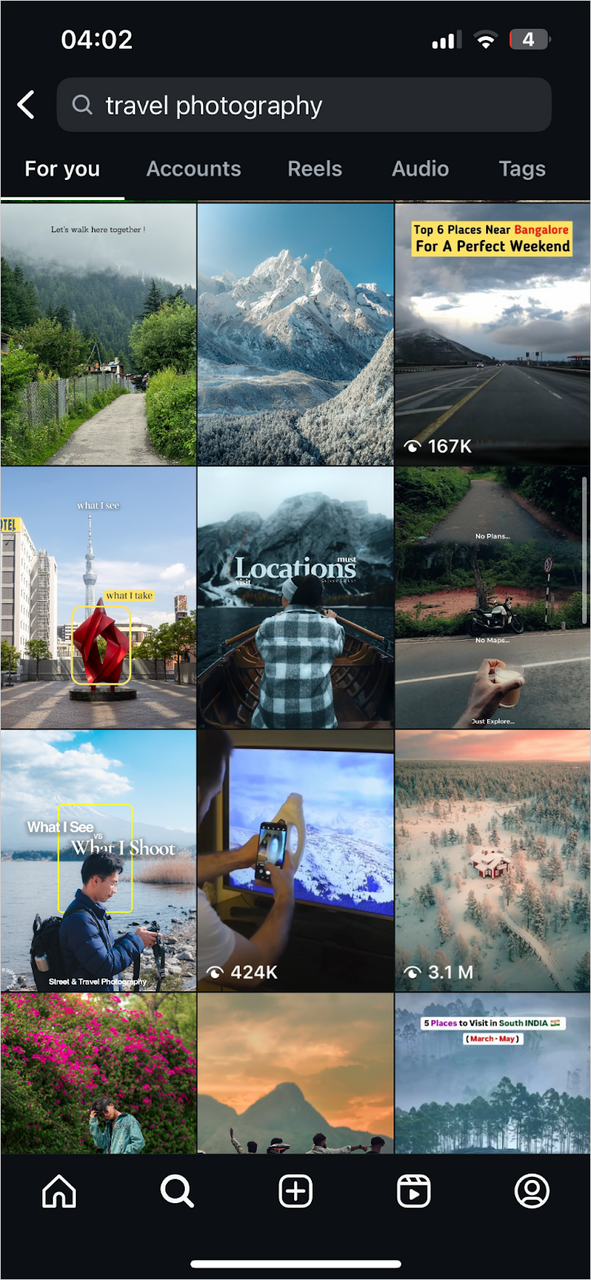
A Screenshot of Instagram search results for “travel photography“
That’s why placing your primary keywords directly in the instagram captions, is so important. Instagram has even confirmed that content becomes easier to find when keywords and hashtags are used in visible text fields.
But relevance isn’t the only thing the algorithm looks at. It also personalizes results based on your own activity. The accounts you follow, the posts you like or save, and the way you interact on the app all influence what Instagram shows you.
So if you regularly engage with fitness content, a search for “workouts” will likely prioritize fitness creators you’ve already interacted with. Instagram uses this behavior to predict what kind of content you’re most likely to care about.
Engagement also plays a big role. Posts that get a lot of likes, comments, shares, and saves tend to rank higher. If many users are interacting with a piece of content, Instagram sees that as a sign of quality. That means a highly engaged post under a popular hashtag is more likely to appear at the top of the search results.
It doesn’t stop at the post level either. Instagram also considers how well a profile aligns with what someone’s searching for. An Instagram account that includes keywords in its handle, name, or bio is more likely to show up.

Instagram Handles that match the keyword rise to the top.
Freshness also counts. Instagram’s search and Explore page generally favors newer posts over older ones.
The platform wants to serve up timely content – nobody searching for “2026 fashion trends” wants to see posts from 2019.
For creators, this means regular posting can enhance your visibility, as each new piece of content is a chance to surface in searches happening right now.
Finally, location can influence what surfaces. For queries related to places or when a user is searching from a specific location, Instagram often highlights local results.
If someone in Dubai searches for “best cafes,” they’ll likely see content tagged or categorized in that area. That’s why it helps to use location tags in your posts and add your location to your profile if it’s relevant to your audience.
Together, these signals shape what people see when they search. And when your content is aligned with how Instagram ranks and personalizes results, it’s much easier to get found.
Is Instagram SEO different from Google SEO?
At this point, you might be thinking, “This sounds a bit like Google’s SEO.”
There are similarities – keywords and content quality matter on both platforms – but Instagram optimization is a different ballgame in several ways.
For starters, Instagram Search Engine is a closed system. Everything that shows up in search is pulled from within the app itself. That includes usernames, bios, captions, hashtags, and tagged locations. There’s no crawling of external websites and no concept of backlinks to build authority.
In contrast, Google scours the entire web and uses backlinks from other websites to determine which pages deserve to rank. With Instagram, your SEO efforts focus entirely on what happens inside your profile, not outside of it.
The visual nature of Instagram adds another layer. Search results are made up of photos, videos, Reels, and profiles, not webpages. Instagram may even use AI to interpret what’s in your images or alt text.
This means eye-catching visuals, clear framing, and descriptive text, plus well-written Instagram citations from authoritative creators, all help Instagram understand and rank your content.
Google, by comparison, relies heavily on text, HTML structure, and metadata to decide what’s relevant. So while Google SEO leans on technical page elements, Instagram SEO favors visual clarity and consistency.
The signals that matter for ranking also diverge. Google rewards things like backlinks, page speed, and structured data. Instagram, on the other hand, pays attention to how people interact with your content. Saves, comments, likes, shares, and even profile visits all influence what gets recommended.
So instead of chasing external links or optimizing site speed, you’re better off creating content that sparks engagement and clearly aligns with your niche.
Personalization is another major difference. Google personalizes results to a degree, mainly based on location or past searches. But Instagram takes it much further. Two people can type the same search term and get completely different results depending on what they like, follow, or engage with.
Finally, there’s content lifespan. Google often shows results that are months or even years old, especially if they’re considered authoritative or evergreen.
Instagram, in contrast, moves much faster. Posts that are new, trending, or recently engaged with are more likely to surface. That’s why SEO Instagram is less about creating timeless cornerstone content and more about showing up consistently with relevant, timely posts.
Instagram SEO Strategy: How to Optimize My Instagram Profile for Discovery?
Some marketers still wonder Can you use SEO on Instagram? The answer is yes, and you should.
Treat your bio, name field, and handle as on-platform metadata, then support them with consistent, keyword-aware content. That’s the core of any winning Instagram SEO strategy.
In this section, we’ll explain how to optimize each of these and the often-overlooked elements like your profile link and location.
1. An SEO-Friendly Username and Name Field
Your Instagram profile is the starting point of everything. It’s the foundation of Instagram optimization, and one of the first things both users and the algorithm look at to understand who you are and what you offer.
That’s why optimizing your profile isn’t a “nice to have,” it’s a must. And if your posts aren’t aligned with your profile and brand identity, they’ll struggle to rank.
Instagram itself has made it clear that three areas matter most when it comes to search: your username (handle), your name field, and your bio.

Each one tells the algorithm, and potential followers, what you’re about. If you get these right, your visibility improves dramatically.
Start with your handle. This is your @username, and it should be easy to remember, easy to spell, and clearly related to your niche or brand. Using your brand name is usually best, but if you’re a creator or professional, including your focus helps.
For example, @brightwavemedia or @brightwave_marketing works well for a media brand, while @chefMaria or @alex_financecoach tells people exactly what to expect. If your current handle is off-brand or doesn’t say anything about your niche, it may be time for a change, just make sure to let your audience know if you rebrand.
Now let’s talk about the name field. That’s the bolded text that shows up right under your profile picture. It’s searchable, so it carries weight in Instagram SEO.
The goal here is to add one or two highly relevant keywords without sounding robotic or cramming in every buzzword you can think of.
Keep it clean, readable, and focused.
A name like “Alice | Yoga Teacher” works. Something like “Alice | Fitness Yoga Wellness Gym Health” doesn’t, it’s spammy, and the algorithm knows it.
Consistency also matters.
If you can, use the same handle or name format across all your social platforms. That way, your audience sees the same identity whether they’re on TikTok, LinkedIn, or YouTube. It reinforces your credibility and makes your brand easier to search for—anywhere.
2. Writing a Keyword-Rich Bio
Once your handle and name are locked in, the next place to focus is your bio. Instagram gives you 150 characters to work with, and every word counts.
Think of your bio the same way you think about a meta description in Google search: it tells people who you are, what you offer, and why they should care, all in a few seconds.
You’ll want to include one or two primary keywords, written in a way that sounds human, not robotic. If you’re a digital marketing coach, you want that phrase in your bio. But you don’t want to sound like you copied it from a keyword tool.
The most effective bios are simple but specific. They might follow a structure like “what you do,” “who you help,” and “how to learn more.” If you serve a local audience, mention your city. If you have a niche offering, say so.
For example, “Wedding Photographer in Dallas, TX” or “Handmade soy candles and home fragrances” gives the algorithm a clear signal and tells your visitors exactly what to expect.
You can also include hashtags or mentions in your bio, but these are optional. They won’t necessarily help you rank, but they can show alignment with a community or a partnership. For example, being “Featured in @veganmag” lends credibility, even if it doesn’t affect your position in search.
To make this actionable, think of a strong Instagram bio like this one:
Plant-Based Chef – Sharing vegan recipes & nutrition tips. Cookbook author | Featured in @veganmag. NYC | New recipe video every Tuesday.
3. Adding Relevant Links and Location
Next, consider the external link and your business location. These don’t directly impact how you show up in Instagram search, but they matter for conversions and visibility.
Your link should always point somewhere intentional: a landing page, your website, a product collection, or a resource hub.
If you use a Linktree-style tool, keep it updated and clean. And don’t forget to give people a reason to click. A short CTA like “Get our free guide” or “Shop new arrivals” adds just enough nudge.

A clear CTA in your bio (like “Join my free newsletter”) turns profile views into clicks
If you’re a local business or creator tied to a specific place, setting your location is a must. Instagram lets business accounts display a physical address and even adds your location to its internal Map tool.
This boosts your discoverability for local search queries. Think “coffee shop in Brooklyn” or “nail salon near me.”
Finally, make sure your category is set correctly. Whether it’s “Public Figure,” “Restaurant,” “Artist,” or “Health Coach,” that category helps visitors instantly understand what you offer. It appears just under your name and is one more subtle signal to the algorithm about what kind of account you run.
A well-optimized Instagram profile works like a mini landing page. It drives discovery, builds trust, and helps turn searchers into followers, and eventually, customers.
How Engagement and Behavior Impact Instagram SEO
Captions and bios are a strong foundation, but Instagram SEO goes further than just words on a profile. The platform pays close attention to how users interact with your content.
Engagement, whether that’s saves, shares, comments, or likes, tells the algorithm what’s worth showing to more people. And these signals aren’t all equal.

Saves, Shares, and Comments as Ranking Signals
Let’s start with saves. When someone saves your post, Instagram sees it as a strong sign that the content is valuable.
Think about a how-to guide, a carousel with tips, or a recipe, these are the types of posts people want to come back to.
If your content gets saved regularly, it tells the platform that it’s not just scroll-worthy, it’s reference-worthy. That alone can help you show up in more feeds and search results.
Shares are another powerful signal.
If users are sending your content to friends via DMs or reposting it to their Stories, that’s a direct vote of confidence. Instagram sees that what you posted resonated enough for people to pass it on, and that’s gold from an algorithm standpoint.
Then there are comments. It’s not just about volume, it’s about quality. Long, meaningful comments show deeper interest.
When a post sparks real conversation, it often earns more space on the Explore page. And don’t forget, replying to comments can double your total engagement. That extra back-and-forth gives the post even more momentum.
Likes still matter too. While they may not be as strong a signal as saves or shares, a high number of likes in a short time can boost your post early in its lifecycle. It’s still one of the fastest ways to show initial interest.
If you want to encourage this kind of interaction, don’t be afraid to ask for it.
Occasionally prompting followers with something like, “If this helped, hit save so you don’t lose it,” or “Send this to someone who needs it,” can go a long way.
Just use it sparingly, no one wants to see the same call to action in every caption.
For creators chasing the answer to “How do I show up on the Instagram Explore page?”, boosting saves and shares is half the battle.
Posting Consistency and Content Relevance
Engagement is one piece of the puzzle. Posting consistently is another. If you disappear for weeks or months, Instagram’s algorithm has less data to work with. That can lower your content’s visibility, even if it’s good. Try to stick to a schedule that you can maintain, whether that’s three times a week or five. More important than frequency is consistency.
It’s also worth paying attention to timing. Use your Instagram Insights to figure out when your audience is most active, and publish when they’re already online. The first hour matters, especially if you want your post to gain traction quickly.
Relevance matters too. If you’ve built a following around food photography, randomly posting memes or unrelated content can confuse both your audience and the algorithm. Instagram is trying to figure out what your account is about so it can show your content to the right people. When your content stays focused, that classification becomes easier—and your discoverability goes up.
Don’t rely on a single format either.
If you’re only posting static images, you’re missing out on the expanded reach that comes from carousels, Reels, and Stories. Reels, in particular, often get prominent placement on the Explore page and are a great way to introduce new followers to your brand.
And if something is trending in your space, whether it’s an audio clip, hashtag, or seasonal momentm lean in, but only if it fits your voice and message.
Chasing trends for visibility only works when the content still aligns with your audience’s expectations.
Together, all of these Instagram SEO tips; how often you post, when you publish, how people respond, and how consistently you deliver, work in tandem with Instagram’s ranking system. And if you want better visibility, they all need to be dialed in.
Avoid These Common SEO Slip-Ups on Instagram
Even with good intentions, it’s easy to fall into habits that end up hurting your visibility.
There are a few common Instagram SEO mistakes that show up time and again, and steering clear of them can make all the difference.
One of the most frequent issues is keyword stuffing. That’s when you overload your captions or bio with hashtags or keywords in a way that feels forced.
You’ve seen it before—bios that read like a laundry list of trending words or captions that repeat the same phrase five times.
Not only does this look spammy to users, but Instagram’s algorithm picks up on it too. Instead of helping your content rank, it can suppress your reach.
Another pitfall is using hashtags that have nothing to do with your content.
Hashtags are great when they match what your post is actually about. But using things like #explorepage or #follow4follow on an unrelated video just to gain traction usually backfires. These kinds of generic or clickbait-style tags attract bots or the wrong kind of attention, and your credibility takes a hit.
Then there’s your profile. If it’s not fully optimized, you’re leaving opportunities on the table.
Think of someone discovering your account through search. If your profile picture is missing, your bio is vague, and there’s no link or context, they’re likely to leave without following.
Your Instagram profile is like a first impression, and if it’s unclear or incomplete, that opportunity is gone.
Over-automating your engagement is another red flag. Tools that auto-follow accounts or leave generic comments might sound like a growth hack, but they can do serious damage. Instagram’s system is good at spotting bots or unusual behavior.
Following and unfollowing hundreds of people in a day, or copy-pasting “Great post!” on dozens of videos, isn’t just ineffective, it can get you flagged.
Finally, one of the biggest mistakes is ignoring your audience. If people take the time to comment on your content and you never reply, that sends the wrong message, to them and to Instagram.
Engagement goes both ways. The algorithm looks at relationships and interest when deciding who sees your posts, and creators who show up and interact tend to get better reach.

Where Instagram SEO Fits in Your “Search Everywhere” Strategy
Getting discovered isn’t just about ranking on Google anymore. These days, people search for answers, ideas, and recommendations everywhere; on Instagram, TikTok, YouTube, and even through AI chatbots.
That’s why your SEO strategy can’t live in a single channel. You need a “search everywhere” mindset.
Instagram SEO is just one part of your visibility stack, but it’s a crucial one.
It works best when it’s integrated with everything else you’re doing, especially organic SEO. These aren’t separate efforts.
They’re two sides of the same strategy.
Even your keyword strategy benefits from this crossover.
The phrases you use on Instagram can help shape what you rank for on your blog or landing page. And the other way around, keywords that work well in Google Search can give you clues for crafting high-performing captions or bios on Instagram. It’s a feedback loop that gets smarter the more you use it.
What all this means is that by optimizing your Instagram presence, you’re not just improving your chances of being found inside the app, you’re expanding your entire search footprint.
You’re creating opportunities for discovery in places where your audience is already spending time. And for people who may never type your brand into Google, but will definitely search for a keyword on Instagram, that makes all the difference.
If you’re ready to make that shift, check out our Search Everywhere Optimization Guide.

It breaks down the strategies we use at SEO Sherpa to help brands build multi-platform visibility that actually works, and shows you exactly where Instagram fits into the bigger picture.
Ready to get found where your audience actually searches?
Instagram isn’t just a social app anymore—it’s a search engine with billions of users typing in keywords daily. If you want your profile, posts, and Reels to show up for the right searches (and turn that discovery into real business), let’s talk strategy.
Book a free discovery call with our team and we’ll help you refine your Instagram SEO, connect it to your broader Search Everywhere Optimization™, and unlock visibility you’re currently missing out on.





















Leave a Reply