
Local SEO statistics show local search remains relevant, and local SEO continues to be a worthwhile strategy for customer acquisition.
Read on to learn the state of local search and what you can do to capture local-intent consumer search behavior.
Article Summary
- Local intent touches around 46% of Google searches.
- Most local searches turn into a store visit or a phone call within a day.
- Local intent is integral to consumer search behavior, with eight in ten US consumers searching for a local business at least once a week and around three in 10 searching daily.
- A local business can use local SEO to gain a competitive advantage, as 58% of businesses don’t optimize for local search and only 30% have a local SEO strategy.
- Inaccurate and incomplete local business information is off-putting, as 63% of consumers say they’d avoid a business outright if they found incorrect listing information.
- Reviews and ratings are trust signals that contribute around 20% of a business’s local pack rankings.
- The local search channel is expanding and now includes mobile search, voice search, AI Overviews, and visual search.
Why Local SEO Stats Matter in 2026
Local SEO stats matter in 2026 because local search converts. It can drive local business website traffic that converts into real, offline revenue.
Even better, it’s doing that faster than almost any other channel.
When someone types a local-intent query into Google Search, chances are high they’re in what Google calls a “micro-moment.”
A micro-moment is an intent-rich moment. A consumer caught in a micro-moment wants to know, go, do, or buy now. This is what makes traffic from local search queries different from general search engine traffic.
The bottom line? A blog post can nurture someone over weeks. A Google Maps search for “plumber near me?” It can end in a booked job the same afternoon.
That’s why local search matters for a local business. How about local search engine optimization statistics? Why are they important?
They’re important because they will tell you if you’re doing local SEO right.
Agencies and in-house marketers, in particular, use them as benchmarks to set honest expectations.
Managing corporate SEO for a multi-location brand or running local visibility for a single storefront? Knowing what “normal” looks like keeps strategy grounded in data.

How Big Local Search Is: Demand and Search Behavior Metrics
Local search is big. Huge. Demand and consumer search behavior say so.
A Google rep speaking at a Search Engine Roundtable said nearly one in two Google searches is local. Also, eight in 10 consumers search for local businesses weekly.
Share of Searches That Are Local / “Near Me”
People are using search engines to discover local businesses.
- 46% of all Google searches have local intent.
- Google Trends data via Glimpse on “near me” searches indicate a mean search volume of 556,615,384.62 and a median search volume of 515,000,000 per 28-day period in the past 12 months.
- In the period from 8 February to 7 March 2026, “near me” Google searches surged to 1.1 billion, growing to almost twice (198%) the mean monthly search volume.
| Covered Period | Monthly Search Volume | Number of Days |
| July 27 – Aug 23, 2025 | 467,000,000.00 | 28 |
| Aug 24 – Sep 20 | 412,000,000.00 | 28 |
| Sep 21 – Oct 18 | 408,000,000.00 | 28 |
| Oct 19 – Nov 15 | 392,000,000.00 | 28 |
| Nov 16 – Dec 13 | 435,000,000.00 | 28 |
| Dec 14, 2025 – Jan 10, 2026 | 515,000,000.00 | 28 |
| Jan 11 – Feb 7 | 554,000,000.00 | 28 |
| Feb 8 – Mar 7 | 1,100,000,000.00 | 28 |
| Mar 8 – Apr 4 | 515,000,000.00 | 28 |
| Apr 5 – May 2 | 578,000,000.00 | 28 |
| May 3 – May 30 | 606,000,000.00 | 28 |
| May 31 – Jun 27 | 736,000,000.00 | 28 |
| Jun 28 – Jul 25 | 518,000,000.00 | 28 |
| SUM | 7,236,000,000.00 | 364 |
| AVE | 556,615,384.62 | |
| MEDIAN | 515,000,000.00 | |
| Source: Glimpse; Accessed on 31 July 2026 | ||
Frequency of Local Searches Among Consumers
Consumers intentionally use Google Search to find local places, retailers, and service providers.
- 84% of consumers report searching for a local business in the last three months.
- 80% of US consumers search online for local businesses at least once a week.
- 32% of US consumers search online for local businesses at least once a day.
This means local intent is ingrained in consumer search behavior.
The takeaway here is that your local business must be discoverable in local searches.
“Near me” phrasing has grown alongside this local search habit. Search interest in near-me queries has been climbing for decades.
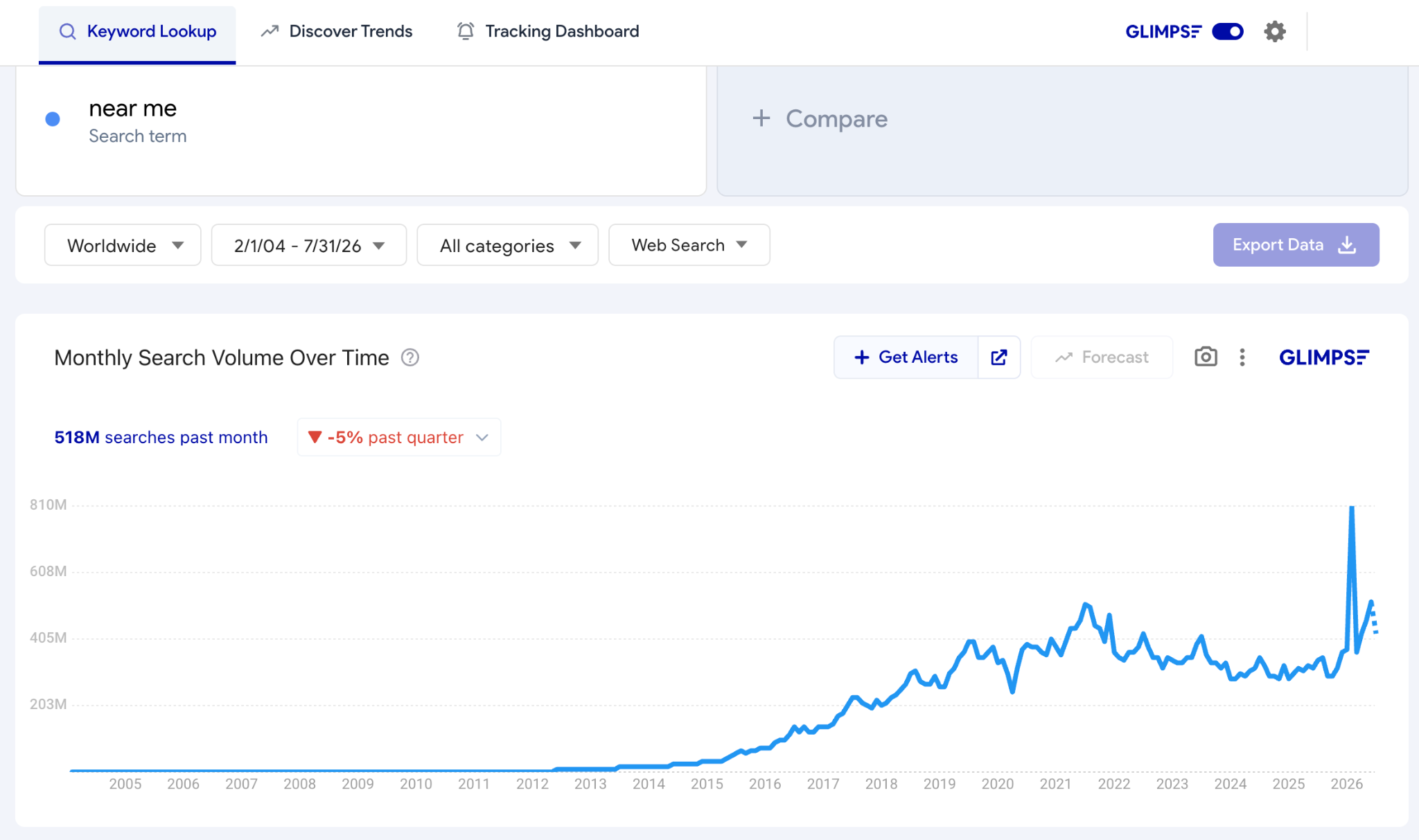
Source: Glimpse
There’s also an increasing number of searches for temporal variations of “near me” terms (e.g., “open now near me”). These search modifiers matter because they capture both local intent and urgent need.
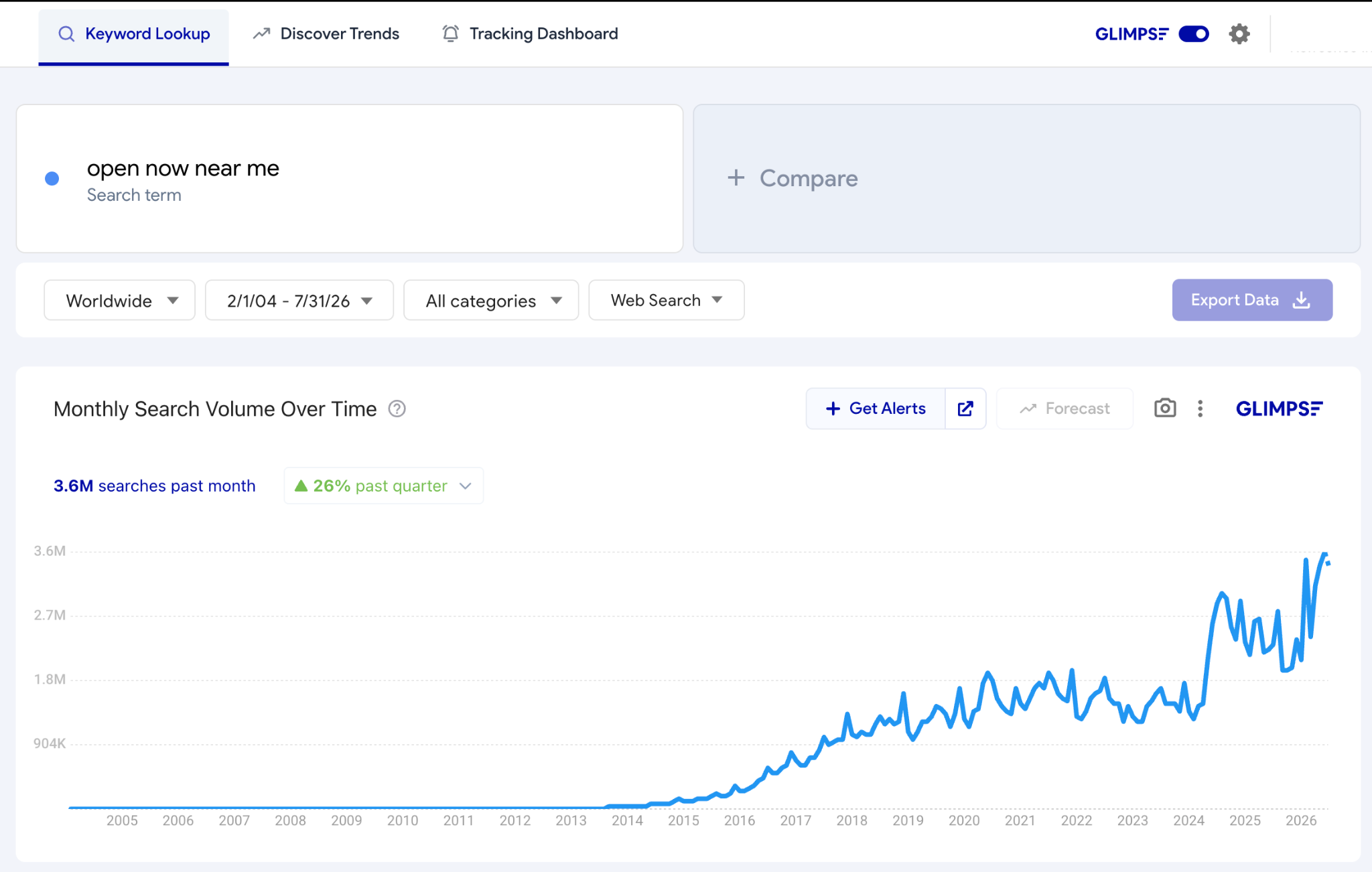
Source: Glimpse
Pro Tip: Optimize your content for a combination of location and time modifiers, such as “near me” and “open now near me.” Do this for your website, social media profiles, and all other places you can be found online.
Optimizing your content for these modifiers makes you more likely to appear in local-intent search results pages.
Alternatives to using “near me” and “open now near me” include location signals, such as the following:
- Business address
- Local street names
- Local landmarks
- Zip codes
- City or town name
They let you signal proximity to local searchers, so incorporate them in your content creation strategy. Use and mention them in your website content, such as your meta titles and meta descriptions, blogs, contact pages, and other pages. Service providers, especially, should also include words that implicitly signal local intent. Some examples are:
- Emergency electrician
- Emergency plumber
- AC repair
- Phone repair
- Clinic
- Hospital
What Happens After the Search: Clicks, Visits and Conversions
Visits, calls, clicks, and sales — that’s what happens after the search. People with local search intent tend to act immediately after searching online.
Click Behavior and Local-Pack Importance
Click behavior and local-pack importance dictate that you must aim for inclusion in the “Google 3-pack” or “Google map pack.”
To land a place in local pack listings, you must get a top-three placement in your keywords’ local business or places search results.
You see, the default local search behavior is clicking on “local pack” listings. Consequently, local-pack businesses tend to get more demand than non-local-pack alternatives.
The click-through and follow-up numbers for local pack businesses and places speak for themselves.
- 42% of searchers click on listings in the local pack when doing a local search.
- Businesses inside the local pack get 126% more traffic.
- Businesses inside the local pack get 93% more follow-through (e.g., website clicks, calls, and requests for directions) than businesses outside the local pack.
That’s a huge concentration of demand sitting in just three business profiles, which is exactly why a Google Map pack placement is worth fighting for.
Note: The local pack is a Google Map with pinned local businesses plus a list of the top three Google Business Profiles for the keyword. It is prominently displayed just above the organic search results, which were the original source of local search traffic. This is why the three businesses featured in a Google Map pack get plenty of exposure. Consumer search behavior favors businesses in local packs, so aim for local pack inclusion for your keywords.
Speed From Search to Visit or Purchase
Local search translates to actual visits or sales, especially when the search is done on a mobile device.
Local search happens during what Google calls “I want to go” moments, which are usually fulfilled through a mobile search.
If someone wants to eat out, needs a plumber, or requires urgent dental care, they go to Google (usually on mobile) and search for relevant, open businesses nearby.
Here’s the kicker. If they like what they see, local searchers visit or call within the day.
- 55% of consumers decide in less than 15 minutes, 75% in less than 30 minutes, and 87% in less than an hour.
- Nearly 3 in 10 (28%) consumers make decisions in less than five minutes.
- 76% of consumers who search for something nearby on their phones visit a business within a day.
There’s no doubt. Local SEO is a high-intent, low-funnel customer-acquisition channel. Local searches naturally and rapidly translate into action.
Business Adoption and the Local SEO Opportunity Gap
There’s low business adoption of local search optimization best practices. This is a clear local SEO opportunity gap a local business can fill.
How Many Businesses Actually Do Local SEO
Not all businesses optimize for local searches, and many of those that do treat it like a side project.
- Around six in 10 businesses (58%) do not optimize for local search.
- The owner (56% of the time) or an employee (25% of the time) handles local SEO.
- Less than one in three businesses (30%) have a local SEO plan.
Treating Google Business Profiles and local visibility as an afterthought can hurt a business. It leaves qualified, high-intent traffic for a competitor to pick up.
This is an opportunity for your business. Hire an SEO agency. Create a local SEO plan. Execute it properly.
Optimize for local search and give local SEO the serious attention and time it deserves, and you can dominate local search and corner your keywords’ “I want or need it now” search engine traffic.
ROI and Impact for Those Who Do It Right
The ROI and impact of local SEO for those who do it right can be phenomenal.
- Local SEO has a typical return on investment of 400-800%.
- Local SEO provides at least two to eight times the ROI of other marketing channels.
For businesses with multiple locations or service areas, local SEO offers a scalable way to capture nearby demand.
Local SEO, with its high ROI, is one of the best tactics to capture leads and sales. While it can take months to bring in results (unlike search ads that can instantly boost traffic), it can continue bringing results even after you stop doing it.
Note: We don’t recommend stopping your local search optimization efforts even after you’ve attained your local SEO business goals. SEO requires continuous, consistent effort so you can stay ahead of the competition.
What Drives Local SEO Success: Key Factors and Best Practices
Mobile adoption and location signals are driving local SEO success. Search engines also often assume local intent and show local search results. Google is unlikely to serve listings for dentists in Florida to someone in Dubai.
Every local SEO strategy comes down to finessing a handful of key factors, such as :
- Accurate business data;
- Strong review signals; and
- A presence that holds up across mobile, voice, visual, and AI-driven search.
Accurate, Complete and Up-to-Date Business Listings
Optimizing for local search requires accurate, complete, and up-to-date business listings.
- 85% of consumers report finding incorrect or incomplete information on business listings.
- 63% of consumers say they won’t use or choose a business with incorrect information.
Pro Tip: Make sure your Google Business Profile and other business listings have the correct:
- Phone number
- Address
- Business name
- Opening hours
- Email address
- Photos (encourage user-contributed photos, too)
Reviews, Ratings and Trust Signals
Reviews, ratings, and trust signals influence consumer decisions and your chances of getting featured in the local map pack.
- Nearly all (97%) of consumers read consumer reviews for local businesses.
- 45% of consumers say they use generative AI tools as a source of local business recommendations.
- 49% and 71% of consumers report using Facebook and Google, respectively, as a source of reviews.
- Review signals account for 20% of a business’s local map pack’s ranking authority.
Whitespark broke down the individual local search ranking factors, and the following are related to reviews and ratings:
- The numerical value of Google ratings
- The number of native Google reviews with text
- The recency of reviews
- The rate at which the business gets new reviews
- The presence of keywords in native Google reviews
- The number of native Google ratings with no text
- The review sentiment
- The number of reviews with photos
- The numerical value of ratings from authority review sites
- The authority of third-party sites contributing reviews
- The number of reviews with videos
- The number of reviews on industry-specific sites
- The number of reviews from traditional third-party review sites
- The presence of a response from the business owner
- The presence of keywords in third-party reviews
- The number of reviews containing answers to review questions
- The number of unstructured reviews from third-party sources (e.g., blog posts, magazines)
- The number of reactions to reviews
- The use of keywords in the owner’s responses to reviews
Pro Tip: First, claim your Google Business Profile. Next, create social media and review site profiles. Remind customers to leave you a review on Google, Facebook, and other authority review sites. Make procuring customer reviews part of your standard operating procedures, so you consistently get new reviews every month. Be rigorous with review management. Monitor your reviews. Respond to reviews and use keywords naturally in your replies. However, do not violate fair review practices; don’t offer incentives or use manipulative tactics. Also try to get AI to recommend your business. That’s a topic for a whole new post, but our guide will get you started in the right direction.
Mobile and “Near Me” Optimization — Because Search Is Mostly On Phones
Mobile and “near me” optimization go hand in hand. Especially since more than half of searches now happen on phones, and a good portion of them have local intent.
- 52.57% of searches are on mobile (according to StatCounter data accessed on 5 August 2026).
- 73% of local business searches occur on mobile.
- 76% of mobile searches for something nearby result in a business visit within a day.
- 28% of mobile searches for something nearby lead to a purchase.
- Mobile searches for “stores open now” and “food open now” have grown 210%.
- Mobile searches for “where to buy/find/get” have grown 130%.
Convenience drives local search conversion on mobile devices. In fact, Google says brand loyalty doesn’t matter as much as convenience to a consumer who wants or needs something immediately.
Pro Tip: Make sure your website loads correctly on mobile. Optimize for mobile speed, Google Maps, click-to-call, and directions.
Your business listings and website must cater to local search intent. More importantly, it must serve I-want-to/ need-to-go moments by prominently displaying business address/es, contact information, open hours, and inventory/service details.
Voice Search, AI Overviews, and Visual Search
Voice search, AI Overviews, and visual search add another layer of geographic relevance to search engine searches.
Voice Search
Voice search happens through smart speakers, mobile phones, computers and laptops, wearables, cars, and smart TVs and streaming devices.
- 20.5% of the global population uses voice search.
- Around 27% of people use voice search on mobile.
- 76% of voice searches have local intent (e.g., with “near me” modifiers).
What distinguishes voice search from typed search? Voice queries made through smart speakers, mobile phones, and other devices tend to be longer, more conversational, and more locally specific.
What this means to you: competitive advantage. That is, if your Google Business Profile features clean, structured, keyword-optimized content and includes complete, accurate business details.
AI-Powered Search
Local search is also happening through AI-powered search.
- Google delivers AI-generated summaries to more than two billion users every month.
- The reach of Google’s AI-generated summaries grew by 33% in just one quarter.
AI-generated summaries pull answers directly from local search data instead of directing people to a list of search results.
This is part of a broader zero-click search trend, and it’s changing how local business data gets surfaced.
- ChatGPT has started surfacing local knowledge panels.
- Gemini can now manage a Google Business Profile on a business owner’s behalf.
Visual Search
Visual search (or searching the web using images) is part of the shifting local search experience.
- Four in 10 U.S. adults are interested in trying visual search, even though only one in 10 uses it regularly.
- 22% of Gen Z and younger millennials use visual search.
Expect visual search volumes to increase over time as early adopters age and younger generations start using it, too.
With Google Lens, especially, people can point a camera at a storefront, a menu, or a product and get local results back instantly.
These practices can help you optimize for voice, AI-powered, and visual search.
- Use natural language in your content.
- Optimize for long-tail keywords.
- Clearly structure your content with header tags (H1 to H6).
- Use questions as headers whenever possible.
- When headers are questions, provide direct-to-the-point answers (40 to 60 words long) directly underneath them.
- Include complete and accurate business information, including operating hours, stock availability, and exact addresses.
- Include many high-resolution images.
Technical Foundations That Support Local Visibility
The technical foundations that support local visibility include:
- Clean meta titles and meta descriptions on location pages
- Logical breadcrumb trails
- Website design that renders fast on mobile
- Tracking, particularly with Google Search Console, to know which local search queries are driving impressions and clicks (to turn guesswork into a measurable local SEO strategy)
- Guarding against link rot that manifests as broken, dead or outdated citations, directory listings, and links that quietly erode trust signals
Why Local SEO Still Matters (And Likely Will for Years)
Local SEO still matters because local search shortens the gap between digital intent and real-world action.
People search and will continue to search for local businesses online. As long as people carry phones, use maps, and expect accurate business details online, local search will happen.
Consumer search behavior indicates they can and will search for:
- Local activities to experience;
- Local services to use; and
- Local places to explore, play at, dine in, and buy from.
Local visibility is an integral part of multichannel marketing, and it is expected to remain so in the foreseeable future.
For agencies and marketers, local SEO stats offer a powerful argument for local search optimization. Especially for physical stores and multi-location brands.
Local search is a high- intent, fast-converting customer-acquisition channel. And the best part? A local business can dominate its niche because not all businesses are optimizing for local search.
Who Needs to Care and Who Gets the Biggest Lift
Any business that depends on foot traffic or a defined service area benefits directly: restaurants, retail stores, home services, and healthcare providers among them. Hospitality is a particularly clear case.
SEO for hotels and luxury travel SEO both lean heavily on the same local trust signals covered here, although they especially cater to guests searching from further away. Accurate profiles, consistent review management, strong review velocity and volume, and map pack visibility are necessary.
Multi-location brands get an outsized lift from local search. Consistent business profiles across dozens or hundreds of locations compound the conversion rates and business performance gains described above.
Frequently Asked Questions
What percentage of Google searches have local intent?
Close to 46% of all Google searches carry local intent. In other words, nearly one in every two Google queries is a search for a local place or business. By optimizing for local search, a business can get better exposure in local searches.
How quickly do local searches turn into a visit or purchase?
About 76% of people who search for something nearby visit a business within a day, and 28% of local searches result in a purchase. This is what makes local SEO so desirable. It is a short, high-intent, bottom-of-the-funnel customer-acquisition channel — the best type there is.
Do most businesses actually run a local SEO strategy?
No, most businesses do not run a local SEO strategy. In fact, 58% of businesses don’t optimize for local search, only 30% have a local SEO plan, and in 56% of cases the business owner handles local SEO. This is an opportunity gap a local business can fill by being more intentional with its local SEO.
How is AI search changing local SEO?
AI search is changing the way people get feedback for local businesses, with 45% of consumers reporting they use AI tools to get business recommendations. AI-generated summaries pull business data into answers. They enhance local visibility for business listings with complete, accurate information optimized for local search.
Why do online reviews matter so much for local rankings?
Online reviews matter so much for local rankings because they contribute to a business’s local pack rankings. Local pack rankings matter because 42% of searchers click on the Google Business Profiles in local packs. Consequently, businesses in local packs get 126% more traffic and 93% more calls, website clicks, and requests for directions.
Wrap-Up and What You Should Do Now
Here’s what you should do now.
Audit. Audit your website, your Google Business Profile, and all of your other business listings online, including social media profiles. Confirm that every profile has been claimed and your name, address, and phone number (NAP) are consistent and accurate across all your listings.
Check your review coverage. Do this across all the platforms your customers use to leave you feedback. Create and implement a plan to get more reviews.
Make sure your website pages load fast. Especially on mobile. Landing page conversion data indicate pages that load in 2.4 seconds convert twice as well as slower pages.
Track local rankings, business visibility, and review velocity the same way you’d track any other ranking factors.
If you’re feeling overwhelmed and unsure how and where to start, we can help. Book a free discovery call with our team, and we’ll show you exactly where your local visibility stands against local SEO benchmarks.























Leave a Reply