

Summarize This Article With AI
 Try with ChatGPT
 Try with Claude
 Try with AI Mode
On January 12, 2026, Apple confirmed a multi-year deal to embed Google’s Gemini into the core of Siri and Apple Intelligence. That puts Gemini on over 2 billion active Apple devices. The same day, Alphabet crossed a $4 trillion market cap.
Then, on May 13, 2026, Anthropic launched Claude for Small Business, a package of 15 ready-to-run agentic workflows that connect Claude directly to QuickBooks, PayPal, HubSpot, Canva, and Google Workspace. Anthropic President Daniela Amodei was direct about the intent: “Small businesses make up nearly half the American economy, but they’ve never had the resources of bigger companies. AI is the first technology that can finally close that gap.”
Two announcements. Both point to the same conclusion:
AI is no longer a research tool people use occasionally.
It’s becoming the operating layer for how people and businesses work, discover, and decide, every single day.
Which makes it worth asking:
Are LLMs genuinely gaining ground as the default search interface? And if so, what does that mean for your business?
Search Everywhere Optimization™ is the strategy of optimizing your brand for visibility across every platform where your audience searches and discovers, including Google, AI tools like ChatGPT, Perplexity, and Gemini, social platforms, YouTube, podcasts, and marketplaces. It’s the operating model for search in 2026, not a replacement for Google SEO.
This report covers the data behind that shift: platform growth, citation behaviour, conversion benchmarks, and the framework for acting on it all.
Article Summary
- Google still delivers 87.5% of referral clicks globally, but AI search converts at 4.4x to 9x higher for service businesses. Volume and value have decoupled.
- ChatGPT’s 900 million weekly active users arrive pre-qualified. They’ve already made their decision inside the LLM before they click through to your site.
- 83% of AI Overview citations come from outside Google’s top 10. Ranking on Google is no longer sufficient, or even necessary, for AI citation.
- Domain authority is the gateway to AI citation: 65.3% of ChatGPT’s top 1,000 cited pages come from domains with a DR of 80 or above. Page-level link popularity barely matters.
- The 4 levers for citation are authority, atomic answers, earned distribution, and extractability. Brands on four or more platforms are 2.8x more likely to appear in ChatGPT responses.
- This is not a new channel to bolt onto your stack. It’s a new operating model.
The Numbers That Rewired Search in 2026
The headlines have been loud. The actual data is louder.
Search isn’t dying.
Combined search and AI query volume is up 26% year-over-year. But the distribution of that volume, and where the value sits within it, has shifted in ways that most marketing teams haven’t fully priced in yet.
Here’s the macro picture.
ChatGPT, Gemini, Claude: The AI Platform Growth Story
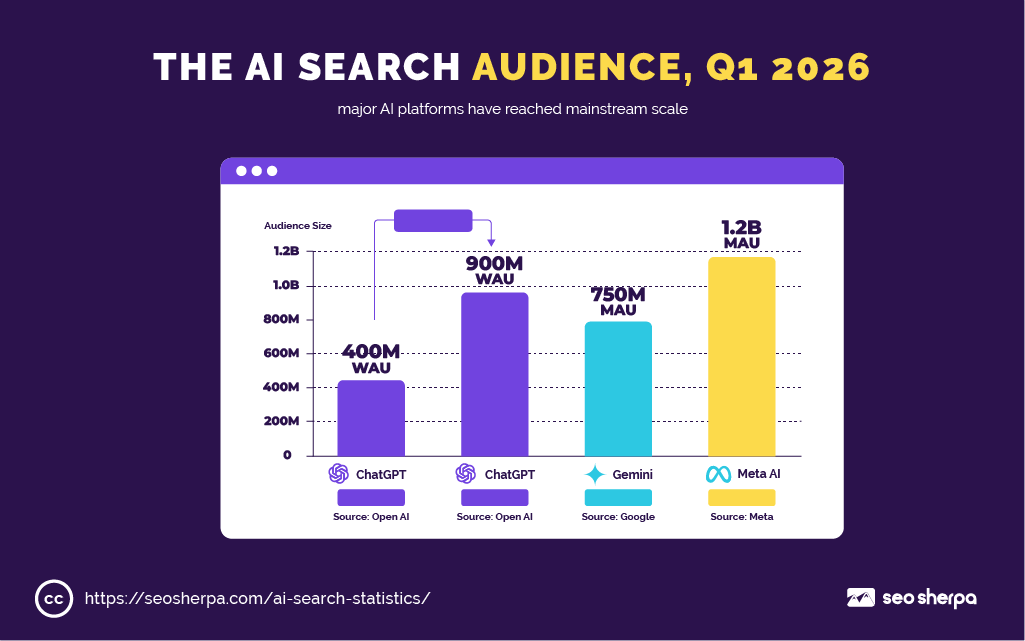
ChatGPT grew from 400 million weekly active users in February 2025 to 900 million by February 2026, according to OpenAI’s announcement alongside its $110 billion funding round.
Gemini sits at 750 million monthly active users, according to Google’s own figures. Meta AI, across WhatsApp, Instagram, and Facebook, has reached 1.2 billion monthly active users.
That’s not a niche audience. That’s the mainstream.
And then Apple went and embedded Gemini into Siri. The January 2026 announcement places Google’s Gemini at the core of Apple Intelligence, extending its reach across more than 2 billion active Apple devices. The AI search audience isn’t just people who consciously open ChatGPT. It’s every iPhone user asking Siri to recommend a law firm, a digital agency, a software platform, or a restaurant.
That’s a distribution shift, not just a product update.
And with Anthropic’s Claude for Small Business now running agentic workflows inside the tools millions of small businesses use daily, the AI user base is expanding beyond early adopters and into the operational fabric of everyday business life.
The implication for SEO is straightforward:
Your potential customers are increasingly making discovery and purchase decisions inside AI interfaces, before they ever open a browser.
Google Is Still Dominant. But the Qualified Clicks Are Migrating.

Google still sends 87.52% of global referral traffic, according to Cloudflare Radar data from April 2026. AI tools collectively account for around 0.27%.
So, is Google still king? By volume, absolutely.
But here’s the thing:
AI search users click 1.4 external links per session, compared to Google’s 0.6. Their session times range from 7.2 to 13 minutes, versus Google’s 2 to 4 minutes. And their conversion rates, which we’ll dig into properly later, are 4.4 to 9 times higher for service businesses.
Volume is on Google. Value has started to move.
Zero-Click Is Accelerating. Here’s the Data.
The zero-click problem isn’t new. The scale of it in 2026 is.
A Similarweb report covered by Digiday found that zero-click rates for news queries jumped from 56% in May 2024 to 69% by May 2025. That trajectory hasn’t reversed.
On Google’s side, multiple studies have measured the impact of AI Overviews on CTR. The range is wide, and being honest about it matters. Ahrefs analyzed 300,000 keywords and found a 34.5% reduction in position-1 CTR when an AIO was present (April 2025), rising to 58% in their December 2025 update as the AIO rollout matured. Pew Research tracked 68,879 actual Google searches conducted by 900 US adults in March 2025 and found that CTR dropped from roughly 15% to 8% when an AIO appeared, with only 1% of users clicking a cited source within the AIO itself.
The variance between studies reflects differences in query types, industries, and methodologies. What the studies agree on is the direction: informational queries are generating less organic traffic than they did two years ago. That’s not in dispute.
How AI Tools Decide What to Cite (And What to Ignore)
This is where most SEO content gets vague. “Create authoritative content” and “build trust signals” are not instructions. They’re adjectives.
Here’s what the data actually shows about citation selection.
Domain Authority Is the Gateway
DR 80 or above. That’s the threshold.
Ahrefs’ analysis of the top 1,000 pages ChatGPT cited in September 2025 found that 65.3% came from domains with a domain rating of 80 or higher, with a median DR of 90.
Here’s the counterintuitive part: page-level URL Rating barely registers. 67.3% of cited pages had a UR between 0 and 10. The page itself doesn’t need to be heavily linked. The domain does.
The implication for your link-building strategy is significant: you’re not just building links to pages. You’re building a domain-level authority ceiling that makes you a credible source for AI tools to pull from. Accumulating domain authority is the primary objective. Page-level link campaigns are secondary.
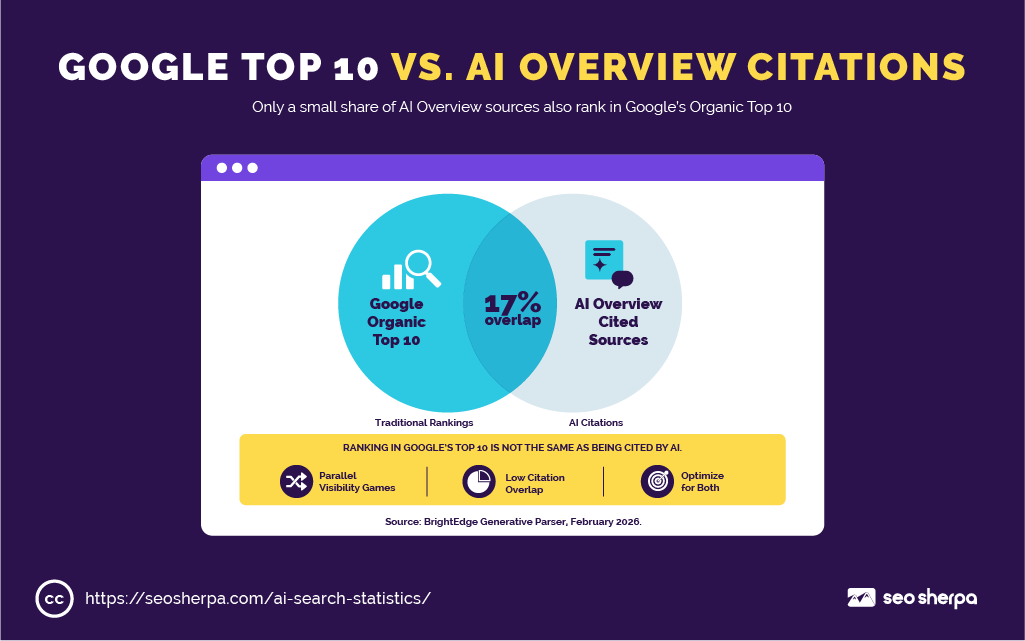
Only 17% of AI Overview Citations Overlap With Google’s Top 10
This is the single most structurally significant finding for any marketer who has spent the past decade chasing Google rankings.
BrightEdge’s Generative Parser, tracking the presence of AI Overviews across industry-specific keyword sets over a full year through February 2026, found that only 17% of AI Overview citations come from pages that also rank in Google’s organic top 10. A separate Moz analysis of 40,000 queries in Google AI Mode found approximately 12% of citations matched URLs in the organic top 10.
Two separate studies.
Both point to the same conclusion:
Ranking on Google is no longer the same game as being cited by AI.
Read that again. The page ranking at position one on Google is, most of the time, not the one the AI cites.
These are now parallel games.
You can rank first on Google without appearing in AI Overviews. You can be cited by ChatGPT without ranking at all. Brands that optimize only for one surface are handing the other entirely to their competitors. Our guide to AI SEO strategy covers how to approach both simultaneously.
Reddit, Wikipedia, and LinkedIn Are the Trust Anchors of the AI Web
Peec AI analyzed 30 million citations across ChatGPT, Gemini, Perplexity, and AI Overviews combined, published in March 2026. Reddit emerged as the most-cited domain across all four platforms.
LinkedIn’s trajectory tells its own story. Between November 2025 and February 2026, LinkedIn moved from rank 11 to rank 5 in ChatGPT’s most-cited sources, according to Profound’s analysis of 1.4 million citations, the largest domain authority shift they observed all year. This isn’t just a social media footnote. Presence and activity on Reddit and LinkedIn are now a citation surface, not just a distribution channel. Our full guides to LinkedIn SEO and Reddit SEO cover the tactical details.
Front-Load Your Answer: The 44% Rule
Research published by Growth Memo’s Kevin Indig in early 2026 showed that 44.2% of LLM citations come from the first 30% of an article.
AI tools read like impatient editors. They want the answer first, the explanation second, the nuance third. If the most citable statement in your article is buried in paragraph 14, it’s functionally invisible to citation algorithms.
The structural fix is simple: define first, elaborate second. Every section should open with a direct, citable answer to the question implied by its heading. This section itself is an example of that principle.
Structured Data Multiplies Your Citation Rate
AirOps’ analysis of more than 15,000 URLs found that 61% of pages cited by ChatGPT included structured data markup, versus only 25% of Google’s top organic results. A separate SE Ranking study of 129,000 domains found structured data implementation consistently correlated with higher AI citation rates across platforms.
Schema is not a nice-to-have in 2026. Our guide to structured data for SEO covers implementation in detail, but the short version: Article schema, FAQ schema, and Dataset schema are the three formats most relevant to citation-driven content.
Earned Media Is Where 82% of AI Citations Come From
Muck Rack’s Generative Pulse report, published in December 2025, found that 82% of links cited by AI engines come from earned media rather than owned content on brand websites. This aligns with the University of Toronto’s generative engine optimization study from September 2025, which found AI tools show a “systematic and overwhelming bias towards earned media over brand-owned and social content.”
Research covered by BrightEdge found that earned media distribution can increase AI citations by up to 325% compared with publishing content exclusively on your own domain.
The implication for content strategy is significant. A blog post on your own site has a single citation surface. The same research, published as a bylined article in a trade publication, cited on a podcast, referenced on Reddit, and shared on LinkedIn, has four. Brands active on four or more platforms are 2.8x more likely to appear in ChatGPT responses.
Your content doesn’t just need to exist. It needs to be distributed.
The Conversion Story: Why AI Search Traffic Is Your Most Valuable Inbound Channel
The data above explains the mechanics of citation. This section explains why it matters commercially.
ChatGPT Converts at 9x Google Organic for B2B Services
Seer Interactive tracked conversion data for a B2B software client from October 2024 through April 2025. The results by platform:
That’s not a marginal difference. ChatGPT traffic converted at roughly 9 times the rate of Google organic for this client.
Important caveat: this is one study, one client, one industry vertical, covering 1,370 AI-driven conversions against nearly 14 million organic sessions. Seer itself is careful to frame it as early evidence rather than a settled consensus. But it’s real data from real revenue, and as Search Engine Land explored, the direction is consistent across multiple independent studies. In a wide-ranging study of more than 500 B2B topics, Semrush found AI search traffic converted at 4.4 times the rate of organic search traffic.
For E-commerce, the Lift Is More Modest
The B2B conversion premium doesn’t translate directly to e-commerce. Multiple studies of e-commerce brands have found that AI search traffic converts with a more modest but still meaningful lift over non-branded organic, typically in the range of 10-30%.
One important attribution point: many AI-influenced conversions surface as branded organic searches in Google Analytics. A user researches on ChatGPT, forms a preference, then searches the brand name on Google. Without post-purchase surveys, you may be attributing AI-influenced conversions to branded organic and significantly undercounting AI’s actual contribution.
ChatGPT traffic to e-commerce sites has grown dramatically year-on-year. Even modest per-session premiums compound at that growth rate.
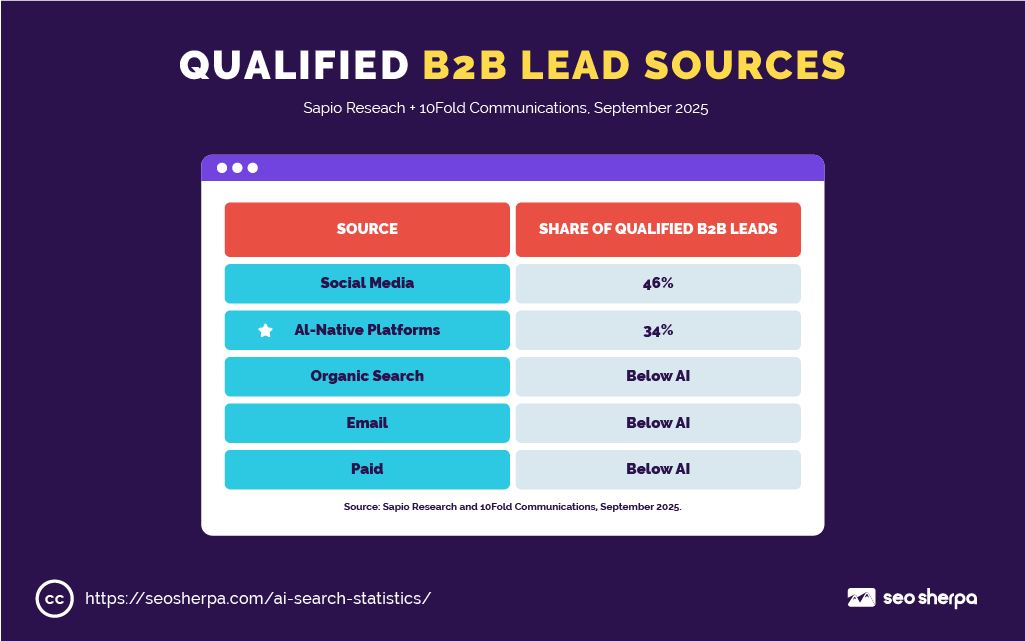
AI Platforms Are Now the #2 Source of Qualified B2B Leads
Sapio Research and 10Fold Communications surveyed 400 senior marketing executives in September 2025 about the sources of their qualified lead pipeline. AI-native platforms came in second overall, behind only social media and ahead of organic search, email, and paid.
This is primary research from 400 senior marketing executives. It tells a story that should change how marketing budgets are allocated in 2026.
Why ChatGPT Traffic Converts: The Pre-Qualification Effect
The mechanism behind the conversion premium isn’t mysterious. It’s behavioral.
By the time a ChatGPT user clicks through to your website, they’ve already completed most of their consideration cycle inside the LLM. They’ve asked follow-up questions, compared options, and formed a view on who they want to work with. They arrive pre-qualified.
Seer’s session data reinforces this. ChatGPT users view 2.3 pages per session versus Google’s 1.2. Session times run 7.2 minutes compared to Google’s 2 to 4 minutes. Profound’s research into how users engage with AI platforms before clicking through found that brand-specific prompts are increasingly common, suggesting users arrive at brand sites having already shortlisted them inside the LLM.
The old model: user searches Google, discovers your brand and begins research.
The new model: user asks ChatGPT to recommend options, forms a view inside the LLM, and arrives at your site having already decided you’re worth talking to.
Your job in Search Everywhere Optimization™ is to be in the conversation that shapes that decision, before the user ever lands on your site.
The Big Picture: What This Means for Your Business in 2026
We’ve covered the citation mechanics and the conversion data. Now for the larger argument.
The Apple-Gemini deal isn’t just a product announcement. It’s confirmation that the major technology platforms have decided AI is the interface layer for their most valuable users. Combine that with Anthropic pushing Claude into the daily operations of small businesses through Claude for Small Business, and the pattern is clear: AI is becoming the first surface where brand discovery happens, not a secondary one.
And then there’s Anthropic’s Cowork.
Anthropic’s Cowork launch wiped approximately $285 billion in SaaS market capitalizations in 48 hours. Thomson Reuters posted its largest single-day stock decline on record. The market’s reaction was stark: if an AI tool can handle knowledge-work workflows natively, the brands embedded within those AI runtimes have a structural advantage over every brand waiting for the dust to settle.
Ranking on Google is the 2015 version of this problem. Being cited inside an AI tool is the 2026 version.
Here’s the reconciliation framework that makes sense of the data: the LLM conversion premium correlates directly with consideration cycle length. Impulse ecommerce sees a 10-31% lift. B2B SaaS and professional services see 3 to 9 times higher conversion. The longer your customers spend evaluating options, the more value pre-qualification inside an LLM delivers. Know your business. Calibrate your expectations accordingly.
Amsive’s research found no significant difference in conversion between LLM and organic traffic in some cohorts. The Seer B2B data comes from a single client. The data is genuinely promising. It is not yet a settled consensus, and any source presenting it as such is selling you something.
What is settled: the direction of travel. Combined search and AI query volume is up 26% year-over-year. The audience is larger. The platforms are more numerous. The consideration journey has migrated. Brands that treat this moment as a threat rather than an opportunity will find themselves optimized for a search engine that no longer controls the full path to purchase.
Volume Is on Google. Value Has Moved. Time to Adapt.
Search isn’t dying. It’s proliferating.
Combined search and AI query volume is up 26% year-over-year. The audience is larger. The platforms are more numerous. But the playbook that served most businesses from 2010 to 2022: rank on Google, drive organic traffic, convert, is no longer sufficient as a standalone strategy.
Google still owns volume. AI tools are capturing an increasingly large share of the consideration journey. With Gemini now embedded in Siri across 2 billion Apple devices, and Claude running inside the daily operations of small businesses across America, the question of whether AI search is mainstream has been definitively answered.
The 4-pillar framework gives you a structure that works across both surfaces: build domain authority, structure content for extractability, distribute through earned media, and implement schema as a baseline. Brands doing all four are 2.8x more likely to appear in ChatGPT responses. Brands that do two of the four hand the other two to their competitors.
The opportunity in 2026 is not to panic about AI disruption. It’s to be the brand that journalists, LLMs, and decision-makers cite when they explain what happens to search after Google. This report is built to be that reference. Use it accordingly.
Want to know exactly where your brand stands across Google, AI Overviews, and AI search citations? Book a free discovery call with SEO Sherpa, and we’ll show you what’s working, what isn’t, and where the biggest opportunities are.















Leave a Reply