

Summarize This Article With AI
 Try with ChatGPT
 Try with Claude
 Try with AI Mode
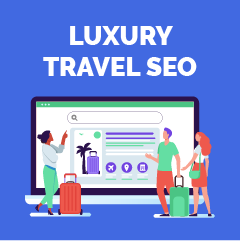
Luxury travel SEO is a strange paradox.
On the surface, it looks like every other SEO discipline with the same search engines, same tools, and the same dashboards telling you what people are searching for and how often they’re doing it. There’s even the same familiar obsession with rankings, organic traffic, and search visibility.
But the moment you apply those same tactics to the luxury travel industry, something feels… off.
Traffic comes in, but it doesn’t convert. Rankings improve, but bookings don’t follow. The numbers look healthy, yet the business impact stays stubbornly flat.
Because luxury travel doesn’t operate on volume. It operates on precision.
You’re not trying to attract more people. You’re trying to attract the right people. The ones who already know what they want, who expect a certain level of service, and who can spot the difference between premium and “trying to look premium” within seconds of landing on your website.
And that changes everything about how search engine optimization needs to work.
This isn’t about chasing visibility for the sake of it. It’s about building a luxury travel SEO strategy that aligns with how affluent travelers search, evaluate options, and ultimately decide.
Article Summary
- Luxury travel SEO prioritizes intent over volume, focusing on high-intent long tail keywords that signal readiness to book
- Luxury travelers search with specificity and expect content that reflects exclusivity, expertise, and personalized service
- Technical SEO, site speed, and mobile optimization directly influence trust, not just search rankings
- Authority signals like high-quality backlinks, structured data, and positive reviews are critical for converting organic traffic into bookings
What Is Luxury Travel SEO?
Luxury travel SEO is the practice of optimizing luxury travel websites to attract high-value users through organic search by aligning keyword strategy, content, and user experience with the expectations of the luxury market.
That definition is clean. Almost too clean.
Because in practice, luxury travel SEO is less about mechanics and more about alignment. Alignment between what your audience is searching for and what your brand represents. Between the experience you’re selling and the way you present it online.
Most SEO strategies are built to maximize reach. They cast a wide net, capture as much organic traffic as possible, and rely on volume to drive results. That model works well in the broader travel industry, where price comparison, deal hunting, and high traffic volumes dominate user behavior.
Luxury travel doesn’t follow that model.
Here, the goal is not to be seen by everyone. It’s to be chosen by the few who matter.
Why Luxury SEO Requires a Different Approach
If you look at how most travel brands approach SEO, you’ll see a familiar pattern. Broad keywords, high search volume targets, and content designed to attract users at every stage of the funnel. It’s efficient, scalable, and widely accepted as best practice.
But when that same approach is applied to luxury travel brands, it creates a mismatch.
Because the luxury travel audience doesn’t behave like the average user. They don’t browse endlessly, don’t click through ten different options, and aren’t interested in generic content that tries to appeal to everyone.
They arrive with intent. Often very specific intent.
Which means your SEO strategy needs to shift from reach to relevance. From attracting traffic to attracting qualified traffic. From optimizing for search engines to optimizing for perception.
This is where the rise of AI search and more sophisticated search engine algorithms becomes relevant. Search engines are no longer just matching keywords. They’re interpreting meaning, evaluating content quality, and prioritizing pages that demonstrate expertise and trustworthiness.
In other words, they’re getting better at identifying what luxury users expect.
And that leaves very little room for shortcuts.

Understanding the Luxury Travel Audience
Before you dive into keyword research or start planning your content marketing strategy, you need to understand who you’re speaking to. Not in broad demographic terms, but in terms of behavior, expectations, and decision-making patterns.
Because luxury travelers are not just a segment of the travel market. They’re a fundamentally different type of user.
Search Behavior of Luxury Travelers
Luxury travelers don’t search the way most users do.
They don’t type fragmented keywords into Google and scroll through pages of results, hoping something stands out. Their searches tend to be longer, more detailed, and far more intentional. In many cases, their queries read like complete thoughts rather than shorthand phrases.
Instead of searching for something broad like “luxury hotels Italy,” they’re far more likely to search for something like “boutique hotels Amalfi Coast with private beach and concierge service.”
It’s specific, descriptive, and, most importantly, it signals intent.
These are long-tail keywords, and while they may not have high search volume, they carry significantly higher value. According to the brief, these types of queries often indicate users who are closer to making a booking decision rather than simply exploring options.
Which is exactly the kind of traffic luxury travel brands should be prioritizing.
Emotional Drivers Behind Luxury Purchases
At a certain price point, logic takes a back seat.
Luxury travel decisions are rarely driven by necessity. They’re driven by emotion. By aspiration. By the desire to experience something exceptional and, in many cases, to signal a certain lifestyle.
People aren’t just booking a hotel or a tour. They’re buying into a story. One that reflects how they see themselves, or how they want to be seen.
That’s why content in the luxury travel space needs to do more than provide information. It needs to reinforce that story.
This is also where EEAT becomes critical. Experience, expertise, authoritativeness, and trustworthiness are tangible signals that reassure users they are dealing with a brand that understands their expectations and can deliver on them.
Without that trust, even the most beautifully designed website will struggle to convert.
Keyword Strategy for Luxury Travel SEO
If there’s one area where luxury travel SEO diverges most clearly from traditional SEO, it’s keyword strategy.
Because in this space, going after high search volume is often the fastest way to attract the wrong audience.
Targeting High-Intent, Low-Volume Keywords
Luxury travel keywords rarely look impressive in keyword research tools.
They tend to have lower search volume, less competition, and fewer obvious opportunities for scale. At first glance, they can seem like a poor investment compared to broader, high-volume terms.
But that’s missing the point.
A keyword with 100 highly qualified searches is often far more valuable than one with 10,000 unqualified ones. Because those 100 searches are far more likely to convert into actual bookings.
Luxury travel SEO is not about maximizing traffic but about maximizing relevance.
This means focusing on long tail keywords that reflect specific experiences, destinations, and service levels. Queries that signal not just interest, but intent.
And when you start thinking in those terms, the entire keyword research process changes.
Examples of Luxury Travel Keywords
The most effective luxury travel keywords tend to combine three elements: destination, experience, and level of service.
When those elements align, you’re not just capturing attention. You’re attracting users who are already imagining the experience you offer.
Searches like “private safari Serengeti luxury travel company bespoke itinerary” or “villa rentals Tuscany with private chef and concierge” may not generate massive traffic, but they attract the kind of potential customers luxury travel brands are built around.
And when supported by a strong SEO content strategy, they can drive consistent, high-quality organic traffic that translates into bookings.

Content Strategies That Attract Premium Travelers
There’s a noticeable difference between content that ranks and content that resonates.
In the luxury travel space, that difference becomes impossible to ignore.
While generic travel content might perform well in search rankings, it rarely creates the kind of connection needed to convert high-value users.
Creating Aspirational, Experience-Driven Content
Luxury travel content should feel less like a guide and more like an invitation.
It should give the reader a sense of what the experience actually feels like, not just what it includes. That means moving beyond surface-level descriptions and into something more immersive.
You’re not just listing amenities. You’re showing what it’s like to arrive, to stay, to experience the destination in a way that feels distinct from everything else.
This is what separates high-quality content from content that simply fills space.
And as highlighted in the brief, creating high-quality, original content is essential to building authority and trust in the luxury travel market.
Without that depth, even well-optimized pages can struggle to perform.
Leveraging Destination Guides and Itineraries
Destination guides are a staple of travel SEO, but in the luxury space, they need to go further.
Because a standard “top things to do” article might attract organic traffic, it doesn’t necessarily move users closer to booking.
What works are curated itineraries and experience-led guides that bridge the gap between inspiration and action. Content that not only informs but subtly positions your brand as the provider of that experience.
A well-crafted itinerary doesn’t feel like marketing.
It feels like the beginning of a decision.
On-Page SEO for Luxury Travel Websites
In luxury travel SEO, your website is not just a marketing asset. It’s part of the product.
Before a user ever speaks to your team or makes an inquiry, they form an impression based entirely on what they see and experience online.
Optimizing for User Experience and Design
User experience in the luxury travel space is not a bonus. It’s a baseline expectation.
Site speed, mobile optimization, and core web vitals all play a direct role in how your brand is perceived. A slow-loading website not only frustrates users but also raises doubts about the quality of the service behind it.
According to the brief, fast loading times and seamless mobile experiences are essential to prevent potential customers from abandoning the site.
Design matters just as much.
Clean layouts, intuitive navigation, and a sense of visual cohesion all contribute to an experience that feels aligned with the luxury market. When these elements are missing, the disconnect is immediately noticeable.
Internal Linking for High-Value Pages
Internal linking is often treated as a technical detail, but in luxury travel SEO, it plays a much more strategic role.
It guides users through the experience.
From an initial blog post to a detailed destination guide. From there to a landing page. And eventually to a booking inquiry.
When done well, it doesn’t feel like navigation.
It feels like progression.
Link Building and Digital PR for Luxury Brands
In most industries, link building is about quantity and consistency.
In the luxury travel space, it’s about context.
Where your brand is mentioned matters just as much as how often it’s mentioned.

Earning Links From Premium Publications
Backlinks from high-end travel publications, established lifestyle platforms, and authoritative industry sources carry a different kind of weight.
They don’t just improve search rankings. They also reinforce brand positioning.
When users encounter your brand across trusted platforms, it builds familiarity and credibility before they even reach your website.
And that combination of visibility and trust is what drives action.
Influencer and Partnership Strategies
Luxury travel brands often benefit from strategic partnerships that extend beyond traditional SEO.
Collaborations with influencers, concierge services, and high-end tour operators can create opportunities for both visibility and high-quality backlinks.
But, more importantly, they reinforce the brand’s position within the luxury travel ecosystem.
Which is something search engines are increasingly able to recognize and reward.
Local and International SEO for Luxury Travel
Luxury travel may be global, but search behavior is often highly localized.
Users are searching for specific destinations, experiences, and services tied to particular locations.
Targeting High-Income Locations
Local SEO becomes particularly valuable when targeting affluent regions and high-income cities.
Optimizing your Google Business Profile, improving visibility on Google Maps, and creating location-specific landing pages all contribute to stronger performance in local search results.
And as the brief highlights, effective local SEO strategies can significantly impact booking rates for luxury travel services.
Because when users are ready to act, visibility in the right place at the right time matters.
Conversion Optimization for Luxury Travel
Traffic alone doesn’t drive revenue.
Conversions do.
And in the luxury travel space, conversion optimization is as much about trust as it is about usability.
Designing High-Converting Landing Pages
Luxury landing pages should feel effortless.
Not because they lack detail, but because everything is presented with clarity and intention. The value proposition is clear. The next step is obvious. And there are no unnecessary distractions.
The experience should feel as seamless as the service.
Because anything less creates hesitation.
Trust Signals and Social Proof
Trust is what ultimately drives bookings.
Positive reviews, testimonials, awards, and recognitions all contribute to that trust. Structured data can enhance how these signals appear in search results, reinforcing credibility before users even click through.
In a high-value market, these details are expected.
Common Mistakes in Luxury Travel SEO
Most mistakes in luxury travel SEO don’t look like mistakes.
They look like standard practice applied in the wrong context.
Aiming for high search volume keywords, producing generic content, ignoring technical SEO until performance drops, and over-optimizing pages to the point where they feel mechanical rather than natural.
Individually, these decisions may seem harmless.
But together, they create a strategy that attracts the wrong audience, weakens brand perception, and ultimately fails to convert.
And in the luxury market, where expectations are higher and margins are tighter, that’s a costly outcome.
Building a Premium SEO Strategy
Luxury travel SEO is not about doing more.
It’s about doing the right things with greater precision.
Better keyword targeting. More thoughtful content. A stronger focus on user experience. A deeper understanding of what your audience expects and how they evaluate options.
Because in this space, your SEO strategy is inseparable from your brand.
And when those two are aligned, something changes.
You stop competing for attention and start attracting intention.
Luxury travel SEO isn’t about getting more traffic. It’s about getting the right traffic and turning it into high-value bookings.
If your current strategy is bringing in clicks but not conversions, there’s usually a disconnect somewhere. In your keyword strategy, your content, your positioning, or all three.
At SEO Sherpa, we build SEO strategies designed for premium brands. The kind that aligns search intent with real buying power, elevates your visibility across search engines and AI search, and turns your website into a consistent source of qualified inquiries.
If that’s the direction you’re heading, let’s talk.
Book a discovery call with our team, and we’ll walk you through exactly where your current strategy is falling short and what it would take to fix it.
No fluff. No generic audits. Just a clear path to more of the clients you actually want.






















Leave a Reply