

Summarize This Article With AI
 Try with ChatGPT
 Try with Claude
 Try with AI Mode
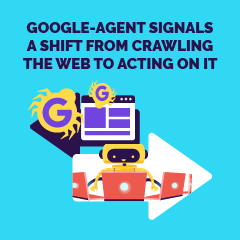
For most of the internet’s history, bots have been observers.
They arrive quietly, scan pages, follow links, collect information, and leave. Their job is to understand what exists, not to interact with it.
We have grown used to that behavior. We design sites around it. We manage access through robots.txt. We think of bots as passive participants in the ecosystem.
That model is starting to change.
Google has introduced a new user agent called Google-Agent, designed to power AI systems that can navigate the web and perform actions on behalf of users. This is not just another crawler. It represents a different kind of interaction.
One where the system does not simply observe the web.
It uses it.
Article Summary
- Google introduces Google-Agent, a user agent for AI-driven interactions
- The agent can navigate websites and perform actions, not just crawl content
- This marks a shift from passive indexing to active participation
- Websites may need to adapt to a new type of visitor
From Indexing To Interaction
Traditional crawling is about discovery.
Bots identify pages, extract information, and feed that data into search indexes. The process is systematic and predictable, even if it operates at massive scale.
Google-Agent suggests something more dynamic.
Instead of simply collecting information, it can interact with interfaces, follow workflows, and complete tasks. It behaves less like a scanner and more like a user, albeit one acting on behalf of another user.
That distinction changes how we think about the web.
Because interaction introduces complexity.
It raises questions about permissions, intent, and control that do not exist in the same way for passive crawling.

The Rise Of The Proxy User
One way to understand Google-Agent is to think of it as a proxy.
It represents the user, but it is not the user. It executes actions based on instructions, but it operates independently. It bridges the gap between human intent and digital execution.
This model is already emerging in other contexts.
AI assistants booking travel.
Automated systems managing tasks.
Agents interacting with services on behalf of individuals.
Google-Agent extends that concept to the broader web.
Which means websites are no longer just interacting with humans and bots.
They are interacting with systems acting for humans.
That is a subtle but important distinction.

Why This Changes The Rules Of Engagement
When bots start acting rather than observing, the rules of engagement shift.
Access becomes more nuanced. It is no longer just about allowing or blocking crawlers. It is about deciding what actions can be performed and under what conditions.
Experience design becomes more complex. Interfaces need to accommodate not just human usability but machine interpretability at an interaction level.
Security considerations evolve. Systems must distinguish between legitimate agent activity and unwanted automation.
In short, the web becomes more layered.
And that layering introduces both opportunity and risk.
Why This Matters For Search Everywhere Optimization™
Search Everywhere Optimization™ is fundamentally about understanding how visibility is created across systems.
Google-Agent introduces a new layer to that equation.
It is not just about being indexed or ranked. It is about being accessible and usable by agents that act on behalf of users.
That has implications for how content and services are structured.
If an AI agent cannot navigate your site, understand your offering, or complete an action, your visibility in that ecosystem may be limited. Not because you are not relevant, but because you are not operable.
Optimization, in this context, extends beyond content.
It touches on architecture, accessibility, and interaction design.
It requires thinking about how systems, not just people, engage with your digital presence.

Your Audience Just Got A New Member
We have spent years optimizing for two audiences.
Humans and search engines.
Now there is a third.
Agents.
They do not browse in the traditional sense. They do not get distracted. They do not respond to design in the same way. They are efficient, goal-oriented, and driven by instructions.
Which means the signals that influence them may differ from those that influence people.
That does not replace human-focused optimization.
But it adds another layer.
And as with every shift in search, the brands that recognize that layer early will have an advantage.

The Real Takeaway For Marketers
The web is evolving from a collection of pages into an environment where actions are performed by both humans and AI systems.
Understanding how those systems interact with your content and services will be critical.
If you want to prepare your digital presence for this next phase of search, book a free discovery call with SEO Sherpa.


















Leave a Reply