

Summarize This Article With AI
 Try with ChatGPT
 Try with Claude
 Try with AI Mode
The rules of search are changing.
Once upon a time, you wrote content, optimized for keywords, and waited for Google to rank you.
Now? Your audience asks AI chatbots questions, scrolls TikTok for answers, and skims summaries in Google’s AI Overviews.
Your content isn’t just competing in blue links. It’s fighting for visibility in a conversation.
Most websites still optimize only for traditional search engines and ignore how large language models (LLMs) find, interpret, and cite content.
Enter LLM SEO, optimizing your content and website so it shows up in generative answers, AI assistants, and chat-based search results.
Welcome to the world of LLM SEO, aka Large Language Model Optimization, also known as Generative Engine Optimization (GEO) or Answer Engine Optimization (AEO).
Yes, it’s acronym soup. But stay with me.
This isn’t just a trend; it’s a paradigm shift in how content is discovered, understood, and surfaced across traditional search engines and AI-powered systems like ChatGPT, Claude, and Perplexity.
Article Summary
- LLM SEO (Large Language Model Optimization) focuses on optimizing content for AI-powered search platforms like ChatGPT, Claude, and Gemini, aiming for visibility in AI responses and zero-click searches.
- Unlike traditional SEO, which targets search engine rankings and click-through traffic, LLM SEO prioritizes semantic depth, content clarity, and conversational keywords to match natural language queries.
- Effective LLM SEO strategies include creating comprehensive topic clusters, structuring content for machine understanding with schema markup, publishing original data, and building authentic brand mentions.
- Large language models use retrieval augmented generation (RAG) to fetch current content, emphasizing the importance of clear, well-structured, and static HTML content for AI visibility.
- Tracking LLM SEO performance involves monitoring brand mentions in AI responses, referral traffic from AI platforms, and using tools like Google Analytics 4 and Google Search Console.
- LLM SEO is an ongoing process that complements traditional SEO. It requires continuous content maintenance, digital PR efforts, and adaptation to evolving AI search behaviors.
What Is LLM SEO and Why It Matters
LLM SEO is the practice of optimizing your content so it can be found, understood, and cited by large language models (LLMs) like ChatGPT, Claude, Gemini, and Perplexity. Instead of fighting for a #1 ranking in Google, you aim to get your content featured in AI-generated answers and zero-click summaries across generative search platforms.
Now that we’ve answered the question, let’s unpack why this matters.
The way people search is evolving faster than Google rolls out algorithm updates (and that’s saying something). More users are bypassing the SERP altogether and going straight to AI tools, asking natural, full-sentence questions and expecting direct, human-sounding answers.
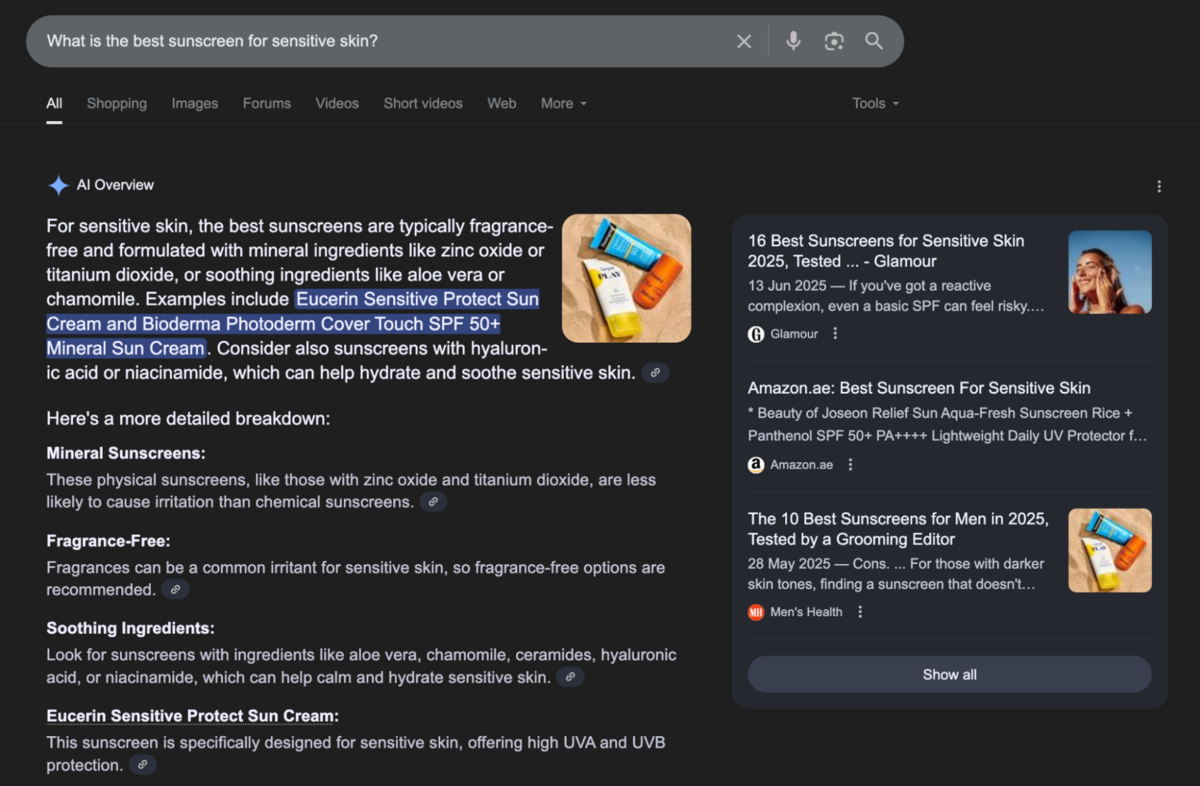
Think: “What’s the best sunscreen for sensitive skin?”
Not: “best sensitive skin sunscreen 2025”
And when those AIs respond? They’re pulling from multiple sources, summarizing insights, and maybe giving you credit, if you’ve done your LLM SEO homework.
Platforms like Perplexity, Bing AI, and even Google’s AI Overviews are pushing this shift toward zero-click search, where users get everything they need without clicking a single link.
So, here’s the thing:
If your content isn’t optimized for AI, you could be invisible where your audience is now discovering information.
LLM SEO doesn’t replace traditional SEO; it builds on it.
We’re no longer just optimizing for search engines. We’re optimizing for language engines. That means a broader, more dynamic content strategy. And yes, a lot more chances to get seen without depending on that old-school Page One spot.
How Large Language Models Process and Rank Content
LLMs process content using two core mechanisms: massive pretraining on web data and real-time retrieval of fresh content via RAG (Retrieval-Augmented Generation). This combo lets them understand what you’ve written and decide if it’s worth surfacing in an answer — all based on meaning, not just keywords.
In other words?
They’re not just skimming for exact-match phrases anymore. They’re decoding intent, context, and structure and are surprisingly picky about it.
At their core, large language models are glorified overachievers. They read everything they can get their digital hands on (pretraining), then, when asked a question, they double-check with the latest sources (retrieval) before crafting a response.
This is where RAG comes in.
Retrieval-Augmented Generation allows models to pull in real-time data from indexed content, meaning they’re not stuck in 2023; if you’ve played your cards right, they’re reading your latest blog post right now.
Pro Tip: Unlike traditional search engines that rely heavily on keywords and backlinks, LLMs value relevance, recency, and… vibe.

So, How Does Content Actually Get Ranked?
It all starts with embeddings. No, not the Pinterest kind.
AI systems turn your content — words, headings, entire paragraphs — into vectors (a fancy way of saying they give your content coordinates in a big math-based idea-space). These vectors help the model understand your content’s meaning, not just what it says.
So instead of asking:
“Does this page mention the keyword ‘SEO strategy’ 16 times?”
It’s asking,
“Does this page seem like it knows what an SEO strategy actually is?”
Clarity, depth, and original thinking win here. Keyword stuffing? That’s so 2012.

How Different Models Access Content
Not all LLMs read the internet the same way. Here’s how they get their intel:
- ChatGPT uses a mix of Bing and OpenAI indexes
- Google Gemini taps into Google Search’s own index and crawlers
- Perplexity blends proprietary crawling with APIs
- Meta AI and others cobble together multiple sources
So yes, it’s messy behind the scenes, but structured, accessible content gives you a front-row seat in most of it.
Want to Get Cited? Make It Easy for Them
AI doesn’t like a hot mess.
If your content is buried in JavaScript, broken up weirdly, or lacks clear headings, it may not exist. These models prefer clean, semantic HTML with clear structure — think proper headings, bullet points, schema markup, and as little JS-rendered fluff as possible.
Static or server-side rendered pages are your best bet here.
Why? Many LLMs don’t process JavaScript-rendered content well (and, let’s be honest, sometimes neither do we).
Pro Tip: If it’s not clearly presented and semantically structured, AI can’t (and won’t) cite it.
Traditional SEO vs. LLM SEO: Key Differences
While traditional search engine optimization and LLM (Large Language Model) SEO share some foundational principles, they diverge significantly in both their strategic focus and technical execution. To future-proof your visibility, it’s crucial to understand how each model works — and how to align with both.
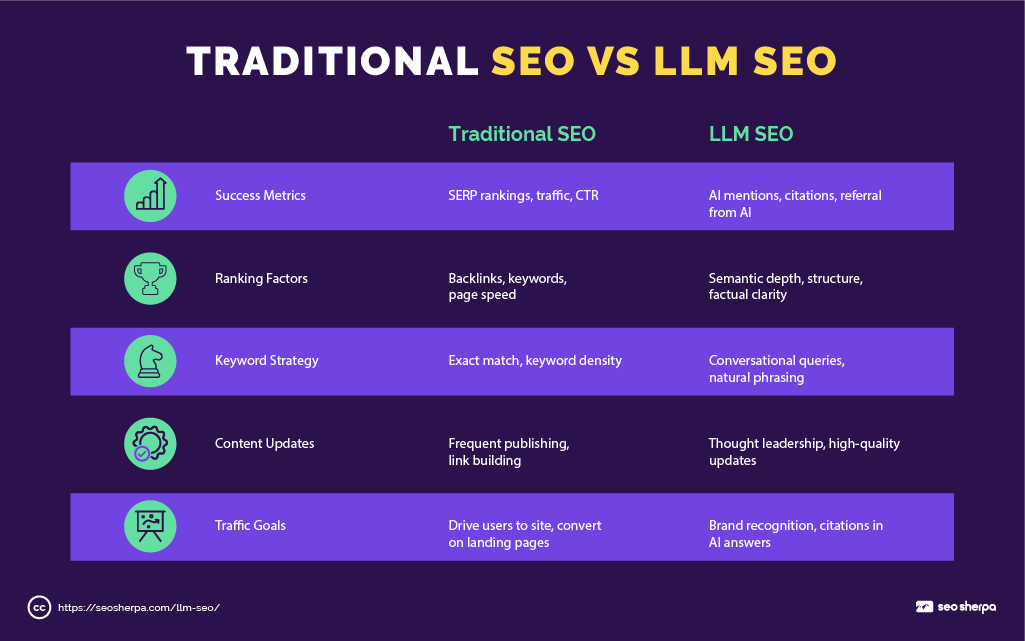
1. Success Metrics
Traditional SEO measures success through SERP rankings, organic traffic sessions, and click-through rates. The core focus is getting users to your website via search engine results.
LLM SEO, on the other hand, prioritizes visibility within AI-generated content. Success is gauged by:
- How frequently your brand is mentioned in AI responses
- Whether your content is cited by AI platforms (e.g., ChatGPT, Gemini, Perplexity)
- Referral traffic from these AI-generated sources
2. Ranking Factors
Traditional SEO rankings are influenced by factors like:
- Backlink authority
- Page speed
- Keyword targeting
- Domain trustworthiness
LLM SEO emphasizes:
- Semantic depth
- Originality and content clarity
- Factual accuracy and structured data
- Authoritativeness as inferred by AI
3. Keyword Strategy
In traditional SEO, keyword strategy relies on tools like Ahrefs or Semrush to identify high-volume phrases. Success hinges on matching exact keywords and optimizing density throughout the page.
LLM SEO shifts toward:
- Natural language queries
- Conversational phrasings
- Semantic relevance over keyword stuffing
Think: “What’s the best way to…” vs. “best TikTok strategy 2025”
4. Content Updates
Traditional SEO often runs on frequency and freshness — frequent content publishing and link-building campaigns help maintain visibility.
LLM SEO rewards:
- Fewer but higher-quality updates
- Fresh, evidence-based insights
- Thought leadership pieces that offer new perspectives or data points AI can trust and cite
5. Traffic Goals
Traditional SEO drives users to your website. The core goal is to generate traffic that converts — through landing pages, blog content, or service pages.
LLM SEO, by contrast, often stops at the answer layer. The traffic goal isn’t just click-through — it’s brand recognition within the AI’s response itself.
You win by being the named expert, the cited source, or the authority quoted in answers.
Why It Matters
While Google Search remains a dominant traffic source, AI Overviews, chat interfaces, and voice assistants change how users discover and consume information. LLM SEO is not about replacing traditional SEO; it’s about expanding your strategy to show up wherever people are searching.
The most resilient approach to modern search?
Combine traditional search techniques with LLM-first publishing practices.
Optimize for both the click and the citation.
Essential LLM SEO Strategies for 2025
LLM SEO success in 2025 boils down to one thing: being the kind of content AI wants to show off.
That means going beyond old-school keyword hacks and stepping into the world of structure, authority, and intent.
The best-performing LLM SEO strategies don’t just look good to Google — they get cited by ChatGPT, Gemini, and Perplexity like you’re the headliner at a digital TED Talk.
So what actually works?
Let’s examine the five tactics that will have AI say your name like Destiny’s Child circa 2001.
Create Comprehensive Topic Clusters
Topic clusters aren’t just an SEO content strategy anymore. They’re how you teach AI that you’re an expert — not just someone with a keyword tool and a dream.
Think of it like building a little neighborhood on the internet.
You’ve got your pillar content — the big, glossy house that introduces the topic — and then all the supporting articles are the friendly neighbors: detailed, useful, and always linking back to the main party.
LLMs love this structure because it helps them map your expertise. And if they trust that you really know a topic? You’re far more likely to land citations in AI answers, not just search results.
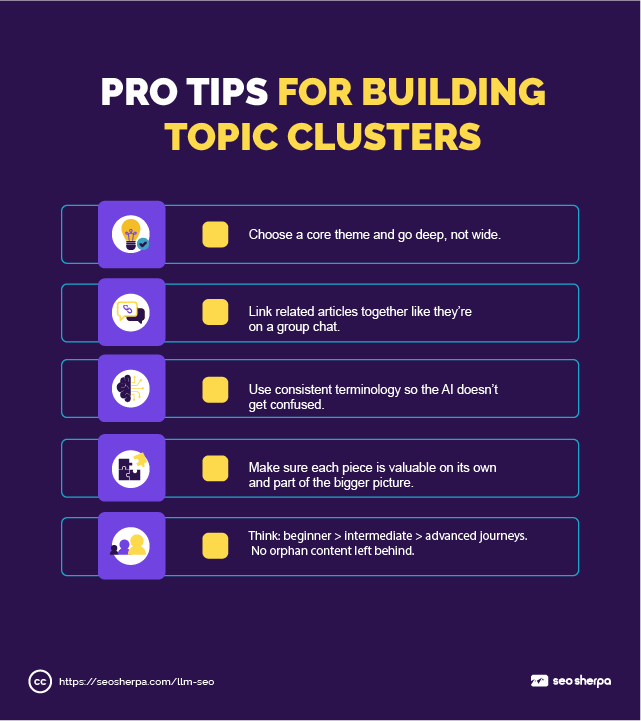
Pro tips for building topic clusters:
- Choose a core theme and go deep, not wide.
- Link related articles together like they’re on a group chat.
- Use consistent terminology so the AI doesn’t get confused.
- Make sure each piece is valuable on its own and part of the bigger picture.
- Think: beginner > intermediate > advanced journeys. No orphan content left behind.
Structure Content for Machine Understanding
Here’s the tea: AI doesn’t skim your blog like a distracted intern. It parses your content like a machine learning linguist with OCD.
That means if your H2s and H3s are messy, your JavaScript is hiding important bits, or your schema markup is nonexistent… you’re basically speaking gibberish.
Use proper structure. Stick to semantic HTML. And for the love of crawlability, serve static content when you can — JavaScript-loaded pages are like putting your article in an escape room.
Pro Tip: The easier you make it for machines to understand your content, the more likely they are to cite it.
Your AI-friendly checklist:
- Use keyword-infused headings that actually make sense.
- Add Schema markup like FAQPage, HowTo, or Product where relevant.
- Keep paragraphs digestible. No 400-word walls of text, please.
- Format using bullet points and numbered lists (like this!).
- Ensure fast loading and serve clean HTML via SSR or static site gen.
Publish Original Data and Evidence-Based Content
If you want AI to name-drop you, give it something worth quoting.
LLMs love original data. Whether it’s a niche survey, internal benchmarks, or an oddly specific case study that only you could create — if it’s unique, AI sees you as a trustworthy source.
That means it’s time to start thinking like a researcher, not a regurgitator.
Pro Tip: Publishing your own data isn’t just good PR — it’s a power move for AI visibility.
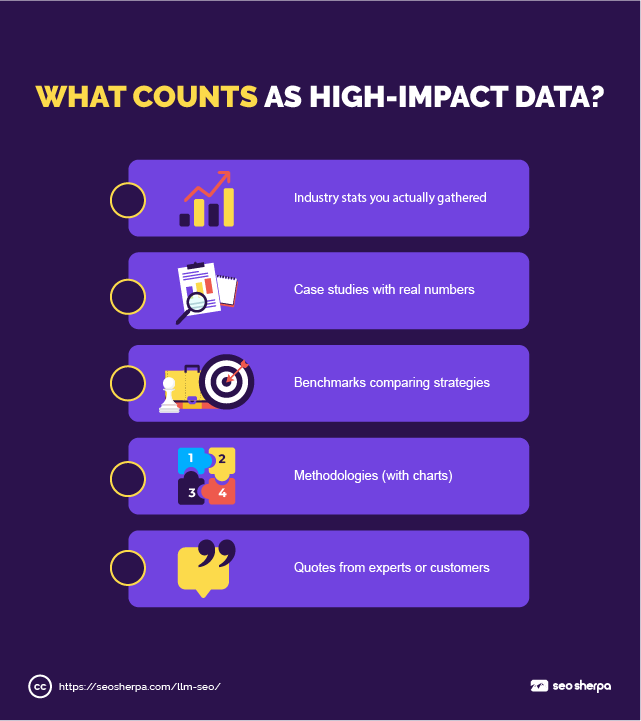
What counts as high-impact data?
- Industry stats you actually gathered, not just “according to Statista”
- Case studies with hard numbers and real outcomes
- Benchmarks comparing methods, platforms, or strategies
- Methodologies that others can reference (with charts, please)
- Quotes from experts or customers that add credibility
Pro Tip: Make it skimmable. Add visuals, clear definitions, and bold takeaways so LLMs can extract and summarize without guessing what you meant.
Optimize for Conversational Keywords
People don’t talk like robots. And now that AI is taking over search, it’s time your content stopped sounding like it was written by one.
Conversational optimization means writing the way people ask:
“How do I improve page speed?” not “page speed optimization SEO best practices.”
It’s less about targeting exact-match keywords and more about matching intent. If someone would say it out loud, write it down.
How to make your content talk back:
- Use headings that literally sound like user questions
- Sprinkle in synonyms and related phrases (don’t repeat, rephrase)
- Anticipate follow-ups and include those answers
- Explain the why, how, and what — not just the what
- Write like you’re helping a real person… because you are

And yes, this also makes your content easier for LLMs to parse and cite.
It’s the content equivalent of showing up to a job interview in a great outfit and knowing the recruiter’s favorite coffee order.
Build Authentic Citations and Brand Mentions
Want AI to trust you? Make sure the internet does, too.
LLMs are trained on community-driven platforms like Reddit, GitHub, Hacker News, and Twitter/X. That means your brand mentions on those platforms aren’t just social signals — they’re part of the model’s memory.
So how do you show up in those places without looking like you’re just there for the SEO juice?
Pro Tip: You show up with value. You participate. You act like a human, not a bot.
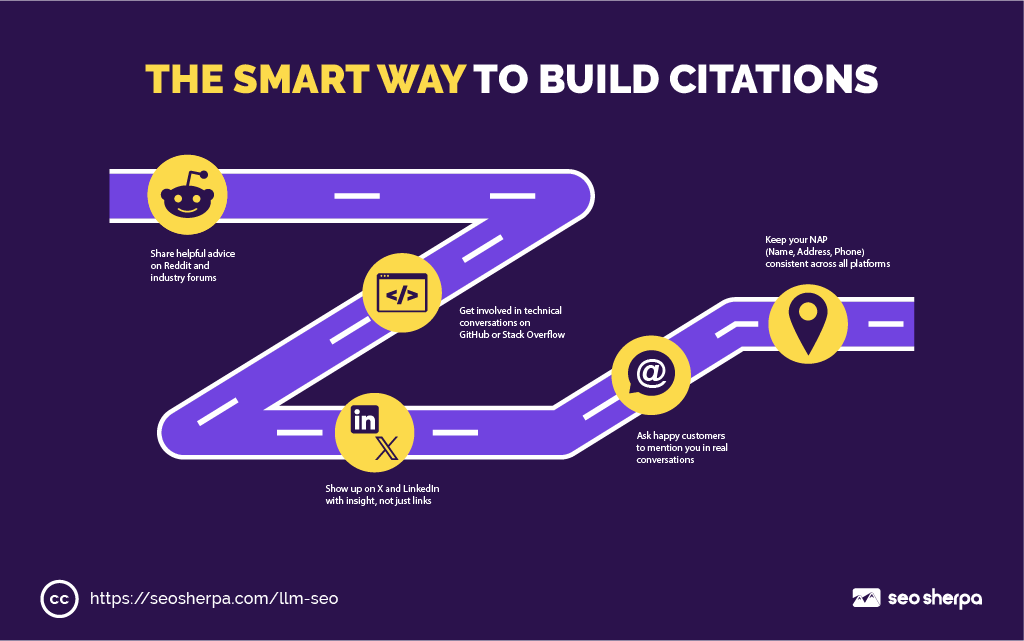
The smart way to build citations:
- Share helpful advice on Reddit and industry forums
- Get involved in technical conversations on GitHub or Stack Overflow
- Show up on X and LinkedIn with insight, not just links
- Ask happy customers to mention you in real conversations
- Keep your NAP (Name, Address, Phone) consistent across all platforms
Advanced LLM SEO Techniques
Ready to graduate from LLM SEO basics to the big leagues?
These advanced tactics aren’t for the faint of heart — but they are for anyone who wants to go from “maybe mentioned” to “AI-cited authority.”
They’re more technical, a bit nerdier, and incredibly powerful for brands that want to win visibility in a generative search world.
Let’s get into it.
Implement Entity-Based Optimization
If traditional SEO is about what you say, entity-based optimization is about who you are — and what the internet says about you when you’re not in the room.
LLMs don’t just look for keywords. They look for entities — people, places, companies, products, ideas — and how they’re connected. If your brand isn’t being recognized as an entity in your niche, you’re basically invisible to the AI.
Think of it like building your digital reputation with receipts.
The goal? Make sure AI systems associate your name with the concepts you want to own.
If you’re a CRM platform, you don’t just want to rank for “CRM software” — you want models to link your brand to “sales automation,” “lead scoring,” and “customer lifecycle management” as naturally as peanut butter and jam.
How to build entity authority:
- Create a killer About page that actually defines your expertise (not just fluff)
- Use consistent terminology across content to build clear connections
- Get mentioned in relevant industry publications and data sources
- Add structured data (yes, again) to reinforce entity relationships
- Write content that clearly answers questions about your core expertise areas

And don’t forget: Google’s Knowledge Graph plays a big role here. If you’re listed there? Congrats, you’re officially in the AI’s VIP section.
Leverage User-Generated Content
AI trusts people more than it trusts marketers. Shocking, I know.
But it makes sense. User-generated content (UGC) is considered authentic third-party validation, and LLMs eat that stuff up.
Platforms like Reddit, GitHub, and Quora are training data goldmines, so if your brand is being talked about there — genuinely — you’re gaining serious ground in AI results.
TL;DR: If other people are talking about you, AI pays attention.
This doesn’t mean spinning up a hundred fake Reddit accounts and astroturfing the thread. AI systems are getting (and will continue to get) better at detecting manipulation. The key is fostering real communities and encouraging honest conversations.
Ways to spark real UGC that LLMs will love:
- Start or join niche Discord/Slack groups and offer real value
- Encourage customers to leave honest reviews in relevant spaces
- Get involved in Reddit conversations (no links, just help)
- Share your takes in professional forums (think Indie Hackers, dev boards, etc.)
- Create “question-friendly” content that sparks replies and discussion

Reddit, in particular, is chef’s kiss for this. If someone posts about your brand in a helpful thread and it’s upvoted? That’s practically a love letter to LLMs.
Experiment with LLMs.txt Protocol
LLMs.txt is an early-stage, AI-specific roadmap for your site. Think of it like a VIP tour guide for language models. It’s experimental, but adding one won’t hurt your rankings — and it could pay off as AI search evolves.
What Is LLMs.txt?
- A plaintext (Markdown‑style) file stored in your site’s root.
- Its purpose? Highlight your most valuable, AI‑ready content. No navigation menus or fluff.
- It’s not about blocking crawlers like robots.txt; it’s about guiding AI to the most significant information about your website.
As Search Engine Land put it, LLMs.txt is “a treasure map for AI crawlers,” helping models skip the clutter and go straight to your gold.
But Google Says… Proceed with Caution
John Mueller at Google put it bluntly:
“AFAIK none of the AI services have said they’re using LLMs.txt… it’s comparable to the keywords meta tag — this is what a site‑owner claims their site is about… why not just check the site directly?”
Despite John’s statement, there are cases of OpenAI requesting LLMs.TXT files as often as every few minutes, so it is definitely worth including.
Why It’s Worth Adding
- Crawling heavy-weight JS and CSS is expensive for LLM crawlers, so they avoid those pages on your site. This is where LLMs.TXT helps you specify canonical pages, update signals, or preferred citation formats to AI systems.
- Yoast, for instance, now auto-generates LLMs.txt with one click to guide AI toward your most important content.
- Search Engine Land highlights that, unlike robots.txt, it’s a curated menu that says, “Here’s where the real content is” — so LLMs don’t wander aimlessly.
Early adopters include WordPress plugins, Yoast, and thousands of sites, though AI usage remains unverified.
The “Don’t Let It Distract You” Warning
- John Mueller warns against treating LLMs.txt like a magic SEO hack — it shouldn’t replace solid tech SEO or schema.
- Don’t spam it or game it. Cloaky tactics could backfire — AI may ignore or penalize it
- If your core site structure is clean (HTML, sitemap, internal links, schema), you’ve already done the heavy lifting.
So, Should You Add It?
Yes — but treat it like a “nice-to-have” roadmap, not a breadcrumb trail to instant visibility.
- It does no harm.
- It signals to AI, “Here’s quality — start here.”
- And yes, early adopters might gain first-mover perks as the standard develops.
Better safe than sorry, right?
How to Implement LLMs.TXT
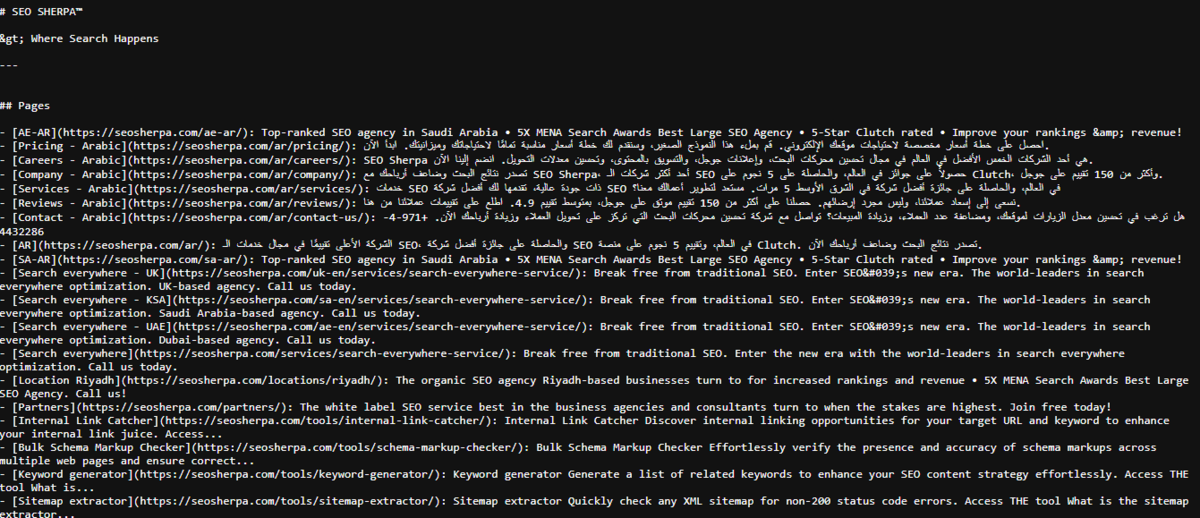
At its core, LLMs.TXT is just a type of Markdown file. Here is an example of the LLMs.TXT file on our site:
Steps to launch:
- Create a Markdown file like the one above, if you’re not sure how, use an LLMs.TXT generator tool.
- Group important content under ## headers.
- Host it at https://yourdomain.com/llms.txt.
- Keep it current — update it when you launch new cornerstone content.

Digital PR and Online Reputation in the Age of LLMs
In the age of AI-driven search, digital PR isn’t just a nice-to-have, it’s survival. If you’re not managing how large language models perceive and represent your brand, you’re basically letting a robot freestyle your reputation.
I’ve seen it happen.
Last month alone, three different brands showed up in AI summaries with outdated info, random claims, or completely wrong messaging — all because they hadn’t optimized for how LLMs gather and interpret data.
If AI is the new first impression, online reputation management just became mission-critical.
Your Brand Story Is Being Told… With or Without You
Language models like ChatGPT and Perplexity are shaping what people see before they ever reach your website. In some cases, they are the destination.
If those systems can’t easily find consistent, trustworthy, structured information about your brand, they’ll fill in the blanks — and let’s just say they’re not always Pulitzer material.
That means LLM SEO and digital PR now go hand in hand.
You’re no longer just trying to rank. You’re trying to train the machines on who you are, what you do, and why they should trust you.
What Modern Digital PR Actually Looks Like
Over the past year, my team’s been testing a dual approach: one foot in traditional SEO, the other firmly planted in LLM territory.

The brands that get it right follow the same playbook:
- They publish contextually rich, original content. No fluff, no AI sludge. Just smart, well-structured pieces that reflect real expertise.
- They maintain accurate, up-to-date info across every platform. Google Business Profile, LinkedIn, Twitter/X, Crunchbase, and anywhere else AI might sniff around.
- They use structured data to spell things out clearly. Because if AI has to guess, it probably won’t guess right.
And here’s the big one:
Brands that nail these basics don’t just show up more often in AI answers; they get framed better. With authority. With context. With credibility.
Leveraging AI Platforms and Tools for LLM SEO
If you want to rank in the age of language models, you need to think like one — and that means using AI tools built for LLM SEO.
This isn’t about stuffing in keywords or chasing backlinks anymore. It’s about aligning your content with how AI actually reads, retrieves, and ranks it.
Welcome to the era of Generative Engine Optimization (GEO) — and yes, it’s a thing.
A very real, very powerful thing.
And those who know how to leverage AI tools properly? They’re eating everyone else’s lunch.
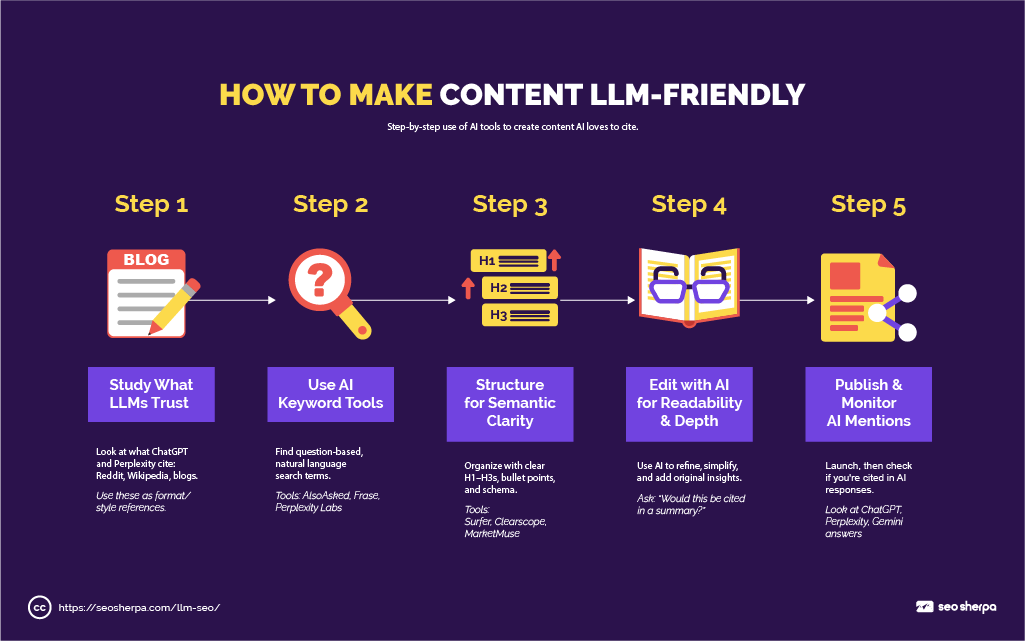
Start With the Training Data
LLMs are trained on specific types of content — think: Reddit discussions, Wikipedia pages, government sites, technical documentation, high-quality blog posts, and well-structured product pages. If you want them to trust you, you have to look like the content they were raised on.
That means:
- Clean structure
- Original insights
- Proper formatting
- Zero fluff
Pro Tip? Spend some time analyzing the kinds of sources being cited in ChatGPT, Perplexity, and other AI platforms. You’ll notice patterns — and those patterns are gold.
Use AI Tools for the Right Kind of Keyword Research
Old-school keyword tools? Still useful. But now you need AI-powered tools that understand conversational search.
Real users aren’t typing “content strategy 2025.”
They’re asking: “How do I build a content strategy that works in the AI era?”
Modern tools can help you:
- Identify question-based queries
- Surface long-tail, natural language terms
- Prioritize semantic relationships over strict keyword matches
And when you start writing with that kind of intent?
LLMs take notice.
Improve Content Depth and Structure with AI
This is where things get juicy. The right tools can:
- Analyze your content’s actual meaning (not just keywords)
- Suggest places to improve clarity, hierarchy, or semantic markup
- Highlight where you’ve missed opportunities to add schema
- Flag content that sounds generic, repetitive, or LLM-unfriendly
Think of them as your robot editors — harsh but honest.
Trust the Process — Because It Works
I’ve helped brands go from invisible to AI front-and-center using this exact approach. We’re not talking vanity metrics. We’re talking citations in AI Overviews. Mentions in Perplexity. Direct callouts from ChatGPT.
And the common denominator?
They leveraged the right tools to make their content irresistible to both humans and machines.
Understanding Click Searches and User Behavior in AI-Powered Search
Traditional search behavior is out. Instant answers are in. If you’re still optimizing for “click-through rates” alone, you’ve missed the memo — and probably most of the traffic.
AI-powered search is fundamentally changing how people find and engage with content.
No more scrolling through 10 blue links and deciding which headline feels the least scammy. Now users type (or speak) full questions and get instant, AI-generated answers often without clicking a single thing.
Welcome to the age of the zero-click search.
Your Content Needs to Think Like a User and an AI
Winning visibility today means anticipating how people actually ask questions — and how machines interpret them. You need to:
- Mirror natural language in your headings and structure
- Answer the entire question clearly and concisely
- Provide layered depth that makes AI say, “Yes, this is answer-worthy”
Here’s the thing:
If your content doesn’t match the question, isn’t detailed enough, or is just a rehash of what’s already out there… the AI’s gonna skip right over you.
This is where conversational SEO meets reference-quality formatting. Think Wikipedia depth with Reddit tone. Or, you know — your usual content, just supercharged.
Generative Engine Optimization (GEO) and Location-Based Search Strategies
Yes, local search is still alive and thriving — but it’s happening inside AI platforms now. And if you’re not showing up when someone asks, “What’s the best [thing] near me?” you’re losing real business, in real time.
Generative Engine Optimization (GEO) is how you get discovered in LLM-driven, location-aware queries. Think:
- “Best web designer in Austin”
- “Top-rated yoga studios near me”
- “Affordable family lawyer in Birmingham”
And guess what?
Most of your competitors aren’t even thinking about this yet.
How to Show Up in Local AI Search
If you want language models to recommend you, you need to:
- Include geo-specific language in your copy, FAQs, and schema
- Keep NAP info (Name, Address, Phone) consistent across every listing
- Optimize your Google Business Profile, social bios, and About pages
- Use structured data like LocalBusiness, Service, and Review schema
- Publish content that addresses local intent questions
I’ve seen brands dominate their city by simply publishing blog posts that answer questions like, “What to expect from a first acupuncture appointment in Phoenix.”
The bar is low. The opportunity? Massive.
Maintaining and Refreshing LLM-Optimized Content
Content decay doesn’t just hurt rankings — it makes AI forget you exist. LLMs continuously refresh their internal understanding of the web using snapshots and real-time data retrieval. So if your content hasn’t been updated in six months… well, that’s ancient history in AI years.
But unlike traditional SEO (where changes can spike or tank rankings overnight), LLM visibility works on slower cycles. Updates might take weeks — or longer — to be fully reflected in how AI references your content.
Your Maintenance Routine: Think Quarterly, Not Constantly
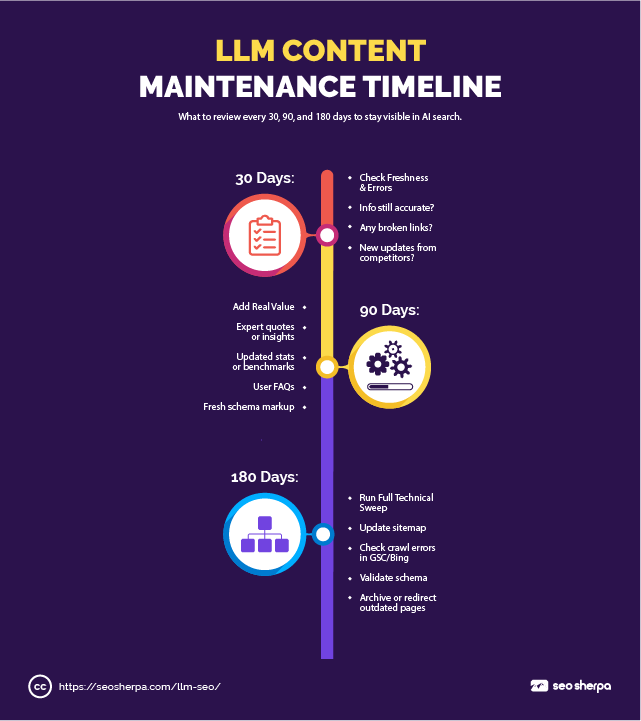
Set up content reviews at 30-, 90-, and 180-day intervals. At each checkpoint, ask:
- Is the info still accurate?
- Are any links broken?
- Have competitors published something better?
But don’t fall into the “update for the sake of updating” trap.
LLMs care about value, not just recency.
Instead of tweaking a stat just to say it’s fresh, focus on adding:
- New expert quotes
- Updated benchmarks or original data
- FAQs pulled from real user questions
- Fresh schema that reflects expanded content
Don’t Forget the Technical Side
Maintaining AI visibility means maintaining crawlability. You’ll want to:
- Keep your XML sitemaps updated
- Monitor crawl errors via GSC and tools like Bing Webmaster Tools
- Ensure your structured data is current and error-free
- Archive old pages properly (redirect or 410, don’t leave them hanging)
Also, different LLMs have different crawling behaviors. Some rely on real-time access (Perplexity), while others pull from index snapshots (Gemini, ChatGPT). That means full visibility requires regular updates and broad platform awareness.
Tracking and Measuring LLM SEO Performance
LLM SEO isn’t just about creating optimized content — it’s about proving that content is discoverable and influential in AI-driven search. That requires tracking beyond traditional KPIs.
In a world where clicks aren’t always part of the journey, success is measured in visibility, citations, and recognition by language models.
If you’re only watching your Google rankings, you’re missing where the real action is happening.
What LLM SEO Success Looks Like
To track performance effectively, you need to monitor signals that reflect both direct and indirect visibility within LLM ecosystems. These include:
- Referral traffic from AI platforms (e.g., ChatGPT, Perplexity, Claude, Gemini)
- Brand mentions in AI-generated responses or overviews
- Citation frequency in answer engines
- Organic search performance for conversational, long-tail keywords
- Indexing and crawl status across AI-accessible platforms
LLMs don’t always drive traffic the same way traditional search engines do. Sometimes, your brand is referenced in an answer but doesn’t get the click. That doesn’t mean the content didn’t work — it means your reputation preceded the visit.
How to Track LLM Traffic in GA4
While GA4 doesn’t yet offer built-in filters for AI platforms, you can surface this data using custom exploration reports.
Here’s how to do it:
Step 1: Create a Custom Exploration Report
- In GA4, go to Explore
- Select Blank to start a new report
- Name it “LLM Referral Traffic” or similar

Step 2: Add Dimensions
- Session source / medium
- Landing page
- Session campaign (optional)

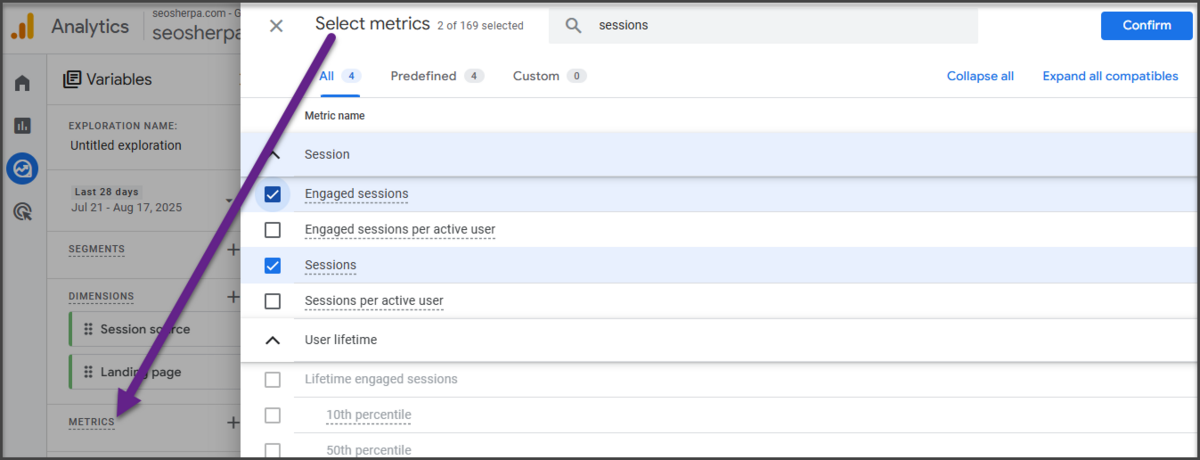
Step 3: Add Metrics
- Sessions
- Engaged sessions
- Average engagement time
- Conversions (if configured)
Step 4: Filter by Known AI Referrers
Filter your report to include sources like:
- chat.openai.com (ChatGPT)
- perplexity.ai
- gemini.google.com
- claude.ai or other emerging platforms

This setup allows you to monitor when users arrive at your site after being served your content in an AI response — even if it’s just one or two visits at a time.
Over time, patterns emerge, and you’ll start identifying the specific content that LLMs trust enough to surface.
Monitor Brand Mentions and Citations
Some of the most valuable LLM SEO signals don’t involve visits at all. Instead, you’re aiming to be cited, referenced, or summarized in AI-generated content.
To track these signals, use tools like:
- Ahrefs Alerts – to monitor mentions of your brand or content titles across the web
- Semrush Brand Monitoring – to track sentiment and context alongside citations
- Perplexity Pro or custom GPTs – to test how often your brand shows up when asking relevant questions
This kind of monitoring gives you insight into how AI perceives your brand — and whether you’re seen as a reliable source.
Track AI Crawling and Indexing Behavior
Visibility in LLMs also depends on your content being accessible.
Regularly monitor:
- Google Search Console – for crawl stats, index status, and structured data errors
- Bing Webmaster Tools – especially important given Microsoft’s role in AI search
- Log file analysis – to identify AI crawler activity beyond standard bots
Different platforms have different access models. Perplexity uses real-time retrieval. ChatGPT relies on Bing data and its internal index. If your content isn’t visible to these systems, you’re not part of the conversation.
Keep an Eye on the Competition
It’s not enough to monitor your own presence — you also need to see how your competitors are performing in AI responses.
Build a simple AI citation tracker:
- Choose 5–10 high-value questions your audience is likely to ask
- Run them through ChatGPT, Perplexity, and Gemini
- Note whose content gets cited, referenced, or linked
- Update weekly or monthly to spot trends
If your competitors are showing up and you’re not, you’ve found a gap to close.
Continuous Tracking, Iteration, and Adaptation
LLM search evolves fast. Citation logic changes. Answer formats shift. New AI tools emerge.
Your measurement strategy should reflect that agility.
Establish a monthly review process that includes:
- GA4 report analysis
- Brand mention snapshots
- Citation checks across multiple LLMs
- Crawl/indexing diagnostics
- Content performance for long-tail and question-style queries
This isn’t a one-and-done process. It’s a living system that adapts as AI platforms continue to shape how users discover and trust information.
Common Mistakes in LLM SEO and How to Avoid Them
LLM SEO isn’t a replacement for traditional SEO — it’s an evolution of it. But far too many businesses make the mistake of treating it like a shiny new toy instead of part of an integrated strategy.
I’ve seen brands absolutely tank their visibility by chasing AI visibility while forgetting the basics that still power discovery — like crawlability, keyword intent, and link equity. On the flip side, I’ve seen SEOs ignore LLMs completely and wonder why their traffic is slowly bleeding out.
Here are the most common LLM SEO missteps — and how to avoid them.

Ignoring Traditional SEO Fundamentals
It might be tempting to focus entirely on getting mentioned by AI tools, but if your technical SEO is broken, none of it will matter.
If Google can’t crawl your content, Perplexity isn’t going to cite it. If your schema is misconfigured, ChatGPT won’t understand what your content is. Structured, crawlable, fast-loading pages are still table stakes.
Avoid this by:
- Ensuring all technical SEO basics are in place
- Using structured data consistently across all major pages
- Maintaining a clear internal linking structure and sitemap
Traditional SEO is the foundation that LLMs still rely on — don’t ditch it in a rush to be futuristic.
Failing to Optimize for Natural Language Queries
LLMs process content differently than traditional search engines. They’re trained to understand how people talk — not how SEOs write.
If your content is still stuck in keyword-stuffing territory or written like a whitepaper from 2004, it’s not going to show up in a conversational AI response.
Avoid this by:
- Using natural language headings, like real questions
- Including full-sentence answers immediately after the query
- Covering the “what,” “how,” and “why” behind the topic — not just the “what”
If you want to be the answer, write like someone is actually asking the question.
Sitting on Structured Data — and Not Using It
Here’s the heartbreaking part: A lot of brands already have the kind of structured, reference-ready content that LLMs love… they just haven’t marked it up.
Whether it’s product catalogs, FAQs, or author bios, this is high-value data that, when formatted correctly, makes it 10x easier for AI to interpret and cite your content.
Avoid this by:
- Implementing the right schema (FAQPage, Product, HowTo, LocalBusiness, etc.)
- Ensuring markup is error-free using tools like Schema Validator
- Updating schema regularly to reflect new content or page changes
Think of structured data as a flashlight in the dark — you’re helping the AI find what matters most.
The Future of LLM SEO: Trends and Predictions
By 2026, experts estimate that 10–15% of all search queries will shift to generative AI interfaces. That’s not just a trend — it’s a full-blown behavioral shift that changes how, where, and why people search.
This transformation won’t replace traditional search overnight. Instead, we’re headed toward a hybrid landscape — where Google Search, Google AI Overviews, Perplexity, Gemini, and other platforms blend traditional rankings with AI-generated answers.
If you’re not optimizing for both, you’re leaving visibility on the table.
Key Trends to Watch
- Factual accuracy and verifiability will become top ranking signals. AI platforms will prioritize content that cites sources, includes evidence, and avoids hallucinations.
- Topic depth will outweigh surface-level coverage. Pages that offer layered insights across subtopics will win citations and user trust.
- Natural language formatting will continue rising in importance. Think Q&A, guides written like conversations, and headings that reflect how users ask.
- User-generated content and authentic brand mentions in forums, Reddit threads, and reviews will carry more weight than ever.
- Structured data standards will evolve. Expect new schema types or AI-specific protocols (like LLMs.txt) to be increasingly adopted.
Prepare for a Quality-First, Context-Aware Future
Language models are already developing more sophisticated ways to evaluate content quality. That means:
- Detecting originality
- Verifying expert authorship
- Rewarding consistency across channels
The brands that will thrive? They’ll be the ones who prioritize content integrity and understand how to communicate with both people and machines.
This Isn’t SEO vs AI — It’s SEO with AI
LLM SEO doesn’t replace what we know. It builds on it and becomes its own silo. Just like you can specialize in link building, or technical SEO, LLM specific SEO can (and most likely will) become its own specialism.
You don’t have to throw out everything that’s worked — you just have to evolve.
The brands that blend traditional SEO fundamentals with forward-thinking LLM strategies will be the ones still standing five years from now — visible, trusted, and impossible to ignore.
Because search isn’t dead.
It’s just growing up.

Ready to Optimize for the Future of Search?
If you’re still optimizing just for Google, you’re missing where the real discovery is happening.
LLM SEO isn’t just the next frontier — it’s already here.
Whether you’re looking to get cited by AI platforms, surface in zero-click responses, or future-proof your content strategy across ChatGPT, Gemini, Perplexity, and beyond, Sherpa can help.

Book a free discovery call today and let us show you how to build a content system that ranks and gets referenced — everywhere.





















Leave a Reply