

Summarize This Article With AI
 Try with ChatGPT
 Try with Claude
 Try with AI Mode
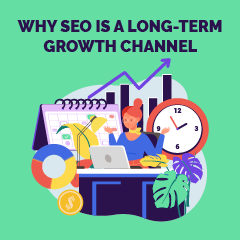
SEO has a bit of a PR problem.
Everyone wants it. No one wants to wait for it.
In a world of paid ads, instant traffic, and dashboards that update in real time, search engine optimization can feel… slow, like planting a tree when you could just buy fruit at the store.
But here’s the part most businesses miss.
That tree? It keeps producing.
While ads stop the second your ad spend does, SEO keeps working quietly in the background — bringing in organic traffic, building brand authority, and lowering your customer acquisition costs over time.
In fact, SEO functions a lot like compound interest. The effort you invest today — content, technical optimization, backlinks — accumulates and builds momentum, creating exponential growth later.
And once you understand that, SEO stops feeling slow.
It starts feeling inevitable.
Article Summary
- SEO is a long-term growth channel that compounds over time, unlike short-term tactics like paid advertising.
- It builds sustainable organic traffic and continues delivering results long after the initial investment.
- SEO strengthens brand authority, making users more likely to trust and click your site in search results.
- High-quality content and backlinks accumulate, making it harder for competitors to outrank you over time.
- SEO supports the full funnel — from awareness to conversion — driving consistent, high-intent traffic.
- The longer you invest in SEO, the lower your acquisition costs and the higher your long-term ROI.
Real Growth Isn’t Instant, and That’s the Point
SEO is a long-term growth channel because it’s designed to build something that lasts.
Which sounds obvious until you realize how much of marketing today is built to do the exact opposite.
Most channels are obsessed with immediacy. Launch the campaign, turn on the ads, refresh the dashboard, watch the numbers move. It’s fast, it’s measurable, and it’s incredibly addictive. You get used to the idea that growth should feel instant, visible, and a little bit dramatic.
SEO doesn’t play that game.
And that’s usually where the frustration starts.
There’s a moment almost every business goes through.
You invest in SEO. You publish content, fix technical issues, maybe build a few links. Then a few weeks go by, maybe even a couple of months, and nothing dramatic happens. No sudden spike in traffic, no overnight jump to the first page, no celebratory Slack message.
So naturally, someone asks the question.
“Is this working?”
It’s a fair question. It’s also the wrong one.
Because SEO isn’t built to give you immediate feedback. It’s built to create long-term momentum.
Short-Term Campaigns vs Sustainable Growth
Paid advertising is simple.
You pay, you appear, you get traffic. The relationship is direct, predictable, and very easy to explain in a meeting.
It’s also temporary.
The moment your ad spend stops, your visibility disappears. The clicks dry up, the traffic drops, and you’re right back where you started. It’s effective, but it’s rented attention. You’re borrowing visibility from the platform, not building anything you actually own.
SEO works differently.
Instead of paying for placement, you’re earning it. You’re building organic visibility by creating content that matches user intent, improving your site so search engines can understand it, and developing authority over time. It takes longer, but the result is something far more durable.
Once a page ranks, it doesn’t just deliver traffic once.
It keeps showing up.
And over time, that turns into long-term traffic that doesn’t require constant reinvestment to maintain.
SEO Is Infrastructure, Not a Tactic
One of the biggest mistakes businesses make is treating SEO like a campaign.
Something you switch on, run for a few months, and then evaluate like a paid channel.
That mindset almost guarantees disappointment.
SEO isn’t a campaign. It’s infrastructure. It’s the underlying system that determines whether your website can consistently show up in search results, attract the right users, and convert them into customers.
It lives in your site structure, your technical performance, your content strategy, your internal links, your backlink profile. It touches everything.
Which means it doesn’t behave like a one-time task.
It behaves like something that improves over time, layer by layer.
Every piece of content you publish, every technical improvement you make, every link you earn adds to the system. And those improvements don’t reset at the end of the month like a paid campaign.
They stack.
That’s why SEO creates a framework where your marketing efforts compound, rather than restart from zero each time.
Compounding Beats Quick Wins
Here’s the part that usually clicks for people.
SEO feels slow at the beginning because nothing is compounding yet.
You’re laying the groundwork. Building pages that haven’t ranked yet, earning links that haven’t fully moved the needle, improving a site that search engines are still learning to trust. It can feel like a lot of effort for very little visible return.
Then something shifts.
Pages start ranking. Not just for one keyword, but for dozens of related search terms. Traffic begins to grow, not in spikes, but in steady increments. You publish new content, and it performs faster than the last piece. You update old pages, and they climb again.
Momentum builds.
And once it does, it becomes very hard to stop.
Because each piece of work is no longer operating in isolation. It’s reinforcing everything else. Your domain authority grows, your content gets discovered faster, your organic results become more stable.
That’s when SEO stops feeling slow.
And starts feeling like the most predictable growth channel you have.
SEO Builds Brand Equity Over Time
SEO doesn’t just bring you traffic.
It changes how people perceive your brand before they even click.
And that’s the part most businesses underestimate.
There’s a subtle shift that happens when your site starts showing up consistently in search results.
At first, you’re just another result on the page. Maybe someone clicks, maybe they don’t. You’re competing with everyone else, trying to earn attention.
But over time, something different starts to happen.
People begin to recognize you.
They see your name again. And again. Across different search terms, different pages, different stages of their journey. You’re not just present, you’re familiar.
And familiarity builds trust faster than most marketing tactics ever could.
Authority Accumulates
Authority in SEO isn’t something you switch on.
It’s something you earn slowly, and then benefit from for a long time.
Search engines are constantly trying to figure out which sites they can trust. Not just which pages are relevant, but which brands consistently deliver high-quality content, demonstrate expertise, and deserve to rank.
That trust is built through signals.
Your content quality. Your backlinks. Mentions across the web. How users engage with your site. How consistently you show up for relevant topics.
Individually, these signals don’t feel dramatic.
But together, over time, they compound.
The more you invest in SEO, the more your site’s authority grows. And the stronger that authority becomes, the easier it is to rank new content, maintain positions, and expand your organic visibility.
It’s a bit like reputation in real life.
No one trusts you after one good impression. But show up consistently, deliver value, and eventually, people stop questioning whether you belong there.
Search engines work the same way.
There’s also a psychological layer to this.
When users repeatedly see a brand ranking near the top of Google search results, they start to associate that brand with expertise, whether consciously or not.
You become the answer.
Not because you told them you are, but because Google keeps reinforcing it.
Evergreen Content Keeps Paying Off
Here’s where SEO starts to feel slightly unfair in the best possible way.
Most marketing efforts have an expiration date.
A paid campaign ends. A social post disappears into the feed. Even a strong PR push fades after a few days or weeks.
SEO content doesn’t.
A well-optimized page can continue generating organic traffic for months or even years after it’s published.
And not just any traffic.
High-intent traffic. People actively searching for solutions, answers, products. People who already have a need and are looking for someone to meet it.
Think about that for a second.
You write a single blog post today. It takes time, effort, maybe a bit of technical optimization. At first, it does very little.
Then it starts ranking.
Then it starts attracting links.
Then it starts bringing in consistent traffic.
Then it becomes a reliable source of leads.
And it just… keeps going.
The real advantage is that these assets are not static.
You can update them, improve them, expand them, align them with changing user intent. Each update strengthens the page further, allowing it to maintain or improve its position in search.
Over time, your site becomes a collection of these assets.
Pages that don’t just exist, but actively contribute to growth. Pages that continue working long after the initial effort is done.
That’s when SEO shifts from being “content marketing” to being something much more powerful.
A system that builds long-term visibility, reinforces brand authority, and continuously attracts potential customers without needing constant reinvestment.
SEO Is a Flywheel, Not a Light Switch
SEO is not something you turn on and suddenly everything works.
It’s something you push.
And at the beginning, it feels like pushing a fridge across a carpet.
There’s this expectation that once you “do SEO,” results should follow quickly.
You fix some technical SEO issues, publish a few pages, maybe build some links, and then… nothing dramatic happens. Traffic barely moves. Rankings inch up if you’re lucky. Internally, it feels like a lot of effort for not a lot of reward.
This is the part where most businesses quietly panic.
Or worse, stop.
Because it doesn’t feel like progress.
It feels like resistance.
But here’s what’s actually happening.
You’re building a flywheel.
At first, every push feels pointless. You lean into it, give it a shove, and it moves maybe half an inch. You push again. Another inch. Still heavy. Still slow. Still deeply unimpressive.
If SEO had a soundtrack at this stage, it would just be someone sighing.
Slow at First, Exponential Later
Then something changes.
Not dramatically. Not in a big “we’ve made it” moment. Just subtly.
The wheel starts to move a little more easily.
You publish a page, and it ranks faster than the last one. Your search visibility improves, and suddenly you’re showing up for more than just your primary target keywords. You start picking up long-tail queries you didn’t even plan for.
Traffic grows, but more importantly, it becomes consistent.
Then leads start coming in. Then links. Then more pages rank. Then those pages support each other through internal links, strengthening your overall site’s authority.
And now you’re not pushing as hard.
Because the system is starting to move on its own.
This is the compounding effect people talk about, but rarely explain properly.
Your early SEO efforts don’t disappear.
They stack.
Every piece of optimized content, every link, every improvement in technical performance adds weight to the flywheel. And the heavier it gets, the more momentum it carries.
That’s when growth stops being linear.
And starts becoming exponential.
There’s also a moment where SEO flips from feeling like work to feeling like leverage.
You update an old page, and it jumps in rankings. You publish something new, and it gains traction quickly because your site already has authority. You’re no longer trying to convince Google you belong.
Google already expects you to show up.
Long-Tail Gains Multiply
Here’s where things get quietly ridiculous.
Most businesses start SEO by thinking about a handful of keywords.
The obvious ones. The competitive ones. The ones everyone wants.
But SEO doesn’t reward narrow thinking.
It rewards depth.
When your content starts ranking, it rarely ranks for just one term.
It ranks for dozens.
Then hundreds.
Then thousands.
Different variations, related queries, long-tail searches, questions you didn’t explicitly target but still answer.
That’s how organic search really scales.
Not by winning one big keyword, but by accumulating visibility across an entire topic.
And search engines love this.
Because from their perspective, a site that covers a topic comprehensively is far more useful than one that only scratches the surface. Depth signals relevance. Breadth signals authority.
So the more content you create around a topic, the easier it becomes to rank for related searches.
Which brings us back to the flywheel.
More content leads to more visibility. More visibility leads to more traffic. More traffic leads to more engagement, more links, more signals that your site deserves to rank.
And the cycle continues.
It’s also worth noting that this effect is no longer limited to Google.
With the rise of AI-driven search, content that demonstrates depth and relevance is more likely to be surfaced in AI-generated answers, summaries, and recommendations.
Which means the same flywheel applies.
Just across more surfaces.
Side Note: The biggest misconception about SEO is that it’s slow. It’s not. It’s just front-loaded with effort. Once momentum kicks in, it’s often the fastest way to scale organic traffic without scaling costs at the same rate.
Search Everywhere Optimization = Long-Term, Omnichannel Growth
SEO used to be simple.
You optimized for Google. You ranked in Google. You got traffic from Google. Everyone was happy, and no one asked too many questions.
That version of SEO is… not exactly gone.
But it’s definitely not enough anymore.
Here’s the uncomfortable truth.
If your entire growth strategy depends on one platform, you don’t have a strategy.
You have a dependency.
And dependencies are great right up until the day they’re not.
Search behavior has changed.
People still use Google, of course. But they also search on TikTok when they want recommendations, YouTube when they want explanations, Reddit when they want honesty, LinkedIn when they want credibility, and increasingly, AI tools when they want a straight answer without clicking anything.
Which means your search visibility no longer lives in one place.
It’s scattered.
And the brands that win are the ones that show up everywhere their audience is already looking.
That’s what we mean by Search Everywhere Optimization™.
It’s not about abandoning search engine optimization.
It’s about expanding it.
Your content strategy still matters. Your technical SEO still matters. Your ability to understand user intent still matters.
But now, the goal isn’t just to rank in Google search results.
It’s to be visible across every platform where search happens.
Because here’s what’s actually happening behind the scenes.
The same content you create for SEO doesn’t just sit on your website anymore. It feeds everything else.
A well-optimized article becomes a YouTube video. That video gets repurposed into short-form content. That content gets shared on social media. It gets referenced in forums. It gets picked up in AI-generated answers.
Suddenly, one piece of work is doing the job of five different channels.
And none of it disappears when you stop paying for it.

Owned Assets, Not Rented Attention
This is where SEO quietly becomes one of the most valuable parts of your entire marketing strategy.
Because SEO builds things you actually own.
Your website. Your content. Your pages. Your rankings. Your presence in organic results.
These are assets.
They don’t vanish overnight. They don’t depend on whether your budget was approved this month. They don’t get turned off because a campaign ended or a platform changed its rules.
They keep working.
Compare that to paid advertising.
Ads are brilliant for speed. They’re great for testing, for quick wins, for getting in front of people fast.
But they are the definition of rented attention.
You pay, you show up. You stop paying, you disappear.
It’s less like owning property and more like staying in a hotel with a very strict checkout time.
SEO is the opposite.
It’s slower to build, yes. It requires patience, consistency, and a bit of faith early on.
But what you’re building is durable.
Content that ranks. Pages that attract high-intent traffic. Assets that continue generating organic traffic long after the initial work is done.
And when you combine that with a broader Search Everywhere Optimization™ approach, something interesting happens.
Your visibility stops being tied to a single channel.
You’re not relying on one algorithm, one platform, or one source of traffic. You’re building presence across multiple surfaces, all reinforcing each other.
Which makes your growth not just bigger.
But more stable.
Because the real goal isn’t just more traffic.
It’s sustainable growth that doesn’t disappear the moment something changes.
SEO Fuels Other Channels (and Gets Stronger With Them)
There’s a weird thing that happens in a lot of marketing teams.
Channels compete with each other.
Paid wants budget. Social wants content. PR wants campaigns. SEO wants time. Everyone is fighting for resources like it’s a reality show, and only one channel gets to survive.
Meanwhile, the smartest companies are quietly doing the opposite.
They’re making their channels work together.
Because SEO, when done properly, doesn’t sit in a corner doing its own thing.
It feeds everything.
Multiplies the ROI of PR, Social, and Content
Most content has a very short life.
You publish it, share it, maybe promote it a bit, and then it slowly disappears into the internet abyss, where old content goes to retire.
SEO changes that.
When content is built with search intent in mind and properly optimized, it doesn’t just get seen once. It keeps showing up in search results, attracting organic traffic, and getting discovered by people who were never part of your initial campaign.
Which means that PR campaigns don’t just create a spike in attention. They create assets that continue to generate visibility.
Social content doesn’t just live for 48 hours. It feeds into pages that rank, which then drive more people back into your social ecosystem.
Even backlinks become more valuable, because instead of pointing to short-lived content, they’re strengthening pages that continue to perform over time.
There’s also a compounding effect here.
The more visibility your content gets through SEO, the more likely it is to be shared, referenced, and linked to. And the more it’s shared and linked to, the stronger it becomes in search.
It’s a loop.
A very useful one.
SEO Supports TOFU, MOFU, BOFU
SEO is one of the few channels that naturally supports the entire funnel without feeling forced.
At the top, you have content that attracts people who are just starting their research. Broad topics, educational pieces, things that answer questions and introduce ideas.
In the middle, you have content that helps users compare options, evaluate solutions, and understand what they actually need.
And at the bottom, you have high-intent pages targeting specific keywords where users are ready to act. These are the pages that drive conversions, whether that’s a purchase, a sign-up, or a lead.
What makes SEO different is that all of these layers connect.
A user might discover you through an informational blog post, come back later through a comparison page, and finally convert on a service page. Each interaction builds familiarity, trust, and intent.
And all of it is driven by the same underlying system.
It’s also one of the reasons SEO tends to deliver such a strong ROI over time.
You’re not creating isolated campaigns.
You’re building a network of pages that guide users from awareness to action, often over weeks or months, without needing to re-acquire them every time.
There’s a quiet efficiency to that.
Instead of constantly chasing new traffic, you’re nurturing the traffic you already have.
Instead of paying for every click, you’re building a system that keeps bringing people back.
And when SEO is working properly, it doesn’t just support your other channels.
It makes them better.
More visible. More discoverable. More durable.
The More You Invest, the More SEO Returns
SEO rewards consistency in a way most marketing channels simply don’t.
Not immediately. Not in a neat, predictable line. But over time, very noticeably.
And usually, a little unfairly.
There’s a pattern you start to see once you’ve worked with enough websites.
The ones that invest in SEO consistently, even when it feels slow, start to pull away. Not all at once, not in some dramatic overnight leap, but steadily. Quietly. Until one day they’re everywhere in the search results, and everyone else is wondering how they got there.
The ones that hesitate, pause, or treat SEO like something they’ll “get to later” tend to stay exactly where they are.
Or worse, they fall behind.
Momentum Is Earned, Not Bought
SEO success doesn’t come from a single campaign.
It comes from showing up repeatedly and doing the right things long enough for them to compound.
That means creating high-quality content that actually matches user intent. It means building a strong backlink profile over time. It means improving your technical SEO so your site performs well and search engines can crawl it efficiently.
None of this is particularly exciting on day one.
There’s no instant payoff. No quick spike in traffic that validates the effort.
Which is exactly why so many businesses stop too early.
But the ones that don’t?
They benefit from something that’s very hard to replicate quickly.
Momentum.
Momentum in SEO looks like this:
New pages rank faster because your site’s authority is stronger. Existing pages hold their positions more easily because they’ve built trust with Google. Your content starts showing up for more keywords than you explicitly targeted because your topical relevance has deepened.
You’re no longer fighting for visibility.
You’re expected to be there.
And that expectation is powerful.
Because once Google starts seeing your site as a reliable source within a topic, it becomes significantly easier to maintain and grow your organic visibility.
That’s not something you can shortcut with a one-month push or a temporary increase in budget.
It has to be built.
Delay = Losing Ground
Here’s the slightly uncomfortable part.
SEO is not just about what you’re doing.
It’s about what your competitors are doing while you’re deciding whether to start.
Every month you delay investing in SEO, someone else is publishing content, earning links, and strengthening their position in the market.
They’re building pages that will rank. Assets that will attract organic traffic. Signals that will increase their authority.
And all of that compounds.
Which means when you eventually decide to invest, you’re not starting from zero.
You’re starting from behind.
This is why SEO often feels harder for late adopters.
It’s not that SEO itself changed.
It’s that the gap between you and your competitors got bigger.
And unlike paid ads, where you can increase ad spend and compete instantly, SEO doesn’t work that way.
You can’t just throw money at it and expect immediate parity.
Because what you’re competing against isn’t just budget.
It’s time. The businesses that win in SEO are rarely the ones who spend the most in a single month.
They’re the ones who started earlier, stayed consistent, and allowed the compounding effect to do its job.
Which brings us back to the original point.
SEO is a long-term growth channel, not because it takes time.
But because it rewards the people who are willing to use that time strategically.
Want a Long-Term Growth Plan That Builds Real Equity?
By now, you can probably see the pattern.
SEO isn’t slow because it’s ineffective. It’s slow because it’s building something most marketing channels don’t even attempt to build.
Equity.
Not rented attention. Not short-term spikes in traffic. Not campaigns that look great for a month and disappear the next.
Real, durable growth.
The kind that shows up consistently in search results, attracts high-intent traffic, and lowers your customer acquisition costs over time. The kind that compounds quietly in the background while everything else fluctuates.
The challenge is that building this kind of growth requires a different mindset.
It means thinking beyond quick wins and vanity metrics. It means investing in content strategy, technical SEO, and authority-building even when the results aren’t immediate. It means committing to a system that strengthens over time instead of resetting every quarter.
And, if we’re being honest, it means doing a lot of things that are easy to get wrong.
Because SEO at this level isn’t just about creating content or targeting keywords.
It’s about:
- Understanding how search engines interpret your site
- Aligning every page with real user intent
- Building authority through the right links and signals
- Structuring your site so growth compounds, not fragments
Get it right, and SEO becomes one of your most powerful growth channels.
Get it wrong, and it becomes a very slow way to go nowhere.
That’s where having the right strategy and the right team makes all the difference.
Ready to Build Long-Term Growth That Actually Lasts?
At SEO Sherpa, we don’t treat SEO like a checklist.
We treat it like what it actually is.
A long-term growth system designed to build organic visibility, increase brand authority, and drive consistent, high-quality traffic that converts.
We help businesses:
- Diagnose what’s holding their SEO performance back
- Build strategies that align with real search behavior
- Create content and technical foundations that compound over time
- Turn SEO into a predictable, scalable growth channel
If you’re tired of chasing short-term wins and want to build something that continues delivering results months and years from now, let’s talk.
Book a free discovery call and we’ll walk you through exactly where your SEO stands today, what’s limiting your growth, and how to turn it into a long-term asset for your business.



















Leave a Reply