


Most people think SEO is about keywords and content.
And yes, those matter.
But none of that works if search engines can’t access, crawl, or understand your website in the first place.
Imagine writing the best article on the internet… and hiding it behind a locked door. No matter how good the content is, search engines crawl nothing and index nothing.
That’s exactly what technical SEO prevents.
Technical SEO focuses on the technical aspects of your website that affect how search engines crawl, index, and rank your pages. It ensures that your site’s pages are accessible, fast, mobile-friendly, and easy for both users and search engine crawlers to navigate.
In short, technical SEO is the foundation that makes every other SEO effort work.
Without it, even great content can struggle to appear in search results.
In this guide, you’ll learn what technical SEO actually is, why it’s critical for search engine rankings, and how to optimize your website’s technical structure for both traditional search engines and the new wave of AI-driven search systems.
Article Summary
- Technical SEO focuses on the technical aspects of your website that help search engines crawl, index, and understand your content. If search engines can’t access your pages, they won’t appear in search results.
- Key technical SEO elements include site structure, page speed, mobile-friendliness, internal linking, and structured data. These factors help search engines interpret your site and improve user experience.
- Technical issues like duplicate content, broken links, and slow page speed can harm your search engine rankings. Regular audits help identify and fix these problems before they impact performance.
- Technical SEO is the foundation of search visibility. A technically optimized site makes it easier for search engines to discover relevant pages and rank them for the right search queries.
- Technical SEO is an ongoing process. Regular monitoring using tools like Google Search Console and site audit platforms helps maintain strong technical SEO health over time.
What Is Technical SEO?
Technical SEO is the part of search engine optimization that focuses on how your website is built and how search engines interact with it.
Think of it as the infrastructure behind your site.
Your content might be excellent. Your keyword research might be spot on. But if search engine crawlers can’t access your web pages, or if your pages never make it into Google’s index, none of that work will help you rank in search results.
That’s why technical SEO focuses on the technical aspects of a website that affect crawling and indexing. It ensures that search engines can efficiently discover your pages, understand their content, and index them in their databases.
When these technical elements work correctly, your content has a much better chance of achieving higher search engine rankings.
The Simple Explanation
In simple terms, technical SEO is about making your website easy for search engines to crawl, understand, and index.
Search engines discover content using automated bots called search engine crawlers. These crawlers move across the web, following internal links, scanning web pages, and collecting information about the content they find.
That information is then stored in Google’s index, which is essentially a massive database of webpages. When someone performs a search, the search engine retrieves relevant pages from that index and displays them in search results.
If your pages aren’t crawled or indexed, they simply won’t appear.
That’s why crawlability and indexing are the foundation of technical SEO. If a page isn’t accessible to search engines, it cannot rank—no matter how good the content is.
Technical SEO vs On-Page SEO vs Off-Page SEO
SEO is often divided into three main categories:
Technical SEO
Focuses on the technical infrastructure of your site, including site speed, mobile friendliness, structured data, XML sitemaps, and site architecture. These technical factors help search engines crawl and understand your website efficiently.
On-Page SEO
Deals with the content and optimization on individual pages. This includes headings, content quality, internal linking, and how well the page matches specific search queries.
Off-Page SEO
Refers to signals outside your website that influence rankings, such as backlinks from other sites, brand mentions, and external authority signals.
All three areas work together.
But technical SEO comes first.
Because before a page can rank, it needs to be discovered, crawled, and stored in a search engine’s database. That entire process depends on your site’s technical SEO health.
In other words, technical SEO makes everything else in SEO possible.
Why Technical SEO Matters
Technical SEO doesn’t usually get the spotlight.
It’s not flashy like viral content. It doesn’t feel creative like a big content campaign. And it definitely doesn’t sound exciting in marketing meetings.
But here’s the reality: technical SEO can make or break your SEO performance.
Because before a page can rank in search engine results, it has to pass through a few critical steps. Search engines crawl your site, interpret your content, and store it in their index. If something breaks during that process, including slow pages, blocked crawlers, or confusing site architecture, your content may never appear in search results at all.
That’s why technical SEO is so important. It ensures that search engines can crawl, index, and understand your site’s pages efficiently.
It Determines Whether Your Pages Can Be Found
The first job of search engines is discovery.
Search engines use automated bots known as search engine crawlers to scan the web. These crawlers move between pages by following internal links and other connections between websites.
If a page isn’t accessible to those crawlers, it simply won’t appear in search engine rankings.
For example, technical problems such as the following can prevent search engines from discovering important pages across your entire site.
- Broken internal links
- Blocked pages in robots.txt
- Missing XML sitemaps
- Orphan pages with no internal links pointing to them
And if search engines can’t find those pages, they can’t index them.
Which means they won’t show up in search results.
It Helps Search Engines Understand Your Website
Technical SEO isn’t just about accessibility; it also helps search engines understand your content.
A well-organized site structure, clear internal links, and properly implemented structured data provide signals about how pages relate to one another and which pages are most important.
For example:
- Internal links pass link equity between relevant pages
- Schema markup can generate rich snippets that improve visibility
- Category pages help search engines understand topical hierarchy
These signals help search engines determine which pages should rank for specific search queries.
In other words, technical optimization helps search engines interpret your website more accurately.
It Improves User Experience
Technical SEO also has a direct impact on user experience, which has become an increasingly important ranking factor.
Search engines measure how users interact with websites. Slow pages, broken navigation, and poor performance on mobile devices often lead to higher bounce rates and lower engagement.
That’s why modern technical SEO focuses heavily on factors like:
- Site speed
- Page speed
- Mobile friendliness
- Core Web Vitals
- Secure HTTPS connections
A slow website speed doesn’t just frustrate users—it can hurt search engine rankings as well.
Improving page load time, optimizing JavaScript files, and reducing page size can significantly improve both performance and search traffic.
It Prevents Costly SEO Problems
Finally, technical SEO helps prevent issues that can quietly damage your visibility.
Common technical SEO issues include:
- duplicate content across multiple pages
- incorrect canonical tags
- redirect chains
- multiple versions of the same page
- pages blocked by a robots meta tag
When these problems appear, search engines may struggle to determine which version of a page should appear in search engine results.
For example, canonical tags tell search engines which version of a page to index when multiple versions of the same content exist.
Without that signal, duplicate pages can split ranking signals and reduce your chances of achieving higher search engine rankings.
That’s why maintaining strong technical SEO health is so important.
It ensures that your website’s technical elements support your SEO strategy rather than quietly working against it.

Core Elements of Technical SEO
Technical SEO isn’t one thing. It’s a collection of systems that work together to make your website easy for search engines to crawl, understand, and rank.
Think of it like city planning.
If the roads are clear, the signs make sense, and the buildings are organized logically, getting around is easy. But if streets lead nowhere, addresses are confusing, and half the doors are locked… things get messy fast.
The same principle applies to websites.
A technically optimized site makes it easy for search engine crawlers to move through your site’s pages, understand how they connect, and determine which ones should appear in search results.
Let’s look at the core elements that make that happen.
Website Architecture and URL Structure
Your site architecture is the blueprint of your website.
It determines how your pages are organized, how internal links connect them, and how easily both users and search engines crawl your content.
A well-structured site typically follows a clear hierarchy:
Homepage
→ Category pages
→ Subcategories
→ Individual pages
This structure helps search engines quickly discover relevant pages and understand how they relate to one another.
For example, strong internal links pointing from category pages to deeper pages pass link equity and help search engines determine which pages are most important.
URL structure matters too.
Clean URLs give both users and search engines context about a page. Compare these two examples:
example.com/shoes/running-shoes
vs
example.com/page?id=8734
The first tells both humans and search engines exactly what the web page contains.
Consistent URL structures also help avoid problems with multiple versions of the same page, which can lead to duplicate content issues.
Crawlability and Indexability
If search engines can’t crawl your pages, they can’t rank them.
It sounds obvious. Yet crawlability issues are one of the most common technical SEO issues websites face.
Search engines discover pages by following links. When Google crawls a site, it navigates through internal links, XML sitemaps, and other signals to find new content.
Several technical elements influence this process:
Robots.txt
The robots.txt file tells search engines which parts of your site they can access and which sections they should avoid. Used correctly, it helps manage crawl activity across your entire site.
Used incorrectly, it can accidentally block search engines from important pages.
XML Sitemaps
An XML sitemap acts like a roadmap for search engines. It lists important sites’ pages and helps crawlers discover them more efficiently.
This is especially useful for large or ecommerce sites where some pages might not be heavily internally linked.
Canonical Tags
Sometimes websites contain multiple pages with the same content or very similar content. This can confuse search engines during indexing.
Canonical tags solve this problem by telling search engines which version of a page should be treated as the primary one.
For example:
<link rel=”canonical” href=”https://example.com/original-page“>
This tag tells search engines which page’s URL to index when duplicate versions exist.
Mobile Optimization
Today, most searches happen on mobile devices.
That’s why Google uses mobile-first indexing, meaning it primarily evaluates the mobile version of your website when determining search engine rankings.
If your site isn’t mobile-friendly, it can struggle to rank well in search results.
Mobile optimization involves several factors:
- responsive design that adapts to different screen sizes
- readable text without zooming
- clickable elements that work well on touch screens
- fast loading pages on mobile networks
Mobile performance is also closely tied to page speed, which brings us to the next element.
Site Speed and Performance
Speed is one of the most important technical factors affecting both SEO and user experience.
A slow website frustrates users and makes it harder for search engines to crawl your site efficiently.
Page speed is also a ranking factor, especially with Google’s Core Web Vitals metrics, which measure loading performance, visual stability, and responsiveness.
Several technical optimizations can improve website speed:
- compressing images
- minimizing JavaScript files and CSS
- using browser caching
- reducing page size
- using a content delivery network (CDN)
Even small improvements in page speed can significantly impact search traffic and user engagement.
HTTPS and Security
Security is another important technical signal.
Websites using HTTPS encrypt the connection between the user and the website, protecting sensitive data from being intercepted.
You’ve probably noticed the small lock icon in the browser address bar. That indicates a secure connection.
Search engines treat secure websites as more trustworthy, and HTTPS has been a ranking factor for years.
Beyond SEO, security also builds user trust. Visitors are far less likely to interact with a site that appears unsafe.
Structured Data and Schema Markup
Finally, structured data helps search engines understand the meaning of your content.
While page content tells search engines what your page says, schema markup explains what that content represents.
For example, structured data can identify:
- products
- reviews
- articles
- FAQs
- organizations
Adding the right structured data markup can enable rich snippets, which enhance how your pages appear in search engine results.
Here’s a simple schema markup example for an article:
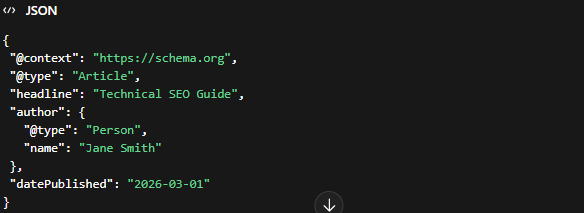
This structured format helps search engines interpret the page more accurately and may improve how it appears in search results.
Common Technical SEO Mistakes To Avoid
Technical SEO problems rarely look dramatic.
Your website doesn’t suddenly explode. There’s no flashing warning sign saying “Google can’t crawl this page.”
Instead, traffic slowly drops. Rankings stall. Pages that should appear in search results quietly disappear.
And when you dig into the data, the culprit is often something small but critical in your technical SEO health.
Here are some of the most common mistakes that cause trouble.
Broken Links and Redirect Chains
Broken links are the potholes of the internet.
When internal links lead to pages that no longer exist, users hit dead ends and search engine crawlers waste crawl budget.
For example, a broken internal link might look like this:
If that web page returns a 404 error instead of redirecting correctly, it interrupts both navigation and crawling.
Redirect chains can be just as problematic.
Imagine this sequence:
Page A → redirects to Page B → redirects to Page C.
Search engines have to follow every step in that chain before reaching the final destination. Too many redirects slow down crawling and can dilute link equity flowing through your site.
The fix is simple: keep redirects clean and ensure that links pointing to old URLs are updated to point to the final destination.
Duplicate Content and Canonical Confusion
Duplicate content is another common technical headache.
It usually happens when multiple versions of the same page exist under different URLs. For example:
example.com/page
example.com/page/
example.com/page?ref=homepage
To a human, these all look like the same page.
To a search engine, they’re different URLs with the same content.
Without clear signals, search engines may struggle to decide which version should appear in search engine results.
This is where canonical tags come in.
A canonical tag tells search engines which version of a page is the preferred one:
<link rel=”canonical” href=”https://example.com/page”>
Using canonical tags correctly helps prevent duplicate pages from splitting ranking signals.
Blocking Important Pages From Crawling
Sometimes websites accidentally block search engines from accessing important content.
This often happens through misconfigured robots.txt files or incorrect robots meta tags.
For example, a robot’s directive like this can prevent search engines from crawling a page:
Disallow: /category/
If that folder contains valuable category pages or product listings on an ecommerce site, those pages may never appear in search results.
In other cases, developers use the noindex tag during staging or testing—and forget to remove it before launch.
The result: perfectly good pages quietly disappear from Google’s index.
Ignoring Page Speed Issues
Slow websites frustrate users and search engines alike.
Page speed is a ranking factor, and slow pages can negatively impact both search engine rankings and user engagement.
Common page speed issues include:
- Oversized images
- Unoptimized JavaScript files
- Too many third-party scripts
- Large page sizes
Improving site speed often involves compressing assets, minimizing code, and reducing the amount of data that loads on each web page.
The faster your pages load, the easier it is for users and search engines to interact with them.
Weak Internal Linking
Internal linking is one of the most overlooked technical SEO elements.
Search engines discover pages by following internal links pointing between pages. If important content isn’t linked properly, crawlers may struggle to find it.
This is how orphan pages happen.
An orphan page is a page with no internal links pointing to it from anywhere else on the site. Even if the page exists, it becomes difficult for search engine crawlers to discover.
Strong internal linking helps search engines:
- Find pages faster
- Understand site architecture
- Distribute link equity across your site
It also helps users navigate your content more easily.
And when both users and search engines can move through your site effortlessly, your chances of achieving higher search engine rankings increase dramatically.
Advanced Technical SEO Tactics (And Why Companies Hire Experts For Them)
Most technical SEO advice online covers the basics.
- Fix your broken links.
- Improve site speed.
- Add structured data.
- Submit an XML sitemap.
All good advice. All necessary.
But the reality is that the technical aspects of SEO become much more complicated as your site grows.
Large sites have thousands of pages. E-commerce sites have multiple versions of the same products. International websites serve different languages and multiple countries. JavaScript frameworks dynamically render content that search engine crawlers may or may not see.
And this is where things can get messy.
Because the advanced side of technical SEO is less like following a checklist and more like performing surgery on your entire site.
Which is exactly why companies hire agencies for it.
JavaScript SEO (Or When Google Can’t See Your Content)
Modern websites love JavaScript.
Developers use it to create interactive pages, load content dynamically, and power complex web applications. From a user perspective, it can make a web page feel smooth and responsive.
From a search engine perspective? Sometimes it’s a nightmare.
Search engines can crawl JavaScript—but not always efficiently. If key content is loaded via JavaScript after the initial page load, search engines crawl the HTML first and may never see that content at all.
Imagine publishing a product description that users can see… but Google crawls the page and finds nothing but an empty container.
Not ideal.
Fixing JavaScript rendering issues often requires careful collaboration between developers and SEO specialists to ensure that critical content is accessible in the initial HTML or rendered correctly for crawlers.
This is one of those problems where a small mistake can quietly prevent important pages from appearing in search results.
International SEO and Hreflang (A Classic Way To Break Your Rankings)
If your website targets multiple languages or multiple countries, things get interesting very quickly.
Let’s say your company serves customers in the US, the UK, and Australia. Each region may have a slightly different version of the same page:
- /us/product-page
- /uk/product-page
- /au/product-page
To humans, the differences are obvious.
To search engines, these pages look suspiciously similar. Without proper signals, search engines might treat them as duplicate content and rank the wrong version for users.
That’s where hreflang tags come in.
They tell search engines which language and regional version of a page should appear for different audiences.
But hreflang implementation is famously easy to mess up.
One incorrect tag and suddenly your UK page starts ranking in Canada while your US traffic disappears.
This is why international websites often rely on experienced SEO teams. When done correctly, hreflang improves search engine rankings in multiple markets. When done incorrectly, it can confuse search engines across your entire site.
Pagination and Canonical Strategy
Pagination sounds simple.
Until it isn’t.
Large ecommerce sites often spread products across dozens—or hundreds—of category pages. For example:
example.com/shoes?page=1
example.com/shoes?page=2
example.com/shoes?page=3
Each page contains different products but has a similar layout and page content.
If search engines interpret these pages incorrectly, several things can happen:
- duplicate pages compete against each other
- the crawl budget gets wasted on irrelevant URLs
- important pages receive less link equity
Managing pagination often requires a mix of:
- correct canonical tags
- strong internal links
- thoughtful site architecture
Handled correctly, this helps search engines understand which pages matter most.
Handled incorrectly, it can scatter ranking signals across dozens of URLs.
Log File Analysis (The SEO Equivalent of Reading Google’s Mind)
Here’s where things get properly nerdy.
Every time search engine crawlers visit your site, the server records that visit in a log file. These logs contain incredibly useful information about how search engines interact with your website.
For example, log file analysis can reveal:
- Which site’s pages Google crawls most often
- Which pages are ignored
- Crawl errors affecting important sections of your site
- Wasted crawl activity on irrelevant URLs
In other words, log files show you what search engines actually do on your site, not what you think they do.
This kind of analysis can uncover technical issues that traditional SEO tools miss.
But reading raw log files isn’t exactly beginner-friendly. It often involves parsing massive datasets and interpreting patterns in crawl behavior.
Which again brings us back to the agency point.
Advanced technical SEO isn’t just about knowing what to fix. It’s about knowing how changes will affect search engines’ crawling and indexing across the entire site.
And when you’re working with thousands—or millions—of pages, those decisions matter.
A lot.
Technical SEO Isn’t Optional. It’s the Foundation.
Technical SEO is easy to overlook.
It doesn’t produce flashy dashboards. It rarely goes viral on LinkedIn. And you won’t find many marketers bragging about their XML sitemaps at conferences.
But here’s the truth: technical SEO can make or break your SEO performance.
If search engines can’t crawl your pages, they won’t index them. If they can’t interpret your site structure, they’ll struggle to understand which pages are most important. And if technical issues like duplicate content, broken links, or slow page speed creep in, your search engine rankings can quietly slip.
That’s why technical SEO focuses on the infrastructure that supports everything else in SEO.
It ensures your web pages are accessible to search engine crawlers, optimized for mobile devices, structured in a way that helps search engines understand your content, and fast enough to deliver a strong user experience.
Get that foundation right, and every other part of search engine optimization becomes easier.
But here’s the catch.
As websites grow, the technical aspects of SEO become significantly more complex. Large sites often have thousands of pages, multiple URL versions, international targeting, JavaScript-rendered content, and intricate internal linking that distributes link equity across the site.
Fixing those issues requires experience.
Because one incorrect canonical tag, misconfigured redirect, or blocked directory can affect search engines’ crawling of your entire site.
That’s where expert technical SEO makes the difference.
Want Experts To Handle Your Technical SEO?
If you’re unsure whether your website’s technical SEO health is holding back your rankings, we can help.
At SEO Sherpa, our team specializes in diagnosing and fixing the technical SEO issues that prevent websites from reaching their full search potential. From improving site speed and resolving duplicate content to optimizing site architecture, structured data, and crawlability, we help ensure your site is built for both users and search engines.
If you’d like expert insight into your website’s technical performance:
Book a free discovery call with our SEO team.
We’ll review your site, identify opportunities to improve technical optimization, and outline a strategy designed to increase your search traffic and achieve higher search engine rankings.
Because when the technical foundation of your site is solid, everything else in SEO works better.















Leave a Reply