



Most websites publish content for humans.
Paragraphs. Images. Videos. Blog posts. Product descriptions.
Search engines, however, don’t read the web the way we do. They scan code, interpret signals, and try to understand what each page actually means.
That’s where structured data comes in.
Structured data is a standardized format added to web pages that helps a search engine interpret the information on a page more accurately. Instead of guessing what a page is about, search engines can read clearly labeled data that identifies entities such as products, authors, organizations, reviews, and publication dates.
And as AI-powered search and large language models become more central to how people discover information online, structured data is becoming more important than ever. It helps machines identify entities, understand relationships, and extract facts that can power rich results, knowledge graphs, and even AI-generated answers.
In this guide, we’ll break down exactly what structured data is, how it works, and why it’s quickly becoming a foundational part of modern SEO.
Article Summary
- Structured data is machine-readable information added to web pages that helps search engines understand content. It uses standardized formats like schema markup to describe entities, relationships, and page details.
- Structured data improves how pages appear in search results. It enables rich results such as review stars, FAQs, product pricing, and other enhanced listings that can increase click-through rates.
- Search engines use structured data to interpret entities and connect them to knowledge graphs. This helps them better understand page intent, content relationships, and brand signals.
- Structured data is increasingly important for AI search and large language models. Machine-readable data helps AI systems extract facts and generate accurate AI-generated answers in modern search interfaces.
- Implementing structured data typically involves adding JSON-LD schema markup to your website and validating it using tools like Google’s Rich Results Test.
What Is Structured Data?
The internet is full of information. But most of it isn’t organized in a way machines can easily understand.
Humans can read a blog post, glance at a product page, or skim an FAQ section and instantly figure out what’s going on. We recognize things like prices, authors, dates, and reviews without thinking twice.
Search engines don’t have that luxury.
They have to analyze page content, interpret context, and guess which pieces of information matter. Structured data exists to remove the guesswork. It labels information in a standardized format so machines can interpret it quickly and accurately.
In simple terms, structured data is the difference between showing a search engine a paragraph… and handing it a neatly labeled spreadsheet.
Simple Definition of Structured Data
At its core, structured data refers to information organized in a predefined format that machines can easily interpret.
Instead of leaving search engines to infer meaning from paragraphs of text, structured data adds labels that explicitly describe what the information represents.
Imagine a blog article, for example.
To a human reader, it’s obvious which parts of the page are the title, the author’s name, and the publication date. But in raw HTML, those elements are often just text on a page.
Structured data solves this by tagging those elements with machine-readable labels.
So instead of this:
“Structured data helps search engines understand your content.”
Search engines might also receive metadata that says:
- Article headline: Structured Data Explained
- Author: Jane Smith
- Publication date: March 5, 2026
Now the search engine doesn’t need to infer meaning because it already knows what each piece of information represents.
That’s the core idea behind structured data markup: turning human-readable content into a machine-readable format that can be easily processed by algorithms.
Structured Data Vs Unstructured Data
To understand structured data, it helps to compare it with the type of information that dominates the web: unstructured data.
Most online content falls into this category.
Think about things like:
- Blog posts
- Text documents
- Social media posts
- Audio files
- Videos
- Web page text
All of these contain valuable information, but they lack a strict data model or predefined structure. In other words, unstructured data lacks a fixed schema, which makes it harder for machines to interpret automatically.
In fact, estimates suggest 80–90% of the world’s data is unstructured, which is why technologies like natural language processing exist in the first place.
Structured data is the opposite.
It follows a well-defined schema in which information is organized into predictable formats, such as rows and columns, key-value pairs, or labeled properties.
Classic examples include:
- Relational databases
- SQL databases
- Google Sheets
- Comma-separated values (CSV) files
Because the structure is consistent, machines can analyze data, query it efficiently, and extract insights much faster.
On the web, schema markup plays this role. It adds structure to otherwise unstructured page content, enabling search engines to interpret it more accurately.
What Is Schema Markup?
When people talk about structured data in SEO, they’re usually referring to schema markup.
Schema markup is a shared vocabulary developed through Schema.org that allows websites to label their content in a way search engines can understand. Major platforms like Google, Bing, and others rely on this standardized system to interpret structured data across the web.
In practice, schema markup is added to a webpage’s code using specific formats that describe the entities on the page.
The most common formats include:
- JSON-LD (JavaScript Object Notation for Linked Data)
- Microdata
- RDFa
Today, JSON-LD is widely considered the preferred approach because it separates structured data from the visible page content, making it easier to implement and maintain.
Once added, this markup acts like a translator. It turns normal page content into linked data that search engines can interpret, connect to entities, and potentially use to enhance search results.
And that’s where structured data starts becoming very powerful.
Because once search engines can clearly understand the information on your page, they can start doing much more interesting things with it.
How Structured Data Works
So far, we’ve talked about what structured data is. Now let’s talk about what actually happens behind the scenes after you add it to a page.
Because structured data isn’t just decorative code sitting in your HTML. It’s a signal system.
When a search engine crawls a page, it scans both the visible page content and the structured data markup attached to it. That markup provides a well-defined schema that tells the crawler exactly what each piece of information represents.
Instead of guessing whether a number on the page is a price, a rating, or a random statistic, the search engine can read the structured labels and immediately interpret their meaning.
Which makes crawling faster, indexing clearer, and understanding your content much easier.
How Search Engines Read Structured Data
The process is surprisingly straightforward.
When search engines encounter structured data markup, they typically follow a sequence like this:
1. The page is crawled
Search engine bots first discover and crawl the page like any other webpage. During this stage, they scan the HTML and look for any structured data embedded in the code.
Because structured data is written in a machine-readable format, it’s easy for crawlers to detect.
2. Schema markup is detected
Once crawlers identify schema markup—usually in JSON-LD format—they begin interpreting the fields defined within the markup.
These fields follow the standardized vocabulary defined by Schema.org, which means the search engine already knows what labels like author, product, review, or publication date represent.
3. Entities and relationships are interpreted
This is where things get interesting.
Structured data helps search engines identify entities and the relationships between them.
For example, a page might contain structured data that identifies:
- a product
- a brand
- a price
- a review rating
- a publication date
Because the data follows a predefined data model, search engines can interpret these relationships quickly and accurately.
4. Data may be used in search features
Once the information is processed, search engines can use it to enhance search results.
This is how features like rich snippets, FAQs, product listings, and other enhanced SERP features appear.
Structured data essentially tells the search engine:
“Here’s the exact information you can display.”
And when that information is clear and trustworthy, search engines are far more likely to use it.
Structured Data Example
To see how this works in practice, let’s look at a simple JSON-LD structured data example for an article.
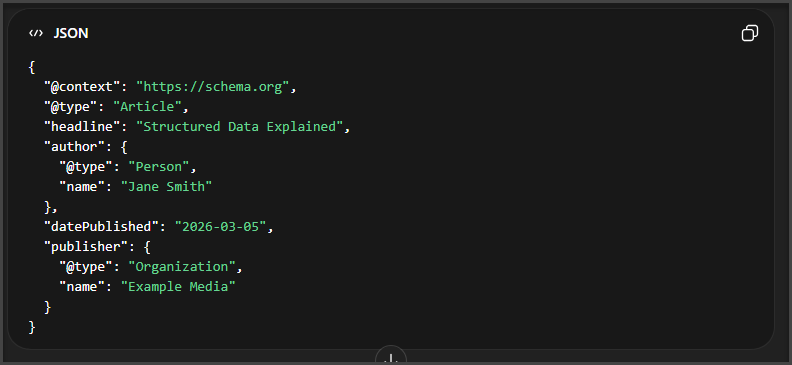
This markup tells a search engine several things immediately:
- The page contains an Article
- The headline is “Structured Data Explained”
- The author is Jane Smith
- The publication date is March 5, 2026
- The publisher is an organization called Example Media
Without structured data, a crawler would have to infer these details from the page’s layout and text.
With structured data, those facts are explicitly labeled in a standardized format that machines can process instantly.
The same principle applies to other page types.
A product schema might include fields for price, availability, and ratings. An FAQ schema identifies questions and answers. An organization schema can define a brand, its website, and social profiles.
In every case, the goal is the same: turn ordinary webpage content into structured, machine-readable information that search engines—and increasingly large language models—can understand and use.
Types of Structured Data Commonly Used in SEO
There are hundreds of schema types available through schema markup, but most SEO implementations rely on a handful of structured data formats that search engines use frequently.
These schema types help a search engine understand what kind of page content it’s analyzing and what information might be useful in search results.
For example, a blog post might include Article schema, an e-commerce page might use Product schema, and a question-based page might use FAQ schema. Each one follows a predefined format so machines can easily interpret the data.
Let’s look at some of the most common types used in SEO.
Article Schema
Article schema is one of the most widely used types of structured data markup, especially for blog posts, news content, and editorial pages.
It tells search engines that the page contains written content and labels important elements such as the headline, author, and publication date. This makes it easier for search engines to interpret the page and sometimes display additional information in search results.
Here’s a simplified JSON-LD example for an article.
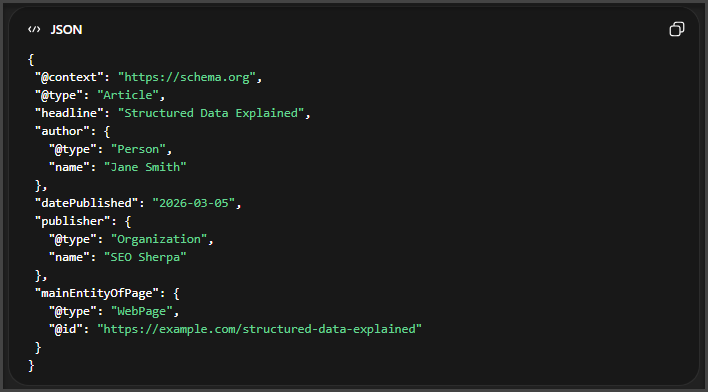
This markup provides machine-readable information that identifies the content as an article and labels its core entities.
Without this markup, a search engine has to infer those details from the page layout. With it, the meaning is explicit.
Product Schema
Product schema is essential for e-commerce sites because it helps search engines understand product details, such as price, availability, and ratings.
This type of structured data is what enables many rich results that appear in e-commerce listings, such as star ratings and product pricing directly in search results.
Here’s a simple example.
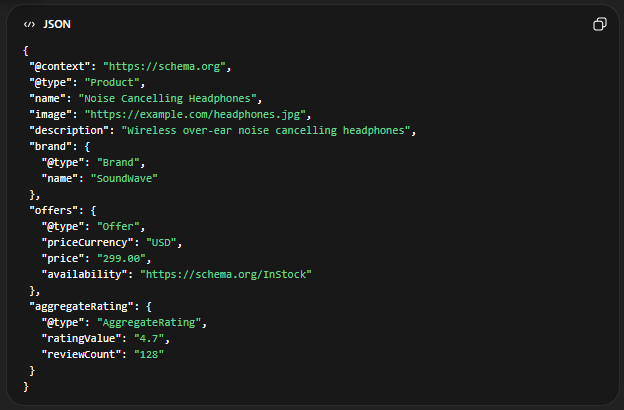
This structured data markup clearly defines the product, its brand, price, and rating. Because the information follows a standardized format, search engines can extract those details and potentially display them as rich snippets.
For e-commerce businesses, this type of markup can significantly improve how products appear in the SERPs.
FAQ Schema
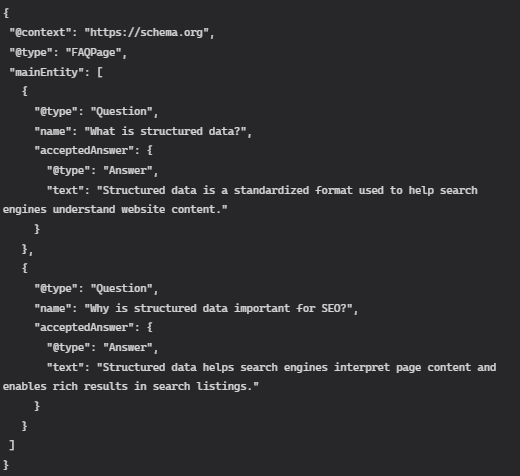
The FAQ schema is used for pages that contain question-and-answer content.
When implemented correctly, it can enable search engines to display expandable question sections directly in search results, improving visibility and increasing click-through rates.
Here’s a simplified example.
Organization and Local Business Schema
Finally, the Organization schema and LocalBusiness schema help search engines understand information about a brand or company.
This type of structured data can include details such as the business name, website, logo, address, and contact information. It also helps connect a brand to the broader ecosystem of entities that search engines maintain in their knowledge graphs.
Here’s a simple example.

For local businesses, this markup might also include address, phone number, and opening hours.
This structured information helps search engines verify brand details and strengthen entity recognition, which can influence knowledge graph connections, local listings, and other enhanced search features.
In short, these schema types act like a data model for your website. They give machines clear instructions about the meaning of your content, making it easier for search engines—and increasingly AI systems—to interpret and use that information.
Why Structured Data Matters for Search Engines
Structured data doesn’t exist just to make developers happy. Its real value is helping search engines understand your content faster, more accurately, and with far less guesswork.
Without structured data, a crawler has to interpret your page the way a human would: reading paragraphs, analyzing context, and determining what information is important. That works, but it’s inefficient.
Structured data simplifies the process.
By adding schema markup to your web pages, you provide machine-readable labels that tell search engines exactly what the content represents. Instead of interpreting raw text, algorithms can rely on a well-defined schema that clearly identifies entities, relationships, and page intent.
That clarity unlocks several important benefits for SEO.
Rich Results and Rich Snippets
One of the most visible benefits of using structured data is the ability to appear in rich results.
Rich results enhance normal search results by displaying additional information directly in the SERP. Instead of a simple blue link and description, users might see ratings, product details, FAQs, or other visual enhancements.
For example, structured data can enable features such as:
- Review stars
- Product prices and availability
- FAQ dropdowns
- Event dates
- Breadcrumb navigation
These enhanced listings, called rich snippets, often stand out significantly more than standard listings.

Example of rich results.
When search engines process this structured data markup, they can extract details such as rating value, price, and availability. That information can then appear directly in search results, giving users useful information before they even click.
Rich results don’t just improve visibility. They often improve click-through rates because enhanced listings are more visually appealing and informative.
Better Content Understanding
Beyond visual enhancements, structured data plays a deeper role in how search engines interpret page content.
Remember, most of the web is unstructured data. Blog posts, text documents, social media posts, and other content formats don’t follow a strict data model.
That means algorithms have to rely heavily on natural language processing to interpret meaning.
Structured data reduces that ambiguity.
By organizing information into a standardized format, structured data clearly defines entities and their relationships. Instead of guessing whether a name refers to a person, brand, or location, the markup explicitly labels it.
For example, a page might contain an article with structured data like this:

This markup tells a search engine exactly what each piece of information represents.
The result is clearer indexing, better understanding of page intent, and more accurate placement within search results.
Knowledge Graph Connections
Structured data also helps search engines connect your content to their internal knowledge graphs.
Knowledge graphs are massive networks of entities and relationships that search engines use to understand the world. They connect people, companies, places, products, and topics into a structured system of information.
Structured data helps feed this system.
When you add schema markup that identifies entities such as organizations, authors, products, or locations, search engines can connect those entities to existing records in the knowledge graph.
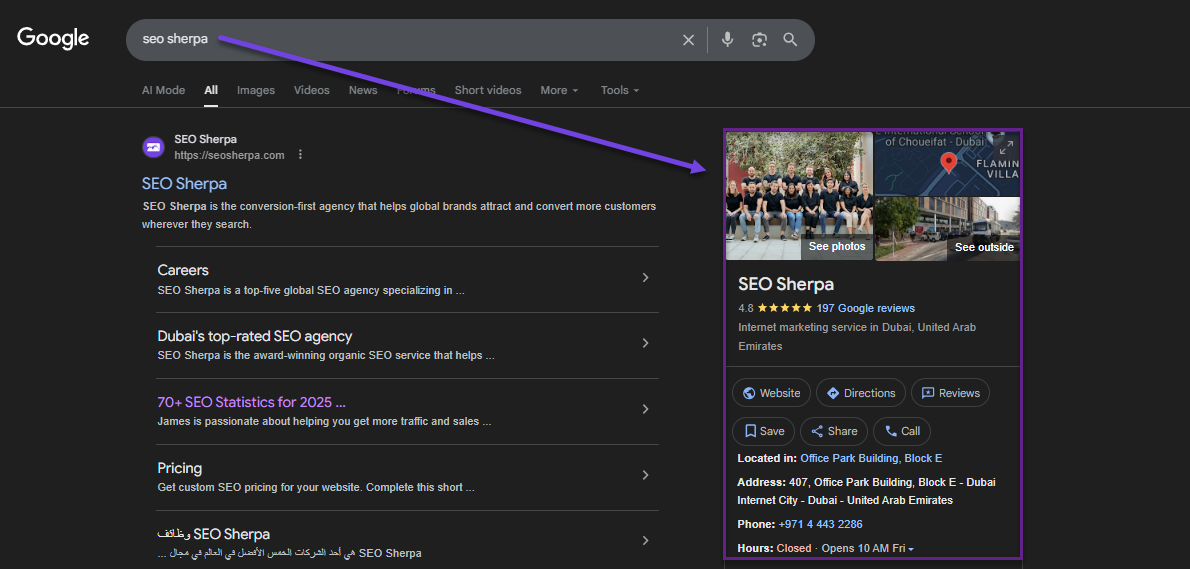
Example of a Google Knowledge Graph Panel.
This markup helps search engines recognize the organization, confirm its identity, and connect it with other data sources across the web.
Those connections strengthen entity recognition, improve brand signals, and make it easier for search engines to associate your site with relevant topics.
In other words, structured data doesn’t just help search engines understand individual pages.
It helps them understand who you are and how your content fits into the broader web of information.
Why Structured Data Matters for AI Search and LLMs
Search engines have been using structured data for years to generate rich results. But a new reason it matters is emerging quickly: AI-powered search.
Modern search systems increasingly rely on large language models to interpret information and generate answers. Instead of simply returning links, they synthesize facts from multiple sources and produce AI-generated answers directly in the interface.
That changes how content gets discovered.
AI systems don’t just read paragraphs the way humans do. They extract facts, identify entities, and analyze relationships across different datasets. When information is already presented in a machine-readable format, that process becomes dramatically easier.
In other words, structured data doesn’t just help pages rank.
It helps machines understand.
How AI Systems Use Structured Data
AI systems rely heavily on structured information to interpret content and extract reliable facts.
Think about what happens when an AI system tries to answer a question like:
“Who wrote this article?”
“What’s the price of this product?”
“When was this page published?”
Without structured data, the system has to infer those answers from raw text documents and the surrounding context. That’s possible, but it requires more complex analysis and introduces more uncertainty.
Structured data removes that ambiguity.
Because the information follows a predefined schema, machines can immediately identify entities and their clearly defined relationships. This makes it easier for machine learning algorithms and large language models to extract structured facts.
Instead of parsing paragraphs to find the author and date, the AI system can simply read the labeled data.
That’s one reason structured data improves retrievability by AI systems and makes content more likely to appear in AI-generated search results.
Structured Data and AI Overviews
Structured data is also increasingly relevant to the new generation of AI-powered search interfaces.
Features like Google AI Overview attempt to summarize answers directly within search results, combining information from multiple pages into a single explanation.
To do that effectively, the system needs reliable facts.
Structured data helps provide those facts.

Example of an AI Overview.
Because the markup explicitly labels the question and answer, it becomes much easier for AI systems to interpret and reuse that information when generating responses.
Structured data also supports voice search, which relies heavily on concise facts that can be delivered as direct answers.
So while structured data has traditionally been associated with rich snippets, its role in AI-powered search is growing quickly.
Structured Data as a Foundation for Search Everywhere Optimization™
If search visibility used to mean ranking in a list of blue links, today it means appearing wherever users are searching for information.
That includes:
- traditional search engines
- AI-powered answer interfaces
- voice assistants
- knowledge panels
- and other emerging discovery surfaces
This broader visibility is exactly what Search Everywhere Optimization™ is designed to address.
To show up across these environments, content needs to be easily interpreted by machines. Structured data plays a critical role here because it provides the standardized format that many systems rely on to extract facts and identify entities.
Think of it as a translation layer between human-written content and machine-readable information.
When structured data is present, AI systems can identify entities, understand relationships, and retrieve key information much more reliably.
And as search continues shifting toward AI-generated answers and entity-based discovery, that machine-readable layer becomes increasingly valuable.
In short, structured data doesn’t just help search engines understand your pages.
It helps every system that relies on machine-readable information understand them too.

How To Implement Structured Data on Your Website
At this point, structured data can sound intimidating.
Schema markup. JSON-LD. Machine-readable formats. Suddenly, it feels less like SEO and more like you accidentally opened a database engineering manual.
Good news: implementing structured data markup is usually much simpler than it sounds.
You don’t need to build a data warehouse, write complex structured query language, or design a new data model from scratch. In most cases, adding structured data means inserting a small block of JSON-LD (JavaScript Object Notation) into your page to clearly label the important information already present in your content.
Here’s how the process typically works.
Step 1: Choose the Right Schema Type
The first step is selecting the schema type that best describes your page content.
Schema markup follows a predefined data model maintained by Schema.org, which provides hundreds of standardized types for labeling information across the web. These schema types help a search engine interpret structured information in a consistent data format.
Common examples include:
- Article schema for blog posts and editorial content
- Product schema for ecommerce pages
- FAQ schema for question-and-answer sections
- Organization or LocalBusiness schema for brand information
Each schema follows a well-defined schema that identifies properties such as the author, brand, price, or publication date.
For example, a simple article schema might look like this:

This structured data tells a search engine exactly what the content represents.
Instead of interpreting paragraphs or text documents, the crawler can immediately identify the article title, author, and publication date because the information follows a standardized format.
Step 2: Add JSON-LD Markup
Once you’ve chosen the schema type, the next step is adding the markup to your page.
Today, JSON-LD is the preferred implementation method because it keeps structured data separate from visible page elements. That makes it easier to maintain and avoids conflicts with HTML layout.
In practice, JSON-LD is simply a block of structured data markup added to the <head> or <body> of your page.
Because this data follows a predefined format, machines can interpret it instantly. The search engine doesn’t need to infer price or brand from surrounding text; it simply reads the structured labels.
This type of structured markup is conceptually similar to how information is organized in relational or SQL databases, where data is stored in tables with clearly defined relationships between fields.
The goal is the same: organize information so machines can retrieve it efficiently.
Step 3: Test the Markup
Once structured data is added, you should validate it before publishing.
Even small syntax errors can prevent search engines from interpreting the markup correctly.
The easiest way to check your implementation is with:
These tools analyze the structured data on your web pages and confirm whether it’s eligible for rich results in search results.
Need to check your schema in bulk? We have just the tool for that!

For example, if your markup includes FAQ schema, the validator will check whether the question and answer fields are correctly formatted.
Testing also helps ensure your markup matches the visible page content, which is important for maintaining data integrity.
Step 4: Monitor Performance
After implementation, structured data becomes part of your broader SEO strategy.
Google Search Console includes rich results reports that show how structured data is being detected across your website. These reports highlight valid schema types, warnings, and errors that could affect eligibility for enhanced search results.
Over time, this data can reveal how structured markup is influencing visibility.
For example, you might notice:
- New rich snippets appearing in search results
- Improved click-through rates
- increased impressions for pages with structured markup
That’s because using structured data helps search engines interpret content more reliably and display more informative listings.
And as search continues evolving toward AI-generated answers and large language models, that structured layer of information becomes even more valuable.
Common Structured Data Mistakes to Avoid
Adding structured data to your website can unlock rich results, better search results visibility, and clearer signals for large language models.
But like most things in SEO, implementation is where things often go sideways.
Not because structured data is complicated, but because people get… creative.
Search engines expect structured data markup to follow a well-defined schema, reflect the actual page content, and use the correct data model. When it doesn’t, the markup gets ignored. In more extreme cases, it can even trigger manual actions.
Here are a few of the most common mistakes we see.
Using the Wrong Schema Type
One of the most frequent errors is choosing a schema type that doesn’t actually match the content on the page.
For example, marking a standard blog post as a product, or tagging a landing page as an FAQ page, simply because it contains one question somewhere in the text.
Search engines aren’t fooled by this. They compare the structured data markup to the visible page content and look for consistency.
If the schema claims the page is a product but there’s no product price, brand, or purchase information, the markup will likely be ignored.
Or worse, flagged as spammy structured data.
Here’s a simplified product schema example that would only make sense on an actual product page:
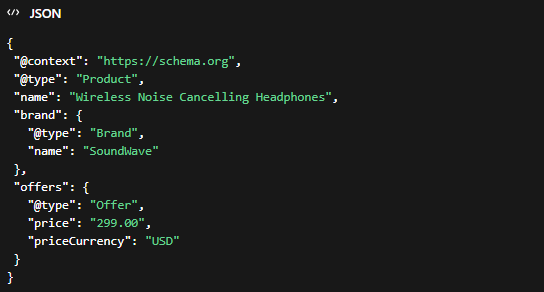
If your page doesn’t actually sell headphones, this markup has no business being there.
Structured data works best when it accurately reflects what the page truly is.
If key properties are missing, search engines may still crawl the page, but won’t always use the markup to generate rich snippets or enhanced search results.
In other words, partial markup often delivers partial benefits.
Spammy or Over-Optimized Schema
This is where things get a little… creative.
Some sites attempt to squeeze every possible rich snippet out of a page by stuffing schema markup with exaggerated claims, fake ratings, or irrelevant structured data.
For example:
- Adding review ratings that don’t exist
- Marking entire blog posts as FAQ schema just to dominate the SERP
- Labeling generic content as a product with fake pricing
Search engines have become very good at spotting these tactics.
If the structured data markup doesn’t match the visible content on the page, it simply won’t be used. In severe cases, sites can lose eligibility for rich results entirely.
Structured data should clarify content, not manipulate search results.
Mismatch Between Markup and Page Content
This mistake is subtle but surprisingly common.
Structured data must always match the visible information on the page. If your markup claims that a page contains a product priced at $99, users should be able to see that price on the page itself.
Otherwise, the search engine sees conflicting signals.
For example, an article schema might include the following structured data:
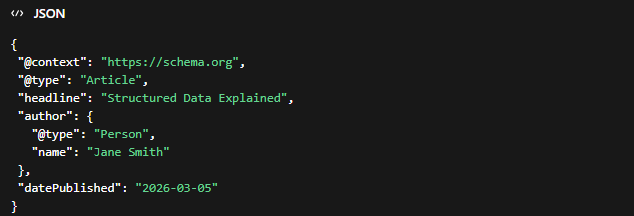
If the visible page content lists a different author or publication date, the markup becomes unreliable.
Search engines rely on structured data because it provides a standardized format for interpreting information. When that data conflicts with what users actually see, the system stops trusting it.
Which defeats the entire purpose of using structured data in the first place.
The Future of Structured Data in SEO
Structured data has quietly moved from “nice to have” to “foundational infrastructure” for the web.
A decade ago, schema markup was mostly about unlocking rich snippets like review stars or FAQ dropdowns. Helpful, sure. But not exactly mission-critical.
Today, the stakes are much higher.
Search engines, large language models, and AI-powered interfaces are increasingly trying to understand the internet as a network of entities, relationships, and facts. And the cleaner that information is structured, the easier it is for machines to process it.
In other words, the web is slowly shifting toward a more machine-readable ecosystem.
And structured data is one of the key building blocks making that possible.
Entity-Based Search
Modern search engines don’t just rank pages. They map entities.
An entity can be a person, company, product, location, or concept. Search engines connect these entities into massive knowledge graphs that describe how information across the web relates to each other.
Structured data helps power that system.
When you add schema markup identifying an organization, author, or product, you give a search engine clear signals about the entities present on your web pages. Instead of guessing, the crawler receives labeled data that fits a predefined data model.
This structured data markup helps search engines connect the organization to other references across the web, strengthening entity recognition and improving how that brand appears in search results.
As entity-based search continues evolving, structured signals like these become increasingly valuable.
The Machine-Readable Web
Most of the internet today still consists of unstructured data.
Blog posts, social media posts, text documents, videos, and audio files all contain useful information, but the meaning is embedded in natural language. That’s why interpreting unstructured data requires complex natural language processing.
Structured data changes that dynamic.
Because it follows a standardized format, machines can immediately interpret structured data without the need to perform deep linguistic analysis. Instead of parsing paragraphs, they simply read the structured labels.
This approach mirrors how data is organized in relational and SQL databases, where information is stored in tables with rows and columns, with clearly defined relationships between fields.
In other words, structured data brings some of the organizational clarity of database systems to the open web.
And that clarity enables more powerful data analysis, faster data integration, and better data storage across different datasets.
AI Search Engines And The Semantic Web
The rise of AI-powered search is accelerating this shift.
When large language models generate summaries or AI-generated answers, they rely on extracting facts from enormous volumes of data across the web. The easier it is to identify entities and relationships, the easier it becomes to generate reliable responses.
That’s one reason structured information is so valuable.
Because structured data is organized in a predefined format, machines can retrieve it quickly and combine it with other sources to generate answers. This improves the reliability of AI systems and reduces ambiguity when interpreting page content.
Structured data also supports technologies like:
- voice assistants, which need concise factual answers
- knowledge graphs connecting entities
- AI-powered discovery interfaces
- search systems analyzing different datasets
Over time, this trend points toward a broader concept often described as the semantic web: an internet where information isn’t just written for humans, but also clearly structured for machines.
Why Structured Data Will Only Become More Important
The benefits of structured data extend far beyond enabling rich results.
Structured information improves how machines understand content, supports AI-driven search systems, and creates the foundation for a more interpretable web. It also enables faster retrieval of specific facts and helps systems analyze data more efficiently.
That’s why structured data already plays a critical role in everything from business intelligence tools to data warehouses, where information is organized to extract valuable insights about things like customer behavior and purchase history.
On the web, the same principle applies.
The clearer the structure of your data, the easier it becomes for machines to interpret your content, connect it with other information, and surface it in the right contexts.
And as search continues to evolve toward AI-driven discovery, structured data will increasingly serve as the translation layer between human-written content and machine-understandable knowledge.
Which means its importance in SEO will only grow.
The Bottom Line: Structure Your Data, Strengthen Your SEO
If there’s one takeaway from this guide, it’s this: structured data helps machines understand your content the way humans already do.
Most of the web still consists of unstructured data—blog posts, text documents, social media posts, videos, and audio files. Humans can read those formats easily, but for machines, interpreting meaning requires complex analysis.
Structured data simplifies the process.
By adding schema markup in a standardized format, you transform ordinary page content into machine-readable information that search engines, large language models, and other AI systems can interpret quickly. Instead of guessing what a page is about, algorithms receive clearly labeled data with clearly defined relationships between entities.
That clarity unlocks real benefits.
Structured data can enable rich results, improve how pages appear in search results, and help connect your content to knowledge graphs and AI-powered search experiences. It also makes your information easier for machines to retrieve, increasing the likelihood that it will appear in AI-generated answers and other emerging discovery surfaces.
In short, structured data is no longer just a technical enhancement. It’s becoming a core part of how the modern web communicates information.
And as search continues shifting toward entity-based indexing, AI search interfaces, and machine-readable content, the role of structured data will only grow.
Ready To Make Your Website Search-Ready?
If your website isn’t using structured data markup correctly, you could be missing opportunities to improve search engine visibility, unlock rich snippets, and make your content easier for AI systems to understand.
At SEO Sherpa, we help brands implement technical SEO, structured data strategies, and Search Everywhere Optimization™ frameworks that improve discoverability across traditional search results, AI search engines, and emerging platforms.
If you’d like to see how structured data and modern SEO strategies could improve your visibility:
Book a free discovery call with our team.
We’ll review your website, identify opportunities for structured data implementation, and outline a strategy to strengthen your presence across both traditional search and AI-driven discovery.
Because when machines understand your content better, your brand becomes much easier to find.

















Leave a Reply