

Summarize This Article With AI
 Try with ChatGPT
 Try with Claude
 Try with AI Mode

Silicon Valley has always loved a good gold rush.
First it was search engines.
Then social networks.
Then mobile apps.
Then the cloud.
Now?
It’s AI agents.
The latest sign of just how intense that race is becoming comes from Meta, which has acquired the AI agent social network startup Moltbook, bringing the company’s founders directly into its AI research division.
On paper, it looks like a fairly typical talent acquisition.
A small startup.
A handful of engineers.
A quiet deal.
But the strategic signal behind it is anything but quiet.
Because companies across the tech industry are now scrambling to build autonomous AI agents capable of performing real-world tasks, from research and scheduling to browsing and purchasing.
And whoever gets that right first may end up controlling the next interface layer of the internet.
If that sounds familiar, it should.
We’ve seen this movie before—with search engines, smartphones, and social platforms all fighting to become the gateway between users and information.
AI agents are shaping up to be the next version of that gateway.
Article Summary
- Meta has acquired AI agent startup Moltbook, bringing its founders into Meta’s AI research team.
- The move highlights the growing competition among tech giants to build autonomous AI agents capable of performing tasks on behalf of users.
- AI agents are increasingly viewed as the next interface layer of the internet.
- For marketers, this signals a future where discovery may be mediated not just by search engines—but by AI systems acting on behalf of users.
Why AI Agents Are The Next Tech Arms Race
For most of the internet’s history, humans did the navigating.
We searched.
We clicked.
We compared.
Technology simply helped us move faster.
AI agents flip that model entirely.
Instead of doing the work ourselves, we delegate it.
You ask an agent to:
- Research software vendors
- Plan a travel itinerary
- Compare products across multiple stores
- Summarize dozens of articles
And it does the browsing for you.
Suddenly the question isn’t “Which website ranks first?”
It’s “Which sources does the agent choose to trust?”
That’s a very different discovery model.
And it’s exactly why companies like Meta, Google, and OpenAI are investing heavily in autonomous AI systems.
Because agents don’t just retrieve information.
They decide what information users see.

Why Meta Is Investing In The Agent Economy
Meta’s interest in AI agents isn’t exactly subtle.
The company has already embedded AI tools across its ecosystem, including:
- AI assistants in messaging platforms
- AI-generated content tools
- AI-powered discovery algorithms
But agents represent a different opportunity.
Instead of simply recommending content, they can execute tasks inside digital environments.
That could mean anything from managing online interactions to navigating services across the web.
For a company whose entire business model revolves around digital engagement, that’s a powerful capability.
And acquiring a startup like Moltbook suggests Meta is accelerating its effort to build that future.
Not just with models.
But with the teams capable of building agent-driven systems.
What AI Agents Mean For Search And Discovery
If AI agents become widely adopted, the way people discover information could shift dramatically.
Instead of opening search engines and browsing results themselves, users may increasingly rely on AI systems to do the exploration.
Think of it as the difference between asking for directions and sending someone else to scout the route.
The agent reads content.
Evaluates sources.
Returns the answer.
Which means discovery increasingly happens before users ever visit a website.
We’re already seeing early versions of this in AI-powered tools like ChatGPT and Perplexity, where answers are synthesized rather than simply retrieved.
Agents take that concept one step further.
They don’t just answer questions.
They complete tasks.
And in doing so, they determine which information sources influence those decisions.
The Search Everywhere Optimization Perspective
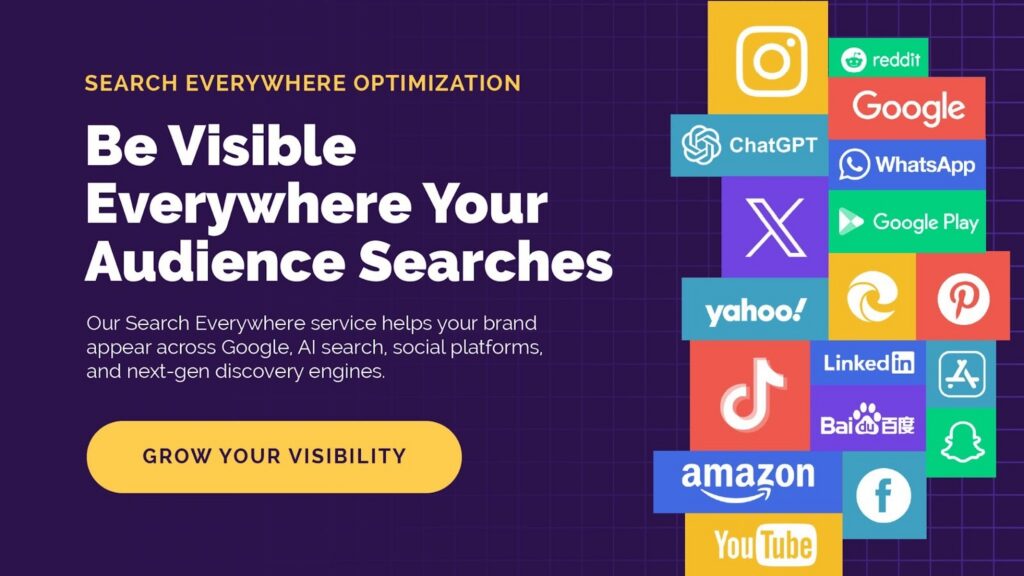
This is another example of why the discovery landscape is expanding far beyond traditional search engines.
Today, information is surfaced through a complex ecosystem of platforms:
- Search engines
- Social networks
- AI assistants
- Marketplaces
- Recommendation systems
AI agents add yet another layer to that ecosystem.
One where decisions are mediated not by ranking algorithms alone, but by AI systems designed to interpret and act on information.
For brands, that means visibility can’t rely on a single platform anymore.
It requires presence across the places where discovery happens.
This is the idea behind Search Everywhere Optimization™.
Instead of focusing exclusively on search rankings, brands need to build visibility across the entire discovery environment.
Because the platforms shaping discovery today may look very different from the ones dominating it tomorrow.
The Internet’s Next Gatekeepers May Not Be Platforms
If the last twenty years of digital marketing taught us anything, it’s that the companies controlling discovery tend to become incredibly powerful.
Search engines shaped how websites were built.
Social platforms shaped how content was distributed.
App stores shaped how mobile ecosystems evolved.
AI agents could shape the next version of that story.
Because once people begin delegating research, comparison, and decision-making to AI systems, those systems become the new gatekeepers of information.
Not because they own the platforms.
But because they decide which sources matter.
And if that happens at scale, the question for marketers will shift from:
“How do we rank higher?”
to something much more interesting:
“How do we become the source the agent trusts?”

The Real Takeaway For Marketers
The rise of AI agents is another reminder that discovery is no longer confined to traditional search engines.
Today, your audience might encounter your brand through:
- AI-generated answers
- Social feeds
- Recommendation algorithms
- Marketplaces
- Autonomous AI agents researching on their behalf
Each of those environments influences visibility.
And the brands that succeed will be the ones that build presence across all of them.
That’s exactly what Search Everywhere Optimization™ is designed to achieve.
If you want to understand how to future-proof your search strategy in a world of AI-driven discovery, book a free discovery call with SEO Sherpa.
We’ll help you build a strategy that ensures your brand shows up everywhere your audience is searching, asking, and exploring.






















Leave a Reply