

Summarize This Article With AI
 Try with ChatGPT
 Try with Claude
 Try with AI Mode

For years, personalization in search has existed in the background.
Google knew where you were.
Roughly what you liked.
Probably how often you panic-searched “symptoms of dehydration” after drinking two coffees and no water.
But the mechanics were mostly invisible.
The results page might shift slightly. Local businesses would move around. Your browsing history quietly influenced what appeared.
Now Google appears ready to make that personalization far more explicit.
According to observations from SEO researchers and early testers, Google’s AI Mode can tailor responses based on a user’s previous searches, browsing behavior, and past interactions. In some cases, the system even indicates that it is “checking for personalized info” before generating recommendations.
That means two people asking the exact same question could receive very different answers.
And if that sounds familiar, it should.
Because the future of search may look less like a universal results page—and more like a highly individualized conversation.
Article Summary
- Google’s AI Mode can personalize responses using a user’s past searches and interactions.
- AI Mode sometimes surfaces brands users have previously interacted with.
- Early research suggests generative results cite Google’s own properties heavily.
- Personalized AI answers could shift SEO from ranking for keywords to earning repeated engagement with users over time.
Why AI Mode Personalization Matters
Traditional search operates on a shared foundation.
Millions of users type the same query, and—broadly speaking—they see similar results.
Of course there are variations.
Location changes things.
Device type changes things.
Search history tweaks the order slightly.
But the core idea has always been consistent: one SERP, many users.
AI Mode begins to dismantle that model.
Instead of delivering a standard list of ranked pages, the system synthesizes an answer that may incorporate signals such as:
- Previous search queries
- Prior site visits
- Past brand interactions
- Contextual preferences
If you frequently search vegan recipes, AI Mode might prioritize plant-based options when recommending restaurants.
If you often click certain brands, those brands might appear again.
Search becomes less like a directory.
And more like a memory.

The Curious Case Of AI Self-Citation
At the same time personalization is increasing, another pattern has caught the attention of SEO analysts.
Google’s generative features—particularly AI Mode and AI Overviews—appear to cite Google-owned properties heavily.
In some analyses, generative answers referenced the same URLs as top organic results only about 13 percent of the time.
That’s a surprisingly small overlap.
Instead, Google frequently references its own ecosystem:
- YouTube
- Google Maps
- Google Knowledge Graph data
And that makes strategic sense.
If Google can answer the question directly using its own infrastructure, the user never needs to leave.
Which means Google becomes both:
The referee of the search ecosystem. And one of the players inside it.

What This Means For Search Visibility
Put those two trends together—personalization and self-citation—and the implications become clear.
Search results are becoming:
- More individualized
- More AI-mediated
- More closed-loop within Google’s ecosystem
Which means visibility is no longer determined solely by rankings.
It may also depend on whether a user has already interacted with your brand.
Think about it this way.
If AI Mode remembers that someone has visited your site, watched your videos, or engaged with your brand before…
You may have a better chance of appearing in future answers.
Search becomes less like a single competition and more like a relationship over time.

The Search Everywhere Optimization Perspective
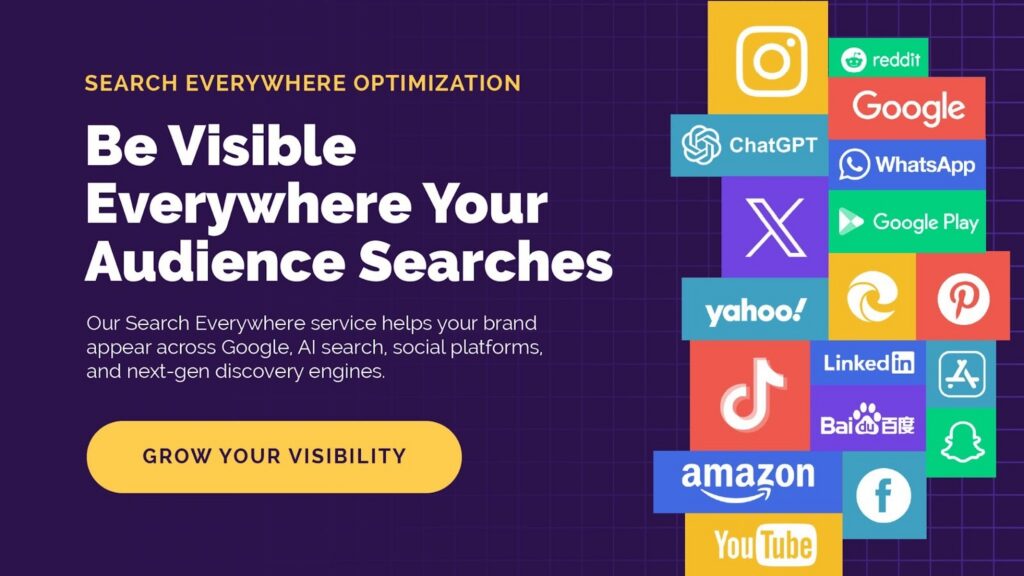
This is where the concept of Search Everywhere Optimization™ becomes incredibly relevant.
Because if personalization favors brands users have already encountered, visibility must start long before someone performs a search.
Your brand might enter that relationship through:
- Social media
- YouTube content
- AI assistant answers
- Community discussions
- Product marketplaces
Every one of those interactions becomes a potential signal.
The more surfaces where users encounter your brand, the more likely those signals appear when AI systems assemble personalized answers.
In other words:
Discovery feeds memory. Memory feeds AI recommendations.
Search Is Becoming A Reputation Engine
If AI Mode continues down this path, SEO may start looking less like technical optimization and more like reputation management at scale.
Because when answers become personalized, the system isn’t just asking:
“Which page is most relevant?”
It’s asking:
“Which sources does this user already trust?”
That’s a fundamentally different model.
It rewards brands that appear consistently across the internet—not just ones that publish well-optimized pages.
And it reinforces something we’ve been saying for a while now.
The future of search is not just about ranking.
It’s about recognition.

The Real Takeaway For Marketers
The search landscape is evolving from static rankings toward dynamic, personalized AI responses.
In that environment, the brands that win will be the ones that show up everywhere their audience encounters information.
That’s exactly what Search Everywhere Optimization™ is designed to do.
If you want to understand how to position your brand for visibility in AI-driven search ecosystems, book a free discovery call with SEO Sherpa.
We’ll help you build a strategy that ensures your brand appears wherever your audience is searching, asking, and exploring.























Leave a Reply