
Summarize This Article With AI
 Try with ChatGPT
 Try with Claude
 Try with AI Mode
The online travel agency has had a very good run. For the better part of two decades, Booking.com and Expedia have sat comfortably between hotels and travelers, collecting commissions in the range of 15 to 25 percent for the privilege of being the place where people go to search, compare, and book. Hotels have grumbled about it for years. Travelers have mostly not noticed. And the OTAs have kept building.
AI Mode may be about to change the arrangement.
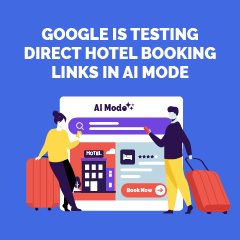
Google is now testing direct hotel booking links inside AI Mode responses, surfacing links to official hotel websites directly within the AI-generated answer rather than routing travelers through third-party aggregators. The feature was spotted in the wild this week and appears to still be in limited testing, with not all users able to replicate it. But combined with everything else Google has been building in this space, it is a very clear signal about where AI Mode is heading for the travel industry.
Article Summary
- Google is testing direct hotel booking links inside AI Mode responses, pulling from official hotel websites rather than OTA listings.
- The feature is currently in limited testing and has not rolled out broadly, but it is part of a much larger agentic travel booking push Google has been building since late 2025.
- Google is working with Marriott, Wyndham, IHG, Choice Hotels, Booking.com, and Expedia to build full in-chat booking capabilities inside AI Mode.
- Research shows 79 percent of hotel links in AI Mode already go to Google Business Profiles, with OTAs receiving just 3.6 percent of clicks despite dominating source citations.
- The Local Pack, which appears in only 6.5 percent of hotel queries, sends 81 percent of its traffic directly to hotel websites, making Google Business Profile optimization essential.
- For hotels, the practical priority is clear: Google Business Profile, Google Hotel Ads, and machine-readable inventory are the new front line of direct bookings.
What Google Is Actually Building Here
This week’s sighting of direct booking links in AI Mode is not an isolated test. It is the latest visible step in a strategy Google has been executing openly since November 2025.
Google’s VP of Engineering for travel and local search told PhocusWire directly that the goal is for users to be able to book flights and hotels without ever leaving AI Mode. The agentic travel booking experience Google is building will allow users to describe what they want in plain language, compare options, browse pricing and availability, and complete a booking with their chosen partner, all inside the same conversational interface. Google has confirmed it is already working with Booking.com, Expedia, Marriott International, IHG Hotels & Resorts, Choice Hotels International, and Wyndham Hotels & Resorts to make this possible.
Crucially, Google has been clear that it will not become the merchant of record.
Partner companies will manage transactions and service bookings. Google is positioning itself as the facilitator, the layer that resolves intent and connects the traveler to the booking, without taking a cut of the transaction itself.
That framing matters. When Marriott’s CEO announced the company was working with Google on a priority search experience to facilitate bookings through AI Mode, he was explicit that the booking would be processed through AI Mode. Not linked out to. Processed through. That is a meaningfully different relationship between a hotel brand and a distribution channel than anything that has existed before.

The Data on Where AI Mode Traffic Actually Goes Today
Before getting to what this means strategically, it is worth understanding what is already happening inside AI Mode when users search for hotels.
Research analyzing 4,000 Google AI Mode hotel queries across eight cities found that 79 percent of hotel links stay within Google via Business Profiles, while OTAs receive just 3.6 percent of clicks despite accounting for 46.6 percent of source citations. Read that again slowly. OTAs are being cited as sources in nearly half of all hotel queries in AI Mode. They are getting less than 4 percent of the clicks.
AI Mode learns from OTAs but sends traffic to Google and hotels.
That gap between who gets cited and who gets the traffic is one of the most important dynamics in AI search right now, and it has direct parallels to what Search Everywhere Optimization™ has been pointing to for some time: being mentioned as a source is not the same as being chosen. Visibility and citation are not the same thing as traffic and conversion.
The Local Pack data is equally striking. The Local Pack appears in only 6.5 percent of hotel queries, but when it does appear, 81 percent of its links go directly to hotel websites. It is the least common surface and the most commercially valuable one. Boutique hotel queries trigger it most often at around 10 percent. Neighborhood-specific queries trigger it least, at under 2 percent.
For hotels, this means two things. Google Business Profile optimization is not optional anymore. And appearing in the Local Pack, even occasionally, is worth considerably more than appearing in the main AI Mode response as a source citation.
What This Means for OTAs
The honest answer is that nobody is entirely sure yet, and the industry analysts are not fully aligned.
When Google announced its agentic travel booking ambitions in November 2025, shares in Booking Holdings and Expedia fell between 4 and 7 percent almost immediately. The market reaction reflected a genuine concern that Google was building the infrastructure to bypass OTAs entirely. Some analysts pushed back on that reading, arguing the risk was overstated and that OTAs would remain essential as inventory suppliers and demand aggregators even in an AI-mediated booking environment.
There is a reasonable case for both positions. If AI assistants route travelers directly to hotel booking engines through official APIs, OTA commissions of 15 to 25 percent are structurally vulnerable. Hotels have strong economic incentives to support any system that lets them bypass those commissions. And Google has made clear it is actively courting hotel groups with exactly that offer.
On the other hand, OTAs like Booking.com and Expedia are not sitting still. Both are early partners in Google’s AI Mode booking ecosystem, and both have been building their own AI capabilities.
The disintermediation paradox here is real.
If ChatGPT or Google AI connects to Booking.com for inventory data, Booking still earns the commission even if the traveler never visits the Booking website. The OTA brand fades from view. The OTA infrastructure stays in the loop.
Whether that is a comfortable position for OTAs to be in for the next decade is the question they are currently trying to answer.
What Hotels Should Do Right Now
The strategic priorities here are relatively clear, even if the full picture is still developing.
Google Hotel Ads is the most direct path to appearing inside AI Mode responses with live pricing and direct booking links. Paid listings receive priority placement, the “Official site” badge, and visibility in AI-generated recommendations in a way that free booking links simply do not. For hotels serious about capturing AI Mode demand, this is no longer a nice-to-have.
Google Business Profile optimization is equally non-negotiable. Since 79 percent of hotel links in AI Mode route through GBP pages, the quality and completeness of that listing directly affects whether users click through to the hotel website or bounce. Photos, reviews, accurate amenity information, and consistent NAP data across every platform all feed into how confidently Google can recommend a property inside an AI-generated answer.
The broader principle, though, is the one that matters most going forward. AI only recognizes machine-readable assets. If a hotel’s inventory, pricing, rooms, dining options, spa services, and local experiences are not digitized into accessible, structured formats, the AI agent cannot see them and cannot include them in an answer. The hotels that are going to win in an agentic booking environment are the ones that have built what some are calling a “digital shelf”: a complete, machine-readable representation of everything they offer, not just the room night.
This is a broader version of the same shift Search Everywhere Optimization™ has always been about. The brands that are findable, structured, trustworthy, and present across the surfaces where decisions are made will capture demand. The brands that are invisible to machines will watch the traffic go elsewhere.
For the travel industry, the machine is increasingly making the booking decision. The question is whether your property is visible enough to be part of the answer.
Want to Understand How AI Search Is Affecting Your Visibility?
Whether you are in travel or any other industry where AI Mode is reshaping how users discover and choose providers, the fundamentals are the same. Structured content, machine-readable data, and a strong brand presence across every surface that matters are what determine whether you appear in the answer or get left out of it entirely.
Book a free discovery call with SEO Sherpa and let’s find out where your visibility stands, where the gaps are, and what it will take to make sure AI systems are finding, citing, and recommending your brand.



















Leave a Reply