

Summarize This Article With AI
 Try with ChatGPT
 Try with Claude
 Try with AI Mode
Let’s clear something up before we start.
Facebook is not dead. It is not just for your parents. And it is absolutely not irrelevant to your SEO strategy.
It has over 3 billion monthly active users. That’s not a niche platform. That’s nearly 40% of the global population. And a meaningful chunk of those people are using Facebook not just to scroll through photos and engage with memes about Mondays, but to actively search for businesses, products, services, and information.
Here’s the part most digital marketing guides miss entirely.
Facebook is a search engine. It has a search bar, an algorithm that ranks results, and billions of queries happening on its platform every single month. More than 70% of Facebook users check out local business pages at least once a week, and19% of U.S. consumers begin their product research on Facebook before going anywhere else.
That is a massive discovery opportunity. And if your Facebook business page is sitting there unoptimized, with a generic URL, a vague About section, and posts that read like they were written by someone deeply uninspired on a Tuesday afternoon, you are leaving visibility on the table.
This guide is going to fix that.
Facebook SEO is the practice of optimizing your Facebook Page, posts, and Groups so they rank higher in Facebook search results and in Google SERPs. It sits at the intersection of social SEO and traditional search engine optimization, and it’s a core component of any serious Search Everywhere Optimization™ strategy.
Let’s get into how it works and, more importantly, how to do it properly.
Article Summary
- Facebook functions as a search engine with billions of queries happening monthly, and optimizing for it requires a real SEO mindset, not just a social media one.
- The Facebook algorithm ranks content based on engagement signals, relevance, recency, and authority, and understanding those ranking factors is the foundation of effective Facebook SEO.
- Your Facebook Business Page is crawlable by Google, which means a well-optimized page can rank in Google SERPs for branded and local queries.
- Page-level optimization (name, username, About section, categories, URL) is the foundation, and most businesses haven’t done it properly.
- Post-level optimization (keywords in captions, hashtags, video descriptions, timing) is what drives ongoing discoverability.
- Facebook Groups are an underused SEO asset that can dramatically increase topical authority and community-driven visibility.
- Facebook SEO is most powerful when it sits inside a broader Search Everywhere Optimization™ strategy rather than operating as a standalone tactic.
What Is Facebook SEO?
Facebook SEO is the process of optimizing your Facebook Page, profile, posts, and Groups so they rank higher in Facebook’s internal search results and appear in external search engines like Google.
The goal is visibility. Not just follower count, not vanity metrics, but actual discoverability by people who are actively looking for what you offer.
Facebook SEO matters because people are searching. They’re typing queries into the Facebook search bar to find local businesses, community groups, products, and information. When someone in your city searches “digital marketing agency Dubai” or “best coffee shop near me” on Facebook, the platform returns a ranked list of results. Where your page appears in that list is not random. It’s the output of an algorithm.
And like all algorithms, it can be influenced.
Facebook as a Search Engine
Facebook processes a significant volume of internal search queries every day. Users search for Pages, Groups, events, products, and posts. The Facebook search algorithm evaluates multiple signals to determine which results are most relevant for a given query, including keyword match, page completeness, engagement history, and proximity for local searches.
This is SEO. It just lives on a different platform.
The mechanics are genuinely similar to Google search. There are ranking factors. There is a relevance signal. There is an authority component. There is keyword matching. Understanding those mechanics and optimizing for them is exactly what Facebook SEO involves.
Why Facebook SEO Matters in 2026
Search behavior is no longer a Google-only activity. Roughly two-thirds of U.S. consumers used social platforms to search in 2025, and Facebook sits at the center of that behavioral shift for older demographics and local search behavior specifically.
If your brand’s strategy treats Facebook as a broadcast channel and nothing more, you are missing a discovery engine that your competitors may already be using effectively.
This is precisely why Facebook SEO sits inside our Search Everywhere Optimization™ framework. The modern search landscape is fragmented across Google, AI tools, social platforms, and community spaces. Winning visibility requires showing up wherever your audience searches, and for a huge portion of potential customers, that includes Facebook.

How the Facebook Algorithm Works
Before you can optimize for Facebook search, you need to understand what the algorithm is actually measuring. Facebook’s ranking system has evolved significantly since the early days of EdgeRank, but the core logic is consistent: content that is relevant, engaging, and trustworthy rises. Everything else sinks.
Here’s what drives that ranking.
Engagement Signals
Engagement is the currency of the Facebook algorithm.
Likes, comments, shares, saves, and click-throughs all signal to Facebook that your content is worth showing to more people.
The algorithm in 2026 specifically favors content that generates genuine interaction, not passive scrolling.
The type of engagement also matters. Comments and shares carry more weight than likes. Reactions carry more weight than a simple like. And meaningful comments, with actual sentences and context, outperform single-word responses.
This has a direct implication for your Facebook SEO strategy: content that sparks conversation ranks better than content that gets passively consumed. The question “Does this stop someone in their tracks?” is more important than “Does this look polished?”

Relevance and Keyword Matching
Facebook’s algorithm matches search queries to content based on keyword relevance. When a user searches for a term on Facebook, the platform scans Page names, About sections, post captions, photo descriptions, and Group names to identify the most relevant matches.
This means keywords need to appear in the right places within your Facebook presence, naturally and strategically, not stuffed in a way that reads as a robot wrote it. Keyword stuffing on Facebook is just as counterproductive as it is on Google. The platform’s NLP capabilities are sophisticated enough to recognize intent, and content that reads unnaturally for the sake of keyword density will underperform content that serves the user.
Authority and Trust Signals
Facebook also weighs authority signals when ranking Pages and posts. A Page with consistent posting history, high engagement rates, complete profile information, and a large following will generally outrank a newer or less active Page for the same search query.
Page activity matters enormously here. Consistent daily posting signals to Facebook that your Page is alive and worth promoting. A Page that hasn’t posted in three weeks is not going to compete with one that posts daily and responds to every comment within an hour.
Off-platform authority plays a role, too. Backlinks to your Facebook Page from reputable websites enhance its credibility and improve its standing in both Facebook search and Google SERPs. This is entity-based SEO logic applied to your social presence: the more the web recognizes your brand as a legitimate entity, the more Facebook’s algorithm treats your Page as authoritative.
Facebook SEO Ranking Factors: A Checklist

If you got fewer than 12 of those ticked, there is real work to be done. And that work will pay off.
How to Optimize Your Facebook Page for SEO
Your Facebook Business Page is the foundation. Everything else, posts, Groups, ads, is built on top of it. If the foundation is weak, the rest doesn’t hold up.
Here’s how to make it strong.
Optimize Your Page Name and Username
Your Page name is one of the most significant keyword signals Facebook uses when matching search queries to results. It should include your brand name and, where naturally possible, a descriptor that reflects what you do or where you are.
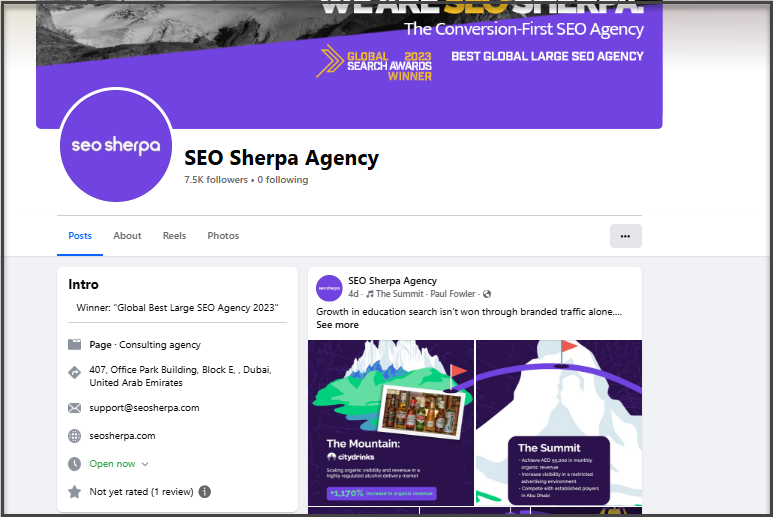
Think “SEO Sherpa — SEO Agency Dubai” rather than just “SEO Sherpa.” The additional descriptor tells Facebook’s algorithm exactly what your Page is about and helps you surface in searches related to your category and location.
Your username, which becomes your vanity URL (facebook.com/yourusername), should be clean, branded, and consistent with your URL across other platforms. If your default URL is still a string of random numbers, changing it to a recognizable username is one of the fastest wins in Facebook SEO. It improves both discoverability and click-through rates when your Page appears in search results.
Fill Out the About Section Properly
The About section is where you have the most space to incorporate strategic keywords naturally, and where most businesses fail spectacularly.
A complete, keyword-rich About section tells both Facebook’s algorithm and visiting users exactly what your business does, who it serves, and where it operates. It should include your primary service or product keywords, your location if relevant, and a clear description of your value proposition.
Avoid writing your About section like a press release. Write it like a well-optimized webpage: clear, purposeful, and structured around what a potential customer would actually search for.
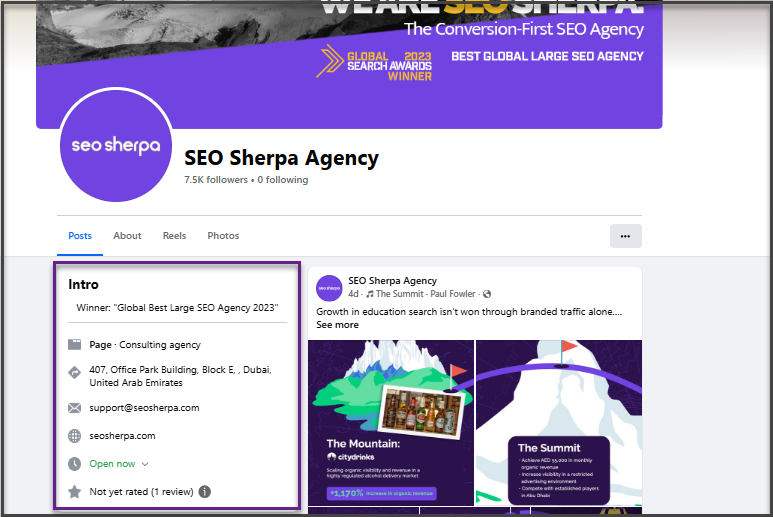
Be thorough. Every field in your Page information matters.
Opening hours, address, phone number, website URL, email, and price range all contribute to how Facebook categorizes and surfaces your Page in relevant searches.
Maintaining accurate and consistent contact details also improves your visibility in localized searches, which ties directly into local SEO performance both on-platform and in Google.
Add Categories and Services
Facebook allows you to select a primary category and up to two additional categories for your Page. These categories are a significant discoverability signal. They tell Facebook what type of business you are and which searches your Page should be surfaced for.
Be specific. “Marketing Agency” is better than “Professional Services” for an agency. “Italian Restaurant” is better than “Restaurant.” The more precisely your categories match your actual business, the more accurately Facebook will match your Page to relevant searches.
If you offer specific services, add them individually in the Services section. Each service you list is an additional keyword signal, and many Facebook users search for specific services rather than business types.
Optimize Visual Elements
Visual optimization on Facebook is often overlooked from an SEO standpoint, but it matters.
Your profile photo (typically your logo) and cover image are the first things users see when they land on your Page. They communicate brand credibility instantly. A blurry logo or a cover image that looks like it was designed in 2009 undercuts everything else you’re doing.
More relevantly for SEO: Facebook now allows alt text on images, and you should be using it. Descriptive alt text on your cover image and profile photo adds keyword context that the algorithm can use. It also improves accessibility, which is something the algorithm rewards.
Post images with intentional, descriptive captions. Photo captions are indexed by Facebook’s search algorithm. A photo of your team at an industry event with a caption that includes relevant keywords will perform better in search than the same photo with a one-word caption.
How to Optimize Facebook Posts for Search
Page optimization is your foundation. Post optimization is your ongoing strategy. This is where Facebook SEO becomes a daily practice rather than a one-time setup task.
Use Keywords in Captions Naturally
Every post you publish is an opportunity to signal relevance to Facebook’s algorithm. Keywords in your post captions help Facebook categorize your content and match it to relevant user searches.
But this is where you need to apply the same discipline you’d apply to on-page SEO. Natural language, not keyword stuffing. A caption that reads “Dubai SEO agency offers SEO services for Dubai businesses looking for SEO” is going to perform worse in every way than a caption that communicates real value while incorporating the right terms organically.
The formula is simple. Write for the person first. Then check that your primary keyword or topic is present and reads naturally. If it doesn’t, rewrite it. Keyword-rich content and readable content are not mutually exclusive.
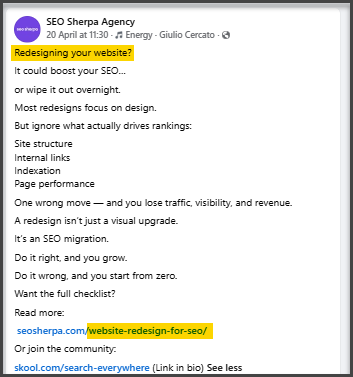
Optimize Hashtags
Yes, hashtags still matter on Facebook in 2026. No, you should not be using 30 of them.
Hashtags on Facebook function as search and discovery mechanisms. When a user clicks or searches a hashtag, they see a feed of content tagged with it. Including 3-5 highly relevant hashtags in your posts extends your reach beyond your existing followers to people browsing those topic feeds.
Choose hashtags that are specific enough to be relevant but broad enough to have an audience. A hashtag like #FacebookSEO will reach a different audience than #SEO. Both might be appropriate depending on your content. #DigitalMarketingTips is more discoverable than #DigitalMarketingTipsForEntrepreneurs2026.
Research your hashtags. Type them into Facebook search and see how much content is associated with them. A hashtag with very low usage means a very small audience. A hashtag with enormous usage means very high competition. The sweet spot is somewhere in the middle.
Post Format and Engagement Hooks
The format of your posts directly affects how much engagement they generate, which in turn affects how widely Facebook distributes them and how prominently they appear in search results.
In 2026, Reels are reshared 3.5 billion times every day across Facebook and Instagram, making video the platform’s most dynamic content format by a significant margin. Native short-form video content receives the strongest algorithmic push in terms of organic reach. If you’re not creating Reels, you’re leaving significant visibility untapped.
For text and image posts, the hook is everything. The first line of your caption needs to stop the scroll. A question, a surprising stat, a bold statement, or a relatable observation will consistently outperform a caption that starts with your company name and immediately lists services.
Structure longer captions with line breaks to improve readability. Facebook rewards dwell time, and a caption that’s easy to read is a caption people actually finish.
Timing and Recency Signals
Recency is a core Facebook ranking signal. Fresh content is consistently prioritized over older content in search results. This means posting regularly isn’t just an engagement strategy. It’s an SEO strategy.
Buffer’s 2025 analysis of over a million posts found that the single best time to post on Facebook is 5 a.m. on Monday, with Tuesday at 5 a.m. and Thursday at 7 a.m. also performing strongly. The logic is behavioral: Facebook’s core demographic of 25 to 34-year-olds checks their feeds first thing in the morning before work, so early posts have time to accumulate engagement before the day’s feed becomes crowded.
Posting at peak times increases the velocity of early engagement, and early engagement velocity signals to the algorithm that your post is worth amplifying. It’s the same compounding effect you see with early traction on any platform.
Consistency matters more than frequency. Publishing five posts one week and then going quiet for ten days is worse for your Facebook SEO than publishing three posts every week, reliably, over three months. Consistent daily posting signals to Facebook that your Page is active, which directly influences how often your content surfaces in search and suggested feed results.
Facebook SEO for Google Rankings
Here’s where Facebook SEO gets genuinely interesting for people whose primary concern is Google.
A well-optimized Facebook Page can rank in Google search results. Not might. Can.
Facebook Pages in Google SERPs
Facebook Pages are public, crawlable web assets. Google indexes them. This means when someone searches for your brand name in Google, your Facebook Page will likely appear in the first few results, often right after your website.
That’s a branded SERP position that you control. An unoptimized Facebook Page with minimal information and low engagement is a wasted ranking position. A well-optimized one reinforces your brand, communicates your services, and provides a pathway for potential customers who find you through Google to engage with your social content.
Social media profiles often secure top positions in search engine results pages, particularly for branded queries. This is not a passive benefit. It’s an active opportunity to shape how your brand appears across the entire first page of Google for your own name.

Indexation and Crawlability
For Google to index your Facebook Page content, it needs to be public. Content that is set to “Friends only” or shared in private groups is not crawlable and will not appear in Google search results.
Your Page’s basic information (name, About section, categories, contact details) is almost always publicly visible. But posts can be set to various privacy levels. For maximum SEO benefit, your business posts should be set to public. This allows Google to index them, which means your posts can potentially appear in Google search for relevant queries.
This is particularly valuable for posts that contain specific keyword combinations that people might search for outside of Facebook. A post about “how to optimize your Facebook page for SEO in Dubai,” set to public, can appear in both Facebook search and Google search results.
Advanced Facebook SEO Strategies
You’ve got the foundations. Now let’s talk about the tactics that separate a solid Facebook presence from one that’s genuinely dominant.
Leveraging Facebook Groups
Facebook Groups are one of the most underused SEO assets on the platform, and the stats around them are striking. Facebook has over 1.8 billion users actively engaging in Groups, and 74% of Group members say they join to connect with others who share similar interests.
Groups rank in Facebook search results, often more prominently than Pages for certain query types. A Group with an optimized name, a clear description loaded with relevant keywords, and an active community of engaged members will surface in searches related to its topic.
For businesses, there are two valid approaches. You can create and manage a Group around a topic adjacent to your business (a digital marketing tips group managed by a marketing agency, for example), or you can participate actively in existing Groups where your target audience already gathers.
Both approaches build authority. The first builds brand authority through owned community management. The second builds visibility through genuine participation in relevant conversations. The algorithm notices both.
The key is authentic value. Groups where moderators clearly exist only to drop links to their own content die quickly. Groups where the conversation is genuinely useful for members grow, and growing Groups gain search prominence.
Entity Optimization
Entity-based SEO is the concept that search engines don’t just understand keywords, they understand entities: named people, brands, places, and concepts with defined characteristics and relationships.
For Facebook SEO purposes, entity optimization means ensuring that your brand appears consistently across the web with the same name, the same description, the same category, and the same contact information. When Google sees “SEO Sherpa” described consistently as a Dubai-based SEO agency across your website, your Facebook Page, your LinkedIn, your Google Business Profile, and third-party review sites, it builds a clear and confident entity understanding of your brand.
That entity clarity improves your visibility across all search surfaces, including Facebook. Inconsistent branding, different business names across platforms, or different contact details, creates entity confusion that weakens your search presence everywhere.
Content Repurposing Strategy
Your Facebook Page should not exist in isolation from your other content channels. The most efficient Facebook SEO strategies treat the platform as part of a broader content ecosystem.
A blog post becomes a Facebook post that highlights the key insight and links back to the full article. That drives traffic to your website and generates social signals (shares, comments, clicks) that reinforce both your Facebook authority and your broader SEO standing. A Reel summarizing the same content reaches a different segment of the same audience and generates its own engagement signals. The Facebook post, shared in a relevant Group, reaches a community that might not yet follow your Page.
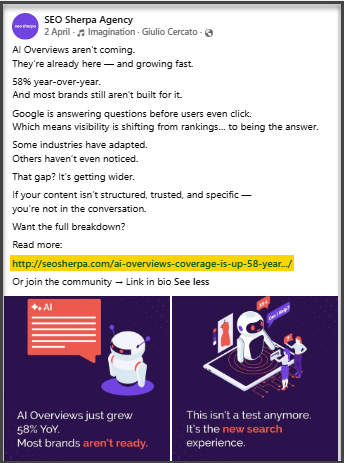
Each piece of content does multiple jobs. That’s not laziness, it’s leverage.
The repurposing loop also strengthens your internal links architecture across your content ecosystem. Consistent cross-linking between your website and your Facebook presence builds the entity signals that help both rank better.
Common Facebook SEO Mistakes to Avoid
Most Facebook Pages make the same mistakes. Here’s how to make sure yours isn’t one of them.
Keyword stuffing your Page name or captions. Stuffing “SEO | SEO Agency | Best SEO | SEO Services” into your Page name or posts doesn’t trick the algorithm. It makes your brand look untrustworthy, reduces engagement because users bounce when they see it, and the algorithm interprets that low engagement as a quality signal. Natural language wins every time.
Ignoring the vanity URL. A generic URL full of numbers is a missed optimization opportunity. It’s also harder to remember, harder to share, and harder for Google to interpret as a branded entity. If you haven’t customized your Facebook URL yet, do it today. It takes two minutes.
Posting inconsistently. Three posts this week and nothing for the next two is not a strategy. The algorithm weights recency and consistency heavily. Set a posting schedule and stick to it, even if that schedule is modest. Three well-crafted posts per week, every week, will outperform 10 posts followed by silence.
Treating Facebook as a broadcast channel. If your entire strategy is posting content and never responding to comments or messages, you’re leaving your most important engagement signal unrealized. The algorithm notices when a Page responds to its audience. More importantly, your audience notices.
Using the wrong content format for the platform. Posting only link posts with large images is not optimal in 2026. The algorithm consistently favors native content, particularly Reels and videos uploaded directly to Facebook rather than shared from YouTube or other platforms. Native content stays on Facebook. External links take users away. Facebook’s algorithm rewards content that keeps people on the platform.
Neglecting local signals. If you’re a business with a physical location or a specific service area, you’re missing significant search traffic if you’re not geotagging posts, listing your location clearly, and creating location-specific content for your most important markets.
Facebook SEO + Search Everywhere Optimization™
No platform exists in isolation. This is the central truth that every social SEO strategy needs to be built around.
Facebook SEO is most powerful when it sits inside a broader Search Everywhere Optimization™ framework. That means your Facebook presence is coordinated with your Google rankings, your Instagram SEO, your TikTok SEO strategy, and your website’s content to create a unified visibility footprint across all the places your audience searches.
The search landscape in 2026 is genuinely multi-surface. Someone might discover your brand through a Google search, visit your Facebook Page to check your reviews and recent posts, join your Facebook Group to engage with your community, follow you on Instagram, and eventually book through your website. That entire journey is a Search Everywhere journey. Optimizing only the beginning or only the end of it misses the full picture.
The brands that dominate in this environment are not necessarily the ones with the biggest budgets. They’re the ones with the most coherent, consistent, and strategically optimized presence across the platforms their audience actually uses.
Facebook, for a very large portion of the global population, is still one of those platforms.
Make Facebook SEO Part of Your Search Everywhere Strategy
Facebook SEO isn’t a hack. It isn’t optional extras. It’s a legitimate search discipline applied to a platform with 3 billion monthly active users, a functioning search algorithm, and the ability to surface your brand in both on-platform searches and Google SERPs.
A fully optimized Facebook Business Page with keyword-rich copy, consistent posting, active community engagement, and a clear entity presence across the web is a real visibility asset. It drives discovery, builds authority, and converts people who were searching for exactly what you offer into people who find you.
But here’s the honest truth: doing all of this well, across Facebook and every other platform your audience uses, takes real strategic thinking and consistent execution. Most businesses don’t have the bandwidth to get it right on their own.
That’s where SEO Sherpa comes in. Our Search Everywhere Optimization™ service is built to help brands win visibility across the entire modern search landscape, not just Google. Book a free discovery call and let’s build a strategy that puts your brand in front of your audience wherever they’re looking.






















Leave a Reply