
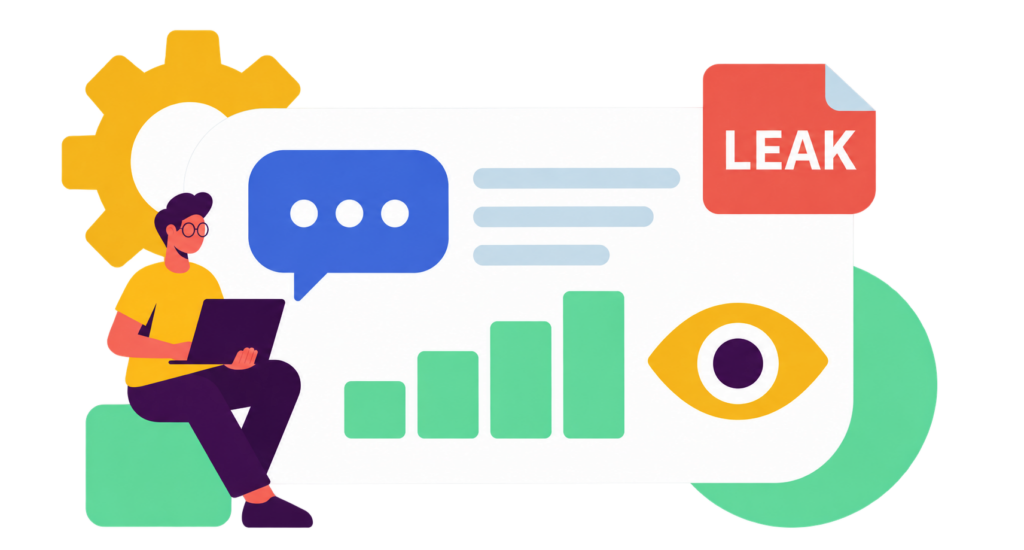

OpenAI may be developing its own version of Google Search Console, allowing businesses to see how frequently they appear in ChatGPT responses and how many clicks those appearances generate.
The potential feature, reportedly part of something called Business Hub, was uncovered by e-commerce analyst Juozas Kaziukėnas on November 6, 2026.
Now, before we get too excited and start planning another dashboard to obsessively refresh every morning, there’s an important caveat.
OpenAI has not officially confirmed, announced or released this feature. The information comes from a leaked interface and observations shared by Kaziukėnas, not an official OpenAI announcement.
However, if the feature does materialize, it could represent a significant step forward for generative engine optimization (GEO), particularly when it comes to something the industry has struggled with: reliable, first-party AI visibility data.
Article Summary
- A leaked ChatGPT interface suggests OpenAI is developing a Business Hub that would allow businesses to claim and manage their presence within ChatGPT.
- The reported tool could provide daily impressions and clicks, giving marketers first-party data on how often their businesses appear in ChatGPT responses.
- Additional features may include business information management and AI-powered business agents.
- OpenAI has not officially confirmed the feature, and no public launch date has been announced.
- If released, the platform could significantly improve GEO reporting, although prompt-level tracking and competitor analysis would still be needed.
What Has Been Leaked About ChatGPT’s Business Hub?
On November 6, Juozas Kaziukėnas shared a screenshot on LinkedIn showing an unreleased ChatGPT interface inviting businesses to Claim your business in ChatGPT.

The screenshot outlined three potential capabilities:
- Business visibility analytics: Track how often a business appears in ChatGPT conversations.
- Business information management: Add products and keep business information updated.
- Business agents: Allow an AI agent to answer customer questions using information supplied by the business.
According to Kaziukėnas, the analytics functionality could track daily impressions and clicks, displaying both metrics in a chart.
He also suggested that businesses would need to verify ownership before accessing the platform, potentially through integrations such as Shopify.
Kaziukėnas claims he first noticed signs of the feature in August, with the latest interface suggesting development may be progressing.
The discovery was subsequently covered by Search Engine Land.
However, there’s an important distinction between an interface appearing in an unreleased product and an actual product launch.
Nothing has been officially confirmed by OpenAI, including the final functionality, availability or release date.
Why a ChatGPT Search Console Could Be Huge for GEO
Here’s where this gets particularly interesting.
One of the biggest challenges with generative engine optimization has been measuring visibility reliably.
With traditional SEO, businesses have access to Google Search Console, which provides first-party information about impressions, clicks, queries and search performance.
That gives marketers a relatively consistent source of data to evaluate their SEO efforts.
GEO hasn’t had the same luxury.
Currently, much of the industry relies on third-party AI visibility tracking platforms. These tools monitor selected prompts and analyze whether brands appear in generated responses.
They’re incredibly useful for understanding recommendations, citations, competitor visibility and AI share of voice.
But there’s a catch.
Most of these platforms measure visibility through a sample of prompts rather than the complete collection of conversations happening within an AI platform.
Consequently, their results reflect the prompts tested and the methodology used, rather than an exact count of real-world brand appearances.
That’s not necessarily a problem with the tools themselves. It’s a limitation of the data available to them.

First-Party Data Could Change the Conversation
If OpenAI introduces direct reporting, businesses could potentially see how frequently ChatGPT actually displays their brand.
That would be a substantial development.
Imagine investing in a GEO campaign focused on improving content, strengthening entity signals and building brand authority through digital PR.
Third-party tools might indicate that your brand is appearing more frequently in relevant AI-generated responses.
An official ChatGPT analytics dashboard could then provide additional evidence showing whether your overall impressions and clicks were increasing.
For agencies, this could help create a much stronger reporting framework for demonstrating improvements in AI visibility.
Of course, we’d still need to understand OpenAI’s reporting definitions and data coverage before calling those numbers comprehensive.
But first-party reporting would be an important improvement over relying exclusively on estimates.
And frankly, anything that helps marketers move beyond presenting estimated AI visibility percentages as gospel would be welcome.
What the Leaked Dashboard Apparently Won’t Show
Before declaring this the end of third-party GEO tracking tools, there’s another important detail.
According to Kaziukėnas, the reported dashboard doesn’t currently provide:
- The prompts responsible for brand appearances
- Competitor comparisons or AI share of voice
- Rankings or recommendation positions
- Individual user data
That creates some fairly significant limitations.
For example, a business could discover that it appeared in 15,000 ChatGPT responses during a month.
Fantastic.
But what exactly were those responses about?
Was ChatGPT actively recommending the business? Was it simply mentioning the company as one option among several? Or was it explaining why customers might want to avoid it?
Those are three very different outcomes.
This is why impressions alone aren’t sufficient for measuring meaningful GEO success.
At SEO Sherpa, we believe effective AI visibility measurement needs to consider not only whether a brand appears, but also the context, accuracy and commercial relevance of those appearances.
An official OpenAI dashboard could provide the numbers. Third-party tracking and strategic analysis would still be needed to explain what those numbers actually mean.
Could Businesses Also Control Their ChatGPT Presence?
There’s another potentially important element to the leaked interface: business information management.
The ability to claim a business, update its details and provide information to an AI agent could introduce a new way for organizations to manage their presence within ChatGPT.
This isn’t entirely disconnected from OpenAI’s existing commercial initiatives.
For example, OpenAI already provides documentation for merchant product feeds, allowing approved partners to supply structured product information for ChatGPT shopping experiences.
The rumored Business Hub could potentially extend business-management functionality further.
However, that doesn’t mean businesses would suddenly control ChatGPT’s organic recommendations.
There’s currently no evidence that claiming a business would guarantee visibility, influence recommendation rankings or give companies editorial control over independently generated answers.
And if anyone starts selling guaranteed ChatGPT recommendations because of a feature that hasn’t even launched, we’d recommend keeping a firm grip on your marketing budget.
What Would This Mean for Businesses and GEO Agencies?
If the rumored functionality becomes available, it could help businesses make more informed decisions about their GEO investments.
Instead of measuring success exclusively through sampled prompts and website referrals, marketers could potentially combine platform-reported visibility with other performance indicators.
That might include AI referral traffic and commercial outcomes, prompt-level visibility, brand citations and competitor recommendations.
For businesses, the benefit would be greater transparency into how their presence within ChatGPT changes over time.
For GEO agencies, it could strengthen accountability by providing another source of evidence when evaluating campaigns.
But there’s also a wider consideration.
GEO shouldn’t be reduced to ChatGPT optimization.
Customers use different AI platforms throughout their research and buying journeys. Improving visibility within one platform doesn’t automatically translate to visibility across the others.
That’s why our approach to ChatGPT SEO sits within a broader Search Everywhere strategy.
An official ChatGPT reporting platform would be incredibly valuable, but it would still represent just one part of the wider AI search landscape.
What Should Businesses Do Now?
For the moment, there’s no confirmed Business Hub product to sign up for.
And we’d certainly recommend against changing your GEO strategy based solely on an unconfirmed leak.
Instead, businesses should continue focusing on the fundamentals of sustainable AI search visibility.
That means understanding the questions their customers ask, monitoring how they’re represented across AI platforms and ensuring their content provides accurate, useful information.
It also means establishing meaningful GEO reporting today, rather than waiting for OpenAI to introduce another analytics platform.
If Business Hub eventually launches, having existing visibility benchmarks will make the new data considerably more useful.
Final Thoughts: A Potential Turning Point for GEO Measurement
It’s important to remember that this is still an unconfirmed leak.
We don’t know whether OpenAI will release Business Hub, when it might become available or what functionality will survive into a finished product.
However, the potential implications are difficult to ignore.
First-party impressions and clicks could provide GEO with something it’s been missing: a more direct, reliable source of ChatGPT visibility data.
That wouldn’t solve every measurement challenge, and it certainly wouldn’t make third-party tracking tools redundant.
But combined with prompt monitoring, competitive analysis and business performance data, it could help make GEO reporting significantly more transparent.
For an industry still working to establish consistent measurement standards, that would be a very welcome development.
Now we just need OpenAI to actually confirm it.
Whether or not Business Hub becomes a reality, understanding how your brand appears across AI-powered search platforms is already essential.
At SEO Sherpa, our GEO services help businesses strengthen their visibility across ChatGPT and the wider AI search landscape.
If you’d like to understand where your business stands and what opportunities you could be missing, book a free discovery call with our team.


















Leave a Reply