


AI search has an attribution problem.
A buyer may discover your brand in Google AI Overviews, compare you inside an AI-powered Answer Engine, return days later through Branded Search, and convert after clicking a Google Ads result. Your dashboard then congratulates paid search. AI search receives precisely nothing.
That is the last-click lie at the center of AI search ROI. AI-generated answers often influence brand discovery long before the final session, which means Google Analytics, Search Console, and traditional attribution methods can understate the real contribution of AI-driven discovery.
The good news is that proving value does not require an enterprise identity graph and a procurement process long enough to qualify as historical fiction.
You can build a credible ROI measurement framework using branded search lift, self-reported attribution, AI referral traffic, assisted conversions, and GA4’s emerging AI channel data. This guide shows you how to connect AI search visibility with pipeline, revenue, and marketing ROI without pretending every citation deserves full credit for the sale.
Article Summary
- AI search ROI measures the financial return from improving visibility in AI-generated answers, including Google AI Overviews, generative search experiences, and other AI-powered Answer Engines.
- Last-click attribution routinely misses AI’s role in the journey because the eventual conversion may arrive through Branded Search, direct traffic, organic traffic, or another channel.
- You can begin measuring without buying an attribution platform by combining branded search lift, self-reported attribution, AI referral traffic, and assisted conversions.
- Visibility metrics are leading indicators, not revenue proof. Citation presence, share of voice, and AI visibility tracking should eventually connect to pipeline influence, conversion rate, and customer value.
- The formula is the easy part. The harder job is defining AI-attributed revenue honestly and assigning a defensible fractional contribution across the full customer journey.
What AI Search ROI Actually Means
AI search ROI is the measurable return generated by improving your visibility inside AI-powered search experiences: Google AI Overviews, generative models, AI summaries, and other answer engines that influence how people discover, compare, and shortlist brands.
The basic formula is familiar:
AI search ROI = ((AI-attributed revenue − total AI search investment) ÷ total AI search investment) × 100
If you spend $20,000 on AI search optimization and can credibly attribute $70,000 in revenue to that work, your ROI is:
(($70,000 − $20,000) ÷ $20,000) × 100 = 250%
The difficult part is not the arithmetic. It’s deciding what counts as AI-attributed revenue without awarding the entire sale to one citation that appeared three weeks before conversion and then disappeared into the dark funnel like a magician with a quarterly target.

AI Search ROI Is Not the Same as Broader AI ROI
This is about search and marketing ROI. Not enterprise AI ROI, not productivity gains, not the money saved because a chatbot now drafts meeting notes nobody reads.
AI search ROI measures the business value created when your brand becomes more visible in AI-generated answers and that visibility influences traffic, leads, assisted conversions, pipeline, or revenue. That may include revenue from identifiable AI referral traffic, assisted conversions involving AI-referred sessions, leads that self-report discovery through ChatGPT or another answer engine, branded search lift following increased citation presence, pipeline influenced by AI-driven discovery, and higher conversion rates from visitors already familiar with the brand.
This is why AI search visibility ROI sits closer to content marketing ROI and SEO ROI than to a general artificial intelligence business case. The work may involve generative engine optimization, answer engine optimization, structured data, and content updates. But the commercial question remains reassuringly old-fashioned: Did this investment produce more value than it cost?
Visibility Is Not ROI
AI visibility tracking is useful, but it’s not the finish line.
Metrics such as share of voice, citation share, citation presence, and content citation rate can show whether generative models are finding and mentioning your brand. Those are leading indicators. They tell you whether your strategy is gaining traction. They do not prove that anyone bought anything.
A brand can dominate citation share for broad informational prompts and generate almost no qualified demand. Another may appear less frequently but show up consistently in high-intent comparisons used by actual buyers. The first dashboard looks more impressive. The second may produce more revenue.
This is why visibility should be segmented by prompt type, customer stage, audience, and commercial intent. A mention in “What is CRM software?” is not equal to a citation in “Best CRM for a 50-person sales team.” One creates awareness. The other may create a shortlist.
AI-Attributed Revenue Should Reflect Influence, Not Ownership
AI search rarely owns the entire customer journey. It often starts or shapes it.
A buyer may encounter your brand in an AI-generated answer, visit your site later through organic traffic, return through Branded Search, speak to sales, and finally convert after an email touchpoint. Last-click attribution credits the final interaction. A more honest model gives AI search a fractional contribution based on the role it played.
Assigning 100% of the revenue to AI search would overstate the case. Assigning 0% would ignore the event that placed the brand into consideration. That is where multi-touch models, cross-channel attribution, and revenue attribution become useful. The goal is not perfect certainty. It is a consistent, defensible method that reflects how customers actually move through the funnel.
Costs Must Include More Than Software
The investment side of the formula is often understated. Teams count the LLM visibility platform subscription, then quietly ignore everything else required to make the program work: agency fees, internal SEO teams, content creation and updates, technical implementation, structured data work, labor costs, research, reporting, and opportunity cost.
Suppose an ecommerce brand spends $3,000 monthly on software, $8,000 on content and technical work, and another $4,000 in internal labor. The actual monthly investment is $15,000, not $3,000. Using the smaller number may produce a delightful ROI percentage. It may also produce a difficult finance meeting when someone locates the rest of the invoices.
Revenue Is Not the Only Useful Return
For businesses with long sales cycles, AI search may influence several pipeline stages before closed revenue appears. Useful intermediate measures include qualified lead generation, pipeline influence rate, demo requests, sales-qualified opportunities, category query volume, branded search lift, and assisted conversions.
A B2B company with a nine-month sales cycle should not judge a new GEO investment using the same window as an ecommerce brand selling $40 skincare products. One can convert before the browser tab cools. The other may require six calls, three stakeholders, a security review, and one person from legal who joins late and changes everything.
AI Search ROI Is a Measurement System, Not One Number
A credible framework connects three layers:
- Visibility: Are AI systems finding and citing the brand?
- Influence: Are those mentions changing discovery, branded search behavior, traffic, or consideration?
- Commercial Impact: Are influenced users generating leads, pipeline, assisted conversions, and revenue?
Jumping from citation presence straight to revenue produces shaky claims. Stopping at citation share produces a visibility report dressed as a business case. The strongest approach tracks the whole chain: visibility creates the opportunity, customer behavior reveals the influence, revenue determines the return.
Why Most Teams Think AI Search Doesn’t Pay Off (and Are Wrong)
AI search often looks underwhelming in a standard analytics report. A handful of referral sessions, a few assisted conversions, and perhaps one suspiciously enthusiastic lead who typed “ChatGPT” into the “How did you hear about us?” box. Meanwhile, branded search, direct traffic, organic search, and Google Ads collect the revenue credit like colleagues who put their names on the cover of a group project they joined at the end.
The issue is usually not that AI search failed to create value. It is that your attribution methods were designed for a cleaner customer journey than the one your customers actually took.
Last-Click Attribution Rewards the Final Doorway
Last-click attribution assigns the conversion to the last tracked channel before purchase. That model is simple. It is also rather like crediting the restaurant’s front door for the entire meal.
Imagine a buyer asks an Answer Engine, “What are the best inventory platforms for a growing ecommerce brand?” Your company appears in the answer. The buyer recognizes your brand and carries on researching. Three days later, they perform a branded search, visit your product pages, leave, return through direct traffic, and request a demo after clicking a remarketing ad.
Google Analytics may credit Google Ads. Search Console may show the branded query. Your CRM may record direct or organic as the original source. The AI interaction that introduced the brand remains invisible. Each later channel may have contributed. But giving the entire conversion to the last touch turns a multi-stage journey into a children’s drawing of a funnel: neat arrows, very few inconvenient humans.
AI Discovery Often Produces a Later Branded Search
One of AI search’s most valuable effects may happen outside the AI platform itself. A user sees your brand mentioned in AI Overviews, ChatGPT, Perplexity, or Copilot, remembers the name, and searches for it later. That later visit appears as branded search or direct traffic.
This is why branded search lift matters. If citation presence increases for commercially relevant prompts and branded query volume rises soon afterward, the relationship is worth investigating. It is not automatic proof of causation, but it is a much stronger business signal than citation share viewed in isolation. The buyer did not necessarily click the AI answer. The answer still influenced what they searched for next.
Missing Referral Data Pushes AI Visits Into “Direct”
Even when someone clicks through from an AI tool, attribution can remain incomplete. GA4 can only classify an AI referral when the visit carries recognizable source information. Visits from apps, privacy-protected environments, copied links, or interfaces that do not pass a referrer may fall into Direct instead.
Direct traffic is GA4’s miscellaneous drawer for sessions where the source could not be identified, so missing referrer data, untagged campaigns, and AI-influenced visits can all inflate it.
Google introduced an AI Assistants default channel group in GA4 in May 2026, which makes identifiable traffic from supported AI assistants easier to separate. But the classification still depends on the referrer being present, so it should be treated as a useful baseline rather than a complete count.
A quiet AI channel beside a growing Direct bucket is not conclusive evidence that AI search optimization is failing. It may simply mean the attribution plumbing has sprung a leak behind the wall.
Zero-Click Influence Does Not Appear in Traffic Reports
AI search visibility often begins before the session exists. A customer may read an AI summary that includes your brand, pricing model, or product category, never click the citation, and still become more likely to recognize you later. That creates brand discovery without referral traffic.
This is where SEO teams get into trouble when they use organic traffic as the sole North Star metric. A campaign can increase AI search visibility, share of voice, branded search, and pipeline familiarity while referral sessions remain modest. The commercial effect may surface later through direct visits, sales calls, or dark social signals. Annoyingly difficult to measure? Yes. Commercially irrelevant? No.
AI Search Sits Earlier in the Buying Journey
A customer using AI search is often defining the problem, researching approaches, comparing vendors, building a shortlist, or checking whether a brand appears credible. Those activities may happen weeks or months before revenue. For ecommerce, the gap can be shorter. For B2B, the journey may involve multiple people, several pipeline stages, a demo, and one stakeholder who replies to every email with “looping in procurement.”
This is why assisted conversions, multi-touch models, and pipeline influence rate are better suited to the channel than a narrow same-day conversion view. AI search is often an introduction channel. Demanding that it behave like a checkout button is a measurement category error.
The Data Behind the Undercount
There is growing vendor-reported evidence that last-click models materially understate AI search contribution, but the figures should be handled carefully.
SegmentStream reports that, across its customers, AI search’s estimated contribution to sales is five to eight times higher than last-click attribution suggests, rising as high as 15 times for B2B and high-value products. Those numbers come from an attribution-platform vendor using its own customer data, so they are useful directional evidence, not an independently audited benchmark. A vendor selling cross-channel attribution has an obvious interest in demonstrating that last click is broken. This does not make the finding false. It means you should not paste “15x” into a leadership deck as a law of marketing physics.
The broader pattern is more defensible than any single multiplier:
AI search frequently influences discovery upstream, the final visit often arrives through another channel, and standard analytics therefore capture only part of the journey. We can also see the scale of the shift.
OpenAI said ChatGPT was handling more than 2.5 billion prompts per day by July 2025, indicating that AI-assisted research had already reached enormous volume before many dashboards had a way to classify it. Not every prompt is a search, and not every search is commercial. But enough buyer research is moving through generative interfaces that ignoring the influence because the referral row looks small is becoming difficult to defend.
Undermeasurement Can Also Become Overclaiming
There’s a danger on the other side. Once teams realize last click understates AI search, they may become tempted to give AI full credit for every conversion that followed a citation. That is equally misleading. A brand mention may have introduced the company. The landing page, email sequence, product quality, sales team, and pricing may have done the rest.
AI search should receive a fractional contribution when evidence suggests it influenced the journey, not ownership of the entire revenue number. Combining AI referral traffic, Branded search lift, assisted conversions, self-reported discovery, and revenue outcomes will give you a far more defensible picture than staring at one GA4 row and declaring the entire channel a decorative experiment. Most teams do not have an AI performance problem. They have an AI measurement problem. And unlike the customer journey, that problem is relatively straightforward to fix.
3 Ways to Measure AI Search ROI Without Buying a Platform
You don’t need an enterprise attribution platform to begin. You need three things your business probably already has: Search Console, Google Analytics, and customers capable of answering a short question without filing a formal complaint. The strongest free framework combines branded search lift, self-reported attribution, and GA4’s AI Assistants channel. None provides perfect revenue attribution alone. Together, they help reveal the influence that last-click attribution politely sweeps under the carpet.
Method 1: Track Branded Search Lift
Branded search lift measures whether more people begin searching for your company, products, or executives by name after your AI search visibility improves. This matters because AI-generated answers often introduce the brand without generating an immediate click.
Google Search Console’s performance report lets you separate branded and non-branded queries, then analyze changes in impressions and clicks over time. Start by creating a list of brand-related terms: company name, common misspellings, product names, executive names, “brand + reviews,” “brand + pricing,” and “brand + alternatives.”
Then establish a baseline. Export at least three to six months of branded query data before a major GEO campaign, tracking impressions, clicks, query volume, and the product pages receiving branded traffic. Next, compare that baseline against changes in AI visibility:

The branded impression increase is:
((17,400 − 12,000) ÷ 12,000) × 100 = 45%
That doesn’t prove AI search caused every additional query. Marketing does not occur in a laboratory where someone has thoughtfully removed the PR campaign, seasonal demand, and enthusiastic new sales director. So annotate other events that could affect branded demand: Google Ads campaigns, product launches, media coverage, influencer activity, events, and offline advertising.
Then look for repeated patterns. Did branded searches rise after citation presence improved across high-value prompts? Did the lift occur for specific products mentioned in AI answers? Did it persist beyond a one-week spike? Correlation is not causation. But repeated, commercially logical correlation is useful evidence, especially when it agrees with your other measurement layers.
Method 2: Ask Customers How They Found You
Self-reported attribution closes gaps analytics tools cannot. Add a simple question to your demo request form, contact form, signup flow, checkout, or sales discovery process: How did you first hear about us?
Use an open-text field rather than relying only on a dropdown. Dropdowns make reporting tidy, but they force customers to describe a messy journey using whichever answer marketing remembered to include last quarter. Someone who discovered you in ChatGPT may select “Google” because “AI assistant” was not an option. An open field captures responses such as “ChatGPT recommended you,” “Saw your company in a Google AI answer,” “Perplexity comparison,” or “I kept seeing your name while researching.”
Standardize these into an AI-discovery category, then connect them to commercial outcomes: lead quality, conversion rate, average order value, sales cycle length, pipeline stage reached, and closed revenue.
Suppose 40 customers self-report AI discovery during a quarter. Of those, 10 convert, generating $80,000 in revenue. Your conversion rate is 25%, and your directly self-reported AI-attributed revenue is $80,000. You may give AI search full credit when the customer explicitly names it. For more complex journeys, assign fractional contribution instead. For example: AI search introduced the brand (30%), organic content supported evaluation (20%), sales interaction influenced the decision (30%), final branded visit closed the conversion (20%). On a $20,000 sale, AI search receives $6,000.
The percentages do not need to be handed down on stone tablets. They need to be documented, consistent, and based on how your funnel works. This method is especially useful for B2B lead generation, where the buying journey crosses devices, people, and several meetings with increasingly elaborate calendar titles. It also captures dark social signals that analytics cannot see, such as copied links and AI recommendations shared internally.
Method 3: Use GA4’s AI Assistants Channel
Google Analytics now includes an AI Assistants default channel group for identifiable traffic from sources such as ChatGPT, Gemini, DeepSeek, Copilot, and Grok. Google notes that this channel excludes traffic from Google’s AI Overviews, which continues to be counted under organic search. That gives you a free baseline for measuring visible AI referral traffic.
In GA4, open Reports, go to Acquisition, open Traffic acquisition, set the primary dimension to Session default channel group, and filter for AI Assistants. Then review sessions, engaged sessions, key events, conversion rate, purchase revenue, landing pages, and new versus returning users.
Do not stop at session volume. AI-assisted sessions may be small but commercially valuable. Compare their conversion rate and customer value with organic, paid, social, and direct traffic. A channel sending 500 visits at a 6% conversion rate may deserve more attention than one sending 5,000 visits at 0.4%.
Next, inspect the landing pages receiving AI referral traffic. These often reveal which brand content generative models consider useful enough to cite. You may find that comparison pages attract high-intent visitors, research-led articles influence lead generation, product pages convert better than informational content, or older content updates produce more AI referral traffic than new pages.
GA4’s Key event attribution paths report can also show which channels initiate, assist, and close conversions, letting you investigate paths such as AI Assistants → Organic Search → Direct → Conversion, or AI Assistants → Branded Search → Google Ads → Purchase. If AI Assistants repeatedly appear early in successful journeys, last-click attribution is undercounting their contribution.
One caveat: GA4 only classifies traffic it can identify. AI Overviews are excluded from the grouping, and visits without usable referral information may appear elsewhere. So treat the channel as a confirmed minimum, not a complete census. Your AI channel report is the visible tip of the iceberg. The rest is probably sitting in Direct traffic, branded search, assisted conversions, and one salesperson’s notebook under “lead said ChatGPT.”
Combine the 3 Methods Into 1 Scorecard
Each method answers a different question:
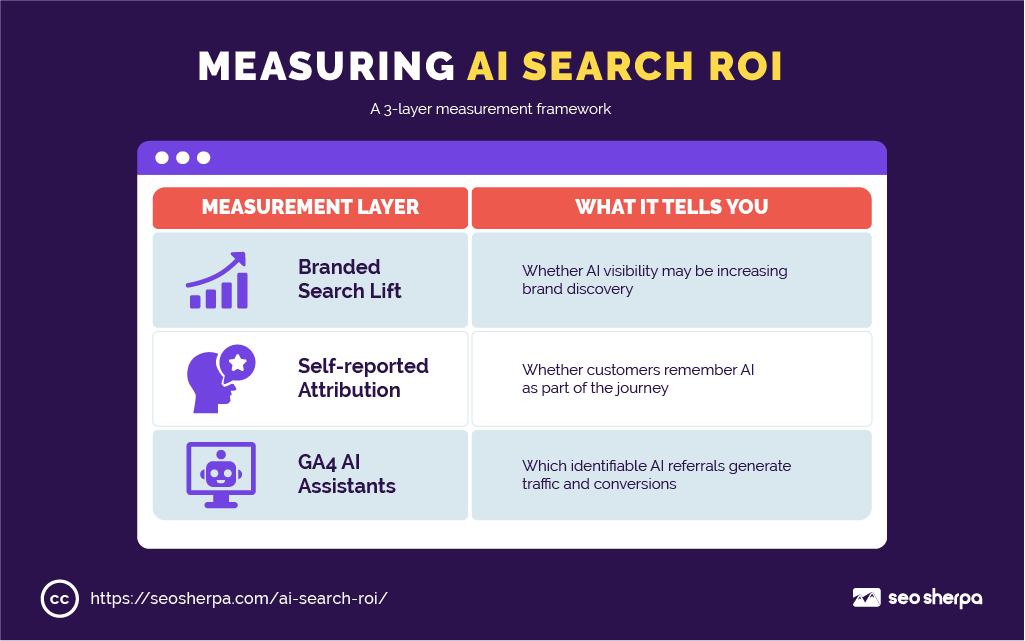
Review them together monthly. A useful scorecard might include citation share for commercially relevant prompts, branded impressions and clicks, AI Assistant sessions, AI-assisted conversions, self-reported AI leads, pipeline influenced, closed AI-attributed revenue, average AI-referred customer value, total GEO investment, and calculated ROI.
When all three layers move in the same direction, the business case becomes much stronger. Citation share rises, branded search grows, more customers name AI tools during signup, AI-assisted sessions appear in conversion paths, and pipeline follows. No single metric proves the entire story. Together, they form something considerably more useful than a vendor dashboard containing 14 shades of purple and one very optimistic visibility probability score.
What ‘Good’ Looks Like: 2026 AI Search ROI Benchmarks
There is no universal “good” AI search ROI benchmark yet. The channel is too new, measurement standards are too inconsistent, and most published results come from vendors and agencies using different attribution methods. So treat benchmarks as directional reference points, not sacred numbers to present in a board meeting while hiding the methodology in eight-point font.
Expect Visibility to Move Before Revenue
AI search optimization usually produces leading indicators before attributable revenue. Citation presence, citation share, and AI search visibility may begin changing within weeks of content updates. Revenue tends to take longer because buyers still need to move through the rest of the journey.
A reasonable planning window is eight to 12 weeks for first citation-rate movement, with revenue attribution becoming more visible over roughly 90 to 180 days, depending on sales-cycle length. These are planning expectations, not guaranteed timelines. An ecommerce brand may see AI referral traffic and purchases relatively quickly. A B2B company selling enterprise software may wait months while the lead progresses through demos, security reviews, and procurement.
Use a staged measurement model:

Citation Growth Is Useful, but Only When the Prompts Matter
A rising citation rate is a positive early signal. But the quality of those citations matters more than the raw total.
Suppose your Citation Presence rises from 10% to 30%.
That sounds excellent. But perhaps the new mentions appear only for broad prompts such as “What is marketing automation?” while your brand remains absent from “Best marketing automation software for ecommerce brands.”
The first creates awareness. The second is more likely to influence pipeline.
So segment AI visibility tracking by informational versus commercial intent, ideal customer profile, product category, funnel stage, region, and brand versus competitor comparison. A benchmark is only useful when it reflects the queries your buyers actually ask. Otherwise, you are measuring applause from the wrong room.
AI-Referred Visitors May Convert at Higher Rates
Several published datasets suggest AI referral traffic can convert at a higher rate than traditional organic traffic, though figures vary considerably by brand, industry, platform, and sample size.
HubSpot reported that traffic referred by large language models converted at roughly three times the rate of traditional search within its own business, attributing a large increase in qualified AI-originated leads to a broader answer engine optimization strategy involving structured content, proprietary insights, and off-site visibility.
This is a named company result, not an independently audited market-wide benchmark, and other studies have found the difference disappears under statistical testing.
The strategic explanation is plausible. Someone arriving from an AI-generated answer may already have described a specific problem, compared several approaches, asked for recommendations, and seen your brand positioned as relevant. That visitor may arrive further along in the decision process than someone clicking a broad informational result.
But do not assume every AI-assisted session is high intent. A citation from “What is email marketing?” is not the same as a recommendation for “Best email platform for a 20-person ecommerce team.” Measure conversion rate by prompt theme, landing page, platform, and customer segment before declaring AI search your most efficient acquisition channel.
Branded Search Lift Is Often the Clearest Free Benchmark
Because so much AI influence occurs without an immediate click, branded search lift can be one of the most practical benchmarks available. A healthy pattern looks like this: citation share rises across commercially relevant prompts, branded search impressions increase, searches involving product names or “brand + pricing” grow, direct and organic conversion volume rises, and self-reported AI discovery increases. One metric alone is ambiguous. Together, they begin to tell a coherent story.
There is no universal percentage that constitutes “good” lift. The right benchmark is your own pre-campaign baseline, adjusted for paid media, PR, product launches, and seasonality. A 12% increase may be meaningful for an established brand with stable demand. A 50% increase may be meaningless if it occurred during a national advertising campaign.
Pipeline Influence Matters More Than Referral Volume in B2B
For B2B companies, referral traffic is often too small and incomplete to serve as the primary success metric. Pipeline influence rate is more useful:
AI-influenced pipeline ÷ total pipeline × 100
Suppose your company generates $2 million in qualified pipeline during a quarter. If $300,000 of that pipeline includes an identifiable AI referral, a self-reported AI discovery response, or another documented influence signal, the pipeline influence rate is:
$300,000 ÷ $2,000,000 × 100 = 15%
That does not mean AI search deserves full credit for $300,000. It means AI played a measurable role in opportunities representing 15% of the pipeline. From there, assign a fractional contribution using your attribution model. This is much more defensible than saying, “ChatGPT sent 47 sessions, therefore the campaign did not work.” One measures strategic influence. The other measures how many browsers remembered to bring referral headers.
Share of Voice Should Be Compared With Competitors
AI share of voice is most useful as a relative benchmark. It shows how often your brand appears compared with competitors across a defined prompt set:
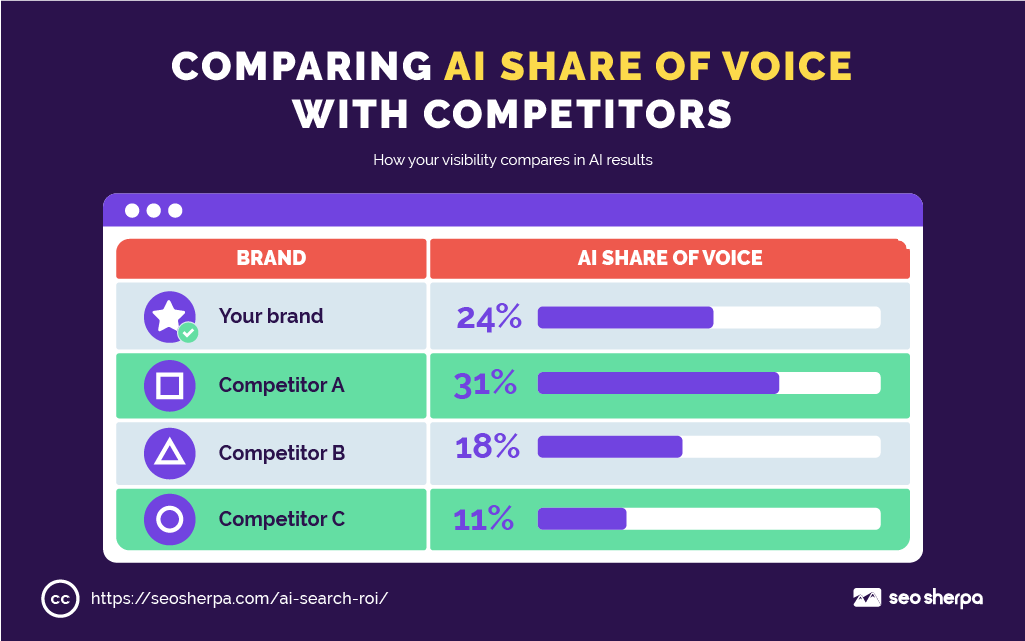
A rise from 8% to 24% shows meaningful progress. But generative outputs vary across runs, wording, time, and platform, so AI visibility should be measured repeatedly and treated as a distribution rather than a single fixed ranking. One prompt check on one Tuesday afternoon is not a benchmark. It is an anecdote with a timestamp. Use repeated queries, prompt variations, multiple platforms, and consistent sampling intervals.
Citation Metrics Need Separate Definitions
LLM visibility platforms use terms such as citation likelihood score, retrievability probability, visibility probability, citation share, and content citation rate. These may sound interchangeable, but they are not. A useful reporting framework separates:
- Retrievability: Whether the content can be discovered and retrieved by the system
- Citation Presence: Whether the brand or page appears as a cited source
- Mention presence: Whether the brand appears without a link or citation
- Prominence: Where and how strongly the brand is presented
- Accuracy: Whether the answer represents the brand correctly
- Commercial Relevance: Whether the prompt relates to a valuable buyer need
In plain English: being cited is promising, being cited accurately for a query used by actual buyers is better, and producing revenue from that visibility is the benchmark that eventually matters.
A Good ROI Percentage Depends on What You Include as Cost
AI search ROI becomes meaningful only when the investment figure is honest. Suppose your annual program produces $240,000 in AI-attributed revenue and costs $80,000:
(($240,000 − $80,000) ÷ $80,000) × 100 = 200% ROI
That means $2 in profit above cost for every $1 invested. But include all relevant costs: agency fees, AI tools, LLM visibility platforms, content production, technical implementation, internal labor, content updates, attribution setup, and reporting time. A 400% return calculated against software spend alone may fall to 120% once the full cost of delivery enters the room. The second number is less glamorous. It’s also far more useful.
Build Benchmarks From Your Own Funnel
The most reliable AI search benchmarks are internal. Start with current performance, then monitor changes across the full chain:

Vendor case studies show what may be possible. Your own data shows what is actually working. And finance departments, rather unreasonably, tend to prefer the second one.
AI Search ROI vs. Traditional SEO ROI: What Changes
AI search ROI does not replace traditional SEO ROI. It extends it. Traditional SEO measurement is usually built around a visible chain: keyword rankings → organic traffic → conversion rate → revenue. AI search makes that chain messier. The influence is real. The trail is wearing a fake mustache. The commercial logic remains familiar, but the evidence appears in different places.
Traditional SEO Is Easier to Connect to Sessions
Traditional SEO often begins with the click. A page ranks, someone clicks it from the search engine results pages, the visit appears as organic traffic in Google Analytics, and Search Console records the query, impression, and click. From there, marketers can connect sessions to leads, purchases, and revenue.
The classic formula is:
SEO ROI = ((SEO-attributed revenue − SEO investment) ÷ SEO investment) × 100
If your SEO program costs $100,000 and generates $350,000 in attributed revenue, your return is 250%. There are still attribution complications, but the initial organic visit is usually easier to observe. AI-driven discovery often begins without one.
AI Search Can Create Value Without Creating Traffic
AI search visibility may influence the customer before they visit your site. Your brand might appear in a Google AI Overview, an AI-generated comparison, a product recommendation, or a cited answer from an answer engine. The user may receive enough information to remember the brand without clicking. That makes zero-click influence much more important.
Traditional SEO teams ask: how much traffic did this page generate? AI search requires an additional question: how did this visibility change what the customer did next? That “next” action might be a branded search, a direct visit, a sales inquiry, a mention during a discovery call, a higher conversion rate when the user eventually arrives, or movement into a later pipeline stage. Traffic remains useful. It is no longer the complete story.
Keyword Rankings Become Citation and Mention Metrics
Traditional SEO tracks positions for defined searches. AI search does not produce one stable list of ten blue links arranged with military precision. Generative outputs can vary by platform, prompt wording, model version, and time.
So keyword rankings are supplemented by Citation Presence, brand mentions, citation share, AI share of voice, content citation rate, and retrievability probability. These answer a different question: how often does the brand appear when AI systems answer commercially relevant questions? That is not the same as ranking third for a keyword, but it performs a similar strategic role. It tells you whether the brand is present in the discovery environment where potential customers are researching.
The Unit of Analysis Shifts From Keywords to Prompt Groups
A buyer rarely asks only one perfectly standardized question. They may start with””Best payroll software for small businesses,” refine to “Which payroll platform works best for a 30-person remote company?” compare “Gusto vs. Rippling for international contractors,” then validate “Is Rippling difficult to implement?”
These prompts belong to the same commercial journey. Tracking each as a completely separate ranking event misses the wider pattern. A stronger framework groups prompts by buyer persona, customer problem, product category, funnel stage, commercial intent, and use case. This lets you see whether you are becoming more visible across an entire decision set, not merely collecting isolated mentions like algorithmic fridge magnets.
AI Search ROI Needs Multi-Touch Attribution Sooner
Traditional SEO can sometimes survive a last-click model. AI search generally cannot. Because AI discovery often happens earlier, its contribution is more likely to appear as assisted conversions, pipeline influence, or branded search lift. A practical fractional contribution model might assign credit like this:

For a $40,000 deal, AI search receives $10,000 in attributed revenue. The percentages should reflect your actual buying journey. An ecommerce purchase may give more credit to the final visit. A six-month B2B sales cycle may assign more value to early discovery. There is no universal weighting model. Anyone claiming otherwise has either solved marketing attribution or is about to invoice you for a platform demo.
Conversion Quality May Matter More Than Traffic Volume
AI search may send fewer sessions but better-informed visitors. Someone arriving from an AI-generated answer may already understand what the product does, how it compares with alternatives, which use case it suits, and why the brand was recommended. So evaluate conversion rate, lead quality, average order value, sales cycle length, pipeline progression, and revenue per session. A small amount of referral traffic can still produce meaningful marketing ROI if those visitors convert well. A crowded shop is not automatically a profitable one. Sometimes it’s crowded only because the air conditioning works.
Content Performance Extends Beyond the Website
Traditional SEO primarily optimizes web pages for search engines. Generative engine optimization also considers whether brand content can be retrieved, understood, and cited by generative models. The strongest source for an AI-generated answer may be a product page, an industry report, a help center article, a comparison page, a third-party review, a forum discussion, a YouTube transcript, or a structured dataset.
This is why brand mentions, external authority, structured data, and consistent entity information matter. Your website remains central, but AI search visibility can depend on how clearly the wider web describes and validates the brand. Traditional SEO asks whether your page ranks. AI search also asks whether the ecosystem around your brand makes it easy to retrieve and recommend.
The ROI Formula Stays the Same
Despite all this complexity, the core formula does not change:
ROI = ((attributed revenue − investment) ÷ investment) × 100
What changes is how revenue gets attributed.
Traditional SEO can often rely more heavily on identifiable organic sessions. AI search needs a blended evidence model using AI referral traffic, branded search lift, self-reported attribution, assisted conversions, pipeline influence, and fractional contribution. The equation remains easy. The inputs require grown-up supervision.
The cleanest approach is to avoid creating two competing measurement kingdoms.
AI search and traditional SEO overlap: both depend on content quality, discoverability, authority, and alignment with demand. So keep your existing SEO ROI framework, then add the missing layers: citation and mention metrics, prompt-cluster visibility, AI referral traffic, self-reported AI discovery, branded search lift, pipeline influence, and multi-touch revenue attribution.
Traditional SEO tells you how customers arrive from search. AI search helps explain why they knew to look for you in the first place.
How to Prove AI Search Is Driving Revenue
AI search ROI is not difficult because the formula is complicated. It is difficult because AI-driven discovery often happens before the click, outside the neat little boxes traditional attribution was built to measure. A buyer may find your brand in AI Overviews, return through branded search, visit a product page, speak with sales, and convert through direct traffic. Last-click attribution then gives the trophy to the final touchpoint while AI search waits in the car park wondering why it bothered introducing everyone.
A stronger model connects three layers:
- Visibility: Are AI systems finding, mentioning, and citing your brand?
- Influence: Is that visibility increasing branded search, referral traffic, assisted conversions, or pipeline progression?
- Revenue: Is the influenced demand producing customers, monthly incremental revenue, and a positive return after full costs?
Start with the free methods. Track branded search lift in Search Console. Add self-reported attribution to signup, checkout, or lead forms. Use Google Analytics to monitor identifiable AI-assisted sessions and conversion paths. Then layer in citation tracking, share of voice, pipeline influence, and fractional contribution as the program matures.
Most importantly, resist the urge to force one metric to do every job. Citation presence is not revenue. Referral traffic is not total influence. And a vendor benchmark is not your forecast simply because it arrived in a polished PDF with a very confident bar chart. The goal is not to make AI search look successful. It is to measure it honestly enough that you can decide where to invest next.
Need help proving the business case for AI search optimization? Book a free discovery call with SEO Sherpa. We’ll help you identify the gaps in your current attribution, connect AI visibility with real commercial outcomes, and build a measurement framework leadership can trust.


















Leave a Reply