

Summarize This Article With AI
 Try with ChatGPT
 Try with Claude
 Try with AI Mode
So, you Google something, and a box appears at the very top of the page with a clean, confident answer. You read it. You leave. You never clicked on a single link.
That wasn’t a glitch. That was the future of search in action.
For years, the SEO playbook was built on one simple goal: get your page to rank, earn the click, send the user to your site. But search engines have been quietly evolving into something else entirely. Something that doesn’t need your click at all. Google AI Overviews, voice assistants, Perplexity AI, and other AI answer engines are now extracting content from trusted sources and delivering answers directly to users in real time, without any referral traffic.
This is where most digital marketers start to panic. And honestly? Understandable.
But here’s the thing. Panicking won’t get you cited. Optimizing will.
Answer engine optimization, or AEO, is the discipline that helps your content become the source answer engines rely on. Not just a page that ranks, but the answer that gets delivered. This guide breaks down exactly what AEO is, how it differs from SEO and GEO, how answer engines actually extract content, and what you need to do to win visibility in this new search environment.
Article Summary
- AEO is about being selected as the answer, not just ranked on the page. It optimizes content for featured snippets, AI Overviews, voice assistants, and zero-click search surfaces.
- Answer engines are different from traditional search engines. They extract and deliver direct answers rather than listing links for users to click through.
- AEO, SEO, and GEO are related but distinct disciplines. SEO wins rankings, AEO wins extractions, and GEO wins inclusion inside AI-generated responses from large language models.
- How answer engines work matters. They use natural language processing, entity recognition, and trust signals to identify content worthy of extraction.
- Structured content, schema markup, and question-based formatting are the core tactical levers for AEO success.
- Zero-click search is growing fast. More than 60% of Google searches now end without a click, making AEO critical for maintaining brand visibility even as organic traffic shifts.
What Is an Answer Engine?
An answer engine is a system designed to deliver a direct answer to a user’s question rather than a list of links to relevant pages. Traditional search engines returned results. Answer engines return responses.
You’ve been using answer engines for years, even if you didn’t call them that. Google’s featured snippets, People Also Ask boxes, knowledge panels, and AI Overviews all function as answer engines layered within the broader search experience. Voice assistants like Siri, Alexa, and Google Assistant are, by nature, answer engines. When you ask your phone what the capital of France is, it doesn’t hand you ten blue links. It just says “Paris.”
The distinction matters because it changes the optimization goal entirely.
Traditional search engines ask: “Which page is most relevant?” Answer engines ask: “Which content is most extractable?” A page can rank on page one and still never appear in a featured snippet. Meanwhile, a page sitting in position five might have its content pulled into an answer box because it was structured to be understood by machines, not just humans.
This is where most SEO strategies fall short. They focus entirely on the ranking game while ignoring the extraction game running in parallel. AI search engines like Perplexity AI and platforms built on large language models are accelerating this trend. They don’t just pull snippets. They synthesize answers from trusted sources and present them as coherent, direct responses to user queries.

Answer Engine Optimization Explained
Answer engine optimization (AEO) is the practice of structuring and formatting content so that answer engines can identify, extract, and surface it as a direct response to user queries.
The core principle is this: optimize for extraction, not just ranking.
Traditional SEO gets your page into the game. AEO decides whether your content crosses the finish line first. It’s the difference between being on the shelf and being the product someone actually picks up.
AEO focuses on:
- Writing clear, concise answers to specific questions
- Structuring content so machines can parse it easily
- Using schema markup to signal what type of content exists on the page
- Building the kind of authority and trust that answer engines defer to
AEO complements your existing SEO strategy. It doesn’t replace it. A page still needs to be indexed, crawled, and considered relevant by Google before its content can be extracted. But once that foundation is in place, AEO is what tips the scales toward actually winning the answer position.
According to SparkToro’s 2024 zero-click search study, more than 60% of Google searches now end without a click. Voice commerce is projected to reach around $80 billion in annual value. Gartner predicts that traditional search engine volume will drop 25% by 2026 as AI chatbots and virtual agents become substitute answer engines. These are not future predictions. They are current conditions. AEO is the discipline built to operate in them.
AEO vs SEO vs GEO: What’s the Difference?
This is the question everyone is tripping over right now, and with good reason. The terminology is evolving faster than the strategies. Here’s the clearest way to think about it.
Traditional SEO (Ranking-Based)
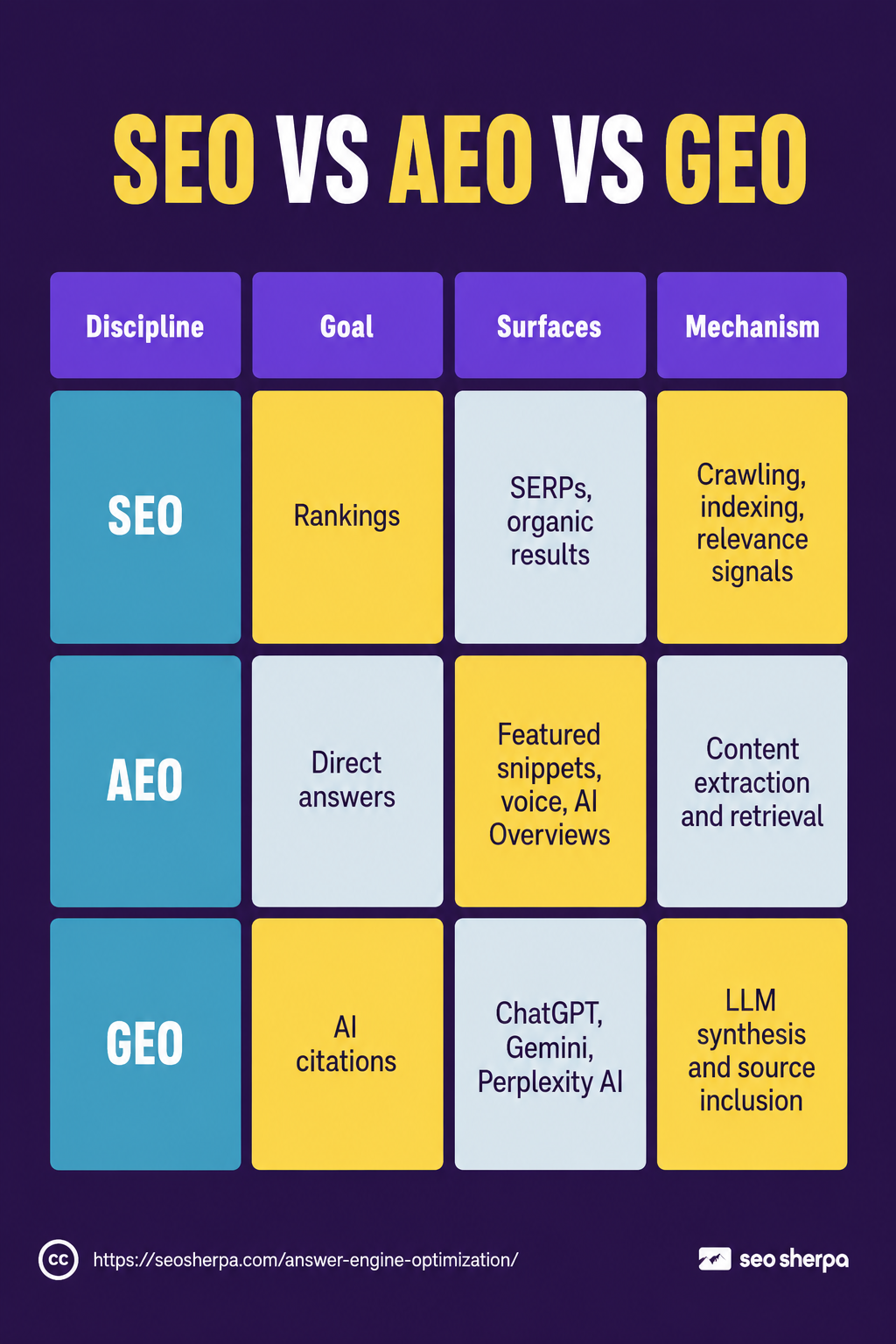
Search engine optimization is about improving your position in search engine results pages. It involves technical SEO, on-page optimization, link building, content strategy, and aligning pages with user intent. The goal is to earn a high ranking and drive organic traffic through clicks.
SEO is not dead. It is the foundation upon which everything else is built. Without solid SEO, AEO and GEO efforts don’t have much to stand on.
AEO (Answer-Based)
Answer engine optimization focuses on getting your content extracted and displayed as a direct answer. The surfaces it targets include featured snippets, People Also Ask boxes, Google AI Overviews, voice assistant responses, and knowledge panels.
AEO is retrieval-based. It’s about helping answer engines understand what your content says and why it’s the most trustworthy, clearly expressed answer to a given query. Unlike GEO, it doesn’t require an AI system to synthesize a new response. It works within existing extraction and retrieval systems.
GEO (Generative AI-Based)
Generative Engine Optimization is a different beast. GEO targets large language models like ChatGPT, Gemini, and Claude, systems that don’t just extract content but synthesize entirely new responses from it. The goal is to become a cited source inside an AI-generated answer, not to have your content extracted verbatim.
Here’s the key distinction: AEO wins the extraction. GEO wins the citation.
Think of them as a hierarchy. SEO gets you visible. AEO gets you selected. GEO gets you synthesized. A strongSearch Everywhere Optimization™ strategy incorporates all three.
How Answer Engines Work
Understanding how answer engines extract content is the fastest shortcut to optimizing for them. There are three core processes at play.
Query Understanding and Intent
When a user types a question into Google or asks a voice assistant something, the system doesn’t just look for keyword matches. It uses natural language processing to interpret the intent behind the query.
Informational queries dominate AEO territory. Searches that start with “what is,” “how to,” “why does,” or “what are” signal that the user wants a direct explanation, not a list of product pages. AI models are trained on vast datasets to recognize these patterns and prioritize content that answers the question clearly and concisely.
This is why understanding user intent isn’t just good content practice. It’s a core AEO requirement. If your content is optimized for commercial intent but the query is informational, no amount of schema markup will save you.
Content Extraction and Formatting
Once the system understands the query, it scans relevant pages for content it can extract. Here is where formatting becomes critical.
Answer engines favor content that is structured clearly with headings, uses short definitional paragraphs, includes ordered or unordered lists where appropriate, and provides direct answers near the top of each section. A page that buries its answer in the third paragraph of a dense block of text will lose to a page that leads with the answer and expands beneath it.
This is the BLUF principle: bottom line up front. State the answer. Then explain it. Answer engines are not looking for narrative. They are looking for clarity.
Authority and Trust Signals
Content extraction is not just about formatting. Answer engines also weigh authority. Google uses E-E-A-T (Experience, Expertise, Authoritativeness, Trustworthiness) signals to assess whether a source is reliable enough to feature.
A site with strong technical SEO fundamentals, credible backlinks, authoritative authors, and a history of accuracy is far more likely to have its content extracted than a well-structured page on a low-authority domain. AI systems scan for trusted voices, meaning brands that are consistently cited and linked to are more likely to appear in AI-generated responses.
Off-site presence matters too. Brand mentions on third-party sites, citations from reputable sources, and a strong Google Business Profile all contribute to the trust layer that search engines factor into their rankings.

Why AEO Matters in 2026
The honest answer is that AEO matters now because the search landscape has fundamentally shifted, and organic traffic is no longer guaranteed just because you rank.
Zero-click searches are not a niche phenomenon. According to SparkToro and Datos, more than 60% of Google searches end without the user clicking a traditional result link. Voice queries continue to grow with smart speakers and mobile assistants, requiring entirely different optimization approaches from those for desktop search. Google AI Overviews are appearing in an increasing share of search results, particularly for informational queries.
In practice, this means a brand can rank in position one and still see its organic traffic decline. The click never happens because the answer was already delivered at the top of the page.
This creates a strategic fork in the road. You can either fight for referral traffic from a shrinking pool of users who still click, or you can optimize to be the source that answer engines trust and extract. The smarter approach is to pursue both. But AEO is what keeps your brand visible even when the click doesn’t happen.
Zero-click visibility can be tracked by monitoring appearances in People Also Ask boxes and featured snippets. These are not vanity metrics. They represent brand impressions, authority signals, and the kind of top-of-mind positioning that influences user decisions even without a website visit.
Key Elements of Answer Engine Optimization
Now, this is where it gets practical. AEO is not one tactic. It’s a stack of interconnected practices that work together to make your content extraction-ready.
Optimize for Featured Snippets
Featured snippets are the most well-established AEO surface. They pull content from pages that are already ranking in the top ten results for a query and display it in a box above the organic results.
To target featured snippets, structure your content around specific question-based queries. Write a concise answer of 40-60 words directly beneath the relevant heading. Use paragraph snippets for definitions, list snippets for step-by-step processes, and table snippets for comparisons or data sets.
Featured snippets reward clarity above everything else. If your answer is buried, vague, or structured for human flow rather than machine parsing, another page will take the position.

Structure Content for Extraction
Every piece of content on your site should be built with extraction in mind. This means leading each section with a direct answer before expanding on the details. It means using clean heading hierarchies so answer engines can map the structure of your content. It means avoiding walls of text in favor of tighter, more digestible paragraphs.
Think of your on-page SEO structure as a filing system. Answer engines are looking for the right drawer. Clear headings and well-organized sections make the filing system easy to navigate.
Use Schema Markup
Schema markup is structured data added to your HTML that tells search engines and AI tools exactly what type of content exists on the page. For AEO purposes, the most relevant schema types are FAQ, HowTo, and Article.
Adding schema markup increases the chances that search engines interpret and directly present your content as an answer. It gives answer engines a machine-readable layer of context beyond what they can infer from the text itself. If you have a dedicated FAQ section on your page and you haven’t implemented FAQ schema, you’re leaving extraction opportunities on the table.
Structured data helps AI tools understand content better, increasing the chances of appearing in AI-generated answers across multiple platforms.
Target Question-Based Queries
Long-tail queries framed as questions are the highest-value opportunities in AEO. Searches like “what is answer engine optimization,” “how do answer engines choose content,” and “what is the difference between SEO and AEO” signal clear informational intent and are exactly the type of query that triggers featured snippets and AI Overviews.
Build a dedicated FAQ section within high-value articles. Identify People Also Ask questions from your target SERPs and answer them explicitly within your content. Tools like AlsoAsked and Semrush’s keyword magic tool are useful for surfacing these question variations at scale.
Improve Entity Clarity
Entity-based SEO is increasingly important for AEO. Answer engines don’t just understand keywords. They understand entities: people, brands, concepts, and places with defined relationships to one another.
Using natural language that makes your content’s entities clear, consistent, and linked to authoritative sources (think Wikipedia, Google’s Knowledge Graph, official documentation) helps answer engines understand exactly what your content is about and who it is for. Incorporating unique facts, proprietary data, and expert quotes also increases the likelihood of being cited by AI models.
Content Formats That Win in AEO
Not all content is equally extractable. Certain formats consistently outperform others in answer engine results, and knowing which to use is half the battle.
Definition paragraphs are the most commonly pulled format for featured snippets. A tight 40-60 word definition immediately beneath a heading is the gold standard for informational queries.
Ordered lists perform well for how-to queries and step-by-step processes. When a user asks, “How do I optimize for featured snippets?” a numbered list is exactly the format the answer engine expects.
Comparison tables are highly effective for queries that pit two or more options against each other, as seen in the AEO vs SEO vs GEO section above.
FAQ sections serve double duty. They target question-based long-tail queries and provide clear, extractable answers that work across voice search and AI answer engines simultaneously. Using a direct question/answer format in content improves its chances of being selected by AI tools considerably.
What doesn’t work? Dense narrative content with no clear structure. Introductions that talk around the answer before getting to it. Pages without any schema markup. Content written purely for humans without consideration for how machines parse it.
How to Optimize Content for AEO (Step-by-Step)
Step 1: Identify Answer Opportunities
Start by analyzing your target SERPs. Which queries are already triggering featured snippets or AI Overviews? Which People Also Ask questions are appearing for your primary keywords? These are your extraction opportunities.
Use tools like Semrush or Ahrefs to identify which of your existing pages are ranking in positions one through ten but not yet featured in answer boxes. These are your highest-priority optimization targets because the ranking work is already done.
Step 2: Write Direct Answers First
For every target query, write a clear, concise answer of 40-60 words immediately beneath the relevant heading. Don’t build up to the answer. Don’t use the heading as a springboard for a story. Just answer the question, cleanly and directly.
This approach serves two masters. It satisfies both answer engines looking for extractable content and users who want quick, clear responses. Leading with value is good for machines and humans alike.
Step 3: Expand With Supporting Detail
A direct answer is the entry point, not the whole article. Once you’ve provided the concise answer, expand with the explanation, context, examples, and nuance that demonstrate your expertise. This depth is what builds authority and keeps users engaged beyond the snippet.
Content creation is essential for earning mentions and citations in AI-powered answer engines. The more comprehensively and accurately you cover a topic, the more likely you are to be treated as a trusted source.
Step 4: Add Structured Data
Implement schema markup that corresponds to the type of content on each page. Add FAQ schema to pages with question-and-answer sections. Use the HowTo schema for step-by-step guides. Ensure the Article schema is in place across your blog content.
Schema implementation need not be complex. Most CMS platforms have plugins that handle it with minimal technical lift. But if you’re running a larger site and want to ensure structured data is implemented correctly and comprehensively, working with a team that understands technical SEO makes a meaningful difference.
Common AEO Mistakes to Avoid
Writing around the answer instead of to it. The most common mistake is treating AEO like traditional copywriting: building narrative tension before revealing the payoff. Answer engines don’t enjoy suspense. If your answer is in paragraph four, you’ve already lost the extraction.
Over-optimizing for a single surface. Featured snippets are not the only AEO surface. Optimizing only for Google’s snippet box while ignoring voice search, AI Overviews, and knowledge panels leaves large portions of the answer engine ecosystem untouched.
Ignoring authority signals. A beautifully structured, schema-enriched page on a low-authority domain will still struggle to win extractions in competitive niches. AEO without an underlying authority-building strategy is a ceiling with nowhere to go.
Using vague, hedging language. Answer engines prioritize clarity. Content that qualifies every claim with “it depends” or “there are many factors” doesn’t give the machine a clean answer to extract. Be specific. Be direct.
Treating AEO as a one-time fix. Monitoring and refining AEO strategies is necessary to ensure ongoing visibility in answer engines. Search behavior evolves. AI systems update. What earns an extraction today may need to be revisited as user queries and platform algorithms shift.
The Future of AEO
AEO is not going away, but it is evolving.
As AI search engines become more sophisticated, the line between retrieval-based AEO and generation-based GEO will continue to blur. Google’s AI Overviews already synthesize content rather than simply extracting it. The distinction between “the answer is pulled from your page” and “your page informs the generated answer” will become increasingly difficult to separate.
But this convergence doesn’t make AEO redundant. It makes it foundational. Large language models and AI search systems all depend on high-quality, clearly structured, authoritative content to do their work. The brands that invest in AEO now are building the content infrastructure that both retrieval and generation systems will rely on.
The future of search will see more personalization and sophistication in answer engines, delivering tailored answers based on user context. That means the content that wins will need to be not just accurate and structured, but genuinely useful in ways that machines can recognize and humans can trust.
The search landscape is changing rapidly. The brands that thrive will be the ones that stop asking “how do I rank?” and start asking “how do I become the answer?”
Final Thoughts
AEO isn’t a trend to watch. It’s a shift that is already underway, reshaping how brands earn visibility, authority, and trust across the entire search environment.
More than 60% of searches end without a click. Voice queries are growing. AI Overviews are expanding across more and more search results. If your content isn’t structured for extraction, it gets left on the shelf while someone else’s gets delivered directly to your target audience.
The good news is that AEO and traditional SEO are not in competition. They’re complementary disciplines that, when combined as part of a broader Search Everywhere Optimization™ strategy, create a compounding visibility advantage that compounds over time.
The bad news: Getting the technical implementation right, identifying the right answer opportunities, and building the kind of E-E-A-T signals that answer engines defer to takes real expertise. It’s not a set-it-and-forget-it project.
If you’re ready to build a content strategy that wins rankings and answers, we’d love to help.
Book a free discovery call with the team at SEO Sherpa and let’s map out what an AEO-ready content strategy looks like for your brand.























Leave a Reply