

Summarize This Article With AI
 Try with ChatGPT
 Try with Claude
 Try with AI Mode
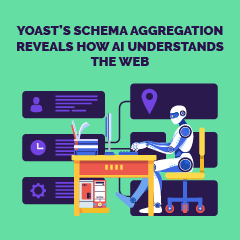
Structured data has always been a little bit like plumbing.
Extremely important.
Technically fascinating.
And almost nobody wants to talk about it.
Most marketers treat schema markup as a checklist item. Add some article schema. Sprinkle in product markup. Maybe throw in FAQ schema if you’re feeling adventurous.
Then move on.
But behind the scenes, structured data plays a much bigger role than most people realize. It helps search engines interpret what a page is about, how entities relate to each other, and how information should be presented in search results.
Now Yoast has introduced a feature called Schema Aggregation, designed to map the structured data across an entire website into what they call a “schema map.”
And while it might sound like a niche technical feature for SEO nerds, it actually hints at something much bigger.
Because as search becomes increasingly powered by AI systems, the way machines interpret websites may matter more than ever.
Article Summary
- Yoast has launched Schema Aggregation, a feature that maps structured data across a website into a single schema overview.
- The tool aims to help search engines and AI systems better understand the entities and relationships across a site.
- Structured data is becoming increasingly important as AI search systems rely on machine-readable signals to interpret content.
- The update reinforces a growing trend: websites that clearly communicate their structure and entities will likely perform better in AI-powered search environments.
What Schema Aggregation Actually Does
Most websites already contain multiple types of structured data.
A typical site might include schema markup for things like articles, authors, organizations, products, FAQs, or events. Each page contributes its own structured information.
But from a machine’s perspective, those pieces of data are often scattered across the site.
Yoast’s Schema Aggregation feature attempts to bring all of that together into a single view.
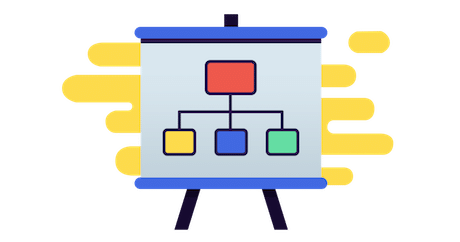
Think of it as a map showing how the entities across your website connect. Instead of isolated schema fragments living on individual pages, the system builds a clearer picture of the relationships between them.
For example, an article might be connected to:
- The author who wrote it
- The organization that published it
- The topic it discusses
- Other related content on the site
When those relationships are structured consistently, search engines can interpret the site’s knowledge graph much more easily.
In theory, this helps machines move from simply crawling pages to understanding the site as a network of entities and relationships.
That distinction is becoming increasingly important.

Why AI Systems Care About Structured Knowledge
Traditional search engines were primarily focused on documents.
They crawled pages, indexed text, and ranked results based on relevance and authority.
AI systems operate differently.
Instead of focusing only on pages, they try to identify entities and facts within those pages. They look for connections between concepts, organizations, products, and people.
Structured data helps machines do exactly that.
When a page clearly defines its entities using schema markup, it becomes much easier for algorithms to interpret what the content represents.
An article isn’t just a piece of text anymore. It becomes a structured object with defined attributes.
The author becomes an entity.
The publisher becomes an entity.
The topic becomes an entity.
Once those relationships are mapped across an entire site, machines can begin to understand the site as a coherent knowledge source rather than a collection of pages.
That’s a big shift.
This Is Really About Machine Readability
If the past decade of SEO was about optimizing content for search engines, the next decade may increasingly be about optimizing content for machines that interpret knowledge.
Large language models, search assistants, and AI-driven discovery tools rely heavily on structured signals to interpret the web.
They can read plain text, of course. But structured information removes ambiguity.
It tells machines exactly what something is.
Instead of guessing whether a name refers to a person, a company, or a product, structured data makes the classification explicit.
That clarity becomes extremely valuable when AI systems are assembling answers, generating summaries, or recommending sources.
Which means the websites that clearly communicate their entities and relationships may have an advantage in the emerging AI search ecosystem.
The Quiet Rise of the Semantic Web
For years, technologists talked about the semantic web as if it were a distant future.
The idea was simple: instead of a web made of pages and links, the internet would eventually become a web of structured knowledge that machines could understand.
That future never quite arrived the way people expected.
But in many ways, it’s happening now—just through different technologies.
Knowledge graphs, schema markup, and AI systems are gradually transforming how machines interpret information online.
Tools like Yoast’s Schema Aggregation feature are interesting because they move websites closer to that model.
Instead of publishing disconnected pages, websites begin to resemble structured information systems.
And when machines can understand how information connects across an entire site, they can interpret authority, expertise, and topical relationships more accurately.
That could influence everything from search rankings to AI-generated answers.
The Real Opportunity for Publishers
The rise of AI search has created understandable anxiety among publishers.
Many worry that AI systems will simply summarize their content without sending traffic.
That concern isn’t unfounded.
But there’s another side to the story.
As AI systems become more sophisticated, they also need reliable sources of structured knowledge.
Websites that clearly define their expertise, authorship, and topical authority may become more valuable in this ecosystem.
Structured data is one of the ways publishers can signal those relationships.
It helps machines understand not just what a page says, but who is saying it and why they matter.
That level of clarity is increasingly important as AI systems decide which sources to reference.

The Bigger SEO Trend
Yoast’s Schema Aggregation feature isn’t revolutionary on its own.
But it reflects a broader shift in how SEO is evolving.
Search engines and AI systems are moving beyond simple keyword matching toward deeper understanding of entities, topics, and relationships.
This means that technical SEO increasingly overlaps with knowledge architecture.
It’s not just about optimizing pages anymore. It’s about structuring information in ways that machines can interpret.
And while most users will never think about schema markup, the systems deciding what information appears in search results almost certainly will.
Want Your Content to Be AI-Ready?
As search evolves toward AI-powered discovery, the way your website communicates its knowledge and authority becomes increasingly important.
At SEO Sherpa, we help brands structure their content, entities, and technical foundations so search engines and AI systems can clearly understand their expertise.
Book a free discovery call with our team.
We’ll review your site’s technical and content structure and help you build an SEO strategy designed for the future of search.
Because in the AI era, the websites machines understand best will often be the ones that win.





















Leave a Reply