

Summarize This Article With AI
 Try with ChatGPT
 Try with Claude
 Try with AI Mode

Social media has become a discovery channel, not just a distribution one.
For many users, platforms such as Instagram, TikTok, and YouTube now influence what they search for and what they buy. That shift is reflected clearly in the latest social media growth statistics.
This guide brings together the latest social media growth statistics to show how large social media has become and how quickly adoption continues to increase.
It covers global user penetration, year-over-year growth, and the difference between reported user identities and active users.
We also look at the typical social media usage, which platforms dominate, and how growth varies by region and age group. We’ll also discuss what these emerging behavioral trends mean if you’re planning your social strategy.
Article Summary
Below are the main points of this article:
- Global social adoption is now mainstream, which means social should be treated as a core part of your digital presence, not an add-on channel.
- Momentum is shifting toward deeper engagement as more markets mature and new-user gains become harder, even if there is a steady growth rate.
- Social media usage time is being pulled upward by video-first platforms, which makes scroll-stopping creative and strong hooks essential.
- People now split attention across a platform mix that changes by context, so marketers need coordinated messaging across touchpoints.
- Content should guide users beyond awareness into action, as social behavior has expanded into discovery, news, communities, and shopping.
- Marketing and content planning should include the gap between user identities and active users.
- For marketers, the winning approach is platform-specific content, mobile-first execution, and regular benchmark updates to keep budgets aligned with shifting audience habits.
Why Tracking Social Media Growth Statistics Still Matters
Social media platforms continue to command a large share of digital attention among the global population. Even as the space matures, social remains one of the main places where people spend time.
Ignoring how the use of different platforms changes can quickly leave a marketing plan out of sync with real user behavior.
Setting new benchmarks, as well as updating them, can help you understand what “normal” social media usage looks like at any given moment. They provide context for performance, making it easier to tell if a campaign is underperforming or if expectations need to be adjusted.
You can only set realistic, quantifiable benchmarks if you know the latest relevant statistics.
Growth patterns also act as early signals. They reveal where momentum is building and where social media usage is slowing.
They identify where opportunities may be emerging across regions and social media platforms.
Social media statistics can give you a clear idea of how people divide their time across different platforms. You can use them as guides as you create your budget and content marketing strategies.
Without this insight, you risk investing heavily in channels where you won’t find your audience.
In short, growth statistics help turn social media from a guessing game into a more informed strategy.

Global Social Media Adoption: How Big & How Fast It’s Growing
Let’s take a look at how big social media is today and how quickly people are adopting it globally.

Total Users & Global Penetration
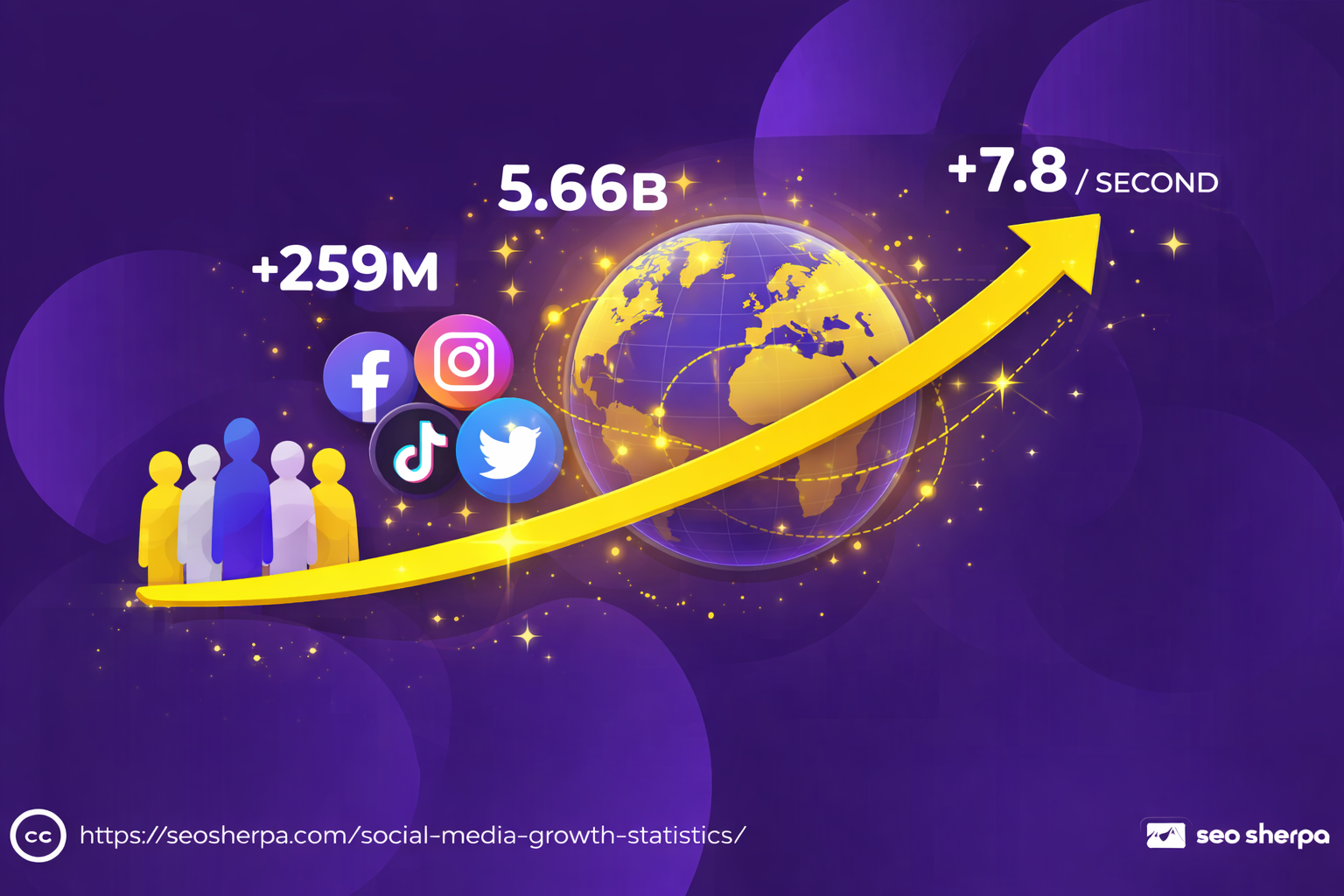
The latest stats show that there are 5.66 billion social media user identities spread across the world, which is more than half of the world’s total population.
This number also comprises 93.8% of internet users, as they also use social media monthly.
Adults aged 18 and above are the most active social media users at 92.6%, more than half of the global population. The average social media user engages in or visits around 6.75 different platforms every month, typically spending an average of 18 hours and 36 minutes on various networks each week.
Since the last report within the same period in 2024, 259 million user identities started using social media platforms. The year-on-year growth is now posted at 4.87%, with an average rate of 7.8 new users signing up on a social networking site every second.
With 5.66 billion users, more than two in three people worldwide now use social media every month. Adoption of these platforms among internet users is close to universal.
Social media usage has indeed followed a steep upward curve, pushing closer to global saturation over the past five to ten years.
This growth is mainly driven by mobile access and expanding connectivity, especially in emerging markets, over the past decade.
Hundreds of millions of people still join social media each year, but growth is easing as more markets reach maturity. This signals a transition as social media will soon be something people are not simply discovering, but something to be used every day.
That means growth is changing form. In addition to relying on new users, social media platforms are leaning on deeper, repeat engagement, and a stronger presence in everyday behavior.
Active Users vs User Identities: What the Numbers Actually Mean
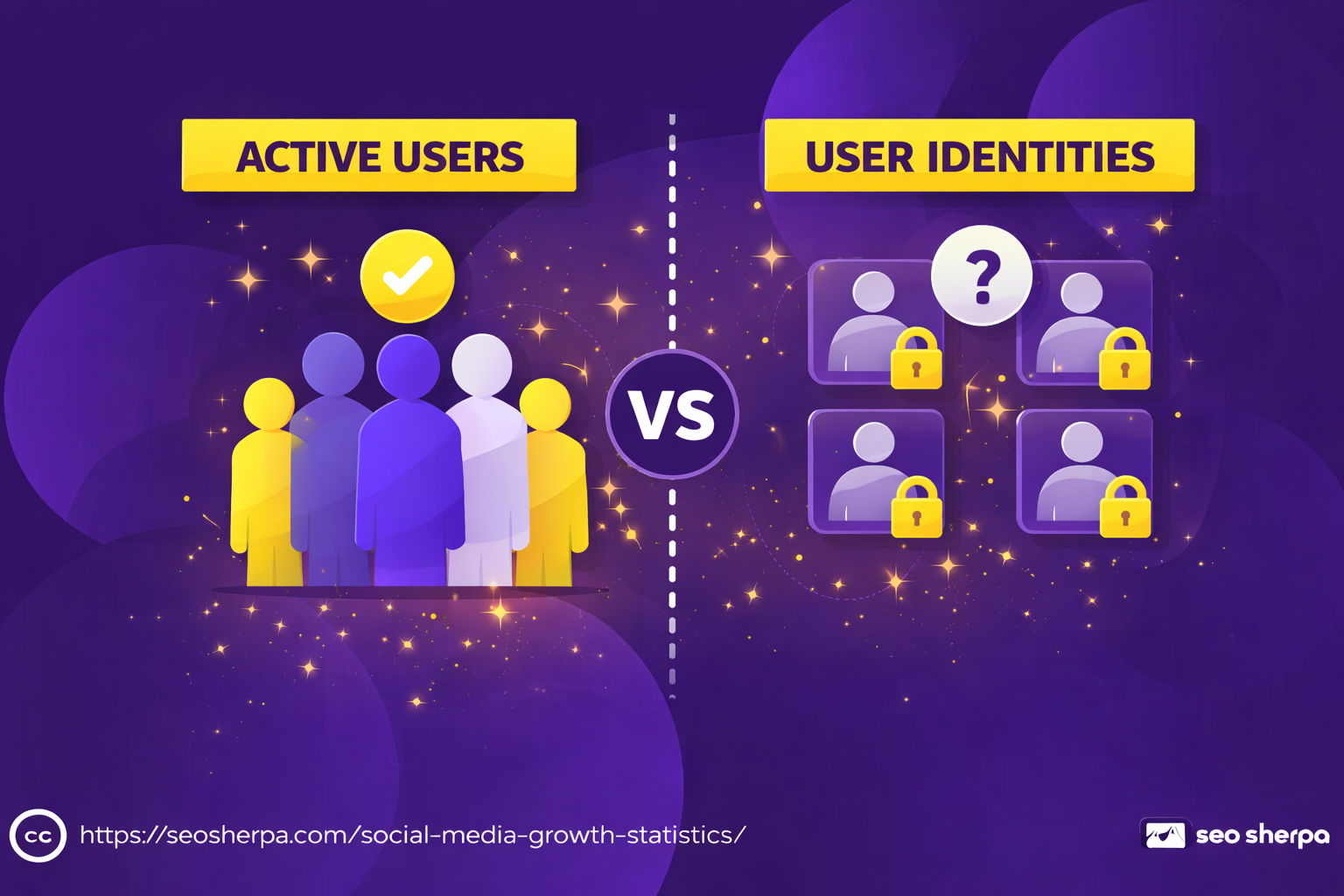
Active social media users are people who log in and do something on social media, such as posting, commenting, and liking posts.
On the other hand, user identities refer to the total number of registered accounts or existing profiles on a social media channel, regardless of how frequently they are opened or used to engage.
Most marketing experts prefer the term user identities over active social media users. This is because one person may have multiple accounts, which do not represent a unique individual or user.
This means that social media user numbers may be higher than the figures for internet users, which significantly affects research results.
This distinction matters for planning and performance. User identities can help show overall reach, but they do not always reflect attention or average engagement rate.
Whenever possible, refer to active user data to get better insight into social media usage, audience quality, and growth potential.
How People Use Social: Engagement & Daily Habits
Let’s delve into how people actually use social media every day.
Average Usage Time & Platform-Hopping
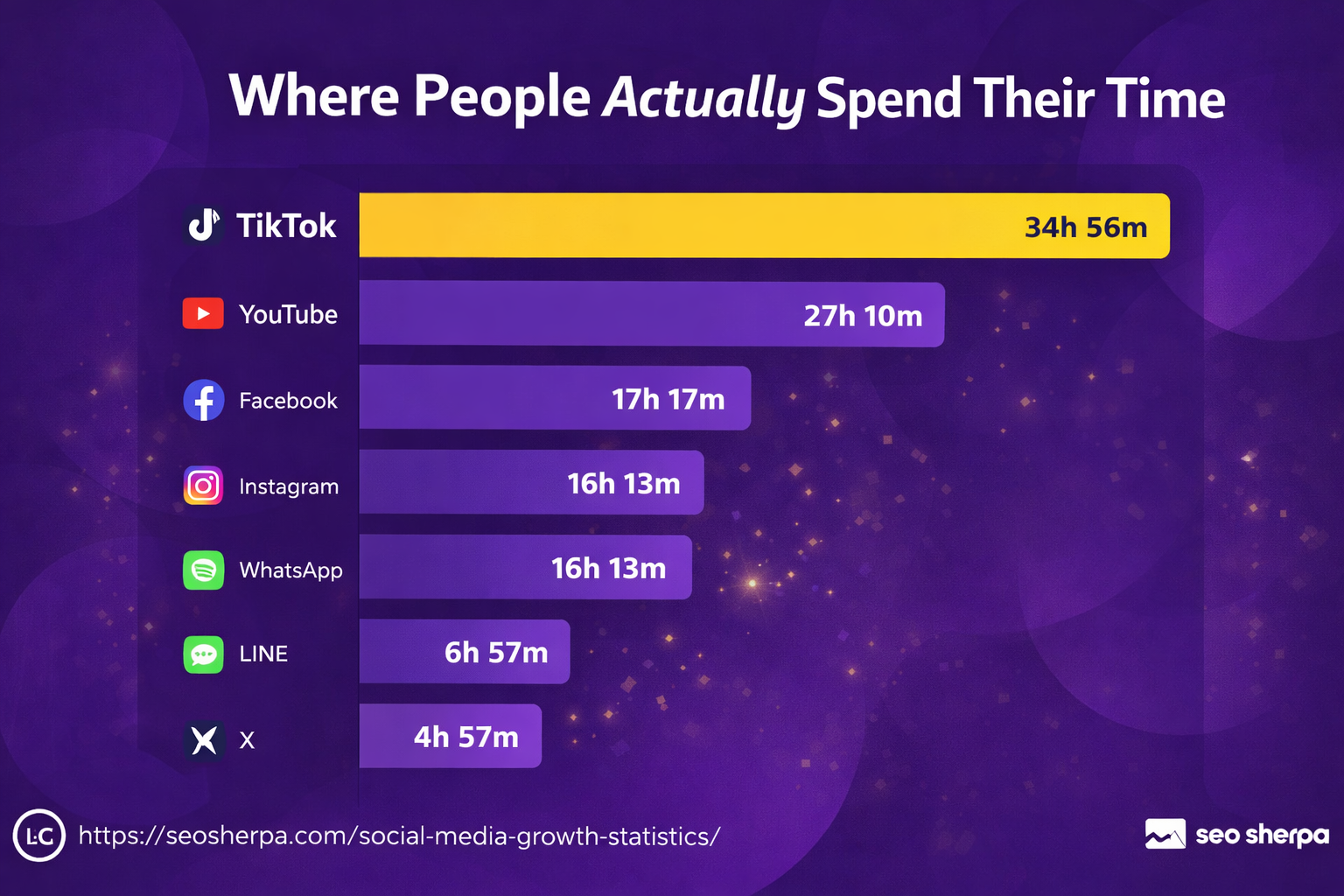
In terms of the average time active users spend on different social media platforms, TikTok is currently the leader, with users spending an average of 34 hours and 56 minutes on the app per month. Its short, highly personalized videos can keep people scrolling for long periods per day.
The monthly average time users spend on YouTube is 27 hours and 10 minutes. The platform’s long-form video, background viewing, and growing use on TVs help explain its high watch time and rank.
Social media statistics show that the average Facebook usage is 17 hours and 17 minutes each month.
Facebook users spend several hours engaging with groups and immersing themselves in interesting news and other content types. As such, it remains one of the biggest social media platforms in the world.
Instagram, WhatsApp, Line, and X (formerly Twitter) round out the top seven.
Source: Smart Insights
As mentioned, the average user visits around 6.75 social media platforms per month, with usage patterns shaped by context rather than loyalty to a single app.
This means that it’s not unusual for social media users to spend only short sessions across several platforms. A lot of daily active users might watch videos on TikTok, browse updates on Facebook, and check messages on WhatsApp, all within the same day.
However, when people spend more time on different platforms, this increases the risk of fragmented attention, which can affect the result of your digital marketing plan.
Platform Popularity & Dominance of Major Players
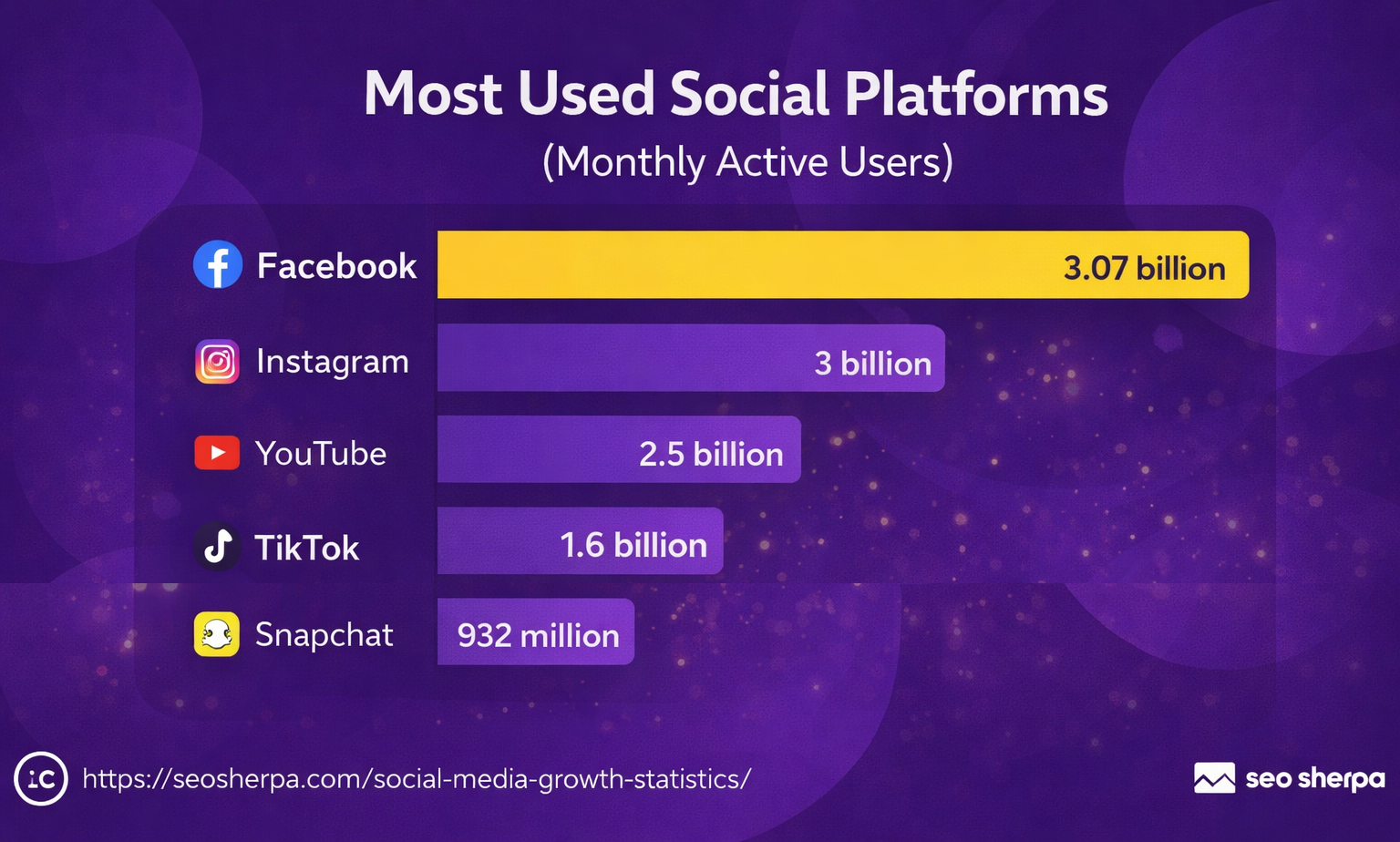
These social media platforms have the highest monthly active user (MAU) counts.
Source: Search Engine Journal
3.07 billion people of the world’s population use Facebook, which is why it remains high in the global ranking. It continues to stand out with its broad reach and deep integration into the user’s daily routines.
Its groups and marketplace features also help keep social media users active.
Instagram, which ranks second, maintains its prominence as a visual discovery platform with its short-form video, creator content, and shopping features. Three billion people of the world’s population are active on this channel.
YouTube’s high watch time for both long- and short-form videos means it continues to be one of the most popular social apps. About 2.5 billion people of the world’s total population are active on this site.
TikTok captures attention quickly and keeps social media users engaged for long sessions, making it one of the most frequently used mobile apps.
Snapchat remains a dominant force for private, visual communication, particularly among younger users.
Platforms to Focus On
Facebook may not be as popular and exciting as before, but it’s still the most widely used social media site. It remains an influential channel, especially among the different meta platforms, which is why it deserves a spot in your marketing plan.
YouTube remains a formidable marketing tool even if it ranked behind Instagram. YouTube ads reached 2.53 billion users in the early part of 2025.
This means it’s still worth investing in videos and YouTube SEO today.
The visual storytelling features, other tools, and target audiences of Instagram, TikTok, and Snapchat make them essential marketing tools for boosting brand awareness and conversions.
Regional & Demographic Variations in Social Growth
Let’s explore the differences in social media growth across regions and groups.
Geographic & Regional Adoption Differences
Social media adoption varies regionally. While global penetration reflects widespread use overall, regional patterns tell a more nuanced story.
Growth appears to have slowed down in mature markets because social media platforms have already reached most connected users and become part of their daily digital habits.
However, newer markets, such as certain parts of Asia and Africa, still have plenty of new social media users signing up for different sites. As such, they have strong growth potential.
This regional growth presents a clear opportunity for brands operating in the Middle East, Africa, and other emerging markets. Businesses should build awareness and trust early as more users join social media platforms.
This can give them a clear advantage before competition intensifies.
Many new social media users are likely to browse the internet on their mobile devices. This means formats like video and community-driven content are especially effective.
Brands that adapt to local language and culture are also more likely to see stronger engagement and long-term results.
Age
Thirty-one percent of user identities on Facebook are between 25 and 34 years old, making them the largest group in terms of age. Twenty-two percent are between 35 and 44 years old.
These figures show that the platform is popular among more mature internet users worldwide.
Forty-two percent of TikTok users are between 18 and 24 years old. It is currently the largest platform attracting younger audiences.
The vast majority of Instagram users are between 25 and 34 years, making up 33.3% of the platform’s overall global user identities.
On Twitter, the predominant age group is 18 to 34, accounting for more than 55% of the social media site’s global users.
YouTube’s biggest audience is users aged 25 to 34. They account for about 12.1% of the site’s overall user identities.
This figure is quite small as the social media platform is popular among different generations.
Based on the data, TikTok and Twitter appeal to the younger demographics. You can tap into this user base by focusing on short, energetic content that touches on trends and gains quick reactions.
Having a well-planned Twitter and TikTok content strategy can also help you draw in younger audiences.
With Facebook and Instagram attracting older age groups among social users, include storytelling and practical messaging in your social SEO.
Ensure you have flexible content styles that combine entertainment and education on YouTube to reach different generations.
Gender
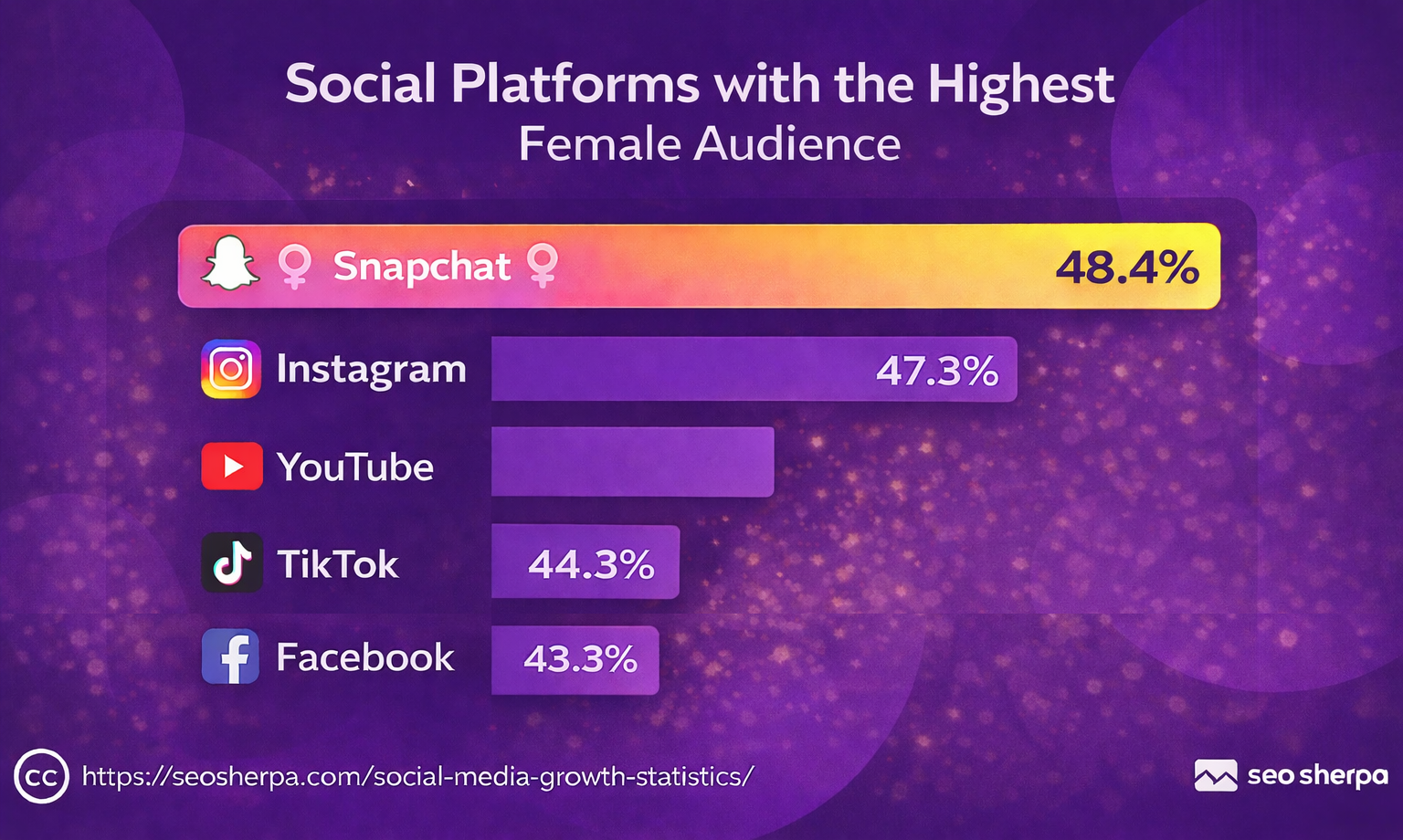
Snapchat has the most female users and identities in the world at 48.4%, followed by Instagram at 47.3%.
TikTok comes in third, with 44.3% of its audience female. Facebook, which attracts 43.3% of female audiences, and LinkedIn, which draws 43.1%, come in fourth and fifth, respectively.
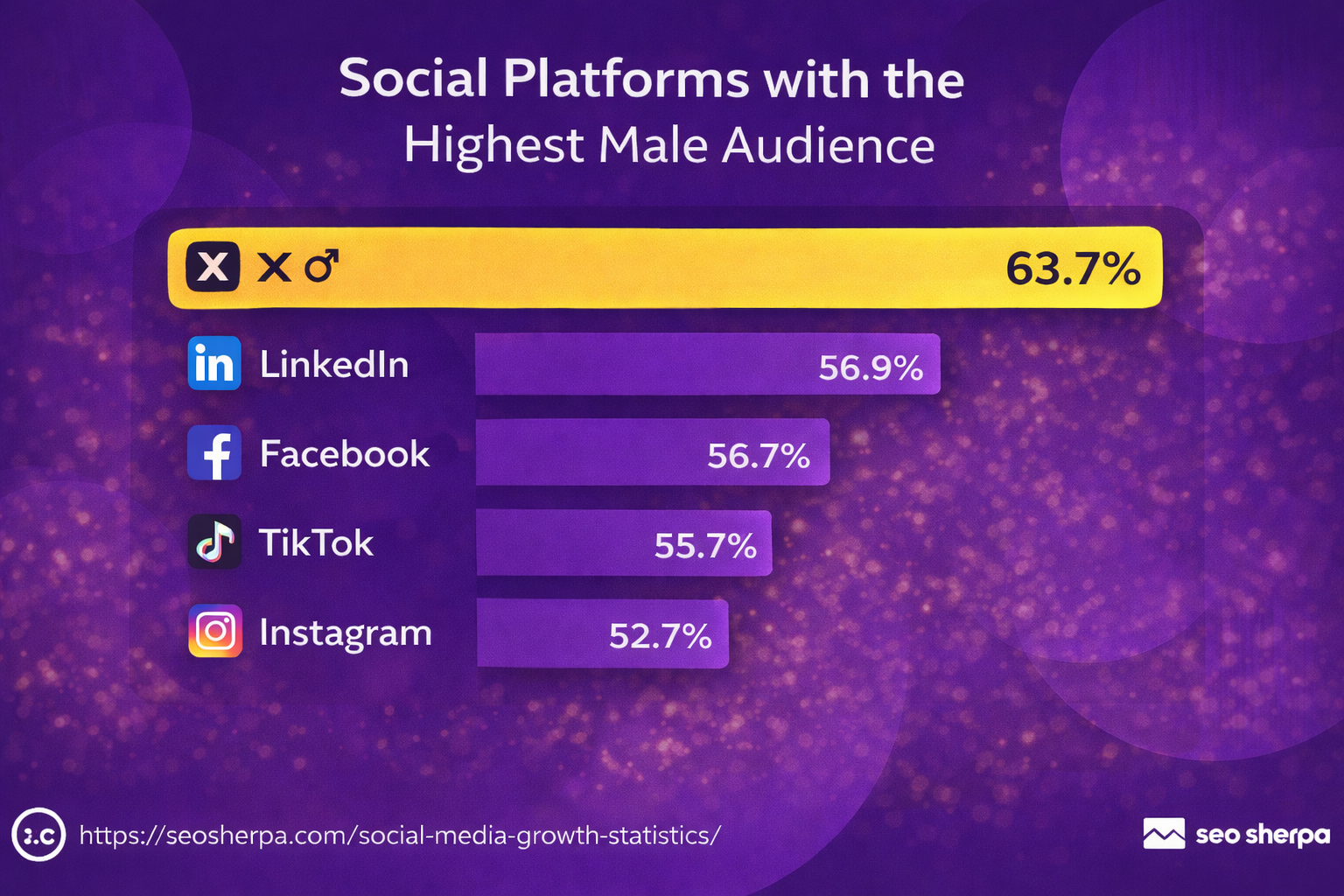
In contrast, X attracts the most male audiences at 63.7%, while LinkedIn comes in second at 56.9%. Meanwhile, 56.7% of Facebook users are male, allowing this channel to land the third spot.
Next, 55.7% of male audiences use TikTok, securing the fourth spot, and 52.7% are drawn to Instagram, making it the fifth-most-popular social media platform among male users.
Source: Statista
Visual, lifestyle-driven content that highlights personal stories and creativity is best suited for Snapchat, Instagram, and other social media platforms with higher female audiences.
These gender differences suggest short videos are more likely to appeal to female internet users on these social media platforms, especially when the content feels authentic and community-focused.
Instagram SEO and other strategies can also boost searches.
Twitter, LinkedIn, and other platforms with predominantly male users can benefit from a more information-led approach. Industry insights and problem-solving content tend to perform better on these social media sites.
Understanding these demographic differences can help you create content that suits the tone, format, and messaging that appeals to your target audience.
What’s Changing: Recent Growth Patterns & Emerging Behavior Trends
Let’s explore the changes in social media use and its key implications.
Social media adoption has moved from rapid expansion into a phase that appears closer to global majority use.
In many regions, especially developed markets, social media platforms are now part of the daily life for most people who have internet access.
It’s safe to say that adoption is nearing a natural ceiling in these mature regions.
For many in these markets, joining social media is not something to experiment with; it’s now more of an expected step once someone goes online.
This shift explains why social media’s growth today looks different from the explosive gains of earlier years.
Improved mobile access and connectivity in emerging markets are driving large numbers of new users to sign up.
As a result, the future growth of social media worldwide depends less on adding first-time users and more on how deeply existing users engage.
You can work this into your marketing strategies by creating more well-thought-out and relevant content that encourages longer sessions and repeat visits. You also need to be more active and consistent on your channels.
Fragmentation: More Platforms, More Touchpoints, More Noise
Social media has become increasingly fragmented, with people hopping from one platform to another as a habit. Instead of spending all their time in one place, users now spread their attention across video apps, messaging platforms, and other channels.
This creates more touchpoints and competition for attention, which can be a huge concern for marketers.
This change presents both opportunity and pressure. You can reach audiences at multiple points throughout the day, but only if your content suits the social media platform and its users.
Posting the same message everywhere no longer delivers the results it once did, since each platform has its own tone and content expectations.
This fragmentation also underscores the importance of flexibility in your content marketing strategy. You need to plan for multiple formats, including short and long videos, static visuals, text updates, and conversational content.
Repurposing can be a valuable tactic to make your work easier. You can use AI tools to present a single idea in various forms to match the platform and the users’ mindset.
Platform-specific optimization matters more than volume at this time as well. Posting less but delivering branded content that feels relevant and native helps cut through clutter.
The strongest results come from understanding where audiences spend time and engaging them there with steady, relevant content.
Evolving Social Media Behavior: From Social to “Everything”
The social media landscape has evolved beyond its initial role as a place to connect with friends. Today, it functions as an all-purpose digital environment where people follow news and discover products.
It’s also a place where users communicate and are a part of communities.
Social media platforms have even replaced search engines and messaging apps. They are now encouraging users to browse and shop online.
This change has reshaped what people expect from brands on social platforms. Internet users worldwide are no longer browsing just to pass the time, but actively using their feeds to explore ideas, access fresh information, and find suggestions they can trust.
As a result, content needs to be more useful and informative, not purely promotional. This is something you should consider in your marketing strategies.
The growth of creator-led discovery and influencer marketing has encouraged people to trust relatable voices and genuine experiences. As a result, this is often more valued than highly polished brand advertising.
Video-first and mobile-first behavior continue to define social media channels. Video length matters, as short clips encourage fast discovery, while longer formats provide deeper learning and entertainment.
These social media trends are likely to stay popular even in the distant future.
Building ongoing relationships instead of one-off interactions is also easier with the platforms’ messaging and community features.
Shopping tools embedded within the social media channels shorten the path from interest to purchasing. This turns social browsing into a direct selling activity and will influence consumer behavior.
Integrating social strategy across the entire customer journey is now indispensable. Content creation should focus on awareness and education to ensure posts lead to engagement and conversion in one connected experience.
Keeping up with these changes allows you to gain more from your digital marketing campaigns and reach more prospective customers.
Implications for Marketers & Brands in 2026
For marketers and brands looking ahead to 2026, the message is clear. Social media is no longer an optional channel or a supporting tactic.
It is a significant channel that influences how people discover and interact with brands.
This means investment and digital marketing decisions should focus on social media sites that continue to expand reach and engagement, especially in regions where adoption is ongoing.
It’s important to show up across multiple social platforms, but spreading your resources too thin may work against you. You’re more likely to see stronger results when you commit to social networks that fit audience behavior and content expectations, and maintain a steady presence with a specific goal in mind.
This highlights the importance of choosing the most relevant social platforms for your brand and audience.
Quality also now matters more than volume. Your focus should be on creating content that earns attention through relevance and usefulness rather than frequent posting.
Your digital marketing strategy should also focus on mobile-first thinking, as video, messaging, and community-led formats are part of most internet users’ daily use.
Audience behavior demands constant review. You need to adjust your social media content strategy when platform preferences change by age, region, and other patterns that emerge.
A local mindset is needed if you’re targeting growing markets. Learn and adopt the language, culture, and context to build trust and engagement.
By adapting early and treating social as part of everyday life, your brand will be better positioned for sustained growth.
Wrap Up & What to Watch Next
As social media moves deeper into people’s everyday routine, the next phase of change will be influenced less by expansion and more by evolution.
Many markets are approaching saturation, which means platform growth will increasingly depend on how people use social rather than how many new users join.
This opens the door for shifts in platform popularity as audiences respond to new features, formats, and experiences.
Video will remain popular, especially short-form content designed for quick discovery and mobile viewing. Increasing your mobile ad spending is something worth looking into.
Private communities and creator-led content are also likely to grow as users look for more personal and trustworthy interactions.
Social commerce is expected to be a more seamless process. Platforms will blend content, recommendations, and purchasing into a single flow.
Regional growth pockets will remain important, particularly in areas where connectivity and mobile access are still expanding.
All these make a regular review of social media statistics essential. Updated data can help you spot early signals and adjust platform priorities.
It also places you in a better position to keep up with the audience’s changing behavior.





















Leave a Reply