

Summarize This Article With AI
 Try with ChatGPT
 Try with Claude
 Try with AI Mode
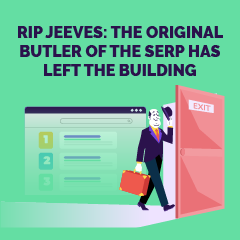
Ask.com has officially closed its doors.
Or, for those of us who remember the internet sounding like a robot choking on a fax machine, Ask Jeeves has finally hung up his little digital towel and retired from butlering the web.
Yes, Jeeves.
The smiling, suit-wearing search butler who stood ready to answer your burning questions back when getting online required military-level coordination with the family landline.
You remember the drill.
You’d wait until nobody was expecting a phone call. You’d click “connect.” The computer would start screaming. Your mum would shout, “Is anyone on the internet?” And then, after approximately three business days, the web would load.
There he was.
Jeeves.
Polite. Helpful. Slightly smug. Ready to answer your question about “what is the capital of France” or “does Leonardo DiCaprio have a girlfriend” or “how do I make my Tamagotchi stop dying?”
A simpler time.
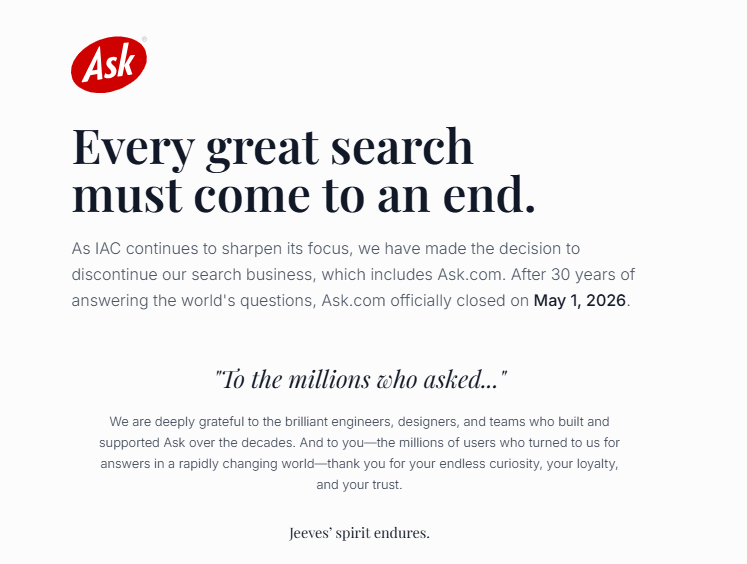
But as of May 1, 2026, Ask.com is no more. Parent company IAC has discontinued the search business, with Ask.com’s farewell page declaring: “Every great search must come to an end.”
And honestly?
For search people, this one hits a little differently.
Not because Ask.com has been a serious Google competitor for a long time. It hasn’t. Let’s not pretend we’ve all been optimizing for Ask traffic in our monthly reports.
But because Ask Jeeves represents something much bigger.
It was one of the earliest mainstream attempts to make search feel conversational, human, and approachable. And now, in the age of ChatGPT, AI Overviews, Perplexity, Gemini, and Search Everywhere Optimization™, the timing of its exit feels weirdly poetic.
The butler walked so the bots could run.
Article Summary
- Ask.com, formerly Ask Jeeves, officially closed on May 1, 2026.
- Ask Jeeves launched in 1996 and became famous for letting users search by asking natural-language questions.
- Jeeves was the friendly, butler-style face of early search, back when Yahoo was a major competitor and dial-up internet was testing everyone’s patience.
- Although Ask.com hasn’t been a serious search player for years, its closure marks the end of an early internet era.
- Ask Jeeves was ahead of its time because it understood that people naturally search by asking questions, not typing robotic keyword fragments.
- Its original question-led search experience feels surprisingly relevant today as Google, ChatGPT, Perplexity, Gemini, and other AI tools push search back toward conversational answers.
- The bigger lesson for brands is that search keeps evolving, and every major shift creates casualties.
- Brands can’t rely on visibility in one place anymore. They need to show up across Google, AI tools, social platforms, video, forums, and every other place their audience searches.
- Ask Jeeves may be gone, but its core idea lives on: people want fast, helpful answers to real questions.
What Actually Happened?
Ask.com has officially shut down.
The company’s farewell message says IAC made the decision to discontinue its search business as part of a broader refocus. The message thanks the engineers, designers, teams, and users who supported Ask over the decades, ending with the very sweet, very emotional line: “Jeeves’ spirit endures.”
Ask.com originally launched as Ask Jeeves in 1996, before Google became the verb that ruined every SEO’s sleep schedule. It was founded in Berkeley, California, by Garrett Gruener and David Warthen, and became known for allowing users to type questions in a more natural way.
That was the whole gimmick.
You didn’t just type keywords.
You asked Jeeves.
Very civilized. Very British. Very “please fetch me the answer, good sir.”
At a time when Yahoo was still a dominant web directory, Google was just emerging, and most people still thought “surfing the web” sounded futuristic rather than like something your uncle would say, Ask Jeeves felt genuinely novel.
It gave search a face.
More importantly, it gave search a personality.
And that mattered.
Because early search was messy.
Finding things online in the late 90s and early 2000s often felt less like using a precision tool and more like rummaging through a digital attic with a candle. You didn’t always know what to type. Search engines didn’t always know what you meant. And half the time, the results felt like they had been assembled by a raccoon with a dial-up connection.
Ask Jeeves tried to make that easier.
Instead of making users think like machines, it invited users to search like humans.
Sound familiar?

Why Jeeves Was Ahead of His Time
It’s easy to look back at Ask Jeeves and treat it like a cute relic.
The mascot. The butler. The old-school web design. The whole thing feels like it belongs in a museum next to AOL CDs, MSN Messenger nudges, and that one family computer everyone fought over.

But the core idea behind Ask Jeeves was genuinely forward-thinking.
It understood something search is still wrestling with today:
People don’t naturally think in keywords.
They think in questions.
They ask things like:
- “How do I fix a leaking tap?”
- “What’s the best hotel in Dubai for families?”
- “Why did my rankings drop after a Google update?”
- “Is my website secretly terrible, or is Google just being dramatic again?”
Traditional search trained people to compress messy human questions into keyword fragments. We learned to search like robots because the robots couldn’t understand us properly.
Ask Jeeves tried to flip that.
It said: ask a question, and we’ll try to help.
That is basically the promise now being sold by every AI-powered search tool on the planet, only with more GPUs and fewer waistcoats.
Today, conversational search is everywhere.
ChatGPT answers questions directly. Google AI Overviews summarize information inside the SERP. Perplexity positions itself as an answer engine. Even Google’s AI Mode pushes users toward a more interactive, conversational way of searching.
And sitting somewhere in internet heaven, Jeeves is probably polishing a silver tray and whispering, “I told you so.”

So Why Did Ask.com Lose?
Here’s the brutal bit.
Being early doesn’t always mean winning.
Ask Jeeves had a clever concept, but Google had the better system.
Google’s PageRank changed the game by using links as a way to evaluate relevance and authority. It made search feel faster, cleaner, and more useful. And once users started trusting Google to find the best answer quickly, most competitors were in trouble.
Ask Jeeves became Ask.com in 2006, dropping the Jeeves character in an attempt to become a more modern search brand.
But by then, Google wasn’t just another competitor.
It was becoming the default behavior.
You didn’t “search it.”
You Googled it.
That’s the kind of brand dominance most companies would sell their office plants for.
Ask.com eventually moved further away from being a serious search competitor. Reports note that by 2010, it had stopped developing its own web search technology and outsourced search functionality instead.
And from there, it became one of those brands people remembered more than used.
A nostalgia engine.
A “whatever happened to…” company.
A digital ghost in a nice suit.
The Search Lesson: Evolution Creates Casualties
This is where the Ask.com closure becomes more than an internet nostalgia story.
Because search has always had casualties.
AltaVista. Excite. Lycos. Dogpile. Ask Jeeves. Yahoo’s original search dominance. Even Bing, bless it, has spent years trying to become more than “the thing your laptop uses before you install Chrome.”
The search landscape has never been static.
It just felt static for a while because Google became so dominant that many marketers started treating “search” and “Google” as the same thing.
They are not.
Search is a behavior.
Google is a platform.
And platforms rise, evolve, lose relevance, pivot, or disappear.
That distinction matters more than ever.
Because we’re now in another major search transition. People still use Google, of course. A lot. But they also search on TikTok, YouTube, Reddit, Amazon, Pinterest, Instagram, ChatGPT, Perplexity, Gemini, and whatever new AI tool has launched by the time you finish reading this sentence.
Search is fragmenting.
Discovery is becoming platform-native.
And user expectations are changing fast.
People don’t just want links anymore. They want summaries, opinions, comparisons, recommendations, visuals, conversations, and shortcuts.
That shift creates opportunity.
But it also creates casualties.
Brands that only optimize for one platform are building visibility on rented land during an earthquake.
Very brave. Slightly unhinged.
The Irony: Ask Jeeves Died Right as Search Became Jeeves Again
The funniest part of this whole story is that Ask.com closed just as search is circling back to the idea that made Ask Jeeves famous.
Conversational search.
Question-led discovery.
Answer engines.
Natural language prompts.
AI assistants that understand intent rather than just matching keywords.
In other words, Jeeves’ entire personality has been reborn as a product roadmap.
The difference is that today’s answer engines are far more powerful. They don’t just retrieve pages. They summarize, synthesize, compare, recommend, and sometimes confidently hallucinate something so wrong it makes your soul briefly leave your body.
But the user behavior is similar.
We are asking machines questions again.
Not typing “best CRM small business 2026.”
Asking:
“What’s the best CRM for a small business with a tiny team, no technical setup, and a founder who cries when they see a dashboard?”
That’s the new search reality.
And it changes how brands need to think about visibility.
It’s not enough to rank for keywords.
You need to be understood as an entity. You need to be cited, mentioned, discussed, trusted, and consistently represented across the platforms where people and machines gather information.
That is where Search Everywhere Optimization™ comes in.
Because the future of search is not one results page.
It’s a messy, multi-platform ecosystem where visibility is shaped by content, brand signals, social proof, structured data, reviews, video, PR, community discussions, and AI-readable authority.
Basically, the SERP has gone feral.
What Brands Should Learn From Jeeves’ Final Bow
Ask.com closing doesn’t mean every brand needs to panic because platforms disappear.
But it should remind us that search behavior changes constantly.
The brands that survive those shifts are not the ones clinging to one channel like it’s the last lifeboat on the Titanic.
They are the ones building adaptable search ecosystems.
That means creating content that answers real questions, not just targets keywords. It means showing up on the platforms your audience actually uses. It means building brand authority beyond your own website. It means monitoring how AI tools describe you, how social platforms surface you, and how your content performs across different discovery environments.
It also means accepting that the old search playbook is no longer enough on its own.
Traditional SEO still matters. Technical SEO matters. Content matters. Links matter.
But they now sit inside a much bigger visibility system.
A brand might be discovered through TikTok, researched on Reddit, compared in ChatGPT, validated through Google, watched on YouTube, and converted through a branded search.
That journey is not a funnel.
It’s a pinball machine.
And your brand needs to be present at every bounce.
The Nostalgia Is Real
I have a soft spot for Ask Jeeves.
Not because it was perfect. It absolutely wasn’t.
But because it captured something charming about the early internet. That sense that everything was new, weird, slightly broken, and full of possibility.
Jeeves made search feel friendly at a time when the web still felt intimidating to normal people.
And honestly, that was no small thing.
It also reminds us that innovation doesn’t always guarantee survival. Sometimes the right idea arrives too early. Sometimes a competitor executes better. Sometimes the market moves on. Sometimes your adorable digital butler gets replaced by a minimalist search box that goes on to dominate the world.
Rude, but historically accurate.
For marketers, the takeaway is clear:
Don’t confuse current dominance with permanent dominance.
Search will keep changing. Platforms will keep rising and falling. User behavior will keep shifting. AI will keep rewriting the rules, then rewriting the rewritten rules, probably with a confidently incorrect citation for dramatic effect.
The job is not to chase every shiny new platform.
The job is to understand where your audience searches, how they make decisions, and what signals influence trust.
That is the future of search.
And Jeeves, in his own little waistcoated way, saw it coming.
We Bid You Farewell…
So, farewell Ask.com.
Farewell Jeeves. You, sir, were a gentleman and a scholar.
You answered our questions before Google became a verb, before AI became everyone’s unpaid intern, and before SEOs started saying “entity salience” in meetings like that was a normal thing to do.
You were the original butler of the SERP.
The first friendly face of question-based search. The patron saint of dial-up curiosity.
And while Ask.com may be gone, the idea behind it is more alive than ever.
People still want answers. They still ask questions. They still want search to feel easier, faster, and more human.
The only difference is that now the butler has been replaced by AI, the mansion is on fire, and every brand is trying to work out which room their customers are searching in.
Want to make sure your brand gets found wherever your audience searches next?
Book a free discovery call with SEO Sherpa, and we’ll help you build a Search Everywhere Optimization™ strategy that keeps your brand visible, trusted, and very much alive. No dial-up required.





















Leave a Reply