
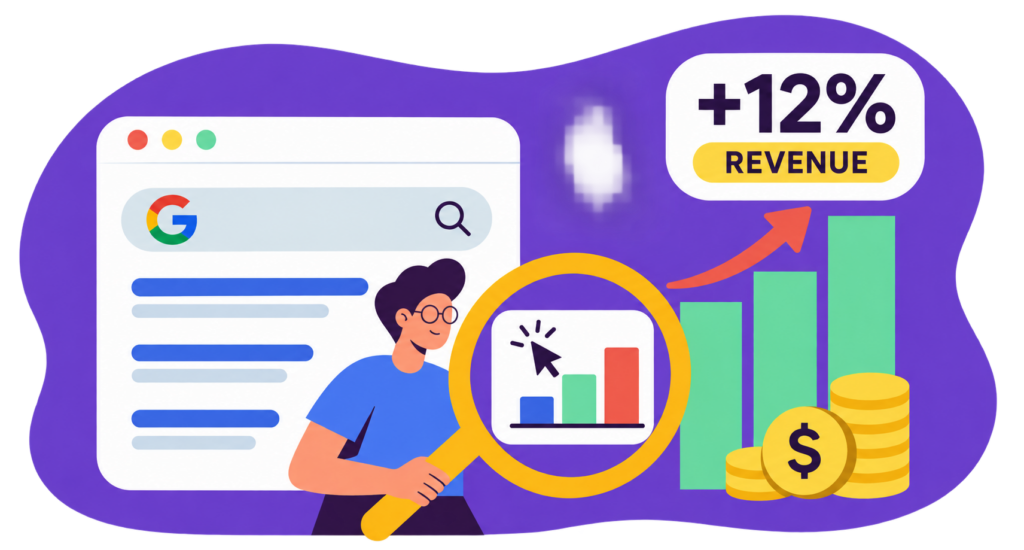

More activity does not always translate neatly into more money. Any business that has celebrated a traffic spike before checking the sales report will recognize the problem.
Alphabet’s October 28 earnings release reported 12% year-over-year growth in “Google Search & other” revenue. Separately, Google said Search query growth was the strongest it had been in five years. Those are different measurements, not two descriptions of a 12% increase in searches.
For business owners, the useful story is how Google’s growing AI search experience connects usage, advertising and commercial value. That matters far more to a marketing strategy than a dramatic headline about its share price.
Article Summary
- Alphabet reported 12% growth in “Google Search & other” revenue for the third quarter.
- Google separately described its strongest year-over-year Search query growth in five years.
- Revenue growth and query growth measure different things.
- Google says its Search approach prioritizes user experience, followed by monetization.
- Businesses should assess their own qualified demand and commercial outcomes rather than treating platform growth as a forecast.
First, What Does the 12% Actually Refer To?
The figure concerns revenue.
Alphabet’s official earnings release identifies 12% growth in its “Google Search & other” business for the quarter ending September 30, 2026. It does not label that figure as growth in the number of searches.
Google’s statement about query growth is separate. The company describes the year-over-year growth rate as its highest in five years without supplying a matching percentage in that statement.
This might sound like a small editorial correction. It changes the meaning of the story.
Revenue can increase because of several interacting factors. Search activity can grow without producing an identical percentage increase in advertising income.
Combining those measures would be like reporting that a store welcomed 12% more customers because its takings increased 12%. The till receipt does not count everyone who walked through the door.

What Is Google Saying About AI Search?
In his published earnings-call remarks, Sundar Pichai says Google is building a connected experience across AI Overviews, AI Mode and traditional Search.
He describes an approach focused on delivering the user experience first, followed by monetization. He also says AI investment is contributing to query growth, including commercial searches.
That gives businesses a useful way to understand the transition.
Google is developing how people use Search while continuing to develop how advertising operates within that experience. Those two processes do not need to progress at exactly the same speed.
It would be a mistake to turn that into a claim that AI search cannot generate commercial value. It would also be a mistake to assume increased usage guarantees attractive results for every advertiser.
The relevant question is how the experience changes customer discovery and the opportunities available to reach those customers.
Why More Queries Do Not Automatically Produce Equivalent Revenue
A search query is an interaction. It is not a standardized unit of commercial value.
Someone researching a general concept may have little immediate buying intent. Someone comparing suppliers for a planned purchase may be much closer to making a decision.
A conversational experience can contain both types of interaction within the same journey.
Consider a hypothetical business owner investigating warehouse software. Their opening question might concern operational bottlenecks, followed by questions about implementation, integrations and pricing.
That sequence could contain several queries before a supplier becomes relevant. Counting the interactions alone would not explain how much advertising revenue they generate.
This is a general illustration, not a reconstruction of Google’s internal economics. The point is that growth in usage and growth in monetization need separate analysis.
What Does the Advertising Expansion Tell Us?
Google also published an AI Mode advertising expansion announcement on October 28.
It describes expansion into ten international markets and follow-up-question ads in the United States. Google identifies further markets as planned destinations rather than completed launches.
The announcement is evidence that Google is continuing to develop advertising inside conversational search.
It is not proof that every new placement will perform well. Nor does it establish that paid visibility can replace useful organic content or a convincing website.
For businesses, this is a reason to coordinate campaign planning with content strategy. A potential customer might encounter sponsored options, source material and brand information during different parts of their research.
The goal is to support that journey consistently, rather than treat each interface as an unrelated marketing project.
Our overview of AI Mode’s international expansion provides background on the wider search experience.
Why This Matters Even If You Do Not Run Google Ads
Changes to Google’s search experience affect more than advertising accounts.
A business investing in organic visibility still needs to understand how customers research, compare and choose. If customers ask more detailed questions, broad content may leave important information unanswered.
That does not mean producing a separate article for every possible sentence someone could type.
A better approach is to identify recurring commercial questions and answer them clearly where they belong. Pricing information, limitations, compatibility and suitability often deserve more attention than another generic introductory guide.
Our discussion of Google’s AI search shift explores the broader visibility context. The practical task is to connect those changes with your customer’s buying process.
What Should Businesses Measure?
The most useful response to an earnings headline is to examine your own commercial evidence.
Start with whether search activity introduces relevant prospects, supports consideration and contributes to sales. Different stages require different measures.
Separate Visibility From Acquisition
Impressions and appearances can show that a business is being encountered. They do not establish that the audience is suitable or ready to buy.
Review which topics and landing pages attract attention. Then investigate whether those visits produce relevant inquiries, purchases or other meaningful actions.
Check Lead Quality
A larger number of form submissions can create more work without creating more customers.
For a service business, compare inquiries with qualified opportunities and eventual sales. For a retailer, examine purchases alongside margins, returns and customer type.
The objective is to understand value, not simply find a larger number.
Document Attribution Limits
Some customer journeys involve several visits and channels. Your reports may therefore provide a partial account of how discovery contributed.
Record those limits, but resist using them to justify unsupported claims. “We cannot see everything” does not mean every unexplained sale belongs to AI search.
Our SEO KPIs guide provides a framework for choosing measures tied to business objectives.
What Should an Agency Recommend?
A useful agency response should connect platform developments with evidence from your business.
That means reviewing audience behavior, commercially important content, campaign configuration and measurement quality. Recommendations should explain why a particular change deserves priority.
It should not involve treating Google’s revenue growth as a forecast for your website.
Nor should it turn uncertainty into an emergency sales pitch. Some businesses may need a focused content update or measurement correction rather than a complete strategic overhaul.
Ask what the agency has observed, what it is inferring and what evidence would test the recommendation. Those distinctions are a practical measure of expertise.
What About the Stock-Market Headline?
An earnings release, a share-price movement and a causal explanation are three separate claims.
A responsible report needs a defined trading period and reliable market data before stating the size of a move. Attributing that movement to one factor requires further evidence.
The original sources verified for this article do not establish that AI Mode caused a 10% stock decline. That claim should therefore not drive the headline or the business recommendation.
For marketing teams, the more useful information concerns Google’s product direction and the economics of customer acquisition. Your content plan does not need to become a live commentary on Wall Street.
Measure the Business Outcome Behind the Activity
Google’s earnings illustrate a familiar commercial principle: activity, revenue and value are related, but they are not interchangeable.
For businesses adapting to AI search, the priority is to understand where qualified demand comes from and how effectively the website converts it. Platform growth is context, not a substitute for that analysis.
If you would like a clearer view of how search visibility supports your commercial goals, book a free discovery call with SEO Sherpa. We can discuss your current performance and where a coordinated SEO and GEO strategy could help.





















Leave a Reply