

Summarize This Article With AI
 Try with ChatGPT
 Try with Claude
 Try with AI Mode
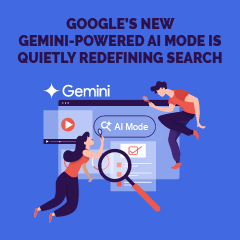
Google just powered its AI Mode with Gemini.
That sounds like a product update. A model upgrade. A nice bit of engineering.
It isn’t.
This is a structural shift in how search thinks.
Because when you plug a more advanced reasoning model into search, you’re not just changing answers. You’re changing the way questions are understood, the way intent is interpreted, and the way visibility is decided.
And this move does not happen in isolation.
It happens exactly at the moment search stops behaving like a list of links, and starts behaving like a decision engine.
Article Summary
- Google’s AI Mode is now powered by Gemini, adding more advanced reasoning
- Search is moving away from matching keywords and toward interpreting intent
- Results are becoming dynamic, personalized, and context-aware
- This accelerates the shift toward Search Everywhere behaviors
- Brand trust and recognition are becoming more important than raw rankings
- Static SEO strategies are becoming less reliable by the day
Why This Matters More Than A Model Swap
On paper, Gemini replacing the brain behind AI Mode sounds technical. In reality, it’s philosophical.
Search engines used to be retrieval systems. You typed something, they fetched the most statistically relevant documents, and you chose.
Now, search engines are becoming reasoning systems. You ask something, they interpret context, weigh intent, evaluate sources, and construct answers.
That changes everything about how visibility works.
When AI Mode was simpler, content could still “win” by being well-optimized. With Gemini-level reasoning layered in, the system doesn’t just look at your page. It looks at who you are, how often you’re referenced, and whether your brand feels like a credible source in that moment.
This isn’t faster search.
It’s smarter judgment.
And judgment changes the game.

Gemini Changes How Stable AI Answers Actually Are
Until now, one of the most frustrating parts of AI Mode and AI Overviews was how inconsistent they could be. You could ask the same question twice, tweak the verb tense, shift the phrasing slightly, or add a single emotional word, and suddenly you were looking at a completely different answer.
That wasn’t a bug. It was a limitation.
Earlier AI systems were far better at pattern matching than they were at true understanding. They reacted to surface language instead of reasoning about real intent. To these systems, small wording changes weren’t small at all. They were interpreted as new questions.
Gemini changes that behaviour.
With more advanced reasoning, Gemini becomes far more stable at recognising intent even when phrasing shifts. It doesn’t just read words, it interprets meaning. That creates answers that are more grounded and far less volatile.
But the answers don’t become identical.
What changes is the type of variation. Instead of chaotic swings between outcomes, you see subtle shifts in emphasis, structure, and framing. The core logic stays intact.
And strategically, this is huge.
Because it kills old-era SEO tricks. You can’t prompt-engineer your way into visibility anymore by tweaking syntax. You can’t confuse the system with phrasing hacks. You can’t outsmart it with grammar gymnastics.
You have to earn its trust.

Search Is No Longer Static, And Neither Are The Results
For most of its life, search has been built on a comforting illusion of stability. You typed something into a box, pressed enter, and trusted that what came back was broadly the same experience your competitor, your colleague, or your client would also see. There were personalisation layers, of course, but the foundations were predictable. Rankings were measurable. Visibility felt controllable. Strategy felt like it lived on solid ground.
That era is ending.
With Gemini now sitting behind AI Mode, search stops behaving like a filing cabinet and starts behaving like a conversation. It doesn’t just retrieve information. It interprets intention, weighs possibilities, adjusts the tone of its responses, and reshapes how results are constructed in real time based on who is asking and how they are asking.
This is where things become uncomfortable for traditional SEO thinking.
When a system starts reasoning instead of retrieving, the concept of a “fixed result” quietly collapses. There isn’t one version of the SERP. There isn’t one stable hierarchy. There isn’t a single, repeatable set of ten blue links you can reverse engineer and dominate. Instead, the system builds answers dynamically, pulling from a constantly shifting mixture of sources, signals, trust markers, and contextual understanding.
Search becomes fluid.
And fluid systems don’t reward static strategies.
You don’t rank once and then enjoy years of passive visibility. You don’t perfect a page and lock in position one. You don’t win by finding the right technical trick and repeating it forever. You win by becoming a source that a thinking system feels safe pulling from again and again.
You don’t out-optimize it. You out-trust it.
And that is a completely different discipline.

This Is Search Everywhere Becoming The Default
This update cannot be understood in isolation, because Google is not operating in a vacuum. What Gemini represents inside AI Mode is the same shift that has been quietly reshaping every major platform over the last few years. Search is no longer something that lives in a search box.
It lives inside platforms, feeds, conversations, voice commands, and recommendation engines. People are no longer switching to “search mode.” They are simply asking, discovering, comparing, and deciding wherever they already are.
TikTok isn’t just serving entertainment. It has become a search engine for Gen Z. YouTube is now treated as a research platform, not a video library. Reddit has turned into a crowdsourced decision engine, where real human experience outranks polished marketing. Pinterest behaves like a visual search layer. AI surfaces like ChatGPT and Perplexity are becoming default discovery tools, not novelty products.
The critical shift here is what platforms are optimizing for.
They are no longer optimizing for clicks. They are no longer optimizing for time on site. They are optimizing for confidence.
Users want to feel certain. They want to feel informed. They want to feel safe in their decisions. So platforms are evolving in a way that mirrors human psychology, not just technical performance. Relevance is no longer enough. Familiarity and trust are becoming the primary ranking systems.
That is what Search Everywhere actually means in practice.
It is not about being present on more platforms. It is about being trusted across them. It is about creating a consistent, recognizable presence that thinking systems feel comfortable recommending, summarizing, and surfacing because they have pattern-matched you as a reliable source.
And when search becomes ambient rather than intentional, visibility stops being something you chase. It becomes something you build.

This Quietly Pushes SEO Toward Brand-Led Visibility
Here’s the shift most teams will feel before they understand it.
Gemini doesn’t just read content.
It evaluates reputation.
It looks for:
- Reference patterns
- Entity clarity
- Cross-platform signals
- Brand mentions
- Consistency of authority
SEO stops being a keyword discipline and becomes a brand discipline.
Because reasoning systems don’t want “optimised”.
They want safe. Trusted. Recognizable.
The Bottom Line
Google powering AI Mode with Gemini isn’t an upgrade. It’s an acceleration. Search engines are becoming thinking systems. Algorithms are becoming evaluators.
Results are becoming opinions.
The future of visibility will not belong to the most optimised brands. It will belong to the most trusted ones.
And the brands that understand that now will not be scrambling later.
By the time everyone else catches up, the thinking engines will have already decided who they trust.
Book a free discovery call with us to see what this means for your business.




















Leave a Reply