

Summarize This Article With AI
 Try with ChatGPT
 Try with Claude
 Try with AI Mode
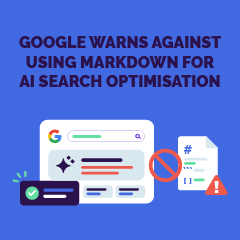
There is a new shortcut doing the rounds in AI search circles.
Strip your pages back to plain Markdown, the theory goes, and large language models will find you easier to read, cheaper to process and more likely to cite.
Google has now stepped in to say the quiet part out loud: this is a solution looking for a problem.
On a recent episode of Google’s Search Off the Record podcast, Search Relations engineers Martin Splitt and John Mueller pushed back on the growing trend of publishing stripped-down Markdown versions of websites purely to please AI systems. Their message was blunt. HTML is still the standard for search and discovery, and Markdown-only pages tend to remove the very signals that both users and machines rely on.
That distinction matters more than it first appears.
Article Summary
- Google’s Martin Splitt and John Mueller advised against creating Markdown versions of websites for AI search.
- Markdown by itself is not a good user experience because it lacks the layout, colour and imagery users expect.
- HTML provides structural signals like headers, navigation and internal links that help both users and machines.
- Maintaining a separate Markdown version doubles the workload and increases the risk of undetected errors.
- A broken AI-facing page can linger unnoticed because no user ever sees it to complain.
- The llms.txt proposal was also questioned because it lacks a genuine discovery mechanism.
- Search Everywhere Optimization depends on rich, visible experiences, not stripped-back content built for bots.
What Did Google Actually Say?
The conversation started with a simple question. Should publishers convert their sites into Markdown to help LLMs understand their content?
Both engineers said no.
Splitt’s first point was about people, not machines. Markdown by itself may not be a good user experience because it neglects the visual elements modern users expect. We like colours, images and content that flows within a considered layout. Markdown, by definition, does not support layouts directly unless you build a mechanism to add one back in.
In other words, the thing that makes Markdown appealing to developers is the same thing that makes it a poor experience for the average visitor.
A raw Markdown document is clean. It is also flat, grey and stripped of the design cues that help people navigate, trust and act.
Splitt acknowledged why the idea is tempting. Fewer tokens, less “cruft,” easier for a model to chew through. But convenience for a crawler is not the same as value for a customer.

The Parallel Version Trap
The second warning was more technical, and arguably more important.
Once you publish a Markdown version for LLMs and keep your HTML version for humans, you now have two sites to maintain. That is twice the work and twice the surface area for things to break.
Mueller and Splitt compared this to the old headaches of dynamic rendering, a stopgap that created hard-to-diagnose bugs and technical debt that teams are still cleaning up years later.
Here is the part that should give any site owner pause.
If your HTML page breaks, a real person notices. They hit a broken layout, get frustrated and email you to complain. That feedback loop keeps your site honest. But if the machine-facing Markdown version breaks, no user ever sees it. The error can sit there quietly for weeks while automated systems index a broken version of your content, and nobody tells you a thing.
You would be optimising for an audience that cannot report a problem.
Why HTML Still Wins for Discovery
The most reassuring takeaway is also the least glamorous.
Crawlers and search engines have spent decades learning to parse messy, real-world HTML. Extracting plain text from HTML is already a trivial, automated task. LLMs have been reading and understanding normal web pages since the beginning.
They do not need a simplified version served on a silver platter.
More to the point, HTML carries context that raw Markdown throws away. Headers, footers, sidebars, navigation and internal links all tell a machine how your content fits together. Flatten that into plain text and you are not adding clarity. You are removing the structural signals that help systems understand your site in the first place.
This is why publishing normal, well-structured HTML remains the primary prerequisite for being crawled, indexed and discovered by both traditional search and AI systems.
The podcast also touched on llms.txt, the proposed file that lists your key pages for AI systems. Mueller was equally unconvinced. He described the discovery use case as a dead end because a self-reported file cannot help an LLM choose your site over a competitor’s. Every site can claim to be the best. That is precisely why the claim stops meaning anything.
Independent data backs this up. An Ahrefs study of 137,000 sites found that the vast majority of llms.txt files are never read by AI crawlers at all.
Why This Matters for Search Everywhere Optimization
Here is where the Markdown debate connects to something bigger.
Search Everywhere Optimization is built on a simple idea. Your customers now discover, research and validate brands across many surfaces, and you need to be present, credible and recognisable at every one of them.
That is fundamentally a case for richer experiences, not thinner ones.
The Markdown shortcut assumes you can win AI visibility by feeding machines a stripped-back version of yourself. But the platforms that matter are pulling signals from the full, living web. They read your HTML. They weigh your structure. They factor in the same authority, clarity and trust signals that make a page genuinely useful to a person.
Strip those away and you do not become more visible. You become more generic.
Think about what actually earns a citation or a recommendation today. A well-structured page with clear headings. Supporting images and video. Internal links that map your expertise. Reviews, community discussions and third-party mentions that validate your brand across platforms. None of that survives a flatten-to-text approach.
This is the same trap as manufactured mentions or mass-produced content built purely for crawlers. It optimises for the machine while forgetting the human on the other end.
A strong Search Everywhere strategy does the opposite. It builds one excellent, richly structured experience that serves people first and lets machines benefit as a natural consequence. Helpful HTML pages support deep research. Video creates awareness. Social proof and community activity provide validation. Each surface adds context, and each reinforces the others.
Google’s advice, stripped of the technical detail, is really a philosophy. Do not build a second-rate version of your site for robots. Build one great version for humans, and trust that the systems designed to understand humans will follow.
That is Search Everywhere Optimization in a sentence.
What Should Businesses Do Next?
Resist the urge to chase the shiny new tactic.
Before you commission a Markdown layer or an llms.txt file, ask a simpler question. Is your existing HTML clean, accessible and well-structured? Is your core content available without being trapped behind heavy scripts? Do your headings, internal links and structured data actually describe your site clearly?
Fix those fundamentals first, because they serve every audience at once.
Then focus your energy where it compounds. Improve the pages you already have rather than building parallel ones you will struggle to maintain. Use structured data for the entities that matter to your business. Strengthen the internal linking that helps both users and machines follow your expertise across the site.
Most importantly, stop treating AI systems as a separate audience that needs a separate, simplified website.
They are reading the same web your customers are. The brands that win visibility across search, AI and every surface in between are not the ones serving the thinnest possible content to bots. They are the ones building the richest, most trustworthy experience for people.
The shortcut is tempting. The fundamentals still win.
Ready to Build Visibility Everywhere People Search?
AI search is changing fast, and the pressure to adopt every new tactic can be overwhelming. But visibility across Google, AI Overviews, AI Mode and beyond still comes down to authority, structure and genuine value, not shortcuts built for machines.
At SEO Sherpa, we help brands build the technical foundations, content authority and cross-platform visibility needed to be found, trusted and chosen across the modern search journey.
Book a free discovery call with our team today to find out how Search Everywhere Optimization can help your business increase its visibility, strengthen its authority and turn more searches into customers.





















Leave a Reply