

Summarize This Article With AI
 Try with ChatGPT
 Try with Claude
 Try with AI Mode
There was a time when search was simple.
You asked a question.
Google showed you ten blue links.
You clicked one, got your answer, and moved on.
Those days are starting to feel quaint.
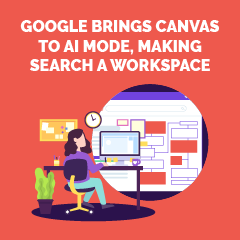
Because with the introduction of Canvas in AI Mode, Google is experimenting with something very different.
Instead of just answering questions, Google Search can now become a workspace.
Users can open Canvas inside AI Mode to organize ideas, draft documents, or even build simple tools using information pulled from the web and Google’s Knowledge Graph.
In early tests, people used it to build dashboards tracking scholarship deadlines and financial aid requirements.
Which is impressive.
But it also raises a much bigger question.
What happens when users stop leaving search altogether?
Article Summary
- Google has introduced Canvas in AI Mode, a workspace within Google Search.
- Canvas allows users to organize plans, draft documents, and build simple tools using web data.
- Early examples include dashboards and planning tools created directly inside search.
- If adoption grows, search could shift from a discovery tool to a destination for productivity and problem-solving.
What Canvas Actually Does
Canvas is essentially a collaborative workspace built into AI Mode.
Instead of asking a question and receiving an answer, users can open a dedicated environment where they:
- Describe a task or project
- Generate structured outputs
- Refine them through follow-up prompts
The system pulls information from across the web and Google’s Knowledge Graph, then assembles something useful.
Not just a paragraph.
But a working artifact.
In some cases that might be a document outline.
In others, a structured dataset or dashboard.
And in more advanced examples, users can even edit the underlying code generated by the system.
Which means search is starting to blur into something closer to productivity software.

Why This Is A Big Shift For Search
For decades, search engines have operated primarily as gateways.
Their job was to help users leave the search engine and find information elsewhere.
But features like Canvas suggest Google is experimenting with a different model.
One where users remain inside the search environment for longer periods.
Instead of sending traffic outward, search begins to absorb activities traditionally handled by:
- Note-taking apps
- Planning tools
- Lightweight software
In that sense, Canvas isn’t just a feature.
It’s part of a broader trend where AI transforms search from a navigation tool into a problem-solving environment.

The Opportunity For Interactive Brand Experiences
For marketers, Canvas also hints at something interesting.
If users can build dashboards, calculators, or planning tools inside search, brands may eventually find ways to participate in those environments.
Imagine AI-generated financial calculators sponsored by a fintech brand.
Or travel planning tools powered by airline or hotel partnerships.
Or marketing dashboards that incorporate brand-specific datasets.
Interactive experiences have always been powerful engagement tools.
Canvas simply moves them closer to the place where discovery begins.
The Search Everywhere Optimization Perspective
The rise of AI workspaces inside search highlights a broader shift in digital discovery.
The boundaries between platforms are dissolving.
Search engines now:
- Answer questions
- Summarize content
- Generate documents
- Build tools
Which means the user journey no longer follows a predictable path from search engine to website.
Instead, discovery happens across a fluid ecosystem of platforms and interfaces.
That’s why Search Everywhere Optimization™ focuses on visibility across multiple discovery environments.
Not just Google rankings.
But the broader ecosystem where people ask questions, solve problems, and explore ideas.
Because increasingly, those experiences may happen without leaving the platform where the question was asked.
Search Is Slowly Becoming Software
Canvas is one of those features that might not look revolutionary today.
But give it a few iterations, and it could fundamentally reshape how people interact with information.
Because once users get comfortable building tools inside search, the next step is obvious.
Why leave at all?
If search can answer questions, generate documents, organize projects, and build simple tools, it starts to look less like a search engine and more like a lightweight operating system for the internet.
And when that happens, the brands that succeed will be the ones integrated into those environments; not just linked from them.
The Real Takeaway For Marketers
The role of search is expanding.
It’s no longer just about helping users find information.
It’s about helping them solve problems directly inside the search interface.
That shift will reshape how visibility works online.
The brands that thrive will be the ones that build presence across the entire discovery ecosystem.
That’s the philosophy behind Search Everywhere Optimization™.
If you want to understand how to position your brand for visibility across AI search, emerging discovery platforms, and traditional search engines, book a free discovery call with SEO Sherpa.
We’ll help you build a strategy designed for the next era of search.




















Leave a Reply