
Summarize This Article With AI
 Try with ChatGPT
 Try with Claude
 Try with AI Mode

Google has finally clarified what counts as an impression inside AI Mode and AI Overviews.
And no, your brand being mentioned by an AI response does not automatically mean you earned one.
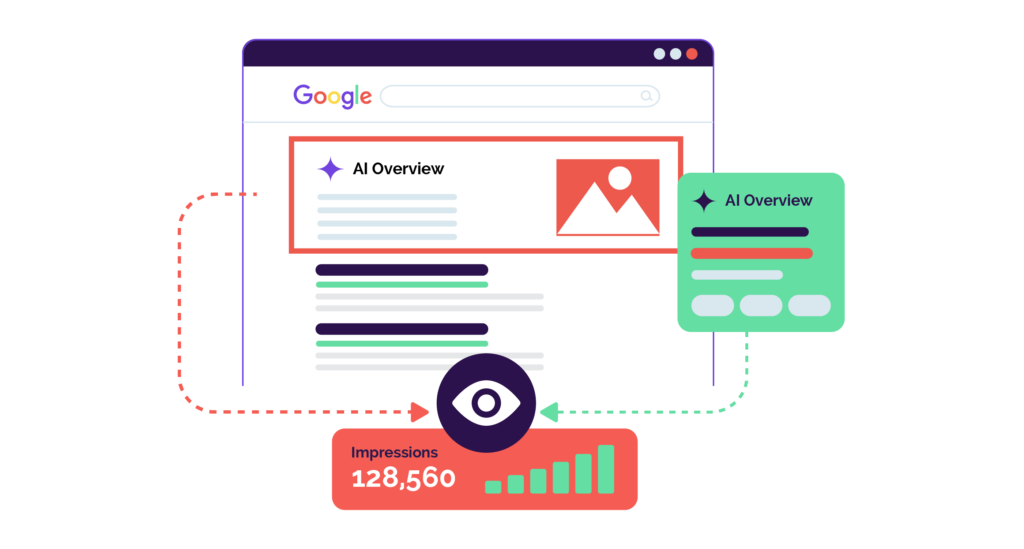
According to Google’s John Mueller, an impression is counted when a link to a page on your website is actually shown within an AI Overview or AI Mode response. An unlinked brand mention, product reference or passing nod to your company is not enough.
That distinction might sound technical, but it matters enormously as businesses begin using AI visibility, citations and Search Console impressions interchangeably. They are related metrics, but they are not the same thing.
Article Summary
- Google counts an AI search impression when a link to your website is displayed.
- An unlinked brand mention does not count as a Search Console impression.
- Links hidden behind an expandable element are only counted when the user activates that element.
- Follow-up questions in AI Mode are treated as new searches.
- AI Mode and AI Overview performance can be included within Search Console data.
- Brands still need to measure unlinked mentions, citations, share of voice and referral traffic separately.
- Search Everywhere Optimization requires a broader measurement framework than Search Console alone.
What Counts as an AI Search Impression?
The clarification came after questions were raised about Google’s newer AI performance reporting and how visibility is recorded.
Mueller explained that impressions are based on links to a site being shown in AI Overviews or AI Mode. If a favicon, source card or another element links directly to a page on the website, it may count. However, when a user needs to expand, activate or interact with an element before the link becomes visible, the impression is only recorded after that interaction occurs.
In other words, Google is applying a variation of its standard impression rules to generative search experiences.
A brand could be discussed prominently in an AI-generated response, yet receive no Search Console impression because no clickable link appeared. Conversely, a page could receive an impression through a source card that the user never clicks.
This is one reason AI search reporting is already becoming more complicated than the familiar impressions-and-clicks model used in traditional SEO. If you are still getting to grips with the basics of how these metrics work, our guide to SEO basics is a useful primer.
Mentions and Impressions Are Not the Same Metric
The clarification exposes an increasingly important measurement gap.
A brand mention can be valuable even when no link is provided. It may influence awareness, preference, trust and future branded searches. Someone could see a company recommended in AI Mode, remember its name and later visit its website directly or search for the brand separately.
None of that would necessarily appear as an AI impression or referral in Search Console.
This means businesses cannot treat Search Console as a complete record of their AI visibility. It can report the links Google displays and the clicks those links receive, but it cannot measure every occasion on which an AI platform discusses, recommends or validates a brand.
That distinction becomes even more important outside Google.
ChatGPT, Perplexity, Gemini, Claude, Copilot and other AI platforms each use different interfaces, citation formats and reporting systems. Some provide clickable citations. Others may mention a brand within generated text without linking to it at all.
A business could therefore have high AI share of voice while receiving relatively few trackable referrals.
How AI Mode Data Is Handled in Search Console
Google has previously confirmed that AI Mode activity can count toward Search Console totals.
Clicks on external links in AI Mode are counted as clicks, while standard impression rules apply when links are displayed. Google also treats follow-up questions as new queries, meaning the impressions, clicks and positions generated by each new response are counted separately.
However, this data has historically been difficult to interpret because AI Mode, AI Overviews and conventional web results have not always been cleanly separated within standard performance reporting.
That can create unusual patterns.
A website may see impressions rise as its pages are surfaced more frequently inside AI-generated experiences, but clicks may not increase at the same rate. The user may receive enough information from the AI response without visiting the source, or the link may appear in a carousel or source panel that attracts limited attention.
This contributes to what many marketers describe as the “great decoupling” between rankings, impressions and clicks. To understand how the results page itself has evolved into these AI-driven experiences, take a look at our complete guide to SERPs and SERP features.
Visibility is increasing, but traffic is no longer guaranteed to follow.
Why This Matters for SEO Reporting
For years, SEO reporting has largely followed a straightforward path:
Rankings create impressions. Impressions create clicks. Clicks create conversions.
AI search has disrupted every stage of that funnel.
A single AI-generated answer may draw information from several sources, mention multiple brands and display only a limited number of links. The source that influenced the answer may not always be the source that receives the most visible citation.
As a result, marketers need to be careful when drawing conclusions from Search Console data.
An increase in impressions might mean a site is appearing more often in AI responses, but it could also reflect changes in traditional search layouts. A decline in click-through rate might indicate weaker titles, but it could equally be caused by AI Overviews answering more of the query directly. Keeping an eye on the wider trends in our roundup of SEO statistics can help you separate signal from noise.
Search Console remains essential, but interpreting it now requires considerably more context.
How Should Brands Measure AI Visibility?
A stronger AI reporting framework should separate several different forms of visibility.
Linked citations show when a platform has presented the website as a source users can visit.
Unlinked mentions demonstrate whether the brand is being recognised or recommended, even when no direct traffic opportunity is provided.
Share of voice measures how frequently the brand appears compared with competitors across a relevant set of prompts.
Referral traffic shows how many users actually arrive from AI platforms.
Branded search demand can indicate whether repeated exposure across AI, social media, video and other discovery channels is encouraging people to seek the brand directly.
Conversions and assisted conversions reveal whether AI visibility is influencing meaningful commercial outcomes.
No single metric provides the full picture. A brand can perform strongly in one area while remaining almost invisible in another.
How This Ties Into Search Everywhere Optimization
This clarification is a perfect example of why modern search strategy cannot be measured through website rankings alone.
Search Everywhere Optimization focuses on building visibility wherever people discover, investigate and validate a business. That includes Google Search, AI Mode, social platforms, YouTube, Reddit, review websites, industry publications and AI assistants.
An unlinked mention in an AI response may not count as a Google impression, but it can still influence a buyer.
The same person might later watch a YouTube video, read a LinkedIn post, check reviews, search the company name and finally visit the website. Search Console may only capture one small part of that journey.
Brands therefore need to create a consistent entity and reputation across the wider digital ecosystem. This includes publishing expert content on owned websites, contributing original insight on third-party platforms, building credible brand mentions, investing in video and strengthening the sources that AI systems use to validate recommendations.
The goal is not simply to generate a link inside one AI Overview.
It is to become the brand that search engines, AI platforms and customers repeatedly encounter—and increasingly trust.
What Should Businesses Do Next?
Businesses should first review how they currently define AI visibility.
If reports combine mentions, citations, impressions and clicks into one metric, they risk overstating or understating performance. Each of these signals should be monitored separately.
Teams should also identify the commercial prompts that matter most to their audience. Rather than checking whether the brand appears for a handful of vanity questions, analyse whether it is recommended for product comparisons, service queries, location-based searches and problem-aware questions that can influence a purchase.
Finally, keep investing in the SEO fundamentals that make content discoverable and citable: clear site architecture, indexable pages, strong internal linking, structured data where appropriate and genuinely useful content. Much of this falls under technical SEO, the foundation that keeps your pages eligible to be surfaced in the first place.
Google’s clarification may narrow the definition of an impression, but the definition of visibility is only getting broader.
Ready to Build Visibility Everywhere People Search?
Search is no longer limited to ten blue links. Your customers may discover your business through Google, AI Mode, social platforms, video, reviews, communities or an AI-generated recommendation before they ever reach your website.
At SEO Sherpa, we help brands build the technical foundations, content authority and cross-platform visibility needed to be found, trusted and chosen across the modern search journey.
Book a free discovery call with our team today to find out how Search Everywhere Optimization can help your business increase its visibility, strengthen its authority and turn more searches into customers.

















Leave a Reply