
Summarize This Article With AI
 Try with ChatGPT
 Try with Claude
 Try with AI Mode
Recipe creators have had a brutal couple of years.
AI-generated answers scraped their ingredients, blended their methods, and served the result to searchers who never clicked through to the site that did the actual cooking.
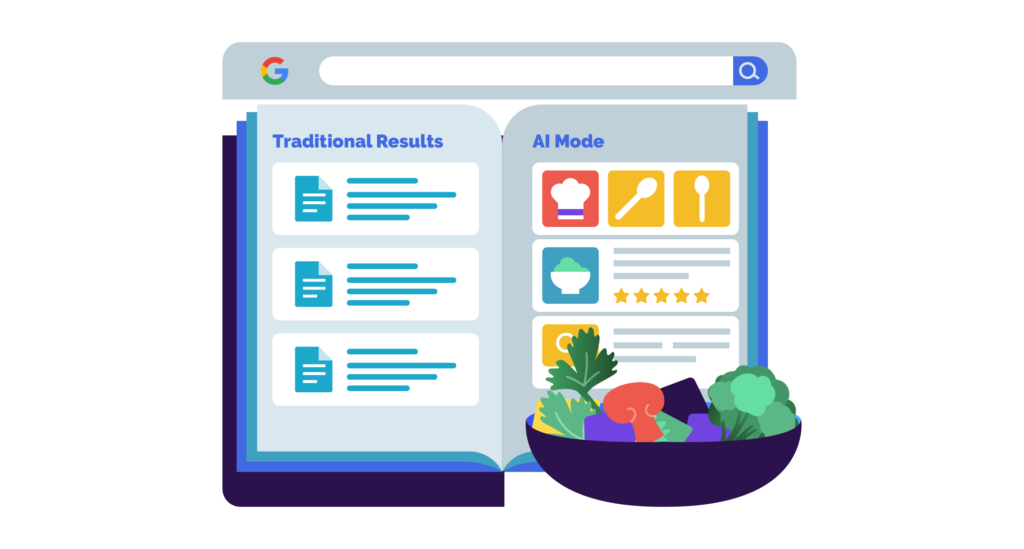
Now Google is offering something back. The company has added new visual elements to recipe results in AI Mode, placing prominent links at the top of responses alongside creator names, recipe ratings, and ingredient counts. It is a real improvement, and it is a genuine attempt to send traffic back to the people who earn it.
Whether it is enough is a different question, and the creators themselves are not convinced yet.
Article Summary
- Google added a new visual treatment to recipe results in AI Mode.
- Recipe links now appear prominently at the top of responses, often in a carousel.
- The links include creator names, recipe ratings, ingredient counts, and images.
- Google’s Robby Stein said the goal is to help people discover and visit recipe pages.
- The update builds on an earlier recipe change Stein announced in March 2026.
- Recipe publishers welcomed the change but said major concerns remain unresolved.
- Search Everywhere Optimization is the durable answer to platform-dependent traffic.
What Did Google Change?
The update was announced by Robby Stein, Google’s VP of Product for Search, in a post on X.
He described it as a new visual treatment designed to make it easier to discover and visit recipe pages within AI Mode.
For relevant recipe queries, users now see prominent links at the top of AI Mode responses, with details like the creator name, recipe ratings, and number of ingredients. The links frequently appear in a carousel, accompanied by images of the finished dish, giving recipe pages a far more visible position than they had when buried beneath an AI-generated summary.
This is the second iteration of a change Stein first introduced earlier in the year.
Back in March 2026, Google rolled out a recipe panel that let users tap a dish to open links to relevant recipe sites alongside a brief overview. The new version pushes those links up to the top of the response and enriches them with the creator and recipe details. Stein tied the two together directly, noting this was a continuation of the recipe work he had discussed in March and thanking creators for their ongoing feedback.
In other words, this is an evolving effort rather than a one-off tweak.

The Backstory Google Is Responding To
To understand why this matters, you have to understand how bad the last two years were for recipe creators.
The core grievance had a name: Frankenstein recipes.
Food creators used the term to describe AI Mode’s habit of synthesizing a new recipe by pulling ingredients from one source, cooking steps from another, and timing guidance from a third. The blended result was assembled by a machine, never actually tested as a complete dish, and sometimes attributed to creators who had nothing to do with it. It satisfied the searcher’s query while sending no traffic, and occasionally no accurate information, anywhere.
The financial damage was severe.
Across the industry, food bloggers reported traffic drops ranging from 30 to 80 percent during 2025, with the worst losses hitting creators who depended most heavily on Google for discovery. Broader studies covering hundreds of thousands of keywords found that AI Overviews cut click-through rates for top-ranking pages by roughly a third on average. For a publisher whose entire business ran on recipe pageviews, that was not a bad quarter. It was closer to an extinction-level threat.
Google’s recipe updates, this one included, are a direct response to that sustained backlash.
The shift they represent is meaningful. Instead of AI Mode providing a satisfying terminal answer, the goal is to make it a useful starting point that funnels users toward creator sites. That is a better deal for creators than what came before.
Creators Say It Is Not Enough Yet
Here is where the story gets more honest.
The publishers most affected welcomed the update, then immediately said the work is far from done.
In a reply to Stein’s announcement, the team at Inspired Taste called the change a step in the right direction while making clear that significant concerns about AI-generated recipes remain unresolved. Their central worry is that Google still displays AI-generated recipe content that can misrepresent a creator’s actual work, sometimes framing the synthesized version as though it were the official recipe.
Better links at the top do not fully fix that.
A more prominent link is a genuine improvement for discovery and traffic. But if the AI-generated recipe still sits in the response, potentially inaccurate and potentially attributed to someone who never wrote it, the underlying accuracy and attribution problems have not gone away. The creators are drawing a clear line between a visibility improvement, which this is, and a trust and accuracy fix, which this is not.
Google, for its part, signaled that more is coming.
Stein pointed to creator feedback as the reason for the continued work, which leaves the door open for further changes. His post did not specify which regions, languages, devices, or exact query types trigger the new treatment, so the rollout details remain fuzzy. What is clear is that Google is still under pressure from recipe publishers, and this update is unlikely to be the last word.
Why Structured Data Still Matters Here
There is a practical takeaway buried in the details for anyone who publishes recipes.
The fields Google is now surfacing look a lot like recipe structured data.
Creator names, ratings, and ingredient counts are exactly the kind of information publishers provide through Schema.org recipe markup. The earlier March version was documented as pulling cook time, prep time, author, aggregate rating, and hero image directly from that structured data. Stein did not explicitly confirm whether markup is mandatory for the new AI Mode treatment, but the overlap is hard to ignore.
The sensible move is to treat clean structured data as a prerequisite.
If Google is deciding which recipe links to elevate and what details to show alongside them, well-formed markup is how you give its systems the cleanest possible information to work with. Complete, validated recipe markup with properly formatted fields is not a guarantee of prominence, but missing or broken markup is a reliable way to be overlooked. This is standard technical SEO hygiene applied to a new surface, and it costs little to get right.
For recipe publishers, that is the actionable piece of this news.
Why This Matters for Search Everywhere Optimization
Zoom out, and the recipe saga is the clearest possible illustration of the Search Everywhere argument.
An entire category of publishers built their businesses on one traffic source, and that source changed the rules.
Creators who relied on Google recipe pageviews for the bulk of their income watched AI features absorb a third to four-fifths of their traffic in a matter of months. They did nothing wrong. The platform simply changed how it worked, and businesses anchored to that single channel had almost no cushion when it happened. This latest update softens the blow, but it does not hand back what was lost, and it comes entirely on Google’s terms.
Search Everywhere Optimization is the structural alternative to that vulnerability.
A recipe creator whose audience finds them across many surfaces is far less exposed to any single Google decision. Think of the same creator with an engaged email list, a strong YouTube presence, an active social following, a recognizable brand, and a reputation that AI assistants have learned to associate with reliable recipes. When Google’s AI Mode changes, that creator still has an audience, because their discovery was never wholly dependent on the results page.
This is not a criticism of pursuing Google traffic. It is an argument for not stopping there.
The creators who weathered the last two years best were the ones with somewhere else to stand. A newsletter that reaches readers directly. A video channel that builds a face-to-name relationship. A community that returns because of who the creator is, not because an algorithm surfaced them this week. Each of those channels is a hedge against exactly the kind of disruption recipe publishers just lived through.
The lesson generalizes far beyond food blogging. Any business depending on one platform for the majority of its discovery is one product decision away from the recipe creators’ bad year. Building visibility everywhere your audience looks is how you make sure a single change is a setback rather than a catastrophe.
What Should Businesses Do Next?
If you publish recipes, start with the structured data.
Make sure your recipe markup is complete and valid, with clean fields for author, ratings, ingredients, and cook time, since these are the details Google is now surfacing in AI Mode. This is the most direct way to position your pages for the new treatment, and it is squarely within your control.
Then look hard at your traffic concentration.
If Google provides the overwhelming majority of your discovery, treat that as a risk to manage rather than a comfort to enjoy. The recipe creators who suffered most were the ones with no other meaningful channel. Build the alternatives now, while you have the traffic to fund the effort, rather than scrambling after the next algorithm shift.
Most importantly, invest in the audience relationships you actually own.
An email list, a loyal video following, a strong brand, and an engaged community are assets no platform can take away in a product update. Diversify your discovery across search, social, video, and AI-mediated surfaces, so your business rests on a foundation broad enough to survive whatever any single platform decides next.
Google is improving how it treats recipe creators. The creators who thrive will be the ones who made sure they never needed Google to.
Ready to Build Visibility Everywhere People Search?
The recipe creator story is a warning for every business that depends on a single platform for traffic. When the rules change, only the brands discoverable everywhere their audience looks come through intact.
At SEO Sherpa, we help brands build the technical foundations, content authority, and cross-platform visibility needed to be found, trusted, and chosen across the modern search journey.
Book a free discovery call with our team today to find out how Search Everywhere Optimization can help your business increase its visibility, strengthen its authority, and turn more searches into customers.




















Leave a Reply