

Summarize This Article With AI
 Try with ChatGPT
 Try with Claude
 Try with AI Mode
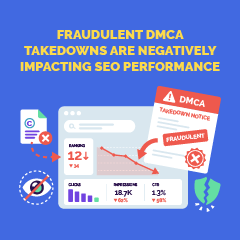
Imagine losing your best-ranking page overnight.
Not to a core update, not to a technical error, but to a competitor who filed a fake copyright complaint against you and paid less than ten dollars to do it.
This is happening, and it is happening more often. Publishers are reporting that pages are being deindexed from Google because of fraudulent DMCA takedown requests filed by bad actors, often competitors, who abuse a system built on trust and very little verification. The page did not do anything wrong. Someone simply claimed it did.
And the system, as it stands, tends to believe them first and ask questions later.
Article Summary
- Publishers are having pages deindexed from Google due to fraudulent DMCA takedown requests.
- Bad actors, often competitors, file fake copyright claims to remove rivals from search results.
- Google does not verify the identity or legitimacy of most filers before acting.
- Reversing a bad takedown can take two weeks at minimum, and stacked claims can take months.
- Anonymous takedown services are sold on freelance platforms for under ten dollars.
- The legal burden of proof falls more heavily on the victim than the person filing falsely.
- Search Everywhere Optimization reduces the damage any single deindexing event can cause.
What Is Actually Happening?
The Digital Millennium Copyright Act, or DMCA, was designed to give copyright holders a fast way to remove stolen content from search results.
That speed is now being weaponized.
Because the system is built to act quickly on complaints, it is vulnerable to people who file complaints in bad faith. Investigations have found that bad actors are submitting false copyright claims to knock competitors out of the search results, then enjoying the ranking gap left behind while the victim scrambles to recover.
The mechanics are depressingly simple.
A fraudster claims that your page infringes their copyright. They often back it up by pointing to a copy of your own content that they published on another site, sometimes backdated, to make it look as though you were the one who stole from them. Google receives the complaint, and if it acts on it, your legitimate page vanishes from search while the fraudulent claim gets processed.
The original author ends up penalized for content they created themselves.

Why the System Is So Easy to Abuse
The vulnerability comes down to verification, or the lack of it.
Google processes an enormous volume of copyright complaints, and it does not meaningfully verify the identity or legitimacy of everyone filing them. That scale makes individual scrutiny difficult, and the result is a system where a false claim can look identical to a genuine one at the point of submission.
The abuse has become a service you can buy.
Reporting has uncovered anonymous takedown offerings sold openly on freelance marketplaces like Fiverr, with some fraudulent takedown requests available for under ten dollars. For the price of a sandwich, someone can attempt to remove a rival’s page from Google. That economics problem is the heart of the issue, because the cost of attacking is trivial while the cost of defending is anything but.
Then there is the asymmetry in the law itself.
Filing a false DMCA claim technically carries a penalty for perjury, which sounds like a deterrent until you look at how it actually works. The perjury standard applies narrowly, and in practice the heavier burden falls on the victim to prove their content is original and to fight their way back into the index. The person filing the false claim risks very little. The person on the receiving end risks their traffic, their rankings, and weeks of their time.
That imbalance is exactly why the tactic keeps spreading.
The Recovery Problem
Even when a takedown is obviously fraudulent, getting your page back is neither quick nor guaranteed.
Reversing a single bad claim can take two weeks at a minimum.
That delay alone can be commercially devastating for a page that drives real revenue. Two weeks out of the index during a peak season, a product launch, or a competitive news cycle can cost far more than the ranking itself. And that is the best-case scenario, where you catch the takedown quickly and file a clean counter-notice.
The worst cases are far uglier.
Sophisticated attackers do not file one claim. They file many, staggered over time, so that as soon as one page is restored another disappears. This stacking tactic can keep a victim tangled in the recovery process for months, fighting a moving target while their competitor sits comfortably in the ranking they vacated. Each individual claim looks small. The cumulative effect can gut a site’s visibility.
Recovery also depends on you noticing in the first place.
If you are not actively monitoring your index status, a page can quietly disappear and stay gone until you happen to spot the traffic drop. By then the damage has compounded, and you are starting your two-week recovery clock late.
How to Spot and Fight a Fraudulent Takedown
The first line of defense is simply knowing it happened.
Watch for sudden, unexplained deindexing of specific pages, especially high-value ones. If a page that ranked well yesterday is gone today with no technical explanation, a takedown is one of the possibilities you should rule in or out quickly. Google Search Console will typically show manual actions or removals, and Google’s own Copyright Removal Transparency Report and the Lumen Database both log takedown requests, so you can check whether a complaint was filed against your URL.
If you find a fraudulent claim, you can file a counter-notice.
A counter-notice tells Google you dispute the takedown and asserts, under penalty of perjury, that your content is not infringing. It is the correct formal route, and for a clear-cut false claim it is usually effective, though it still runs on the same slow timeline. Documenting your authorship, with original publication dates, drafts, and timestamps, strengthens your position considerably.
The uncomfortable truth is that prevention is largely outside your control.
You cannot stop someone from filing a false claim. What you can control is how fast you detect it, how well you can prove your authorship, and how much of your visibility depends on any single page that a bad actor could target.
That last point is where strategy comes in.
Why This Matters for Search Everywhere Optimization
A fraudulent takedown is an attack on a single point of failure.
It works precisely because so much of a site’s traffic often depends on a small number of high-ranking pages on one platform. Knock out the right URL on Google, and you can knock out a meaningful chunk of a business’s visibility. The narrower your presence, the more damage a single malicious claim can do.
Search Everywhere Optimization is the structural answer to that fragility.
When your brand is discoverable across many surfaces, no single deindexing event can take you offline. A customer who cannot find your deindexed page on Google might still discover you through YouTube, a LinkedIn post, a Reddit thread, a review platform, or an AI assistant that has learned to associate your brand with its area of expertise. The attack that would cripple a single-platform business becomes a survivable inconvenience for a diversified one.
Breadth is a form of insurance.
There is a second layer to this as well. When you have built genuine authority across multiple platforms, your authorship is easier to prove. If your content, your expertise, and your brand appear consistently across your own site, your social channels, your video, and third-party mentions, the timeline of who published what first becomes far clearer. A fraudster backdating a scraped copy has a much harder time when the real author has a visible, cross-platform footprint establishing them as the original source.
Authority everywhere is both a visibility strategy and a defense.
This does not make you immune. Fraudulent takedowns are a real and growing problem, and no strategy removes the risk entirely. But a brand whose visibility is spread across the whole search ecosystem is far more resilient than one betting everything on a handful of Google rankings that a competitor can attack for the price of lunch.
What Should Businesses Do Next?
Start by monitoring your index status like it matters, because it does.
Keep an eye on Search Console for sudden removals or manual actions, watch your analytics for unexplained traffic drops on specific pages, and periodically check the Lumen Database and Google’s transparency report for takedown requests filed against your URLs. Early detection is the single biggest factor in how much a fraudulent takedown ends up costing you.
Next, get your authorship documentation in order before you ever need it.
Keep records that establish when you published your content, including original drafts, timestamps, and version history. If you are ever hit with a false claim, that evidence is what turns a slow, uncertain recovery into a straightforward counter-notice. Preparation done in calm conditions pays off enormously under pressure.
Finally, reduce your dependence on any single point of failure.
Audit how much of your traffic relies on a small cluster of pages on one platform. If the answer is uncomfortable, that concentration is a risk, and diversifying your visibility across search, social, video, and AI-mediated discovery is the most durable protection you can build. The goal is a presence broad enough that no single malicious claim, algorithm change, or technical failure can take you down.
The DMCA was built on trust. Until that changes, your best defense is to be impossible to erase with a single complaint.
Ready to Build Visibility Everywhere People Search?
Relying on a handful of Google rankings leaves your business exposed, whether the threat is a fraudulent takedown, an algorithm update, or a technical failure. The brands that stay resilient are the ones discoverable everywhere their audience looks.
At SEO Sherpa, we help brands build the technical foundations, content authority, and cross-platform visibility needed to be found, trusted, and chosen across the modern search journey.
Book a free discovery call with our team today to find out how Search Everywhere Optimization can help your business increase its visibility, strengthen its authority, and turn more searches into customers.


















Leave a Reply