
Summarize This Article With AI
 Try with ChatGPT
 Try with Claude
 Try with AI Mode
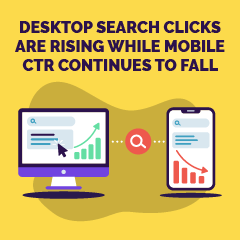
The death of organic clicks may have been slightly exaggerated.
On desktop, at least.
New data from Advanced Web Ranking shows a growing divide between desktop and mobile search behaviour. Between Q4 2025 and Q1 2026, click-through rates increased across several desktop positions while mobile CTR declined, particularly for the top result.
The changes affected branded and unbranded searches, multiple search intents, short- and long-tail queries and 22 different industries.
This is not simply a story about one ranking position having a good quarter. It is evidence that the same Google ranking can now produce very different outcomes depending on the device, layout and search experience surrounding it.
Article Summary
- Advanced Web Ranking compared CTR data from Q4 2025 with Q1 2026.
- Desktop CTR across the first five positions increased by a combined 10.54 percentage points.
- The first mobile result saw a 2.20 percentage-point decline overall.
- Branded desktop searches experienced substantial CTR increases.
- The top result for unbranded mobile queries fell by 3.07 percentage points.
- Changes were recorded across all query lengths and search intents.
- Device-level reporting is increasingly essential for diagnosing SEO performance.
- Search Everywhere Optimization can reduce dependence on a shrinking mobile organic click opportunity.
What Did the CTR Study Find?
Advanced Web Ranking analysed an international dataset containing millions of search terms and thousands of websites. It compared CTR averages from Q1 2026 with those recorded in Q4 2025.
Across all industries, the click-through rates of the first five desktop positions increased by a combined 10.54 percentage points.
Mobile moved in the opposite direction.
On mobile devices, the first-ranking website experienced an overall CTR decline of 2.20 percentage points.
For unbranded searches, the difference was even more pronounced. The first four desktop positions recorded a combined CTR increase of 7.19 percentage points, while the number-one mobile result declined by 3.07 percentage points.
The study also found that the changes were not confined to one particular kind of search. CTR shifts affected branded and unbranded keywords, different query lengths, multiple intents and 22 industries.

Why Might Desktop Clicks Be Increasing?
There is unlikely to be one universal explanation.
Desktop users frequently search in different contexts from mobile users. They may be at work, conducting deeper research, comparing suppliers, reviewing complex products or performing tasks that naturally require visiting multiple websites.
A desktop screen also provides substantially more space.
Even when AI Overviews, ads, shopping modules, videos or other SERP features appear, several organic results may still remain visible without extensive scrolling. Users can evaluate page titles, domains and supporting information more easily. Our complete guide to SERPs and SERP features breaks down how these elements compete for attention on the page.
Desktop behaviour may therefore remain more click-oriented, particularly for commercial research and considered purchases.
There is also a possibility that users are becoming more selective about when they use search.
Simple informational questions may increasingly be answered through mobile AI assistants, social search or instant SERP features. More complex tasks that still reach Google on desktop may have a naturally higher likelihood of generating website visits.
The study does not prove this explanation, but the device split supports the broader idea that search journeys are becoming more fragmented by context.
Why Is Mobile CTR Falling?
Mobile search has become extraordinarily crowded.
An AI Overview can occupy much of the initial viewport. Add sponsored results, shopping features, local packs, videos, forums, image carousels and related questions, and the first traditional organic result may appear far below the point users initially see.
Even a number-one ranking can therefore be number one in name while feeling considerably less prominent in practice.
Mobile users are also more likely to accept a fast answer.
They may be searching while travelling, shopping, watching television or performing another task. If Google can provide an answer, phone number, map result, summary or product option directly within the interface, the incentive to visit another website decreases.
This does not mean mobile search has become commercially irrelevant. It means the value of a mobile ranking depends heavily on the complete SERP environment.
A top ranking beneath an AI Overview and four other features is not equivalent to a top ranking on a relatively clean desktop result.
Branded Search Is Becoming Even More Valuable
One of the strongest findings involved branded desktop queries.
All ten ranking positions for branded searches recorded CTR increases, ranging from 1.99 to 5.78 percentage points for individual positions. On mobile, the increase was considerably smaller, remaining around one percentage point for several top-ten results.
This reinforces the value of brand demand.
When users search for a company, product or service by name, their intent is clearer. They are less likely to be satisfied by a generic summary and more likely to click through to the official website or another brand-controlled property.
For businesses, this means SEO cannot focus solely on capturing existing non-branded demand.
Marketing also needs to create the demand that produces branded searches in the first place.
A person may first discover the company through TikTok, YouTube, LinkedIn, a podcast or an AI recommendation. When they later search for that brand on Google, the resulting visit may be attributed to organic search even though another channel created the interest.
This is why last-click reporting often undervalues the platforms responsible for discovery.
Rankings Alone No Longer Explain Traffic
The findings offer a useful warning for SEO reporting.
A business can maintain the same rankings while experiencing completely different traffic outcomes across desktop and mobile. Looking only at average position may therefore conceal the real problem.
Suppose a website’s desktop CTR improves while mobile CTR falls. If mobile represents the majority of impressions, total organic traffic could still decline even though desktop performance looks stronger.
The reverse is also possible for a B2B website with a desktop-heavy audience.
SEO teams should segment Search Console reporting by device, query type, country, page group and search intent. They should also compare CTR changes against SERP features rather than assuming a lower CTR indicates weaker copy. If your rankings look stable but traffic is sliding, our guide on why rankings drop and how to fix it covers how to run this kind of diagnosis.
Sometimes the title is not the problem.
Sometimes Google has placed half the internet above it.
Informational and Commercial Searches Are Both Changing
The study found CTR changes across all types of intent, which suggests the shift cannot be reduced to AI Overviews affecting only basic informational questions.
Commercial, navigational and transactional searches are also being reshaped by richer SERP layouts.
Google increasingly allows users to compare products, explore local businesses, evaluate services and continue follow-up research without immediately visiting a website. This makes the organic result one component within a much larger search experience.
The value of appearing within supporting features can therefore rival the value of the conventional blue link.
Videos, local profiles, product feeds, images, discussions and third-party reviews may all influence the user before the website receives a click.
How This Ties Into Search Everywhere Optimization
The desktop-mobile divide supports the central argument behind Search Everywhere Optimization: businesses cannot depend on one ranking format or one discovery environment.
Mobile users may encounter a company through an AI Overview, Google Business Profile, YouTube Short, Reddit thread, TikTok video or review platform before they ever see its website.
Desktop users may later conduct deeper research, search for the brand and click through at a much higher rate.
These are not separate funnels. They are stages within the same discovery journey.
A strong Search Everywhere strategy ensures the brand is recognisable at every stage. Helpful videos can create awareness. Social content can demonstrate expertise. Reviews and community discussions can provide validation. Authoritative website pages can then support deeper research and conversion.
This also helps explain why branded desktop CTR is such an important signal.
When a business has already built recognition across multiple touchpoints, Google is no longer being asked to introduce the company from scratch. The user arrives with intent, familiarity and a reason to click.
Search Everywhere Optimization therefore does not replace SEO.
It makes SEO traffic more valuable by creating the brand demand and trust that improve the likelihood of a click.
What Should Businesses Do Next?
Begin by splitting performance by device.
Compare CTR, clicks, impressions, conversions and average position across desktop and mobile. Then examine the actual SERPs for the queries that matter most, rather than relying entirely on rank tracking.
Businesses should also prioritise mobile experiences beyond page speed.
Titles and descriptions need to communicate value quickly. Local profiles should be accurate and persuasive. Video and image assets should be optimised for discovery. Product feeds, reviews and structured data should support the SERP features surrounding the organic result. And once the click arrives, conversion rate optimization is what turns that hard-won visit into a lead or sale.
Most importantly, stop measuring SEO as though every impression has the same opportunity to become a click.
A desktop impression, a mobile impression and an AI search impression may all appear in the same report, but they can represent radically different user experiences.
The ranking is only the beginning of the story now.
At SEO Sherpa, we help brands understand where their audiences are searching, how those journeys differ by device and platform, and how to build the visibility that turns discovery into branded demand and conversions. Get a free discovery call with our team today.




















Leave a Reply