

Summarize This Article With AI
 Try with ChatGPT
 Try with Claude
 Try with AI Mode
For all the talk about AI taking over the internet, something interesting is happening.
People are craving other people again.
Not polished blog posts. Not perfectly optimized landing pages. And definitely not another AI-generated YouTube tutorial that sounds like it was written by a committee of robots.
They want conversation. Context. Real opinions. Access.
That’s why communities are exploding.
From hobby groups to high-ticket courses, platforms like Skool, Circle, and even Reddit are becoming the places people go to learn, ask questions, and make decisions. Not just because the content is good, but because it’s human.
And if you run one of those communities?
You’ve probably hit the wall already.
Because, unlike a traditional website, you can’t just publish a page, optimize for keywords, and expect to rank in Google search. Most community platforms sit behind logins, limit indexability, or scatter valuable discussions across threads that search engines struggle to fully understand.
Which means the real challenge isn’t just building a community.
It’s getting that community discovered.
Across search engines. Across AI search. Across the messy, decentralized way people actually find information today.
That’s where community SEO comes in.
In this guide, I’ll show you how to turn your community into a search asset, not just a walled garden. So you can attract more members, drive organic traffic, and show up where your audience is already looking.
Article Summary
- Community SEO is about turning discussions, user-generated content, and community activity into visibility across search engines and AI search platforms
- As AI content floods the web, users are shifting toward communities for authentic answers, making them a powerful discovery channel
- Platforms like Skool and Circle create a challenge: valuable content exists, but isn’t always easily discoverable or indexable
- The winning approach blends community engagement, content repurposing, and search optimization to drive sustainable, long-term growth
What Is Community SEO?
Community SEO is the practice of using user-generated content, discussions, and active community participation to increase visibility across search engines, AI search systems, and distributed discovery platforms.
But that definition alone doesn’t quite do it justice.
Because this isn’t just another SEO tactic you bolt onto your strategy. It’s a shift in how content is created, discovered, and trusted.
Instead of relying solely on static pages, you’re building a living layer of content. One that evolves through questions, answers, comments, and conversations. One that naturally generates long-tail keywords, reflects real user behavior, and stays continuously fresh without you having to “publish” something every time.
In other words, you’re not just creating content anymore. You’re creating context.
And that context is exactly what modern search engines and AI systems are trying to understand.
This is why community SEO plays so well with the rise of AI search.
Large language models don’t just look for pages that mention keywords. They look for content that demonstrates understanding. Nuance. Multiple perspectives. Real-world phrasing.
Which is exactly what happens inside a healthy community.
A single discussion thread can cover dozens of related queries. It can mirror how users actually search. It can surface objections, comparisons, and edge cases that a typical blog post might miss.
That’s incredibly valuable.
Not just for ranking in traditional Google search.
But for being cited, summarized, and surfaced inside AI-generated answers.
And here’s where it gets even more interesting:
Community SEO doesn’t rely on one platform.
It can live across Reddit threads, forum posts, private groups, owned community hubs, and even semi-closed platforms like Skool or Circle. Each contributes to your overall visibility in different ways.
Which means your SEO strategy is no longer tied to a single website.
It becomes an ecosystem.

Community SEO vs Traditional SEO
Traditional SEO is built on control.
You create pages. You optimize them. You structure internal links. You decide what gets published and when. It’s clean, predictable, and entirely owned.
Community SEO is the opposite.
It’s messy. Dynamic. And driven by your community members as much as your brand.
Instead of a handful of carefully crafted pages, you get hundreds or thousands of pieces of user-generated content. Forum posts, replies, discussions, each targeting slightly different keywords and angles without you explicitly planning them.
Which means:
- Traditional SEO focuses on static, owned content
- Community SEO thrives on dynamic, continuously generated content
There’s also a shift in where visibility happens.
With traditional SEO, everything funnels back to your site. Rankings, traffic, conversions. It’s centralized.
With community SEO, visibility is distributed.
Your content might rank on Reddit. Show up in a forum. Get pulled into an AI answer. Or influence a decision without ever driving a click.
That can feel uncomfortable at first.
But it’s also where the opportunity is.
Because search is no longer just about blue links. It’s about being present wherever decisions are made.
Why Community SEO Matters in 2026
Community SEO matters because the way people search and trust information has fundamentally changed.
First, AI has reshaped discovery.
Users are asking full questions, expecting direct answers, and often getting them without having to click through to a website. That means fewer opportunities to “win” traffic the traditional way.
Second, user-generated content is dominating search results.
Scroll through Google today, and you’ll see it everywhere. Reddit threads. Quora answers. Forum discussions. Google is actively prioritizing content that reflects real experiences and opinions over polished, publisher-led pages.
Why?
Because it aligns better with user intent.
People don’t just want the “best” answer. They want to know what actually works. What others think. What to avoid.
And communities deliver that at scale.
Third, trust is shifting.
In a world where AI can generate content instantly, authenticity becomes the differentiator. And nothing feels more authentic than a real conversation between real users.
All of this creates a perfect storm.
Search engines want it. AI models rely on it. Users trust it.
Which means if your brand isn’t part of those conversations, you’re missing a growing share of visibility.
Not just in organic search traffic.
But in the entire discovery layer of the modern web.

The Rise of Community-Led Search
Search didn’t disappear. It just changed shape.
Instead of starting and ending on a search engine, discovery now zigzags across platforms. A user might Google something, skim a Reddit thread, ask ChatGPT a follow-up, and then join a community to validate their decision.
All within ten minutes.
Which means the real battleground for visibility isn’t just the SERP anymore. It’s the entire journey around it.
And communities sit right at the center of that journey.
They’re where questions get refined. Where edge cases get explored. Where users move from “what is this?” to “should I trust this?” to “what are people actually doing?”
That’s not just content.
That’s influence.
And search engines, along with AI systems, are paying very close attention.
Google’s Shift Toward UGC and Discussions
Google has been quietly rewriting the rules of what “good content” looks like.
And increasingly, it doesn’t look like a blog post.
It looks like a thread.
You’ve probably noticed it already. Search for almost anything with even a hint of nuance and you’ll see Reddit, Quora, and forum posts climbing into top positions. Sometimes outranking polished, high-authority websites.
That’s not an accident.
Google has leaned heavily into surfacing discussions through features like “Discussions and forums,” prioritizing content that reflects real user experiences, opinions, and back-and-forth dialogue.
Why?
Because it maps better to how people actually think.
A traditional page gives you a single, curated answer. A discussion gives you multiple perspectives, objections, and lived experiences. It shows how a topic plays out in the real world, not just how it’s packaged for search.
From a search optimization standpoint, this changes a few key things:
- Relevance is no longer just about keywords, but about context across multiple voices
- Freshness is baked in through ongoing discussions and new replies
- Depth comes naturally through questions, follow-ups, and related topics within threads
In other words, forum posts and community discussions aren’t just ranking despite being messy.
They’re ranking because of it.
AI Search and Community Signals
If Google nudged the door open for community content, AI search kicked it off its hinges.
Large language models thrive on conversational data. They’re trained on it. They retrieve from it. And when generating answers, they lean heavily on sources that reflect how people actually ask and answer questions.
Which makes communities a perfect fit.
Every thread is essentially a bundle of long-tail keywords, natural language queries, and real-world context. The exact ingredients AI systems need to understand intent and produce useful responses.
This is where community SEO becomes more than just a traffic play.
It becomes a visibility layer inside AI-generated answers.
Because when tools like ChatGPT or Perplexity assemble a response, they’re not just pulling from polished articles. They’re synthesizing insights from across the web, including forums, discussions, and user-generated content.
That means:
- Your brand can be referenced without being clicked
- Your ideas can be summarized without a direct visit
- Your community can influence decisions without ever ranking a traditional page
It’s a different kind of exposure.
Less measurable in the old sense. But arguably more powerful.
And here’s the key insight most people miss:
Communities don’t just show up in AI search because they exist.
They show up because they mirror human thinking.
Messy. Layered. Context-rich.
Exactly the kind of content AI systems are designed to understand.
Types of Communities That Impact SEO
Not all communities play the same role in search.
Some are built for visibility. Others are built for experience. And a new wave is emerging that tries to do both, blending community, content, and monetization into a single ecosystem.
If you treat them all the same from an SEO perspective, you’ll either miss opportunities or invest in the wrong places.
So before we get tactical, we need to get clear on the landscape.
Because “community SEO” can mean very different things depending on where that community lives.
Open Communities (Reddit, Quora, Various Forums)
Open communities are the most visible layer of community SEO.
They’re fully crawlable, highly active, and perfectly aligned with how search engines interpret relevance. Every discussion, reply, and comment becomes indexable content that can rank in search results.
That’s why Reddit threads and forum posts dominate Google search for so many queries.
They naturally generate:
- Long-tail keywords through real conversations
- Highly relevant content shaped by actual user behavior
- Continuous updates that signal freshness to search engines
- Engagement signals like replies, dwell time, and interaction depth
From a pure search engine optimization standpoint, they’re incredibly powerful.
But they come with a trade-off.
You don’t own anything.
You’re contributing to a platform that captures the traffic, the rankings, and the long-term SEO value. Your brand might benefit indirectly, but you’re not building a compounding asset.
That’s why open communities are best used as a visibility and distribution layer, not your core SEO foundation.
Semi-Closed Communities (Slack Groups, Skool, Circle)
This is where the real shift is happening.
Semi-closed communities have traditionally included Slack groups or private Discord servers. Typically, they’re accessed via a website landing page, with conversations happening behind the scenes.
From an SEO perspective, these older models have limited direct impact.
Search engines can’t see inside them. The value comes from networking, engagement, and brand affinity, not from rankings or organic traffic.
But platforms like Skool and Circle have taken this model and evolved it into something much bigger.
They’re not just chat hubs.
They’re all-in-one ecosystems.
Inside a single platform, you can have:
- A structured community with discussion threads
- Courses and learning materials
- Events, updates, and content hubs
- Monetization layers (free, paid, tiered access)
- Member profiles and activity tracking
And most importantly, you create an environment where people don’t just consume content.
They participate in it.
That changes everything.
Because instead of publishing content for users, you’re facilitating a space where content is continuously created by your community members.
And in 2026, this model is exploding.
More creators, educators, and businesses are moving toward Skool and Circle-style communities because they offer:
- Direct access to the brand or expert (something AI content can’t replicate)
- A mix of passive learning (courses) and active learning (discussion)
- Flexible monetization models
- Stronger retention and community growth compared to traditional websites
Skool, in particular, adds another layer: gamification.
Members earn levels, unlock status, and get rewarded for contributing. Which means more posts, more discussions, and more user-generated content over time.
From a community perspective, it’s incredibly effective.
From an SEO perspective, it creates a massive, constantly evolving content engine.
But here’s the catch.
Most of that content isn’t fully accessible to search engines.
Which means the SEO opportunity isn’t as straightforward as “publish and rank.”
It’s about how you extract, structure, and amplify the value created inside the community.
And that’s exactly where community SEO becomes strategic.
Owned Community Hubs
Owned community hubs sit somewhere between traditional SEO and community-driven growth.
These are forums or discussion areas hosted directly on your website. Fully indexable, fully controllable, and fully integrated into your broader SEO strategy.
They give you the best of both worlds:
- Scalable user-generated content across hundreds of pages
- Full control over internal links, site structure, and optimization
- Direct ownership of traffic and search rankings
- The ability to connect discussions to your core content and services
In theory, this is the ideal setup.
You get community-driven content with traditional SEO benefits.
But in practice, they’re harder to build.
You don’t get Reddit’s built-in audience. You don’t get the plug-and-play experience that Skool offers. You have to actively drive users, manage discussions, and maintain quality over time.
Which is why many brands are now combining approaches.
Using platforms like Skool or Circle to build the community experience, while leveraging owned websites to capture and scale the SEO value.
So, Where Does That Leave Us?
If we’re talking about community SEO in 2026, the center of gravity is shifting.
Away from pure forums.
Away from isolated Slack groups.
And toward all-in-one community platforms like Skool and Circle.
Because that’s where:
- Communities are growing fastest
- Content is being created most naturally
- Businesses are building real monetizable ecosystems
That’s also where the biggest SEO gap exists.
And where the biggest opportunity is.
How Community SEO Works
Community SEO works because it aligns almost perfectly with how modern search engines and AI systems evaluate content.
Not through isolated pages.
But through patterns.
Patterns of behavior. Patterns of language. Patterns of interaction.
When you build an active community, you’re not just creating content. You’re creating a system that continuously produces relevant content, shaped directly by what your audience cares about.
That’s why it performs so well across both traditional search and AI-driven discovery.
Let’s break down the mechanics.
User-Generated Content at Scale
At the core of community SEO is one thing: user-generated content.
Not the kind you carefully plan in a content calendar. The kind that emerges naturally when people ask questions, share experiences, and respond to each other.
Every discussion thread becomes a new page.
Every reply adds context.
Every question introduces a new keyword opportunity.
And here’s where it gets powerful.
This type of content naturally targets long-tail keywords, the exact phrases people actually type into search engines or ask AI tools.
Not “SEO strategies.”
But:
- “best SEO community to join in 2026”
- “is Skool better than Circle for SEO learning”
- “how to grow organic traffic with a community”
You don’t have to guess these.
Your community generates them for you.
At scale.
This is one of the biggest advantages of community SEO. Instead of creating a limited number of pages, you’re unlocking hundreds or thousands of keyword variations through real conversations.
And because this content reflects actual user behavior, it aligns far better with search intent than most top-down content ever could.
It’s not optimized for users.
It’s created by them.
Which is exactly what search engines want to see.
Freshness and Continuous Content Creation
Search engines love fresh content.
But consistently publishing new, relevant pages is hard.
Communities solve that problem by default.
An active community is always producing new content:
- New discussions
- New replies
- New perspectives on existing topics
This creates a constantly evolving content layer that signals relevance to search engines.
Instead of updating a blog post every few months, your community is updating itself every day.
And that matters.
Because freshness isn’t just about publishing dates. It’s about whether content reflects current thinking, current problems, and current conversations.
Communities do that naturally.
They also create what most websites struggle with:
Momentum.
A single thread can start small, then grow into a detailed, multi-angle discussion over time. That depth builds organically, without needing to plan or manually rewrite content.
From an AI search perspective, this is even more valuable.
Because AI systems prioritize content that reflects ongoing relevance and layered understanding, not just static information.
Engagement Signals and Authority
Not all content is treated equally.
Search engines don’t just look at what’s written. They look at how people interact with it.
This is where communities have a major advantage.
They generate strong engagement signals:
- Comments and replies
- Time spent reading discussions
- Back-and-forth interaction
- Returning users
All of these indicate that the content is useful, relevant, and worth paying attention to.
And over time, this builds perceived authority.
An engaged community signals trust.
Trust signals authority.
Authority improves visibility.
It’s a compounding effect.
On top of that, community content often generates natural backlinks.
When users find valuable discussions, they share them. They reference them in blog posts. They link to them in other communities.
That creates organic link growth without traditional link-building campaigns.
And again, this isn’t forced.
It’s a byproduct of value.
The Hidden Layer: Discovery → Membership
Here’s the part most SEO strategies miss.
Community SEO isn’t just about traffic.
It’s about conversion into community members.
When someone discovers your content through search, they’re not just landing on a page.
They’re entering an environment.
One where they can:
- Ask follow-up questions
- Engage with other members
- Access deeper resources
- Stay connected over time
That changes the dynamic completely.
Instead of a one-time visit, you create an ongoing relationship.
Which is why community SEO is so effective for long-term growth.
You’re not just increasing organic traffic.
You’re building an active community that continues to generate content, attract new users, and strengthen your overall search presence.
Challenges of Community SEO
By now, community SEO probably sounds like a cheat code.
Unlimited content. Perfect alignment with user intent. Strong engagement signals. Visibility across search engines and AI platforms.
And it is powerful.
But it’s not easy.
In fact, this is where most people get it wrong.
Because community SEO doesn’t behave like traditional search engine optimization. You don’t have the same level of control. You don’t always get the credit. And if you don’t structure things properly, a lot of the value gets lost.
Let’s unpack the realities.
Indexability Issues (Skool, Circle)
The biggest challenge with platforms like Skool and Circle is simple:
Search engines can’t see most of what’s happening inside.
Content sits behind logins. Discussions live in protected environments. Valuable insights, the kind that would absolutely rank in Google search, are effectively invisible to crawlers.
Which creates a frustrating gap.
You might have:
- High-quality discussions
- Valuable, relevant content
- Deep insights driven by real users
But none of it contributes directly to your search rankings.
This is why community SEO for these platforms isn’t about “optimizing pages” in the traditional sense.
It’s about creating entry points.
Public-facing pages, like your homepage, about page, or community landing page, become critical. These are what search engines can crawl, understand, and rank.
And if those pages are optimized properly?
They can drive discovery, even if the core experience sits behind a login.
This is also where AI search behaves slightly differently.
Even a limited public context, if well structured, can be enough for AI systems to understand what your community is about and surface that in their responses.
Which is exactly the gap we’ll exploit later.
Content Quality Control
When you open the door to user-generated content, you get scale.
But you also get noise.
Not every post is valuable. Not every comment is insightful. And without some level of structure or moderation, communities can quickly drift into low-quality, repetitive, or off-topic discussions.
From an SEO perspective, that’s a problem.
Because while search engines reward fresh and relevant content, they’re also getting better at filtering out thin or low-value material.
Which means more content doesn’t automatically equal better performance.
You need:
- Clear discussion structures (categories, topics, threads)
- Guidance for community members on what to post
- Active moderation to maintain quality
- A focus on creating relevant content, not just more content
The goal isn’t volume.
It’s useful volume.
Content that actually answers questions, reflects real experiences, and adds something meaningful to the conversation.
Attribution and Traffic Loss
This is the uncomfortable truth about community SEO.
You won’t always get the click.
In traditional SEO, the goal is clear: rank higher, drive traffic, convert.
In community SEO, especially with open platforms or AI search, visibility doesn’t always translate into visits.
Your content might:
- Rank on Reddit instead of your website
- Be summarized in an AI-generated answer
- Influence a decision without a user ever clicking through
That can feel like a loss.
But it’s really a shift.
From traffic to influence.
From clicks to presence.
That said, it does mean you need to be intentional about capturing value where you can.
Because otherwise, you’re building awareness without building an asset.
And that’s not a sustainable strategy on its own.
The takeaway?
Community SEO works.
But only if you understand where the value is created, where it’s captured, and where it leaks.
Because, unlike traditional SEO, this isn’t a closed system.
It’s an ecosystem.
How to Do Community SEO (Step-by-Step)
Step 1: Choose the Right Community Platform
Before you think about keywords or content, you need to choose where your community lives.
Because that decision shapes everything that comes after, especially how discoverable your community is.
At a high level, the choice often comes down to platforms like Circle or Skool.
Both are powerful. But they serve slightly different goals.
If you want a polished, feature-rich environment focused solely on the community experience, Circle is a strong option. It gives you flexibility, control, and all the bells and whistles you’d expect from a modern community platform.
But if you’re a creator, educator, or running a community as a business?
Skool has a clear edge.
Because it’s not just a community platform. It’s built for discoverability and growth.
It combines:
- Community discussions
- Courses and structured learning
- Member progression and gamification
- Monetization layers
All in one place.
And that matters.
Because more visibility = more members.
More members = more revenue.
Skool also leans into engagement through gamification. Members earn levels, unlock status, and are incentivized to contribute. This naturally increases user-generated content over time.
From a community perspective, that’s powerful.
From an SEO perspective, it creates a constantly expanding content ecosystem.
So the decision isn’t just about features.
It’s about your goal:
- If you want a controlled, experience-first community → Circle
- If you want growth, discoverability, and monetization → Skool
And if community SEO is part of your strategy, that second option becomes hard to ignore.
Step 2: Structure Discussions for SEO
Once your platform is set, the next step is structure.
Because even though community content is user-generated, it still needs direction.
Without structure, discussions become fragmented. Topics overlap. Valuable content gets buried.
With structure, your community becomes a search-friendly content system.
Start by organizing your community around keyword clusters.
Not just broad categories like “SEO” or “Marketing.”
But specific, intent-driven topics:
- Technical SEO
- Local SEO
- Link building strategies
- AI SEO / LLM SEO
- Community growth
Each category should map to how users actually search.
Then focus on thread creation.
Thread titles should mirror real search queries.
Not:
“Quick question”
But:
“How do I increase organic traffic with community SEO?”
This does two things:
- It makes discussions easier to navigate for users
- It aligns content with how search engines interpret queries
Over time, this creates a network of relevant content built around real-world questions.
Step 3: Seed High-Intent Conversations
Communities don’t grow on autopilot.
Especially early on.
You need to seed discussions intentionally.
But not randomly.
Focus on high-intent questions your audience is already searching for.
Think:
- “What are the best SEO communities to join?”
- “Is Skool better than Circle for building a course community?”
- “How do you grow organic traffic without relying on blog posts?”
These are the kinds of queries that show up in search results, AI answers, and community discussions.
When you introduce them into your community, you’re doing two things:
- Creating valuable content for existing members
- Building content that aligns with external discovery
And because responses come from multiple users, you naturally get depth, nuance, and multiple perspectives.
Which is exactly what both search engines and AI systems favor.
Step 4: Repurpose Community Content into SEO Assets
Here’s where you start capturing value.
Because while your community generates incredible content, not all of it is directly indexable, especially on platforms like Skool or Circle.
So you extract it.
Take your best discussions and turn them into:
- Blog posts
- FAQ pages
- Landing pages
- Resource hubs
This allows you to:
- Target specific keywords more directly
- Build internal links across your site
- Capture organic search traffic on owned pages
You’re essentially turning conversations into structured content.
And because it’s based on real user questions, it aligns perfectly with search intent.
Step 5: Encourage Search-Friendly User-Generated Content
Not all user-generated content is equal.
A one-line reply doesn’t carry much SEO value. A detailed response with context, examples, and explanation?
That’s gold.
So you need to guide your community. Not by forcing it. But by shaping behavior.
Encourage:
- Descriptive posts that clearly explain problems
- Detailed responses that add value
- Use of relevant keywords naturally within discussions
- Clear formatting and readability
The goal is to create valuable content, not just activity.
Because search engines prioritize content that actually helps users.
Step 6: Connect Your Community to Your Main Site (And Make it Discoverable)
This is where most people drop the ball.
They build a great community… and then hide it.
If your community lives on Skool or Circle, most of the valuable content inside it is gated.
So your public-facing layer becomes critical.
And that starts with your about page.
This page should not be an afterthought.
It should be treated like a high-converting, fully optimized landing page.
That means:
- Clear explanation of what your community offers
- Strategic use of keywords and entities
- Structured content that search engines can understand
- Videos and images to enhance context and engagement
- Internal linking (where possible) to strengthen structure
Because this page is doing two jobs:
- Getting discovered (SEO, AI search, social search)
- Converting visitors into members
Now layer in distribution.
Your community link should live everywhere:
- YouTube descriptions
- TikTok bios
- Instagram profiles
- Any platform where your audience discovers you
So whether someone finds you through social SEO, traditional search, or AI-generated answers, they all land in the same place.
And that place needs to convert.
Finally, think about visibility inside your community.
What you hide, search engines can’t see.
So ask:
- Can users preview your courses?
- Can they see lesson titles or outlines?
- Are parts of your content accessible without login?
Even partial access helps search engines and AI systems understand what your community offers.
And this becomes increasingly important as discovery shifts toward queries like:
“best communities for X”
Because AI systems don’t just look for pages.
They interpret context.
The more visible context you provide, the easier it is to be included.
Community SEO for Skool and Circle (Platform-Specific Tips)
By now, it should be clear that not all community platforms behave the same when it comes to SEO.
But Skool and Circle deserve special attention.
Because while they’re often grouped together, they play very different roles in a community SEO strategy.
And if you’re building a community as a business, understanding that difference is everything.
Skool SEO Considerations
Skool isn’t just a community platform.
It’s a discovery engine disguised as one.
Unlike traditional closed communities, Skool has a layer of visibility that makes it far more aligned with how modern search works, especially when you factor in AI search and entity-based discovery.
But here’s the nuance.
Most of the actual value inside your Skool community is still gated.
Which means your SEO success doesn’t come from “ranking posts.”
It comes from how well you position your public-facing layer.
And this is where most people massively under-optimize.
Your about page?
That’s not an about page.
It’s your homepage. Your landing page. Your SEO asset.
It needs to do all of the following:
- Clearly explain what your community is about
- Use relevant keywords naturally (e.g., “SEO community,” “learn SEO,” “search everywhere”)
- Include entities and context that AI systems can understand
- Showcase what users will get (courses, discussions, outcomes)
- Use images and videos to add depth and clarity
- Be structured in a way that’s easy to crawl and interpret
Because this is the page that gets:
- Indexed by Google
- Interpreted by AI Overviews and LLMs
- Clicked from social platforms
It’s doing all the heavy lifting.
And when done properly?
It works faster than most people expect.
We saw this firsthand.
When we launched our own Skool community, we didn’t build out a full website. No blog posts. No supporting pages. Just the Skool setup and a well-structured about page.
Within three days, it was being discovered across:
- Traditional Google search
- AI Overviews
- ChatGPT responses
Even for broad queries like “SEO communities.”
No backlinks. No domain authority. Just clear positioning, structured content, and alignment with how modern search works.
That’s community SEO in action.
Circle SEO Considerations
Circle plays a different game.
It’s built for experience.
If your priority is creating a polished, flexible, deeply customizable community environment, Circle is excellent. It gives you more control over how your community looks, feels, and operates.
But from an SEO perspective, it’s less naturally discoverable.
That doesn’t mean it’s ineffective.
It just means your strategy needs to adapt.
With Circle, SEO tends to happen outside the platform rather than within it.
You rely more on:
- Your main website
- Supporting blog content
- External distribution channels
- Repurposed community insights
The community itself becomes a value layer rather than a discovery layer.
So the question becomes:
Do you want your community to be the product?
Or the engine behind your content ecosystem?
Circle is stronger in the second scenario.
Skool is stronger in the first.
Workarounds to Capture SEO Value
Regardless of platform, one thing remains true:
If your content is hidden, its SEO value is limited.
So the goal isn’t to open everything up.
It’s to strategically expose enough.
Here’s how to do that.
First, leave certain elements ungated where possible.
Not everything needs to be fully accessible. But giving visibility into:
- Course structures
- Lesson titles
- Discussion previews
- Community topics
Helps search engines and AI systems understand what your community offers.
And that understanding is what drives discovery.
Second, repurpose your best content.
Take high-performing discussions and turn them into:
- Blog posts
- Landing pages
- “Best of the community” content
- FAQ-style resources
This allows you to capture organic traffic on your own domain while still leveraging community-driven insights.
Third, think in terms of AI interpretation, not just indexing.
When someone searches:
“best communities for SEO”
AI systems aren’t just looking for pages with that keyword.
They’re trying to understand:
- What each community offers
- Who it’s for
- What kind of value it provides
If your public-facing content clearly communicates that, you become far more likely to be included.
Even without traditional rankings.
And finally, connect everything.
Your community shouldn’t exist in isolation.
Link to it from:
- Your website
- Your blog
- Your social profiles (YouTube, TikTok, Instagram)
- Any platform where your audience discovers you
Because discovery today is layered.
Social → search → AI → community.
And your job is to make sure every path leads back to you.
Community SEO + Search Everywhere Strategy
If traditional SEO was about ranking pages, and LLM SEO is about being cited…
Community SEO is about being part of the conversation.
And when you combine all three?
That’s where things get interesting.
Because search is no longer a single channel.
It’s a network.
Users move between Google search, AI tools, social platforms, and communities without thinking twice. They don’t care where the answer comes from. They care that it feels relevant, trustworthy, and useful.
Which means your strategy can’t live in one place either.
It has to show up everywhere.

Communities as a Distribution Layer
Most people think of communities as a destination.
Somewhere users go after they’ve discovered you.
But in a Search Everywhere model, communities also serve as a distribution layer.
They don’t just host conversations.
They create visibility.
Every discussion, every question, every piece of user-generated content becomes a surface where your brand can be discovered:
- In search results (through forum-style content or indexed pages)
- In AI-generated answers (through contextual understanding)
- In social platforms (through shared discussions and ideas)
This is what makes community SEO so powerful.
It doesn’t rely on a single page ranking.
It creates multiple entry points across the web.
And because that content is shaped by real users, it naturally aligns with how people search, especially in AI-driven environments where conversational queries dominate.
In other words:
Your community isn’t just where people gather.
It’s where your visibility expands.
Owning vs Renting Your Audience
There’s one tension that sits at the heart of all of this.
Ownership.
When you rely on platforms like Reddit or even AI search visibility, you’re renting attention. You benefit from reach, but you don’t control the environment.
When you build your own community, even on platforms like Skool or Circle, you move closer to ownership.
You create a space where:
- You control the experience
- You build direct relationships with members
- You retain long-term value beyond a single visit
But even then, you’re still operating within an ecosystem.
Because discovery often happens outside your owned environment.
That’s why the smartest strategy isn’t either-or.
It’s both.
Use external platforms for reach.
Use your community for depth.
Use your content (site, blog, assets) to anchor long-term SEO value.
Each layer plays a role.
And when they’re connected properly, they reinforce each other.
Here’s the change most people miss:
SEO used to be about bringing users to your website.
Now it’s about meeting users wherever they already are, and giving them a reason to come closer.
Communities do that better than almost anything else.
Because they don’t just answer questions.
They continue the conversation.
Real Examples of Community SEO in Action
It’s one thing to talk about community SEO in theory.
It’s another to see how quickly it works in practice.
So instead of pointing to big brands or long-established forums, let’s show you what happens when you apply this from scratch.
No authority.
No backlinks.
No layered content strategy.
Just the fundamentals done right.
Example 1: Search Everywhere Academy
Our first test was the Search Everywhere Academy.
Search Everywhere Academy
This is a Skool-based community we launched specifically for:
- Junior SEOs
- Website owners
- People looking to understand how search is evolving beyond traditional SEO
It gives a behind-the-scenes look at what we’re actually doing. What’s working. What’s not. And direct access to our team.
At the time of writing?
It had been live for just over two weeks.
No website pages.
No blog content.
No backlinks.
Not even linked from our main site or social profiles.
Just a Skool setup and a properly structured about page.
And within three days, it was already being:
- Discovered in Google search
- Surfaced in AI Overviews
- Referenced inside ChatGPT responses and includes an entity panel

Even for broad, competitive queries like:
“SEO communities”
Which is exactly the kind of query most people assume requires months of SEO effort.
Instead, it was picked up almost immediately.
And without any promotion, it grew to 40+ members in the first two weeks purely from organic discovery.
No paid traffic.
No outbound push.
Just visibility.
This is the key shift.
When your community is clearly positioned, properly structured, and aligned with how modern search works, it doesn’t need a traditional content ramp-up.
It becomes discoverable almost instantly.
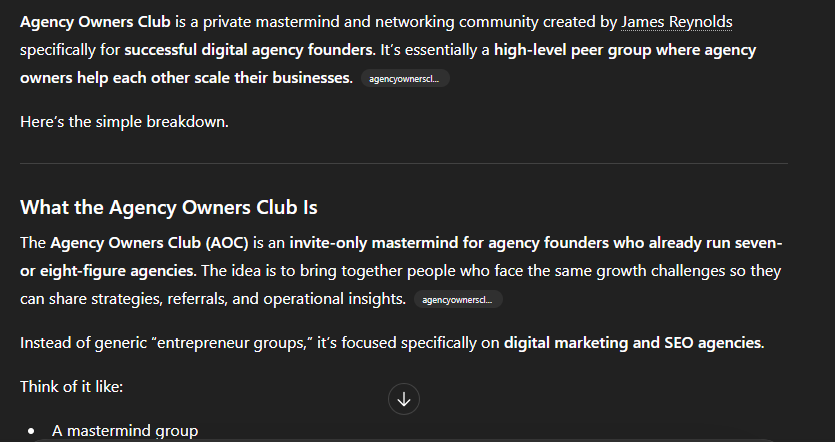
Example 2: Agency Owners Club
Our second test was built for a completely different audience.
This community is designed for agency owners.
Not just SEO agencies, but also web development, social media, and digital service businesses.
The focus is simple:
- Share wins and challenges
- Collaborate with other agency owners
- Access masterminds led by James on scaling to seven figures
Again, this was launched on Skool.
Again, very early.
And again, we saw the same pattern.
Despite being invite-only by design, it still started generating:
- Discovery through search engines
- Visibility in AI-driven search environments
- Organic member sign-ups without active promotion
Which highlights something important.
Community SEO isn’t just about volume.
It’s about alignment.
When your community clearly communicates:
- Who it’s for
- What it offers
- Why it matters
Search engines and AI systems can interpret that context quickly.
And once they can interpret it?
They can surface it.
Even if everything else is minimal.
What This Proves
Both of these communities were built recently.
Both are early.
Neither relied on traditional SEO tactics.
And yet both became discoverable almost immediately.
Why?
Because they followed the exact principles we’ve covered:
- Clear positioning and intent
- Strong public-facing entry point (about page)
- Alignment with real user queries
- Structured context that AI systems can understand
- Community-driven value at the core
This is what community SEO looks like in practice.
Not slow.
Not complicated.
Not dependent on massive authority.
Just aligned with how search actually works now.
The Future of Community SEO
If the last decade of SEO was about content…
The next one is about context.
Because content is no longer scarce.
AI can generate blog posts, landing pages, and even entire websites in seconds. The barrier to “creating content” has effectively disappeared.
Which means content alone is no longer a competitive advantage.
Context is.
And communities are the most scalable way to create it.
Here’s what’s already happening.
Search is becoming more conversational. AI systems are becoming more personalized. Users are becoming more selective about what they trust.
And in that environment, static content starts to lose its edge.
Not because it’s useless.
But because it’s incomplete.
A blog post gives you an answer.
A community gives you answers, opinions, edge cases, and real-world experiences.
That depth is what both users and AI systems are gravitating toward.
Communities as Primary Knowledge Sources
We’re moving toward a world where communities aren’t just supporting content.
They are the content.
Instead of asking:
“Which blog ranks #1?”
Users are asking:
“Where are people actually talking about this?”
That’s a fundamental shift.
Because it moves discovery away from single-author content and toward collective knowledge.
And that’s exactly what communities provide.
- Multiple perspectives
- Real-time updates
- Natural language discussions
- Continuous content creation
All of which align perfectly with how modern search engines and AI systems evaluate relevance.
In many cases, communities are already outperforming traditional websites for this reason.
And that gap is only going to widen.
AI-First Search Changes Everything
AI search doesn’t rank content the same way traditional search does.
It doesn’t just look for the “best page.”
It looks for the best understanding.
Which means it draws on multiple sources, synthesizes insights, and presents answers that reflect a broader view of the topic.
That’s where communities have a massive advantage.
Because they naturally contain:
- Long-tail queries and conversational phrasing
- Layered discussions around similar topics
- Real-world examples and use cases
- Signals of trust through engagement and interaction
In other words, they mirror how humans think.
And AI systems are designed to interpret exactly that.
So while traditional SEO focuses on ranking pages…
Community SEO positions you to be included in answers.
That’s a different game.
The Decline of Blog-Only Strategies
This doesn’t mean blogs are dead.
But “blog-only” strategies are.
Publishing articles in isolation, without any connection to a broader ecosystem, is becoming less effective.
Because you’re competing against:
- AI-generated content at scale
- Communities generating real-time discussions
- Platforms capturing attention before users even reach a website
To stay competitive, content needs to be part of something bigger.
An ecosystem that includes:
- Your website (for structure and ownership)
- Your community (for depth and engagement)
- External platforms (for distribution and reach)
This is the foundation of Search Everywhere.
And community SEO is a core piece of that.
What This Means Going Forward
The brands that win in this next phase won’t just create content.
They’ll create environments.
Places where:
- Users can engage, not just consume
- Content evolves, not just gets published
- Value compounds over time through participation
Because that’s what both users and AI systems are starting to prioritize.
And it’s not a future trend.
It’s already happening.
Conclusion and Next Steps
Community SEO isn’t a trend.
It’s a response to how search actually works now.
Users don’t just read content anymore. They explore, compare, ask, validate, and, increasingly, do it within communities. Whether that’s through search engines, AI-generated answers, or platforms where conversations are already happening.
Which means if your strategy still revolves around publishing pages and hoping they rank, you’re playing a shrinking game.
The opportunity is bigger than that.
It’s in building ecosystems.
Where your website captures demand.
Your community creates context.
And your brand shows up across every stage of discovery.
That’s what Search Everywhere really means.
And community SEO is one of the fastest ways to get there.
If you’re thinking about launching a community, or already have one and want it to actually drive visibility, traffic, and growth…
Let’s talk.
We’ll walk through your current setup, identify where you’re missing opportunities, and map out how to turn your community into a real acquisition channel across search and AI.
Book a free discovery call with SEO Sherpa.
No fluff. Just a clear strategy on how to make this work for your business.























Leave a Reply