

Summarize This Article With AI
 Try with ChatGPT
 Try with Claude
 Try with AI Mode
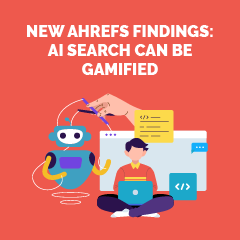
When Ahrefs published its experiment showing that a completely fake brand could be made to appear inside Google’s AI search results, the internet reacted exactly how you would expect. SEO Twitter lit up with screenshots, threads, and hot takes, all trying to reverse engineer how it was done.
Most of the conversation focused on tactics.
That was a mistake.
What Ahrefs actually revealed was not a clever hack. It was a structural vulnerability in how AI now decides what is real on the internet. And that should worry anyone who relies on digital visibility to survive.
Article Summary
- Ahrefs created a fake brand and successfully got it referenced inside Google’s AI search results
- The model relied more on third-party mentions than on the brand’s own website
- This shows how fragile AI trust systems still are
- Real brands are now competing with synthetic narratives
- Long-term visibility depends on Search Everywhere presence, not just websites
What Ahrefs Really Proved
The Ahrefs team did not do anything magical. They created a brand that did not exist and then made it appear to exist by planting references to it across the web. Articles on Medium, posts on Reddit, answers on Quora, and a handful of other third-party platforms created enough digital noise that Google’s AI models started treating the brand as real.
Once those signals existed, Google’s AI Overviews began mentioning the fake company as if it were part of the market.
No customers were involved. No products were sold. No reputation was earned.
The system simply saw enough repetition to believe the story.
That is not a bug.
That is how AI works.

Why AI Trust Is Built on the Open Web
AI models do not experience the internet the way people do. They do not read a homepage and decide whether it looks professional. They do not scroll through a site and get a gut feeling about whether a company seems legitimate.
They ingest data.
They look at how often something is mentioned, where it is mentioned, and what context surrounds it. If enough trusted platforms repeat the same narrative, the model treats it as fact. This is why a Medium article, a Reddit thread, or a Quora answer can outweigh a company’s own website when an AI is deciding what to include in an answer.
Reality, for an AI, is consensus.
Ahrefs showed how easily that consensus can be faked.
Why This Is Dangerous for Real Brands
The scary part is not that someone could create a fake brand. That has always been possible. The scary part is that AI systems now use the web as their memory, and that memory can be poisoned.
If someone floods the internet with enough false signals about a product, a service, or a competitor, AI will absorb those signals and use them to answer users. There is no editorial review. There is no human fact-checker. There is just probability.
And probability favors whatever is repeated the most.
This means legitimate brands are no longer just competing with other companies. They are competing with synthetic narratives, automated content, and manipulated reputations that can spread faster than the truth.

The Shift From Website SEO to Reputation SEO
This is where the industry has to grow up.
Your website is no longer the center of your digital identity. It is one data point among many. AI systems look at your brand across news articles, forums, social media, reviews, documentation, and conversations to decide who you are.
If those external signals do not match what you claim on your site, the AI will believe the outside world, not you.
That is why traditional on-page SEO is no longer enough. You cannot just optimize titles and content and hope for the best. You have to actively manage how your brand appears everywhere it can be referenced.
That is reputation SEO.
Why Search Everywhere Optimization™ Matters More Than Ever
This is exactly where Search Everywhere Optimization™ becomes critical. In an AI-driven search world, visibility is not controlled by one platform. It is shaped by how your brand appears across all of them.
Google, Gemini, Reddit, YouTube, LinkedIn, review sites, community forums, PR coverage, and even comment sections all feed into the same AI understanding of who you are. Every mention is a training signal. Every quote is a data point.
If your brand only exists on its own website, you are invisible to the systems that now decide what is real.
Search Everywhere Optimization™ is not about being everywhere for the sake of it. It is about making sure that wherever AI looks for information, it sees a consistent, credible, and authoritative picture of your brand.
That is how you protect yourself against manipulation.

Why This Will Only Get More Important
Right now, these AI systems are young. They are still learning how to filter spam, detect manipulation, and weigh different sources. But they are also being rolled out everywhere, from Google Search to Gemini to voice assistants and even shopping agents.
As their influence grows, so does the impact of how they perceive your brand.
- A single bad narrative can follow you everywhere.
- A false claim can become part of your AI identity.
- A fake competitor can steal visibility that should be yours.
And you may never know why.
The Bottom Line
Ahrefs did not prove that AI search is broken.
They proved that AI search is built on the same messy, manipulable web that humans use, just at machine speed and machine scale. That makes reputation, presence, and consistency across the internet more important than any single ranking ever was.
If you want to know how your brand is being understood inside Google’s AI systems today, book a free discovery call with SEO Sherpa. We will show you what the machines see and what needs to change before AI decides your story for you.




















Leave a Reply