

Summarize This Article With AI
 Try with ChatGPT
 Try with Claude
 Try with AI Mode
Picture this.
You ask an AI tool a question. It responds instantly with a clean, confident answer. You scan it, maybe glance at the sources if you are curious, and move on.
No scrolling. No comparison. No ten blue links competing for your attention.
Just an answer, delivered with quiet certainty.
Now here is the part most people miss.
Where that answer comes from is changing. Not gradually, and not in a way you can safely ignore. It is shifting in a way that redefines how visibility works altogether.
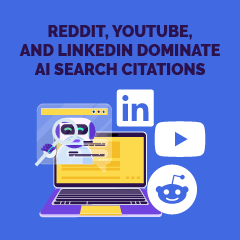
Recent data shows that Reddit, YouTube, and LinkedIn are now the most cited domains across AI search experiences, with Wikipedia and Forbes rounding out the top five.
At first glance, it feels like an odd mix. A forum, a video platform, a professional network, an encyclopedia, and a global publisher.
But when you look at what each of these platforms contributes, the pattern becomes difficult to ignore.
This is not random.
It is a reflection of how authority itself is being redefined in a world where answers are assembled, not simply ranked.
Article Summary
- Reddit, YouTube, and LinkedIn are now among the most cited sources in AI search
- Wikipedia and Forbes complete the top five, combining structure with authority
- AI systems prioritize usability, authenticity, and clarity over traditional SEO signals
- Community and creator content is outperforming brand-owned blogs
- Visibility is shifting from rankings to citation inclusion
- Brands need to rethink distribution, not just content production
What AI Systems Are Actually Looking For
For years, SEO has trained us to think in a very specific way.
Find the keyword. Match the intent. Optimize the page. Improve your position in search engine results pages and capture organic traffic.
That model still matters. It has not disappeared. But it is no longer enough on its own.
AI search introduces another layer of evaluation. One that sits alongside traditional search engine optimization but operates with a different set of priorities.
It is no longer just asking which page is the most relevant.
It is asking which source is the most useful, the clearest to interpret, and the easiest to extract from in order to build an answer.
That shift might seem subtle, but it changes how content is selected.
Because the best content is no longer just the most optimized.
It is the most usable.
Content that is structured well, expressed clearly, and grounded in something real tends to rise to the surface. Content that simply mirrors what already exists tends to fade into the background.

Why These Platforms Keep Showing Up
If you break down the platforms that dominate AI citations, each one contributes something different. Together, they form a complete picture.
Reddit brings lived experience. It answers questions the way people actually discuss them, with all the nuance, disagreement, and honesty that comes with real conversations. It is not polished, but it feels real.
YouTube removes ambiguity. It shows how things work instead of just describing them. That visual clarity makes it easier for AI systems to interpret and extract meaning from the content.
LinkedIn adds professional perspective. It is where practitioners share insights from actual experience, often in a tone that is direct and grounded rather than overly refined.
Then you have Wikipedia and Forbes anchoring the mix.
Wikipedia provides structure and consistency. It organizes information in a way that is easy for machines to understand. Forbes contributes authority and editorial weight, reinforcing credibility at a broader level.
Individually, each platform fills a gap.
Together, they create context.
And context is exactly what AI systems need when building answers that feel complete rather than fragmented.
Where This Leaves Traditional SEO Content
This is where things start to feel uncomfortable for a lot of brands.
Traditional SEO content often sits in a middle ground that is no longer as effective as it once was. It is optimized, structured, and factually correct, but it tends to lack distinction.
Many articles say similar things, just phrased slightly differently. The structure is familiar, the tone is safe, and the ideas are predictable.
For a traditional search engine, that is acceptable. Rankings can still be assigned based on authority, backlinks, and relevance.
For an AI system trying to construct an answer, it creates a problem.
If multiple sources say essentially the same thing, there is no strong signal indicating which one should be prioritized. There is no clear reason to choose one over another.
So the system looks elsewhere.
It looks for content that adds something unique. A perspective, an experience, or a level of clarity that stands apart from the rest.
And increasingly, that kind of content is not coming from brand-owned blogs.
Community Content Isn’t Winning By Accident
Reddit’s position at the top is not a coincidence.
It is filling a gap that traditional content has not addressed particularly well.
When people ask questions like “Is this actually worth it?” or “What should I expect?” they are not looking for a perfectly structured article. They are looking for experience.
They want to hear from someone who has already gone through it. Someone who can speak candidly about what worked, what did not, and what they would do differently.
That kind of insight is difficult to replicate in traditional content formats. It does not come from keyword research or editorial planning. It comes from real usage and honest reflection.
AI systems are leaning into that.
They are prioritizing sources where the answer feels grounded in reality, not just written to perform well in search rankings.
Video Is Quietly Becoming A Citation Layer
YouTube’s presence in the top three reveals another important shift.
Search is no longer purely text-based.
It is becoming multimodal, which means AI systems can interpret and extract information from video as well as written content.
A well-structured video that explains a concept clearly can now function as a source in its own right. It can be analyzed, summarized, and incorporated into an AI-generated response.
This changes the role of video in a content strategy.
It is no longer just a supporting format or an engagement tool. It becomes part of the citation layer itself.
And if your brand is not present in that layer, you are limiting where you can be included.
LinkedIn Changes The Game More Than It Looks
LinkedIn’s role in this shift is easy to underestimate.
It does not look like a traditional publishing platform, and it does not follow the same conventions as blogs or media sites.
But that is precisely why it works.
LinkedIn content tends to be faster, more direct, and more opinion-driven. It sits somewhere between structured content and real-time commentary.
That makes it particularly valuable for AI systems that are not just pulling static information, but incorporating current thinking.
It also changes how thought leadership functions.
It is no longer just about brand building. It becomes part of your search visibility.
Because when ideas are being discussed, refined, and shared in real time, those conversations become part of the pool that AI systems draw from.

This Is Not A Content Problem. It’s A Distribution Problem
Most brands do not struggle with content creation.
They struggle with where that content lives.
The default approach is to publish everything on the company website, optimize it for search engines, and wait for it to rank.
But AI systems do not operate within those boundaries.
They pull from across the web. From forums, videos, social platforms, and structured sources.
If your brand only exists in one place, your visibility is limited to that place.
And in a world where answers are assembled from multiple sources, that limitation becomes more significant.
The challenge is no longer just creating valuable content.
It is ensuring that content exists in the environments where answers are actually being formed.
The Search Everywhere Optimization™ Reality
This is where the idea of Search Everywhere Optimization™ becomes relevant.
Search no longer happens in a single location, and visibility is no longer determined by a single ranking.
Your brand needs to exist across multiple platforms, particularly those that AI systems consistently reference and trust.
That means thinking beyond your own website and considering how your content is distributed across different environments.
It requires a shift in mindset.
From focusing solely on where you publish, to understanding where your content is actually being used.

The Strategic Takeaway
The rise of Reddit, YouTube, and LinkedIn in AI search citations is not a passing trend.
It is a signal of a deeper shift.
Search is moving away from ranking pages and toward assembling answers. It is prioritizing usefulness, clarity, and context over traditional optimization signals.
In that environment, visibility is no longer about being first on a list.
It is about being included in the answer itself.
And that requires a different approach to content, authority, and distribution.
Ready To Get Your Brand Cited, Not Just Ranked?
If your current SEO strategy is focused only on rankings, you are only competing in part of the landscape.
The real opportunity lies in becoming part of the answer layer, where AI systems pull, combine, and deliver information directly to users.
At SEO Sherpa, we help brands build Search Everywhere Optimization™ strategies that extend beyond traditional search. Strategies designed to strengthen your authority, expand your digital presence, and position your content where it is actually used.
If you want to understand how your brand shows up in AI search, and how to improve it, let’s talk.
Book a discovery call with our team and we will walk you through what is working, what is missing, and how to move from being ranked to being referenced.



















Leave a Reply