

Summarize This Article With AI
 Try with ChatGPT
 Try with Claude
 Try with AI Mode
When llms.txt burst onto the scene, it was hailed by some as the robots.txt for the AI era.
But according to new research from Ahrefs, most AI systems appear to be ignoring it entirely.
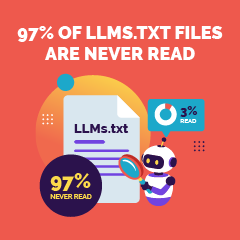
After analyzing 137,000 domains, Ahrefs found that 97% of llms.txt files received no recorded visits, while fewer than 20% of requests observed in server logs came from identifiable AI bots and tools.
The findings suggest that enthusiasm around llms.txt may have outpaced adoption.
Article Summary
- Ahrefs analyzed 137,000 websites with llms.txt files.
- 97% of those files received no recorded visits.
- Fewer than 20% of requests came from named AI bots and tools.
- Current AI systems appear to make limited use of llms.txt.
- Adoption remains low despite significant industry attention.
Has The Industry Been Overhyping LLMs.txt?
Perhaps.
But maybe that’s asking the wrong question.
The fact that AI crawlers rarely access llms.txt today doesn’t necessarily mean the protocol is useless.
It simply means adoption is still in its infancy.
After all, many standards spend years before becoming widely implemented. Sitemap.xml files weren’t universally important overnight. Structured data wasn’t immediately embraced. Neither were Core Web Vitals.
New standards often mature slowly.

Why The Findings Shouldn’t Surprise Anyone
AI search itself is still evolving.
Most major platforms are focused on crawling websites, understanding content, and improving retrieval systems. Formal standards governing how that information is presented are still emerging.
That means llms.txt remains largely experimental.
The Ahrefs data doesn’t prove the protocol has failed.
It simply confirms that most AI systems aren’t relying heavily on it—yet.
Should You Stop Using LLMs.txt?
Probably not.
There’s little downside to implementing it.
The file is simple to create, inexpensive to maintain, and may provide value as adoption grows.
Think of it like schema markup in its early days.
Many websites ignored it for years. Those that implemented it early benefited as support expanded.
The same may or may not happen with llms.txt.
No one knows.
And that’s precisely why declaring it “dead” feels premature.
What This Means for Search Everywhere Optimization
The Ahrefs study reinforces an important lesson.
Technical files alone won’t make you visible in AI search.
AI visibility still depends on fundamentals:
- Strong content.
- Clear site architecture.
- Entity understanding.
- Crawl accessibility.
- Topical authority.
- Presence across multiple platforms.
LLMs.txt might become another helpful signal in the future.
But no text file is going to compensate for weak content or poor authority.
The Bigger Picture
Perhaps the most valuable takeaway from the Ahrefs study is this:
Not every shiny new tactic becomes the next robots.txt.
The SEO industry has a tendency to chase silver bullets.
But AI search, like traditional search before it, appears to reward fundamentals far more than hacks.
LLMs.txt may eventually become an important standard.
Or it may remain a niche protocol.
Either way, businesses would be wise not to confuse experimental tactics with strategy.
Need Help Building Visibility in AI Search?
SEO Sherpa helps brands navigate the rapidly evolving world of AI search and Search Everywhere Optimization.
Book a free discovery call and discover how your business can build visibility across Google, AI search engines, and the platforms influencing modern search.























Leave a Reply