

Summarize This Article With AI
 Try with ChatGPT
 Try with Claude
 Try with AI Mode
You’ve done your research. You know you need SEO. And then you ask for a quote.
One agency says $500 a month. Another says $5,000. A third sends over a 12-page proposal with a price tag that makes your eyes water.
All three claim to do “the same thing.”
This is the SEO pricing problem. No standard rates. No published menus. Just a wild west of figures that makes it almost impossible to know whether you’re getting a deal or being taken for a ride.
Here’s the thing: the confusion is intentional. Vague pricing protects agencies that can’t justify their fees. Transparency exposes the ones that can.
This guide cuts through the noise. You’ll get real numbers, real data and a clear framework for understanding what you should be paying, what you get at each level and how to spot the red flags before they cost you.
Let’s start with the number everyone’s searching for.
Article Summary
- SEO pricing varies widely: monthly retainers typically range from $1,500 to $5,000 for most businesses, with enterprise campaigns reaching $20,000+ per month.
- The most common pricing model is the monthly retainer, preferred by 53% of agencies globally.
- US agencies charge significantly more than European counterparts, with North American hourly rates up to 6x higher than some EU markets.
- Cheap SEO (under $500/month) is rarely legitimate and carries serious penalty risks, including deindexing and Google penalties.
- The median SEO ROI is 748%, meaning every $1 spent returns approximately $7.48 in revenue.
- What you pay is less important than what you get; scope, deliverables and strategy determine real value.
What Is SEO Pricing?
SEO pricing refers to the cost a business pays to improve its organic search rankings. That sounds simple. In practice, it’s anything but.
Unlike paid advertising, where you set a budget and buy clicks directly, search engine optimization involves ongoing strategic work across technical SEO, content creation, link building and performance analysis. The cost reflects the time, expertise and tools required to do all of that well.
The challenge is that there’s no standardized price list. A $500/month SEO package and a $5,000/month package can both be called “SEO services.” What’s inside them is entirely different.
SEO pricing is also context-dependent. A local bakery competing for “best sourdough near me” has very different needs from a B2B SaaS company targeting competitive enterprise keywords globally. The same digital agency might quote both clients very different figures, and both quotes could be completely reasonable.
Understanding how search engines evaluate and rank content, and what work goes into influencing those evaluations, is the fastest way to understand why SEO costs what it does.
The three main pricing models you’ll encounter are monthly retainers, hourly rates and project-based fees. Each suits different situations. Understanding which model fits your needs is the first step to evaluating any proposal.

Average SEO Costs in 2026
Let’s get to the numbers.
The global SEO services market reached $74.9 billion in 2026, and with that kind of money changing hands, pricing data is more robust than ever. Here’s what the research actually shows.
Monthly Retainer Pricing
Monthly retainers are the bread and butter of professional SEO. You pay a fixed monthly fee for an agreed scope of ongoing work.
Based on analysis of 350 SEO agencies, basic retainers covering 10 to 15 hours of work per month start at around $1,159 and range up to $1,800. Mid-tier retainers covering 20 to 25 hours run from $2,312 to $2,890. High-tier retainers at 30 to 40 hours per month start at $3,500 and can exceed $4,600.
For enterprise clients and e-commerce businesses with complex needs, those numbers climb significantly higher. Large-scale ecommerce SEO, including product page optimization and detailed campaign management, can range from $5,780 to $11,561 per month.
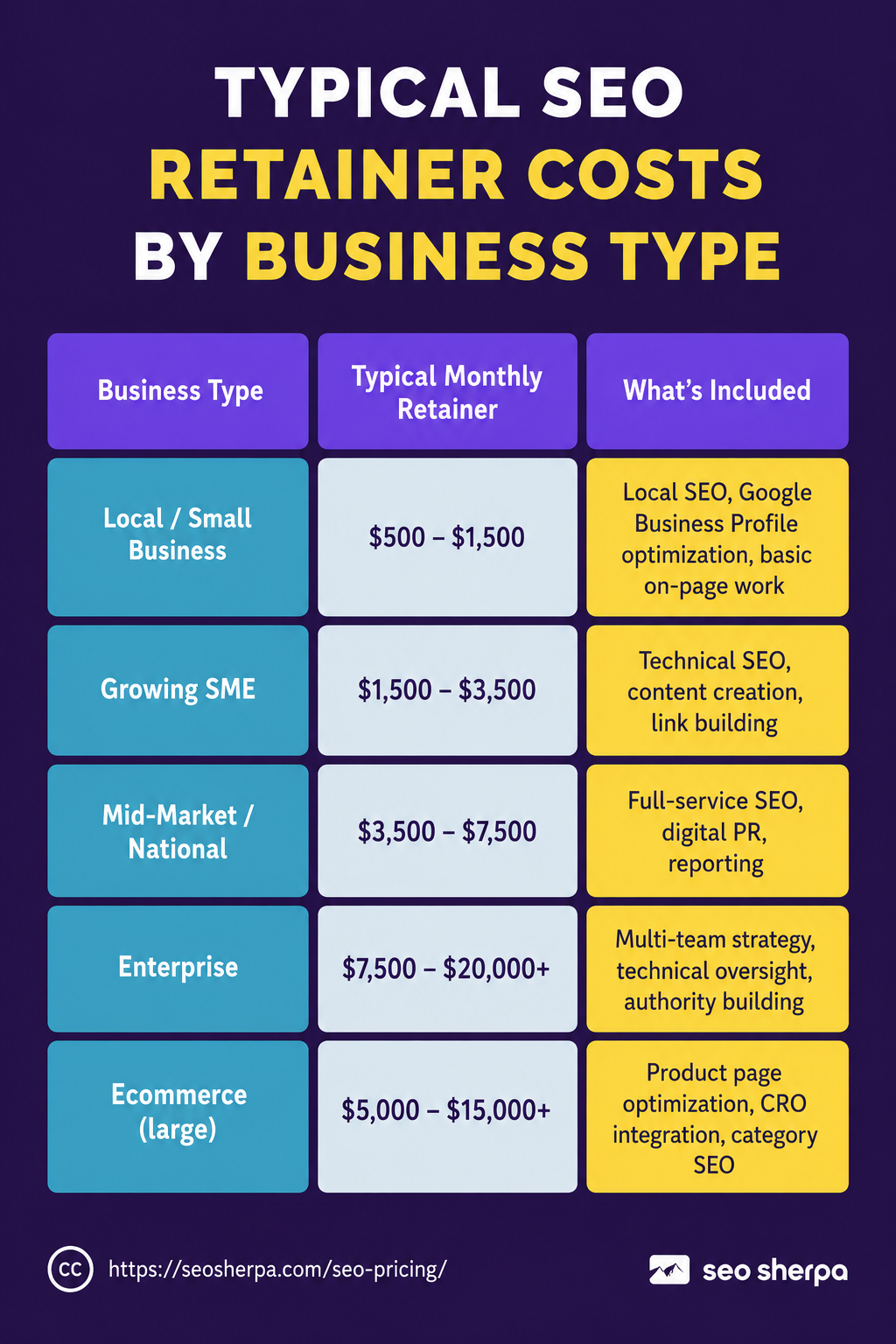
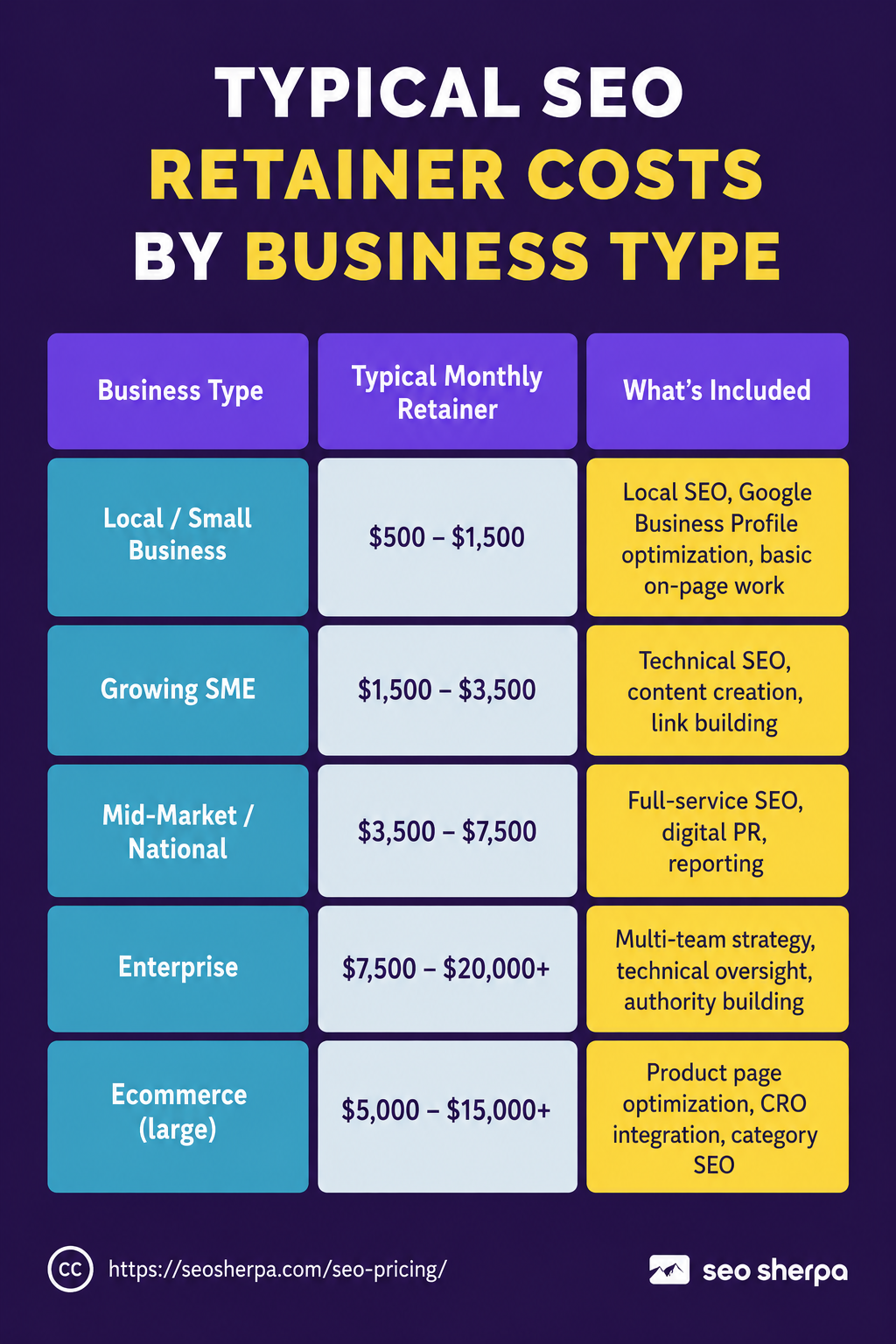
Here’s a practical breakdown by business type:
Pro Tip: Be wary of any company offering SEO for $150 or less per month. The average SEO specialist earns upwards of $70,000 annually. At that price point, an agency is either relying on black-hat SEO tactics or producing very few results.
Hourly SEO Pricing
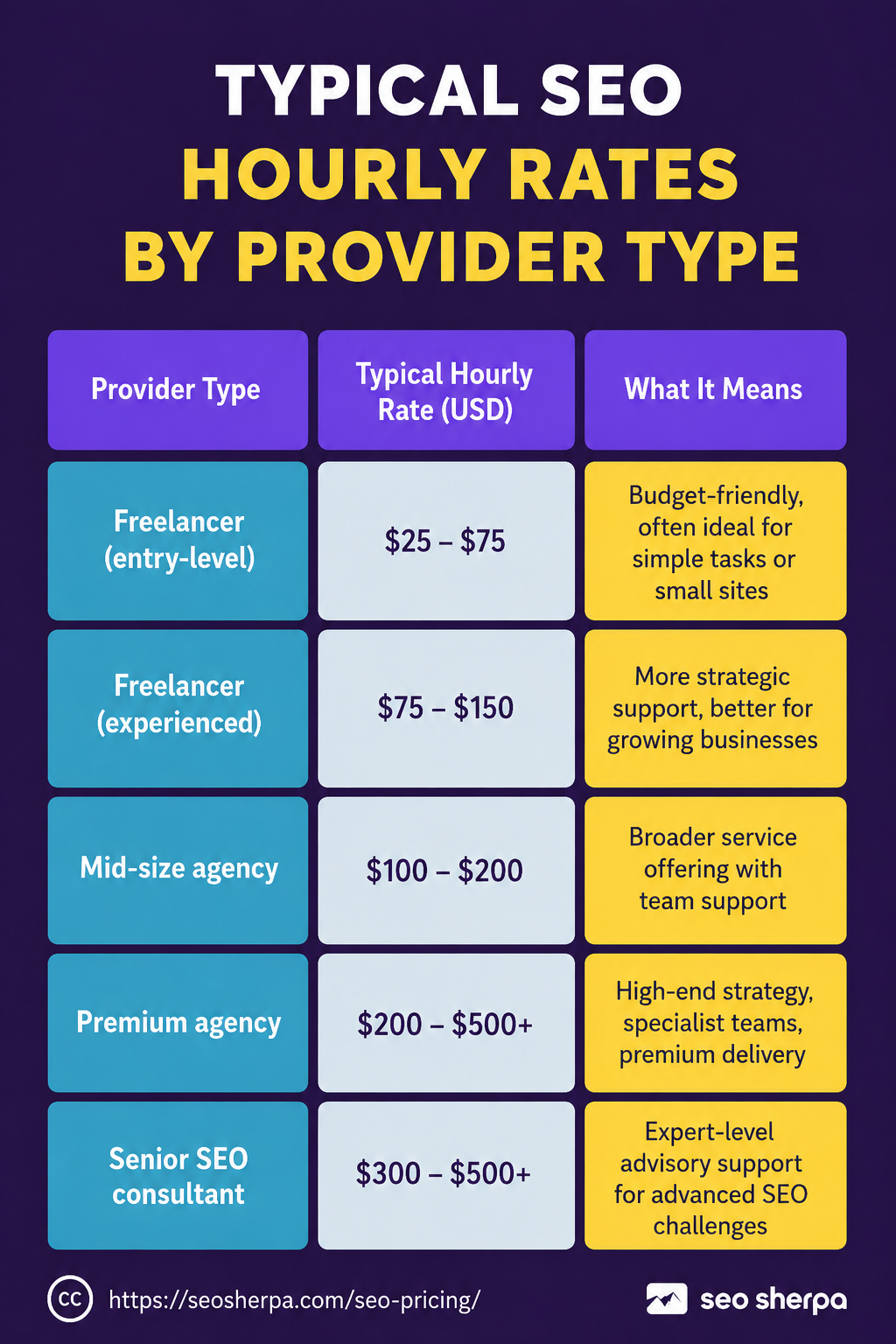
Hourly rates suit businesses that need advice, a website audit or specific one-off tasks rather than ongoing work.
The overall average SEO hourly rate globally sits at $65.28, but this masks significant variation. Based on agency analysis, the average hourly rate for agencies is approximately $115.61.
US SEO services typically charge between $85 and $500 per hour, with mid-range agencies charging $125 to $185 per hour.
In the UK, hourly rates typically range from £50 to £300 depending on the agency’s expertise and location.
Side Note: Hourly billing works well for audits and one-off consultations. It becomes expensive quickly for ongoing work. If you’re spending more than 10 hours a month on hourly work, a retainer is almost always more cost-effective.
Project-Based SEO Pricing
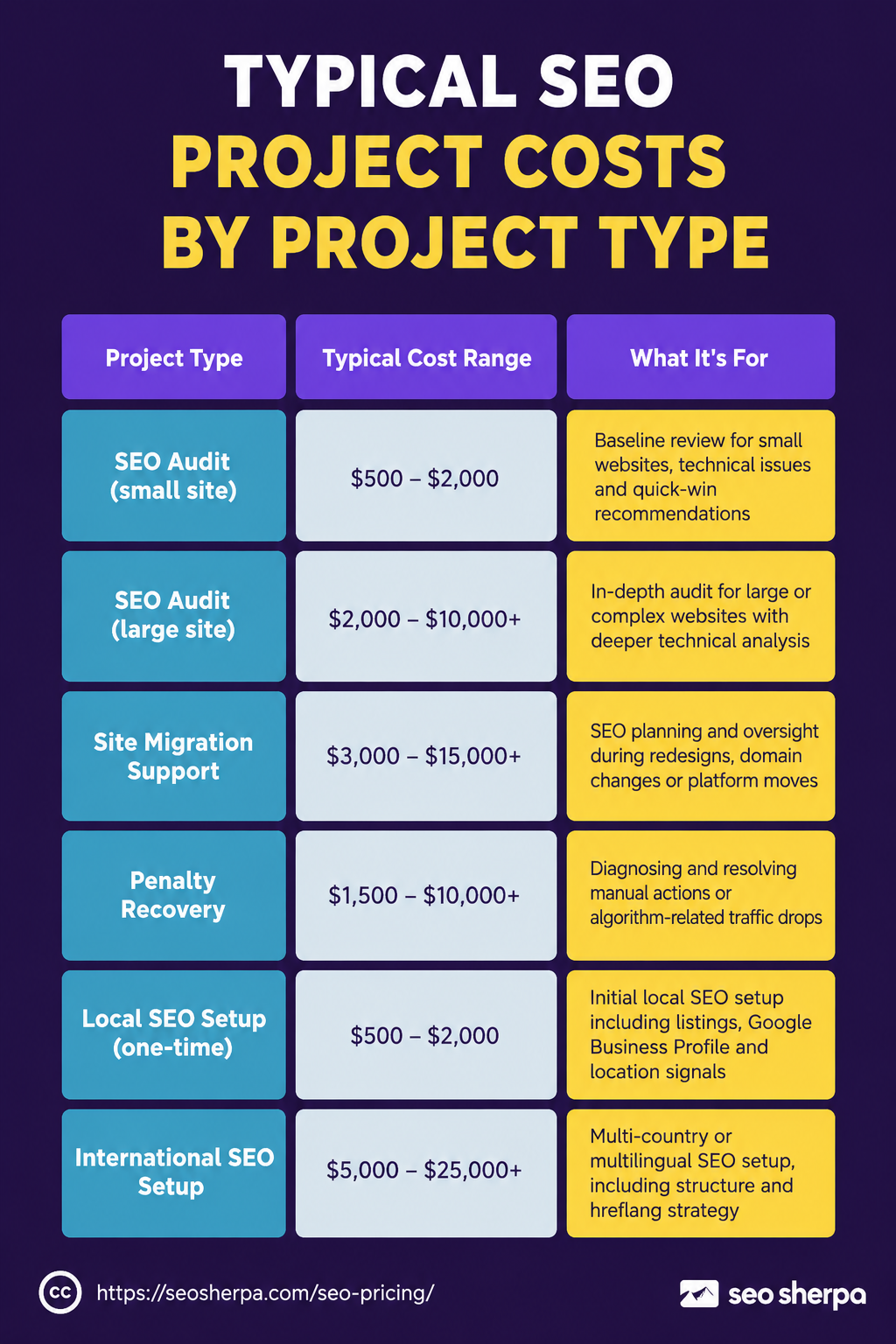
Project-based pricing applies to defined scopes with a clear start and end point. Website audits, site migrations, penalty recovery campaigns and one-time content builds all fall into this category.
SEO project costs typically run $1,000 to $5,000, though some businesses pay over $10,000 depending on the scope, timeline and requirements.
Common project types and indicative costs:
SEO Pricing Models Explained
The price tag tells you the amount. The pricing model tells you the structure. These are very different conversations.
Retainer Model
The retainer is the standard model for ongoing SEO. You pay a fixed monthly fee. The agency delivers an agreed set of services each month. Both parties know what’s included and what success looks like.
Fifty-three percent of agencies prefer monthly retainers over other pricing models, and 80% list retainers as a preferred option.
Retainers work because SEO is not a one-time project. Organic rankings take time to build. Content compounds. Link authority accumulates. A retainer keeps the momentum consistent.
The key is making sure your retainer includes clear deliverables, not just vague commitments to “work on your SEO.” A good retainer should specify content pieces per month, link-building targets, technical reviews and reporting cadence.
Performance-Based SEO
Performance-based pricing ties some or all of the agency fee to results. You pay more when keyword rankings improve, and less (or nothing) when they don’t.
It sounds appealing. Pay only for results. What could go wrong?
Quite a lot, actually.
The problem is that performance-based models can create perverse incentives. An agency chasing fee bonuses might optimize for the easiest rankings rather than the ones that drive real business value. Targeting low-competition, low-volume keywords is easy. Competing for your actual money terms is much harder.
There’s also the attribution problem. Did the organic traffic increase because of the agency’s work, or because a competitor dropped off? Performance-based contracts rarely resolve that question fairly.
Use performance bonuses as a complement to a base retainer, not as the primary structure.
Custom and Enterprise Pricing
Enterprise SEO defies standard packages. When you’re managing thousands of pages across multiple markets, integrating with development teams and requiring bespoke reporting tied to revenue data, cookie-cutter pricing breaks down.
Enterprise pricing is almost always custom. High-stakes global campaigns for major brands often cost $5,000 to $20,000 per month, reflecting global competition and the complexity of multi-market strategy.
At the enterprise level, the right question isn’t “how much does this cost?” It’s “what does this represent as a percentage of the revenue opportunity?”
SEO Pricing by Geography: US vs UK vs Global
This is where things get genuinely interesting.
Where your agency is based matters enormously. The same scope of work can cost dramatically different amounts depending on the market. Digital agencies in different regions operate under different cost structures, salary benchmarks and competitive dynamics.
United States
Monthly rates charged by US SEO agencies typically run $2,500 to $5,000 for established agencies. Freelancers in the US generally charge $1,000 to $3,000 per month for comparable work.
National SEO campaigns in the US can cost between $2,500 and $100,000 a month, depending on your business, the competition and your objectives.
Major metro areas add a premium. SEO pricing in Los Angeles, San Francisco and New York City is among the highest in the country, sometimes 2-3 times more than other large markets.
United Kingdom
SEO costs in the UK range from £400 to £6,000 per month, with pricing influenced by compliance requirements, competition in major cities such as London and Manchester, and the campaign’s scope.
UK agency retainers for small businesses typically range from £995 to £1,500 per month and cover local SEO, on-page optimization, and content production. Growing or mid-size businesses typically spend £1,500 to £3,500 per month for more comprehensive support, including technical SEO, digital PR and a full content strategy.
Europe
German agencies charge €1,000 to €3,000 per month, broadly aligned with Western European rates. Spanish agencies tend to be more affordable, ranging from €800 to €2,000 per month. Eastern European markets like Poland offer significantly lower rates, ranging from 2,000 to 5,000 PLN per month, approximately $540 to $1,350.
The North America vs Europe Pricing Gap
The biggest regional pricing gap is in hourly rates. Forty percent of North American agencies charge above $125 per hour. Only 6% of European agencies charge the same rate.
Here’s a global comparison table:
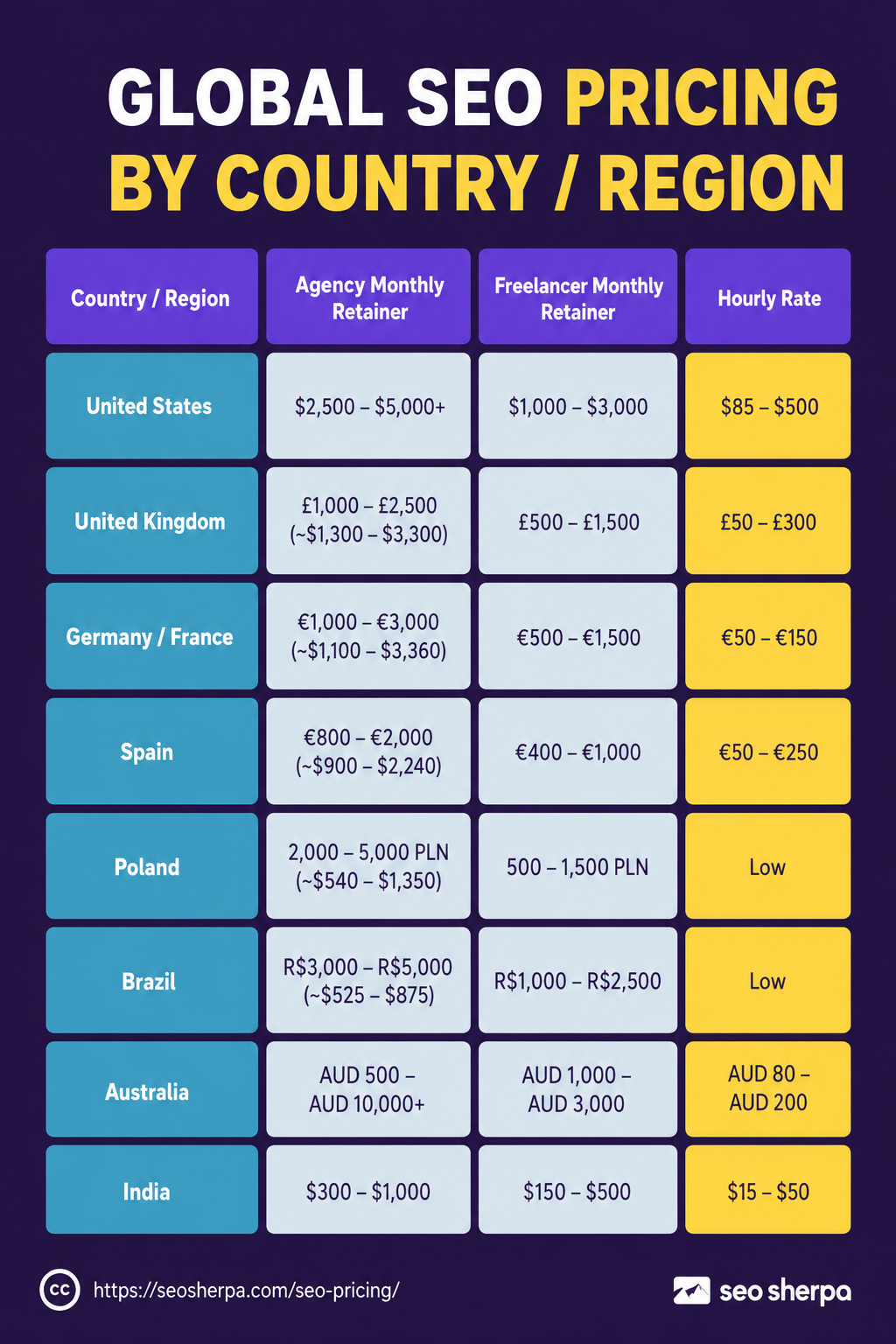
Important Note: Lower prices don’t always mean lower quality. Many UK and European agencies deliver excellent work at rates well below those of their US counterparts. But lower prices don’t automatically mean better value either. The question is always what’s in scope, not just what’s on the invoice.
What Top Agencies Actually Charge
Let’s look at real published pricing from agencies listed on Clutch:
WebFX starts at $3,000 per month. Ignite Visibility starts at $3,500 per month. Victorious SEO starts at $5,999 per month. Breakline, a UK-based agency, starts at $799 per month.
Premium agencies like Indexsy and Directive start at $8,000 to $15,000 per month, while WebFX and Victorious offer lower entry points of $3,000 to $5,000 per month.
These are entry-level figures. Larger campaigns with these agencies cost considerably more.
What Influences SEO Pricing?
Price doesn’t come from thin air. Every figure a digital agency quotes is a function of these variables.
Website Size and Complexity
A clean 50-page website is relatively straightforward to optimize. A 5,000-page site with years of technical debt, crawl errors, duplicate content and crawl budget issues requires substantially more work.
Most agencies conduct a website audit before finalizing pricing. This audit typically surfaces crawl errors, page speed problems, structured data gaps and content quality issues that define the real scope of work. If a proposal arrives without any discovery process, treat that as a red flag.
The cost of that initial website audit is usually absorbed into an ongoing retainer, or charged separately if it’s a standalone project.
Industry Competition
The more competitive your niche, the more investment is required. Legal, financial services, healthcare and insurance are among the most expensive industries for SEO because competition for high-value keywords is intense.
Digital agencies with deep expertise in competitive verticals typically charge a 30-50% premium over generalists. That premium reflects the difficulty of achieving organic rankings in those spaces, not just the agency’s brand premium.
Current SEO Performance
Starting from zero is more expensive than building on an existing foundation. A site with strong technical health, a healthy link profile and some domain authority needs less remedial work. A new site, or one recovering from Google penalties, needs considerably more.
Before any agency quotes you, they should review your Google Search Console data, run a backlink analysis and assess where your organic search performance currently stands.
Goals and Timeline
Steady, compounding long-term growth over 18 months costs less than aggressive ranking gains in six. Faster timelines require more content production, more link building and more intensive strategy work, all of which costs money.
Prices are 20-40% higher in major metro markets like New York, London and Sydney than in smaller cities. Contract length also affects pricing, with 12-month commitments sometimes reducing monthly rates by 10-15%.
AI Search and Google AI Overviews
This is the newest cost variable in SEO pricing. Sixty-one percent of agencies are considering adding optimization for Google AI Overviews and other AI-driven search experiences to their service offerings.

Agencies that have finalized pricing for AI search visibility and Generative Engine Optimization services generally charge an average monthly fee of $937 for this work.
As Search Everywhere Optimization becomes the standard, AI visibility will become a standard line item in every serious SEO proposal. Businesses that ignore this shift will feel it in their organic traffic numbers.
What Do SEO Services Typically Include?
Understanding what’s inside your SEO package matters as much as the price. Here’s a breakdown of what comprehensive search engine optimization services actually cover.
Technical SEO
A full website audit typically costs $500 to $5,000 as a standalone project, covering technical issues, content quality and backlink analysis in a comprehensive review.
Ongoing technical SEO as part of a retainer typically includes:
- Core Web Vitals optimization: including Largest Contentful Paint, Interaction to Next Paint and Cumulative Layout Shift
- Page speed improvements to reduce bounce rates and improve user experience
- Crawl budget management: ensuring search engines can efficiently crawl and index your priority pages
- Structured data and schema markup to enable rich results and improve Knowledge Graph entity recognition
- Crawl error resolution: fixing broken links, redirect chains and 404 pages flagged in Google Search Console
- Alt tags and image optimization for accessibility and visual search
- Bing bots and multi-search-engine crawlability checks for brands targeting audiences beyond Google
- Internal links auditing to improve content hierarchy and link equity distribution
Technical SEO is the foundation. Without it, everything built on top is less effective. Even the best content strategy underperforms on a site that search engines struggle to crawl.
On-Page SEO and Content Optimization
On-page optimization covers the content and code of individual pages. It is where keyword research meets content quality, and where many agencies spend the bulk of their ongoing retainer hours.
Typical on-page deliverables include:
- Keyword research and mapping to target the right search intent at each stage of the funnel
- Title tags, meta descriptions and header structure aligned to keywords ranking targets
- Internal links strategy to build topical authority and distribute page equity
- Content optimization for semantic depth and entity SEO, helping search engines build accurate Knowledge Panels around your brand
- Alt tags for all images, optimized for both accessibility and organic image search
- Content audit of existing pages to identify underperforming assets for consolidation, optimization or removal
On-page optimization for standalone pages typically costs $100 to $500 per page. In a retainer, a monthly page volume is agreed upon in advance.
Off-Page SEO and Link Building
Link building is frequently the most expensive individual component of an SEO campaign. It’s also the most impactful way to improve domain authority and organic rankings.
Link building can cost around $100 to $2,000 per link or $5,000 to $20,000 per month for a managed outreach program, depending on link value, content quality and industry competitiveness.
Quality matters enormously here. A handful of editorially placed external backlinks from authoritative sites drives far more ranking improvement than hundreds of directory submissions. Regular backlink analysis ensures your link profile stays clean and that toxic links aren’t dragging down your domain authority.
Digital PR is increasingly bundled with off-page SEO in the mid and upper tiers. It earns editorial coverage and high-authority external backlinks simultaneously, making it one of the most efficient uses of SEO budget for brands with strong stories to tell.
Local SEO
For businesses serving a defined geographic area, local SEO is its own discipline within the broader service set.
Local SEO services typically include Google Business Profile (formerly Google My Business) optimization, local citations management, local keyword research, review generation strategy and location page optimization.
Local citations, which are consistent mentions of your business name, address and phone number across directories and platforms, are a core local search ranking factor. Semrush Local and similar tools are commonly used to audit and manage citation consistency at scale.
Local SEO campaigns typically cost $300 to $2,000 per month, depending on competition, number of locations and the scope of the citation-building program.
Content Marketing and Content Strategy
Content production is often the highest recurring cost within an SEO retainer. SEO-optimized blog posts or service pages typically cost $150 to $1,000 per piece based on length and complexity.
A comprehensive content strategy covers:
- Content calendar development tied to keyword research and search intent mapping
- New content production targeting priority keywords
- Content audit and optimization of existing pages
- Content production for structured content formats such as FAQs, how-to guides and comparison pages that perform well in AI Overviews and featured snippets
- Content optimization for conversational queries and AI/SGE visibility
Content marketing compounds over time. A well-written article targeting a high-intent keyword continues generating organic traffic for years. That long-term growth is one of the clearest arguments for sustained content investment over ad spend.
Cheap vs Expensive SEO: What’s the Difference?
This is the question underneath every SEO pricing conversation. Can you get good results for $500 a month? What do you actually get for $5,000?
The answer is not just about quality. It’s about risk.

Red Flags of Cheap SEO
Cheap SEO is cheap for a reason. The corners being cut are usually the ones that matter most.
In 2026, the consequences of black-hat SEO tactics go well beyond simply dropping in organic rankings. They include deindexing, manual actions and permanent bans from Google’s index.
The warning signs to watch for:
Guaranteed rankings. No ethical SEO professional can guarantee positions in search results. Google controls its own algorithm. Any digital agency promising “#1 rankings in 30 days” is either lying or planning to use tactics that will eventually destroy your organic visibility.
No deliverables listed. If a proposal doesn’t specify what you’re getting each month, you’re not buying a service. You’re buying hope.
Suspiciously low link-building costs. High-quality editorial link building requires genuine outreach, relationships and content. If an agency is promising 50 external backlinks for $200, those links will damage your link profile, not improve it.
No discovery or website audit before quoting. Legitimate agencies ask questions and review your data before they quote. A proposal without any discovery process is a generic template, not an SEO strategy.
Private blog networks (PBNs). Google’s SpamBrain system is now extremely effective at identifying manipulative backlink creation patterns. AI-assisted spam networks create vast numbers of pages across multiple domains, following identical templates or link arrangements. When Google identifies a coordinated pattern, Google penalties often apply across entire networks, not just individual URLs.
Vanity metrics with no business connection. Watch out for agencies that report on keyword rankings and organic traffic increases without connecting those numbers to conversion rates, session durations or revenue. Traffic without business impact isn’t an SEO result.
The Value of Premium SEO
Here’s the business case for proper SEO investment.
A well-executed SEO campaign yields a median ROI of approximately 748%, meaning roughly $7.48 in return for every $1 invested in SEO. Some sectors, such as medical devices, report ROI exceeding 1,100%.
Organic search generates 44.6% of all revenue attributed to digital marketing channels for B2B companies and remains more effective than paid ads for long-term growth.
The average cost per lead from SEO is 61% lower than from paid search. The intent quality of organic search traffic is simply higher. People who find you through search engines were already looking for what you offer.
Ad spend disappears the moment you pause the campaign. Rankings built through legitimate SEO continue delivering organic traffic, leads and revenue long after the initial investment. That’s the compounding advantage that makes premium SEO genuinely worth the cost.
SEO Pricing: What It Costs By Service Type
Not all SEO budgets cover the same scope. Here’s a granular breakdown of what individual service components typically cost, whether as standalone projects or as additions to a retainer.
Side Note: Many marketing teams ask for these as à la carte additions to an existing retainer. Agencies that offer modular pricing are generally more transparent than those that only sell fixed packages. Flexibility in scope is a green flag.
SEO Pricing and AI Search: The New Cost Variable
Google AI Overviews now appear on more than 13% of all desktop queries, and that figure doubled in under three months in early 2026. AI search is not a future concern. It’s a current one.
This creates a new dimension in SEO pricing that didn’t exist two years ago.
Optimizing for AI Overviews and Google AI-driven search experiences requires a different approach to content. Structured content, clear entity relationships and Knowledge Graph signals all influence whether your brand gets cited in an AI Overview or a Generative Engine Optimization result.
Entity SEO, the practice of building clear, structured signals around your brand’s people, products and topics in Google’s knowledge systems, including Knowledge Panels and structured data, is increasingly part of what premium agencies include in their service scope.
For businesses serious about AI visibility, this work typically adds $500 to $1,500 per month on top of a standard retainer, depending on the scope of entity optimization and structured content creation required.
The brands that invest in this now will have a meaningful advantage over those waiting to see how AI search develops.
How to Choose the Right SEO Pricing Package
You now have the numbers. Here’s how you can use them.
Questions to Ask an Agency Before Signing
Transparency separates good digital agencies from great ones. Ask these questions before committing to any contract:
- What deliverables are included each month? You should receive a clear list, not vague language about “ongoing optimization.”
- Who will actually be working on my account? Understand whether you’re getting a senior strategist or a junior account manager following a template.
- How do you approach link building? Any legitimate answer will describe outreach-based, editorial backlink creation. Anything else is a risk to your link profile.
- What does success look like at 6 months and 12 months? Agencies that can’t describe realistic milestones haven’t thought carefully about your campaign.
- What reporting do you provide? You should see progress in keyword research, changes in organic traffic, conversion rates, session durations and user signals, all tied to business outcomes.
- How do you use Google Search Console and Semrush Local or equivalent tools? These are table stakes for any competent agency.
- What happens to my content, accounts and data if we part ways? You should own everything, always.
- Can I see examples of results for businesses similar to mine? Case studies from comparable industries are far more useful than generic testimonials.
Budget Allocation Tips
How much of your revenue should go to SEO investment?
The right answer depends on your industry, competition and growth goals. But as a general framework:
- Early-stage businesses: 5 to 10% of marketing budget, focused on technical foundation and local search
- Growth-stage businesses: 10 to 20% of marketing budget, expanding content marketing and link building
- Scaling businesses in competitive niches: 20% or more, with SEO as a primary acquisition channel for marketing teams
According to Search Engine Journal’s State of SEO, 12.96% of SEO practitioners work with budgets exceeding $10,000 per month. Most businesses operate effectively in the $1,500 to $5,000 range.
Side Note: Brands that allocate more than 25% of marketing spend to SEO double their ROI compared to those investing less than 10%. Spreading a small budget across multiple channels often produces mediocre results everywhere. Budget concentration matters.
Is SEO Worth the Cost?
Let’s deal with this directly.
Ninety-two percent of marketers plan to maintain or increase their SEO investment in 2026, even amid AI disruption. That is not the behavior of an industry losing faith in the channel.
The number one organic search result earns a 39.8% click-through rate. The second position earns 18.7%. The third earns 10.2%. The gap between ranking first and ranking third in search results is larger than most businesses realize.
SEO leads close at 14.6% compared to just 1.7% for outbound marketing. The intent quality of organic search traffic is simply higher. People who find you through search engines were already looking for what you offer.
The honest caveat is that SEO takes time. Meaningful increases in organic traffic typically take six to 12 months to materialize. The median break-even period for a well-run SEO campaign is around seven months. After break-even, returns compound.
For e-commerce SEO businesses, the compounding effect is particularly pronounced. Product pages that rank in search results continue to generate revenue with minimal incremental ad spend. Paid ads disappear the moment you pause the campaign.
For enterprise SEO, the business case is even clearer. Enterprise sites with large page counts have enormous latent organic potential. Unlocking even a fraction of it through technical fixes, content production and structured data delivers returns that dwarf the investment.
The cost per lead from organic search, averaging $31 compared to $181 from PPC, is the clearest data point of all. Organic traffic is not “free.” But it is significantly more efficient than paid at scale.
Get a Custom SEO Quote
SEO pricing is never truly one-size-fits-all. The right SEO investment for your business depends on your goals, your competition, your current performance and how quickly you want to grow.
What we can tell you is that businesses that invest appropriately in SEO with the right provider consistently outperform those that don’t. The data is clear on that.
If you want to understand exactly what it would take to improve your organic search visibility and what a realistic investment looks like for your specific situation, we’re happy to show you.
Book a free discovery call with SEO Sherpa
No hard sell. No generic packages. Just a clear-eyed look at your opportunity and an honest conversation about what it would take to capture it.






















Leave a Reply