

Summarize This Article With AI
 Try with ChatGPT
 Try with Claude
 Try with AI Mode
For SaaS companies, SEO is the highest-return growth channel at scale, and the numbers settle the argument before it starts.
Organic search generates 44.6% of all B2B SaaS revenue, more than any other single channel. Over a three-year average, SEO delivers around 702% ROI for B2B SaaS with a break-even point near seven months. And organic customer acquisition costs roughly 40% less than paid channels, about $205 versus $341 per customer.
So here’s the bottom line: If you run a software company and SEO is not a core part of your growth model, you’re leaving your single largest revenue channel underbuilt while paying a premium for traffic that disappears the moment you stop spending.
A real SaaS SEO strategy, grounded in proper search engine optimization rather than guesswork, changes that. This guide explains how to build it properly. Not the generic version that treats software like any other website, but the SaaS-specific version that accounts for recurring revenue, long buying cycles, product-led growth, and a funnel that runs from a curious first search all the way to a paying subscription. We will cover the framework, the keyword strategy, the content that actually converts, the technical foundation, and the metrics any Director of SEO needs to prove it is working.
Let me start with what SaaS SEO is and why it does not behave like the SEO you may already know.
Article Summary
- SaaS SEO is the practice of optimizing a software company’s website to rank in search and AI results, built specifically around recurring revenue, long funnels, and product-led conversion.
- The economics are decisive: organic search drives 44.6% of B2B SaaS revenue, and SEO returns around 702% ROI with a seven-month break-even.
- SaaS SEO is different because the buying cycle is long, the product is complex, and the goal is qualified trial signups and demos, not raw traffic.
- Keyword strategy must map to funnel stages. Bottom-of-funnel terms convert 5 to 10 times higher than awareness content and should be claimed first.
- The framework rests on three pillars working together: technical SEO, a product-led content strategy, and authority built through links and digital PR.
- Product-led content and comparison pages are where SaaS SEO earns its conversions, not generic blog posts.
- Expect results in 7 to 12 months. SEO compounds, lowering CAC over time, which is exactly why it outperforms paid acquisition for SaaS at scale.
What Is SaaS SEO?
SaaS SEO is the process of optimizing a software-as-a-service website to rank in search engines and AI tools, with the specific aim of driving qualified signups, trials and demos rather than just traffic.
The definition sounds close to regular SEO, and the mechanics overlap. You still need technical health, content and authority. What changes is the business model underneath, and that model reshapes every website SEO and search marketing decision you make.
A traditional business often sells a one-time product or service. A SaaS business sells a subscription, which means the relationship and the revenue compound month after month. That single difference cascades through everything. A customer is worth far more over their lifetime, so you can justify investing more to acquire them. The buying decision is more considered, often involving multiple stakeholders and weeks of research. And the product itself is usually complex enough that buyers need education before they are ready to commit.
SaaS SEO exists to serve that reality. It leans heavily on content marketing, and a deliberate content marketing strategy is what holds the whole program together. It is less about chasing the highest-volume keyword and more about meeting a buyer at every stage of a long, research-heavy journey, then converting them into a trial or demo when they are ready. The compounding math is what makes it so powerful. A blog post you publish today can drive qualified traffic for three to five years, turning your SEO investment into an asset rather than a rental.

Why SaaS SEO Is Different
SaaS SEO is different because recurring revenue, long sales funnels, and product complexity change what you optimize for and how you measure success.
Start with recurring revenue. Because a SaaS customer pays every month and a healthy company keeps them for years, lifetime value is high, which justifies a deeper, more patient SEO investment than a transactional business could ever rationalize. You are not optimizing for a single sale. You are optimizing for a relationship.
Then there is the funnel. A SaaS buyer rarely searches once and converts. They search to understand the problem, search again to explore categories of solutions, then search a third time to compare specific products before a trial. Your content has to be present at each of those moments, which is why funnel-stage mapping matters more in SaaS than almost anywhere else.
Finally, product complexity. Software solves intricate problems, and buyers need genuine education to evaluate whether your product is a good fit. That is the foundation of product-led content, where the product is woven naturally into the solution rather than bolted on as an ad. Get this right, and your conversion rate climbs, because SEO-sourced leads convert from MQL to SQL at 51%, compared to just 26% for PPC traffic.
Why SEO Is Critical for SaaS Companies
SEO is critical for SaaS companies because it lowers customer acquisition cost while building a compounding, predictable pipeline that paid channels can never replicate.
Every SaaS founder eventually runs into the same wall. Paid acquisition works, then it gets more expensive, then it gets more expensive again, and margins erode while the board asks why CAC keeps climbing. The median SaaS CAC has reached $2.00 for every $1.00 of new annual recurring revenue, up 14% from 2023. That trajectory is not sustainable for most companies.
SEO bends the curve the other way. Because organic content compounds, your cost per acquired customer falls over time rather than rising. By month 18, effective SEO CAC typically drops 38 to 45% compared to month six, driven by accumulated traffic and content that keep working. No paid channel does that. The day you pause Google PPC ads, the traffic stops. The content you published a year ago is still ranking.
There’s a scale story here too. The SaaS market is enormous, estimated at over $500 billion in 2026 and climbing toward $819 billion by 2029, which means competition for paid keywords is fierce and only intensifying. Organic visibility is how you build a durable position that competitors cannot simply outbid you for overnight.
SEO vs Paid Acquisition for SaaS
The honest comparison is that paid acquisition buys speed while SEO builds equity, and a serious SaaS company needs both for different reasons.
Paid ads deliver immediate traffic, which is genuinely useful for validating messaging, testing landing pages, and filling the pipeline while slower channels ramp. The catch is that paid is a rental. You hold your position only as long as you keep paying, and the rent keeps rising as more competitors bid on the same terms.
SEO is the opposite. It is slow to start and demands patience, but every piece of content and every earned link becomes an asset that keeps producing. The LTV-to-CAC ratio for SaaS companies with strong SEO programs is around 4:1, meaning four dollars come back for every dollar spent acquiring a customer. The smartest operators use paid to learn fast and fund the early months, then let SEO carry the long-term load as the lower-cost, higher-margin channel.
How SaaS SEO Works (The Framework)
SaaS SEO works through three pillars operating together: technical SEO, content strategy, and authority. Neglect any one, and the other two underperform.
Think of it as a structure. Technical SEO is the foundation that lets search engines access and trust your site. Content is the building that attracts and converts visitors. Authority is what tells search engines your building is worth ranking above the competition. Most SaaS companies overinvest in one pillar and ignore the rest, which is why so many content libraries sit unread, and so many technically perfect sites rank for nothing. Here’s how each pillar works.
Technical SEO for SaaS
Technical SEO for SaaS is the work of making sure search engines can crawl, render and index your site, which is more challenging for software products than for simple websites.
SaaS sites carry unique technical complexity. They often run on JavaScript-heavy frameworks, sit behind login walls, and generate thousands of pages, all of which can confuse search engines if handled carelessly. The priority is making sure your important pages can actually be crawled and indexed, that your product and marketing pages are not accidentally hidden behind app dashboards or buried under indexing issues, and that your site architecture passes authority logically from one page to the next.
The fundamentals still apply, and they apply harder at scale. Clean site structure, fast load times, solid on-page SEO, and a logical internal linking system that connects your content clusters. Our technical SEO guide covers the full foundation, but for SaaS specifically, crawl efficiency and proper indexing are where most of the hidden value lives.
Content Strategy for SaaS
Content strategy for SaaS is the practice of building content that attracts qualified buyers at every funnel stage and converts them into trials and demos.
This is the engine of SaaS SEO. The most effective approach organizes content into topic clusters, where a comprehensive pillar page anchors a cluster of supporting articles, all interlinked to signal genuine authority on a subject. Around that, you build the high-intent pages that actually convert: product pages, comparison pages, and landing pages tuned to specific buyer searches. A repeatable content creation process keeps quality consistent as you scale.
The mistake most SaaS teams make is treating content as a volume game, building a content production machine that publishes constantly without a plan. It’s an intent game. Managing the full content lifecycle, from creation through distribution and periodic refresh, and running a genuine content distribution effort behind each piece, is what turns a blog into an authority blog. A real content strategy connects each piece to a buyer’s actual question and a clear next step, rather than publishing blog articles into the void and hoping for traffic.
Link Building for SaaS
Link building for SaaS is the process of earning authoritative backlinks that build domain authority and signal trust, with tactics suited to the way software companies operate.
SaaS has natural link-building advantages that most industries lack. Integration partnerships create legitimate reasons for other companies to link to you. Original data and research, which a software company sits on by default, make excellent linkable assets. Digital PR turns founder expertise and product insights into coverage and links. Our SEO vs digital PR guide explains how the two reinforce each other.
The principle is the same one that governs all good link building: relevance and quality over volume, and never the shortcuts. We only practice white-hat SEO because a private blog network (PBN) or bought links is a fast route to a penalty that, for a growth-stage SaaS company, can be devastating. Our link building strategies guide lays out the approach that compounds safely.
SaaS Keyword Research Strategy
SaaS keyword research is the process of finding the search terms your buyers use at each funnel stage, then prioritizing by intent rather than raw volume.
Here’s where SaaS SEO diverges most sharply from generic keyword research. Volume is a vanity trap. A keyword with 20,000 monthly searches that attracts people who will never buy is worth less than a keyword with 200 searches from people ready to start a trial. The discipline is in sorting your keywords by where the searcher sits in the funnel, mapping them to your customer personas and the user search journey, then sequencing your effort accordingly.
BOFU Keywords (High Intent)
Bottom-of-funnel keywords are high-intent terms from buyers who are actively evaluating solutions, and they should be your first priority.
These are searches like “best CRM software for sales teams,” “[your competitor] pricing,” or “[product category] alternatives.” The person searching is close to a decision, which is why bottom-of-funnel content converts 5 to 10 times higher than awareness content. They also tend to be less competitive than head terms, because plenty of SaaS companies chase the high-volume educational keywords while neglecting the ones that actually drive revenue.
Claim these first. Capturing buyers at the point of decision delivers pipeline almost immediately, which also helps justify the longer-term content investment to a skeptical board.
TOFU Keywords (Traffic Drivers)
Top-of-funnel keywords are educational, high-volume terms that build awareness and feed the top of your funnel over time.
These are the “what is” and “how to” searches, the broad informational queries that introduce your brand to buyers long before they are ready to purchase. They drive the bulk of your organic search visitors and search traffic and establish the topical authority that helps your whole domain rank. Many are long-tail keywords with lower competition and clearer intent.
The strategic order matters. Build your bottom-of-funnel pages first to capture revenue, then expand into top-of-funnel content to widen the pipeline. Doing it backward, which is what most SaaS companies do, means waiting a year for traffic that converts poorly while your high-intent pages sit unbuilt.
SaaS Content Strategy That Converts
A SaaS content strategy that converts is built around the product and the buyer’s journey, not around publishing volume or keyword counts.
Generic content does not convert software buyers. What converts is content that demonstrates your product solving the exact problem the reader came to research. That requires two things most content libraries lack: genuine product integration and pages built specifically for high-intent comparison searches.
Product-Led SEO
Product-led SEO is the practice of weaving your product naturally into content as the solution to the reader’s problem, rather than treating it as a separate sales pitch.
This is the technique that separates great SaaS content from forgettable blog articles. Instead of writing a generic guide to a problem and bolting a CTA on the end, you show your product as the natural answer within the content itself. A guide to managing remote teams written by a project management tool should demonstrate how that tool solves each challenge, with real screenshots and concrete workflows.
Done well, product-led content educates and sells simultaneously, which is exactly why it converts. It also tends to be the content AI tools cite, whether that is ChatGPT, Google Gemini, or Perplexity, because it is specific, authoritative and genuinely useful rather than thin and generic.
Comparison and Alternative Pages
Comparison and alternative pages target buyers actively choosing between specific products, and they are among the highest-converting pages a SaaS company can build.
When someone searches “[Product A] vs [Product B]” or “best [competitor] alternatives,” they are in active buying mode, weighing real options. A well-built comparison page meets them there with an honest, detailed breakdown that positions your product fairly and clearly. These pages capture buyers at the precise moment of decision, which is why they convert so strongly.
The key is honesty. Buyers see through a comparison page that trashes every competitor and crowns yours the winner on every axis. A credible, balanced comparison that acknowledges trade-offs builds trust that actually closes the deal.
The SaaS SEO Funnel Explained
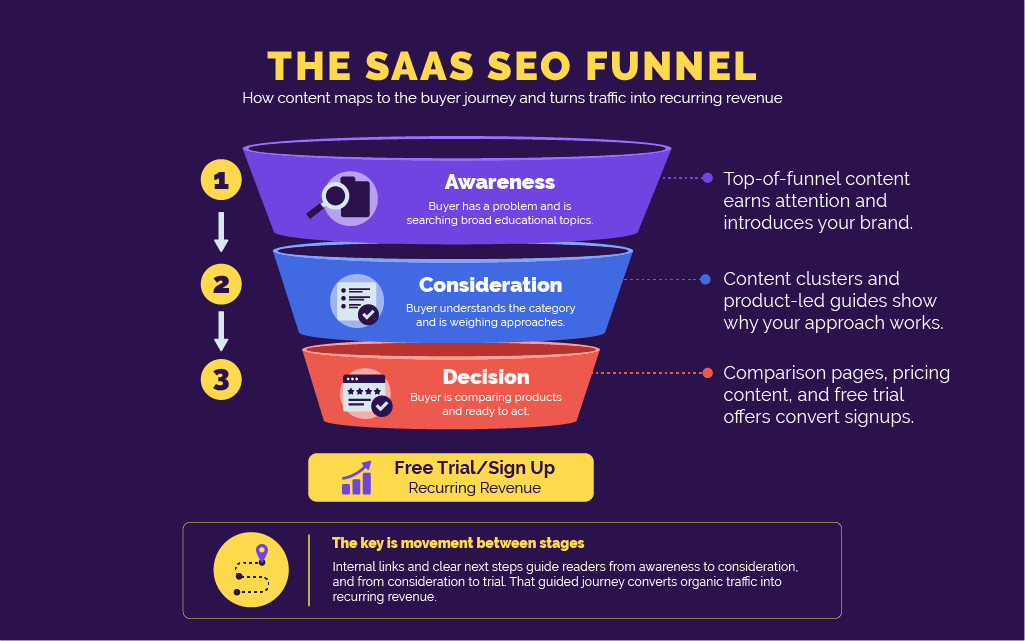
The SaaS SEO funnel maps content to the three stages of a buyer’s journey: awareness, consideration and decision.
Understanding this funnel is what turns scattered content into a system. At each stage, the buyer is asking a different question, and your content has to answer the right one at the right time.
At the awareness stage, the buyer has a problem but does not yet know the solutions. They search broad, educational terms, and your top-of-funnel content earns their attention and introduces your brand. At the consideration stage, they understand the category and are weighing approaches. Here, your content clusters and product-led guides demonstrate why your approach works. At the decision stage, they are comparing specific products, and your comparison pages, pricing content, and free trial offers convert them into signups.
The art is moving buyers smoothly from one stage to the next through internal links and clear next steps, rather than leaving them stranded at the top of the funnel. A reader who lands on an awareness article should find a natural path toward the consideration content, and eventually toward a trial. That guided journey, mapped to the marketing funnel, is what converts organic traffic into recurring revenue.
Technical SEO Best Practices for SaaS
Technical SEO best practices for SaaS center on speed, clean indexing, and handling the JavaScript and scale challenges that software sites uniquely face.
Start with site speed, because it is both a ranking factor and a conversion factor. Core Web Vitals, Google’s real-world performance metrics, measure how fast your content loads, how quickly the page responds, and how stable it is while rendering. A slow SaaS site loses rankings and signups at the same time, which is why website performance and funnel optimization go hand in hand. Our page speed guide covers the fixes that matter most.
JavaScript SEO deserves special attention for SaaS. Many software sites are built on frameworks like React or Ruby on Rails that render content client-side, which can leave search engines seeing blank pages if rendering is not handled correctly. Make sure your important content is server-rendered or properly pre-rendered so crawlers actually see it.
Then there is the scale layer. Large SaaS sites need a clean XML sitemap guiding crawlers to important pages, careful crawl budget management so search engines do not waste time on low-value URLs, correct canonical tags to prevent duplicate content from diluting your rankings, and schema markup applied consistently across templates. Add proper 301 redirects when URLs change, hreflang tags if you serve multiple regions, SSL encryption as a baseline, and structured data to make your content machine-readable for both search engines and AI systems. None of this is glamorous, but at scale, it’s the difference between a site Google understands and one it gives up on.
Link Building Strategies for SaaS
Link building strategies for SaaS focus on earning authoritative, relevant backlinks through the assets and relationships software companies naturally generate.
The strongest SaaS link building does not look like link building at all. It looks like creating things worth linking to. Original research and proprietary data reports, drawn from the usage data your product already collects, make powerful linkable assets that journalists and bloggers cite naturally. Link bait content, meaning genuinely useful free tools, calculators, or industry benchmarks, earns links for years.
Integration partnerships are a SaaS-specific goldmine. Every tool you integrate with is a potential partner page and a natural, editorially justified link. Beyond that, the durable tactics still apply: guest posts on authoritative industry publications, digital PR that turns your expertise into coverage, and listings in reputable software directories. A backlink gap analysis against your competitors, run through SEO tools like Ahrefs and its Site Explorer, will quickly show where they’re earning links that you’re not, which is usually the fastest route to a focused outreach list.
What matters most is relevance and authority. Ten links from respected SaaS and industry sources move your domain rating further than a hundred links from unrelated sites, and unlike the shortcuts, they will not collapse under the next round of Google algorithm updates.

SaaS SEO Metrics to Track
The SaaS SEO metrics that matter connect search performance to pipeline and revenue, not vanity traffic numbers that look good in a report.
This is where SaaS SEO measurement gets more sophisticated than standard SEO, because the goal is not traffic but a qualified pipeline. Start with the search fundamentals in Google Search Console: impressions, clicks and rankings for your priority keywords, which show what you are surfacing for and where you are close to a breakthrough. Layer in organic traffic and behavior from Google Analytics 4, and pull it together in a Looker Studio dashboard so the data reports tell a clear story.
But the metrics that actually matter to a SaaS business sit further down the funnel. Track how organic search contributes to MQLs and SQLs, trial signups, email subscribers, and ultimately new customers. Tie it back to CAC, LTV, and even churn rate so you can prove that organic is lowering acquisition cost and improving unit economics over time. Connecting your analytics to your customer relationship management system closes the loop from search to revenue. Watch your domain rating climb as authority builds, and your monthly traffic value as a proxy for the paid spend your organic coverage is replacing.
The discipline is simple to state and hard to maintain. Measure pipeline, not pageviews. An SaaS SEO program that reports qualified leads and CAC efficiency earns its budget. One that reports traffic alone eventually gets cut.
Common SaaS SEO Mistakes to Avoid
The fastest way to improve an SaaS SEO program is usually to stop making the mistakes quietly undermining it. These are the ones we see most.
The first is over-focusing on traffic. SaaS teams celebrate a spike in sessions that produces no signups, mistaking volume for progress. Traffic that does not convert into trials or demos is a cost, not a win. Optimize for a qualified pipeline from the start.
The second is ignoring search intent. Publishing content based on volume alone, without asking what the searcher actually wants, produces pages that rank for terms no buyer cares about. Every piece of content should map to a real buyer question and a clear funnel stage.
The third is neglecting bottom-of-funnel content. Most SaaS companies pour everything into top-of-funnel awareness content because it is easier to produce, and then wonder why traffic never converts. The high-intent comparison and pricing pages, the ones that actually drive revenue, sit unbuilt. Reverse the order.
The fourth is weak calls to action. Even strong content fails to convert when the next step is unclear or buried. Every page should guide the reader naturally toward a trial, a demo, or the next stage of the funnel.
How Long Does SaaS SEO Take?
SaaS SEO typically takes seven to 12 months to deliver meaningful results, with bottom-of-funnel pages often ranking faster than broad awareness content.
This is the question every founder asks, and the honest answer is that SaaS SEO is a compounding bet, not a quick win. Content-led SEO generally needs six to 12 months to build meaningful organic traffic, though high-intent bottom-of-funnel keywords can start converting sooner because they are less competitive and more targeted.
That timeline frustrates founders under pressure, but it is also the source of SEO’s advantage. The slow ramp is exactly what makes organic search a moat. Anyone can switch on paid ads tomorrow. Nobody can buy the authority and content library you spent a year building. By month 18, that patience pays off in materially lower CAC and a pipeline that keeps producing without proportional spend. We go deeper into the timeline in our guide to how long SEO takes to work.
The right expectation to set with your board: treat the first two quarters as foundation building, expect momentum in the second half of year one, and plan for compounding returns from year two onward. SaaS SEO rewards companies that commit and punishes those that quit at month four.
How SEO Sherpa Scaled a Subscription Platform
Strategy is easy to describe, so here is what it looks like when executed properly on a site with the same technical and scale challenges a SaaS company faces.
FACES, a fast-growing beauty platform with a complex, multi-subdomain infrastructure, came to us with the exact problems that plague large software sites: bloated technology, crawling and indexation issues, and ranking signals scattered across too many subdomains. The parallels to a SaaS site wrestling with JavaScript rendering and sprawling page counts are direct.
We rebuilt the foundation first. We migrated the site from multiple subdomains to a single root domain with a clean subfolder structure, consolidated the technology stack, and simplified crawling and indexation. Then we drove link equity to the new structure through internal and external links, and used templates to optimize tens of thousands of pages at scale. That’is programmatic SEO in action, the same approach a SaaS company would apply to build programmatic pages for integrations or comparisons.
The results speak for themselves. Organic traffic rose 334%, from 29,778 to 116,658 monthly sessions in 12 months, and monthly revenue from organic search grew by 1,024%. The campaign generated AED 5,620,304 in revenue from AED 154,306 in fees, a 3,643% return. Different industry, identical playbook: fix the technical foundation, optimize at scale, build authority, and let the compounding do its work.
Next Steps
SaaS SEO is not a marketing tactic you add once you have traction. It’s the growth engine that builds the traction, compounding quarter after quarter while lowering your acquisition cost and feeding a pipeline that paid channels cannot match.
The companies that win the next few years will be the ones that have built and owned compounding visibility across Google, AI Overviews, and every surface where software buyers now research before they buy. That shift toward Search Everywhere Optimization™ is not a reason to wait. It is the reason to start now, while competitors are still renting their traffic and watching CAC climb.
The path is clear. Build the technical foundation, map your content to the funnel, claim your high-intent keywords first, weave your product into content that genuinely helps, and measure pipeline rather than pageviews. Then commit for long enough to let the engine compound, because the SaaS companies that last through the early months are the ones that own their category by year two.
If you want a partner that has scaled organic growth for ambitious brands and knows exactly where an SaaS company should focus first, book a free discovery call. We will map the highest-leverage opportunities for your business and show you how to capture them before your competitors do.





















Leave a Reply