

Summarize This Article With AI
 Try with ChatGPT
 Try with Claude
 Try with AI Mode
For years, SEO professionals have measured success with rankings, clicks, and impressions.
But AI search is changing the rules.
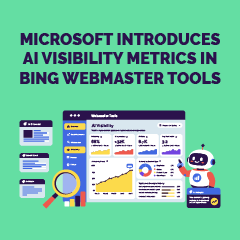
Microsoft has announced four new AI visibility reports inside Bing Webmaster Tools—Intents, Topics, Citation Share, and Compare—giving site owners deeper insight into how their content appears across Bing AI and Copilot experiences.
While Google still provides limited reporting around AI Overviews and AI Mode, Microsoft is taking a different approach: opening the black box and giving marketers more visibility into how AI systems surface and cite content.
Article Summary
- Microsoft has added four new AI visibility reports to Bing Webmaster Tools.
- New reports include Intents, Topics, Citation Share, and Compare.
- The update builds on Bing’s AI Performance dashboard.
- Publishers can better understand why their content is being cited.
- Citation Share introduces a new way to measure AI visibility.
- The features are currently rolling out globally in preview.
AI Search Needs New Metrics
Traditional SEO has always revolved around rankings.
But AI search doesn’t necessarily work that way.
Being represented in AI-generated answers, recommendations, and summaries matters just as much as occupying the number one position in the SERPs.
Microsoft’s latest update acknowledges this shift. Rather than focusing solely on traffic and rankings, these reports help publishers understand where and why AI systems choose their content.
It’s one of the clearest signs yet that search is evolving beyond blue links.

Intents
The Intents report groups citations based on the type of user query behind them.
This gives publishers a better understanding of whether they are appearing for informational, commercial, navigational, or other search intents.
Understanding intent has always been central to SEO. Microsoft is simply extending that concept into AI search.
Topics
The Topics report shows the themes and subject areas associated with your content.
This helps publishers understand where they have topical authority and identify opportunities to strengthen coverage in important areas.
In an AI-driven search environment, topic depth and breadth matter more than ever.
Citation Share
Perhaps the most interesting addition is Citation Share.
Rather than focusing on rankings, Citation Share measures how often your site is referenced compared to other sources within AI responses.
That represents a meaningful shift.
Success in AI search isn’t just about being present. It’s about how much of the conversation your brand owns.
Compare
Compare allows site owners to benchmark AI visibility across different periods.
This makes it easier to measure whether optimization efforts are improving citation frequency and visibility over time.
Think of it as month-over-month reporting for AI search.
Why This Matters
For the past two years, much of the AI visibility ecosystem has been built by third-party tools attempting to reverse-engineer what search engines weren’t showing.
Microsoft is now providing native reporting.
That’s significant.
It signals that AI visibility is becoming an important performance metric in its own right—not simply an extension of traditional SEO.
And while Bing may not command Google’s market share, Microsoft continues to be one of the most transparent platforms when it comes to AI search.
What This Means for Search Everywhere Optimization
This update reinforces a bigger trend.
Search is becoming increasingly fragmented.
People search on Google, Bing, ChatGPT, Copilot, YouTube, TikTok, LinkedIn, Reddit, and countless other platforms. AI systems pull information from many of these sources.
Success is no longer defined by a single ranking position.
Brands need to build visibility across multiple channels, create authoritative content, and establish strong entity signals that AI systems can understand and trust.
The companies that win won’t just optimize for Google.
They’ll optimize for everywhere their audience searches.
The Emergence of Citation Share
For decades, SEO revolved around rankings.
But Microsoft may have just introduced a new KPI for the AI era.
Citation share.
Not where you rank.
Not how many clicks you receive.
But how frequently AI systems choose your content over competing sources.
That may become one of the defining metrics of search over the next few years.
And Microsoft is giving us an early glimpse into what that future looks like.
Need Help Improving Your AI Visibility?
SEO Sherpa helps brands build authority across Google, AI search engines, and the platforms that influence them.
Book a free discovery call and discover how Search Everywhere Optimization can help your business get found, trusted, and chosen wherever customers search.
This angle feels much more “Sherpa” to me: authoritative, forward-looking, and focused on how businesses should respond rather than promoting an internal framework.



















Leave a Reply