
Summarize This Article With AI
 Try with ChatGPT
 Try with Claude
 Try with AI Mode
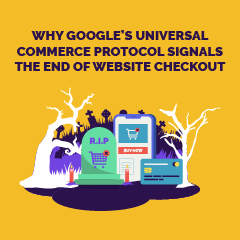
For most of the internet’s history, buying something online has meant visiting a website. You land on a product page, you scroll through photos, you skim reviews, you add to cart, and you eventually make your way through a checkout flow that has been tweaked and tested for years. Entire marketing teams, CRO specialists, and ecommerce platforms exist purely to optimize that moment.
Google just announced something that quietly makes all of that feel fragile.
It is called the Universal Commerce Protocol, and it is designed to let AI agents discover, evaluate, and purchase products on behalf of users directly inside Gemini and AI Mode. That might sound like a convenience feature, but in reality it represents a structural shift in how commerce happens online.
This is not a new checkout button. This is Google moving the act of buying out of websites and into its own AI layer.
Article Summary
- Google’s Universal Commerce Protocol lets AI agents discover and buy products directly inside Gemini and AI Mode
- Users no longer need to browse e-commerce websites or go through traditional checkout flows
- Google becomes the intermediary between the customer, product, payment, and fulfillment
- Product feeds, availability, pricing, shipping, and brand trust matter more than page design
- Ecommerce SEO shifts from ranking pages to being selected by AI agents
What Google Actually Launched
When Google talks about the Universal Commerce Protocol, it frames it as a technical standard for agentic commerce. In plain terms, this means AI can now do the entire shopping journey on a user’s behalf. A user describes what they want, and the agent finds products, compares them, checks inventory, and completes the purchase without ever sending the person to a website.
This removes the browsing layer entirely.
The user does not open ten tabs.
They do not scroll through filters.
They do not read five blogs.
They get one outcome.
And Google controls that outcome.
This turns Gemini and AI Mode into something much more powerful than a search engine. It becomes a decision engine for commerce, sitting between the customer and every retailer on the internet.
Why This Is Not Just a Payments Update
It is tempting to compare UCP to Stripe, PayPal, or Shop Pay, but those are still tools that live inside websites. They assume the website is where the sale happens.
UCP removes the website from the equation.
When the agent handles discovery, comparison, and checkout, the store becomes just a data source. The relationship between the customer and the brand now runs through Google.
This is why the announcement is so dangerous for traditional e-commerce. Google is not just facilitating transactions. It is positioning itself as the place where buying happens, much like Amazon did, but without building a marketplace UI. The marketplace lives inside the AI.
The End of the Product Page as We Know It
E-commerce websites have always been designed to persuade humans. Beautiful imagery, emotional copy, lifestyle photography, social proof, and urgency all exist to push a visitor over the line.
AI agents do not care about any of that.
They do not feel inspired by your branding.
They do not respond to your copywriting.
They do not notice your design.
They evaluate data.
What the agent sees is your product feed, your pricing, your stock levels, your delivery times, your returns policy, and your customer ratings. That becomes the basis of the decision. If your data is incomplete or inaccurate, you will not be chosen, no matter how good your website looks.
In this world, your Google Merchant Center feed becomes more important than your homepage.
Search Becomes a Procurement Engine
The Universal Commerce Protocol quietly turns search into procurement. When a user asks Gemini to buy something, that request is not answered with links. It is answered with a decision.
Which product is best. Which seller is most reliable. Which offer should be chosen.
Those decisions are made by Google’s AI ranking system, and they will be influenced by every signal Google has about your business, from structured data to fulfillment reliability.
This is where ecommerce SEO stops being about keywords and starts being about operational excellence.
Your shipping speed becomes a ranking factor. Your stock accuracy becomes a ranking factor. Your customer satisfaction becomes a ranking factor.
The line between marketing and logistics disappears.
Why Advertising Will Not Work the Same Way
Traditional paid search is built on clicks. You bid to show up, someone clicks, and they land on your site.
But when an AI agent is making the purchase, there is no click.
There is just a selection.
Google’s incentive shifts from selling traffic to taking a cut of transactions. That pushes the entire ecosystem toward a model where brands compete to be the chosen supplier, not the most visible advertiser.
It looks less like Google Ads and more like Amazon’s Buy Box, where one seller gets the sale and everyone else disappears.
The Invisible Loss of Market Share
The most unsettling part of UCP is how quietly it will change who wins. When AI agents decide, users never see the alternatives. There is no comparison table. There is no SERP. There is no scrolling.
There is just one answer that feels smart and personal.
If your brand stops being selected, you will not see a drop in impressions. You will not see a ranking fall. You will just see sales slow down, with no obvious reason why.
That is a very different kind of competition.
Why Big Brands and Reliable Sellers Will Win
In an agent-driven commerce system, trust becomes everything. Google’s models will favor businesses that consistently deliver what they promise, because failed orders and unhappy customers train the system to avoid them.
This shifts the balance toward brands that have strong reputations, stable operations, and clear data. Smaller brands can still win, but only if they are as reliable and transparent as larger competitors.
This is no longer about who writes the best product description.
It is about who the machine trusts.
The Bottom Line
Google’s Universal Commerce Protocol does not kill ecommerce. It kills the idea that ecommerce happens on websites.
Buying is moving into AI.
Discovery is moving into AI.
Decisions are moving into AI.
And Google now controls that layer.
If your business is not structured, trusted, and optimized for that reality, it will simply not be chosen when machines start doing the buying for people.
If you want to understand how your products and brand will perform in this new AI-driven commerce environment, book a free discovery call with SEO Sherpa. We will show you how visible and competitive your business really is in the systems that are starting to decide where money flows online.




















Leave a Reply