

Summarize This Article With AI
 Try with ChatGPT
 Try with Claude
 Try with AI Mode
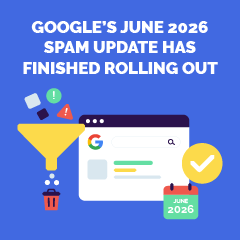
Google’s June 2026 spam update is officially complete.
The rollout began on June 24 and finished on June 26, making it one of Google’s faster announced spam updates. Google described it as a “normal spam update,” although some tracking tools and members of the SEO community reported noticeable ranking volatility around the rollout.
As ever, the word “normal” is doing some fairly heavy lifting.
The update applied globally across all languages and locations, targeting websites that Google’s systems identify as violating its search spam policies. Google did not disclose the percentage of queries affected or highlight one specific tactic being targeted.
Article Summary
- Google’s June 2026 spam update ran from June 24 to June 26.
- The update applied globally and across all languages.
- Google described it as a normal spam update.
- It targeted violations of Google’s existing search spam policies.
- Google did not provide a specific list of tactics targeted by this update.
- Recovery may require correcting policy violations and waiting for Google’s systems to reassess the site.
- Spam policies also extend to AI-powered Google Search experiences.
- Search Everywhere Optimization should be built on genuine authority, not manufactured mentions or shortcuts.
What Was the June 2026 Spam Update?
Google announced the rollout on June 24, stating that it would affect all languages and locations.
The update was completed approximately two days later, on June 26. Search Engine Roundtable reported that the rollout appeared more widespread than some previous spam updates, although Google itself did not provide detailed information about its impact.
Unlike a broad core update, which reassesses how Google evaluates and rewards content across the web, a spam update is designed to improve Google’s ability to identify practices that violate its spam policies.
These may include manipulative content, deceptive behaviour, scaled low-value publishing, cloaking, hacked content and other attempts to influence rankings without providing genuine value to users. If you want a fuller breakdown of how these different releases work, our guide on why rankings drop and how to fix it walks through the distinction in detail.
However, Google did not say that every section of its spam policy was involved in this specific rollout.
That means website owners should avoid diagnosing a decline based solely on whichever tactic happens to be receiving the most attention on LinkedIn that week.

A Fast Rollout Does Not Necessarily Mean a Small Update
The June update took around two days to complete, which is considerably faster than many core updates.
That does not necessarily mean the effect was limited.
Spam detection systems can target identifiable patterns relatively quickly, particularly when Google is refining classifiers or enforcement systems that already exist. A site using a heavily replicated or clearly manipulative approach may therefore see a sharp change within a short period.
The speed of the rollout also makes analysis difficult.
Traffic fluctuations during the same week could have been caused by the spam update, previous algorithmic changes, seasonality, demand shifts, AI search features or normal ranking volatility. Website owners need to compare multiple data sources before deciding the spam update was responsible.
Look at page-level changes, query groups, directories, templates and content types rather than relying on a single top-line traffic graph.
If one highly templated section collapsed while original service and product pages remained stable, that provides a much stronger diagnostic signal than an overall 15% decline.
Which Sites Were Targeted?
Google said the update affected sites violating its established search spam policies.
Those policies cover a wide range of practices, including cloaking, doorway abuse, expired domain abuse, hacked content, hidden text, keyword stuffing, link spam, machine-generated traffic, misleading functionality, site reputation abuse and scaled content abuse. Interestingly, Google told Search Engine Roundtable that this particular update did not target link spam or the site reputation abuse policy.
Not every ranking decline during a spam update means that a site has received a manual action.
Algorithmic spam systems can simply reduce the visibility of pages or sites that no longer meet Google’s quality thresholds. There may be no notification in Search Console and no single issue that can be fixed with one button.
Google also does not always ignore an entire domain. Its systems may affect particular pages, content groups or patterns more heavily than others.
This is why broad deletion campaigns can do more harm than good.
Before removing hundreds of pages, businesses need to establish whether those pages are actually low quality, whether they serve users and whether they have unique commercial or informational value.
AI-Generated Content Is Not Automatically Spam
Every spam update now produces the same predictable question: “Was this targeting AI content?”
Google’s policies do not classify content as spam merely because AI helped create it.
The issue is whether content has been created or scaled primarily to manipulate rankings without adding meaningful value. A well-researched article that uses AI during outlining, editing or production is fundamentally different from thousands of lightly modified pages produced to capture every imaginable keyword.
Google’s scaled content abuse policy is technology-neutral.
The same rule can apply to content written by people, generated by software or created through a combination of both. The problem is the production of large volumes of unoriginal or unhelpful material for ranking manipulation. We covered this same tension when Google shipped its August 2025 spam update, and the guidance has not changed.
This matters because automation itself is not the enemy.
Many professional SEO teams use AI to support research, improve workflows, analyse datasets and accelerate content production. The expertise, editorial judgment and original value added after that point are what separate a genuine content system from a spam factory wearing a very nice SaaS subscription.
Recovery From a Spam Update
Google advises affected website owners to review its spam policies and make the necessary changes.
However, recovery may not be immediate.
Google’s systems need to recrawl, reprocess and reassess the website after improvements have been made. Depending on the issue and the systems involved, meaningful recovery can take weeks or months.
Businesses should begin with a focused audit:
- Examine which pages lost visibility.
- Identify shared templates, content patterns or acquisition methods.
- Review whether pages genuinely satisfy the search intent.
- Check whether third-party sections are being hosted primarily for their ranking authority.
- Assess whether content is original, accurate and useful.
- Review links, redirects, structured data and technical implementation for deceptive or manipulative behaviour.
Much of this diagnostic work overlaps with a proper technical SEO review, which is often the fastest way to separate a genuine spam signal from a crawl or indexing problem masquerading as one.
The aim should not be to “reverse-engineer the update” through guesswork.
It should be to remove the reasons Google might reasonably view the site as untrustworthy or low value.
Spam Policies Now Matter Beyond Traditional Search
One of the most significant developments in 2026 is that Google has explicitly connected its spam policies with AI search experiences.
Google has stated that the same spam policies apply to AI Overviews and AI Mode. It has also warned against attempts to manipulate AI citations or manufacture mentions purely to influence generative results.
This closes off one of the more optimistic narratives being sold around generative engine optimization: that AI search represents a fresh loophole where traditional quality standards no longer apply.
It does not.
Google’s AI systems still rely on the wider search ecosystem to retrieve, evaluate and support information. A domain that loses trust because of spammy practices may therefore lose visibility across both traditional results and AI-generated answers.
How This Ties Into Search Everywhere Optimization
Search Everywhere Optimization is not about publishing as much content as possible across as many platforms as possible.
It is about creating consistent, credible evidence that a brand deserves to be discovered and recommended.
That evidence may include original website content, expert commentary, customer reviews, social activity, video, community participation, digital PR and relevant third-party mentions. However, these signals must be earned and authentic.
The wrong interpretation of Search Everywhere is to mass-produce generic LinkedIn articles, seed manufactured Reddit discussions, buy artificial brand mentions and publish hundreds of pages simply because AI systems might crawl them.
That is not authority layering. It is spam with a multichannel distribution plan.
A sustainable strategy connects genuine expertise across platforms. A detailed study might live on the brand’s website, be discussed by an expert on LinkedIn, demonstrated through YouTube, referenced by an industry publication and debated within a relevant community.
Each platform adds context and validation.
This creates the type of coherent brand footprint that both users and AI systems can recognise without relying on manipulation.
What Should Businesses Do Next?
Businesses that experienced significant declines around the update should avoid making panic-driven changes.
First, confirm whether the decline aligns with the rollout dates and whether it affects specific areas of the website. Then review Google’s spam policies against the actual practices being used across content, link acquisition, programmatic publishing and third-party partnerships.
Brands should also audit their off-site strategies.
As AI visibility becomes more valuable, there will be growing temptation to purchase mentions, fabricate discussions or treat every authoritative platform as a parasite SEO opportunity. Google has already made it clear that attempts to manipulate citations are not a clever new discipline beyond SEO policy.
They are simply another form of search manipulation.
The winners will be the brands that use automation intelligently, distribute expertise widely and still maintain a very human standard of judgment.
At SEO Sherpa, we help businesses identify risky SEO practices, recover lost visibility and build sustainable strategies rooted in genuine authority—not short-term tactics that disappear with the next update. Get a free discovery call today.





















Leave a Reply