


Google has quietly flipped the switch on one of the more interesting interface changes we’ve seen this year.
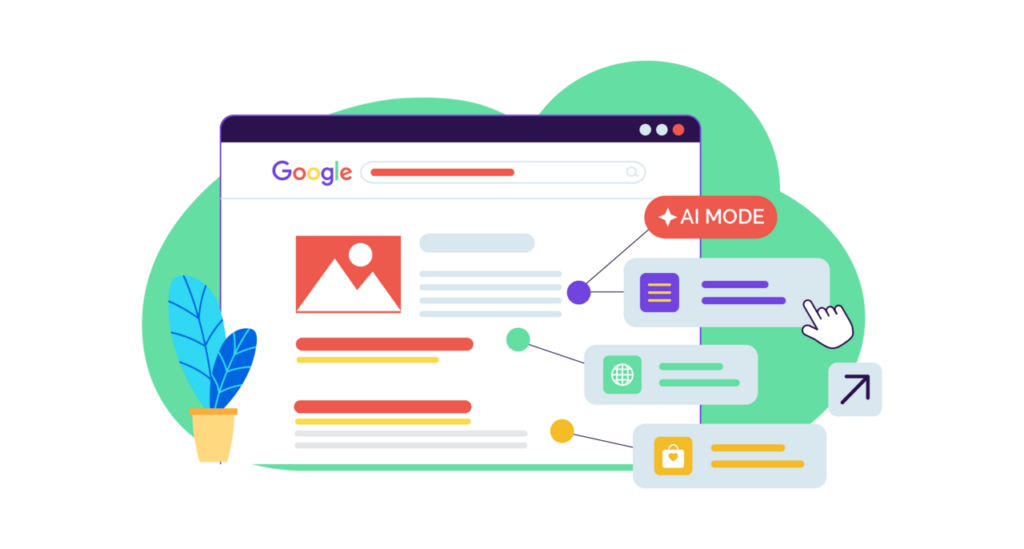
Contextual overlay link cards are now live inside AI Mode.
Robby Stein from Google previously announced on X that AI Overviews and AI Mode would begin showing grouped links in a pop-up when users hover over them on desktop. That experience is now fully visible.
And it changes how attribution works in AI-generated answers.
Article Summary
- Google has launched contextual overlay link cards inside AI Mode on desktop
- Hovering over linked text now reveals grouped source links in a pop-up
- The feature was previously announced by Robby Stein on X
- This shifts how users interact with citations in AI-generated responses
- Visibility within AI Mode becomes more interactive and layered
- Brands must optimize for citation presence, not just blue-link rankings
What the New Overlay Experience Looks Like
Inside AI Mode, certain linked phrases now trigger a pop-up overlay when hovered over on desktop.
Instead of a single static hyperlink, users see grouped source links related to that claim or statement. These links appear in a compact card-style interface layered directly over the AI-generated response.
It feels more dynamic.
More modular.
And much more intentional.
This is not just cosmetic UI refinement.
It is a shift in how Google presents attribution inside AI-driven answers.

From Inline Links to Layered Citations
Previously, AI Overviews displayed citation links more traditionally, often as superscript-style references or inline sources.
Now, those references are bundled contextually.
Hover. Reveal. Explore.
The interaction encourages users to engage with multiple sources tied to a specific point rather than clicking a single outbound link blindly.
This creates a different visibility model.
Instead of competing for one blue link click, brands are competing to be included within grouped contextual citations.
That is a structural shift.
Why This Matters for Publishers
AI Mode is not simply a feature. It is Google testing a new browsing paradigm.
When citations become layered overlays instead of obvious standalone links, click behavior changes.
Users are no longer scanning a list of ten results.
They are navigating within a structured AI-generated narrative.
And your brand’s visibility depends on whether it is selected as a supporting source within that narrative.
That selection process is algorithmic.
And competitive.
Citation Visibility Is the New Ranking
In traditional Search, ranking position defined visibility.
In AI Mode, citation inclusion defines visibility.
That distinction matters.
If your content is not being selected as a contextual source for specific claims, you effectively disappear from that interaction layer.
Even if you rank organically elsewhere.
The contextual overlay system reinforces something we are seeing across AI search environments: inclusion is selective.
It is not about indexing alone.
It is about being trusted enough to be cited.
Grouped Links Change the Click Economy
Here is where things get strategic.
When multiple links are grouped inside a hover card, you are no longer competing against the entire SERP.
You are competing against a curated shortlist.
That shortlist is algorithmically assembled based on relevance, authority, and alignment with the AI-generated statement.
If your brand appears in that group, you are validated as a source.
If it does not, you are invisible in that moment.
This compresses the competitive landscape.
And raises the bar.
AI Mode Is Becoming a True Browsing Layer
The contextual overlay feature reinforces a broader trend.
AI Mode is evolving from “enhanced answers” into a self-contained browsing environment.
Users can read summaries, expand citations, explore sources, and continue queries without returning to traditional search results.
It is a guided experience.
Structured. Layered. Curated.
And every UI refinement moves Google closer to that AI-first interaction model.
This is not incremental.
It is architectural.
What Brands Should Be Watching
If you want to understand your exposure risk in AI Mode, start tracking citation presence.
Not just rankings.
Are your pages being referenced in AI Overviews? Are they included in contextual overlay groups?
That visibility layer is becoming increasingly important as Google reduces friction within AI experiences.
The more complete AI Mode becomes, the less incentive users have to click through traditional blue links.
Which means brand presence inside the AI response itself becomes the primary battlefield.
This Is Bigger Than One Interface Update
It is tempting to treat contextual overlay link cards as a minor UX improvement.
It is not.
It signals that Google is refining how it handles attribution in AI-generated answers. The hover interaction keeps users inside the AI experience while still offering source transparency.
That balance matters.
Google needs to provide citations for credibility. But it also wants to retain user engagement within its AI interface.
This overlay system does both.
And that is deliberate.
The Search Everywhere Optimization™ Angle
Search visibility is no longer confined to rankings on a results page.
It now includes:
Inclusion within AI summaries. Presence in citation clusters. Authority signals recognized by generative systems.
AI Mode’s contextual overlays reinforce that Search Everywhere Optimization™ is not theoretical.
It is operational.
Visibility now lives inside layered interfaces, not just SERPs.
Brands that treat AI citation inclusion as a core KPI will be better positioned than those still measuring success purely by organic ranking.
Because ranking is no longer the whole story.
In some environments, it is not even the main one.

The Strategic Takeaway
Google’s contextual overlay link cards may look like a simple hover feature.
They are not.
They redefine how attribution is presented in AI Mode.
They compress competition into curated groups.
And they elevate citation inclusion as a visibility metric.
AI Mode is not replacing Search overnight.
But it is steadily reshaping how users interact with information.
And every UI change like this moves the ecosystem further toward AI-native discovery.
The question is not whether this will impact traffic models.
It already is.
The question is whether your brand is visible inside those overlay cards.
Or watching from the outside.












Leave a Reply