

Gemini is no longer just another AI-powered chatbot. It is now a core part of Google’s ecosystem, enabling everything from AI-supported search experiences to developer tools.
In this guide, we’ve compiled the latest Gemini statistics for 2026 from official Google announcements and trusted industry research.
Whether you’re a marketer, SEO specialist, business leader, or journalist, you’ll find up-to-date data, including Gemini’s user growth, market share, adoption trends, and key metrics, that you can cite and use in your research and reporting.
Article Summary
- Gemini reached over 900 million monthly active users as of May 2026, while AI Overviews expanded its reach to roughly 2 billion search users, making Google one of the world’s largest AI distribution platforms.
- Apple’s announcement of a Gemini-powered Siri at WWDC on June 8, 2026 will bring Google’s AI to more than a billion iPhones, creating what many consider the most significant AI distribution partnership to date.
- AI Overviews are reshaping search behavior and reducing organic click-through rates, meaning brands increasingly need to earn citations within AI-generated answers rather than simply rank highly in search results.
- Generative AI has become a mainstream marketing tool, with 80% of marketers already using AI in some capacity. Gemini’s growth is no longer just a technology story. It’s also changing how brands reach and engage customers.
- Gemini Enterprise surpassed 8 million paid seats across 2,800 companies, highlighting strong demand for Google’s AI products among businesses.
Why Gemini Statistics Matter Right Now (The iPhone Moment)
If there was ever a defining moment for Google Gemini, it happened on June 8, 2026.
At WWDC, Apple rebuilt Siri around a custom version of Google’s Gemini, making Gemini the default brain of a billion iPhones.
This is a remarkable shift. For years, Google and Apple competed for users’ attention. Now one of Google’s flagship generative models sits at the heart of Apple’s assistant, extending Gemini’s reach to the world’s largest premium smartphone ecosystem.
Industry observers have called the partnership the biggest AI distribution deal to date. While neither company has disclosed financial terms, reports say the agreement could be worth around $1 billion annually.
More importantly, it highlights Gemini’s evolution from a standalone AI-powered chatbot into foundational artificial intelligence used by billions of consumers through the Google products they already rely on.
Gemini User Statistics
At Google I/O last May, Google announced that over 900 million people from 230 countries use the Gemini app every month.
Originally introduced as Google Bard, Gemini’s rapid growth demonstrates Google’s expanding AI model and ecosystem as well as its increasing presence across consumer and business products.
The figures below break down Gemini’s usage trends, web traffic patterns and demographics.

Monthly and Daily Active Users
How many monthly active users (MAU) does Gemini have? As mentioned, the platform has over 900 million monthly active users as of May 2026. This number is up from 750 million users in Q4 2025, 650 million in Q3 2025, and 450 million earlier that year. Q4 2023 registered 7 million users.
A report also states that the Gemini app surpassed 35 million daily active users at the start of 2025, indicating strong engagement beyond one-off visits.
Gemini’s reach extends even further through AI Overviews, which now serve around 2.5 billion users each month in Google Search.
People who use AI Overviews may not necessarily be Gemini app users, but they broaden the tool’s visibility across Google.

Traffic, Sessions, and Demographics
Third-party web traffic data suggests that Gemini attracted around 1.35 billion visits in November 2025, representing a 14% month-over-month increase.
These visitors spent an average of seven minutes using the Gemini app per session, with roughly 76% of web traffic coming through direct visits.
These figures indicate that many users access Gemini intentionally rather than through referrals or search.
Similarweb also reports that adults aged 25 to 34 make up the largest share of Gemini’s audience at 29.37%, with men accounting for a larger proportion of users than women.
These figures come from Similarweb’s panel-based estimates, so they should be treated as directional insights rather than audited usage data.
Gemini Market Share vs ChatGPT and Rivals
Google Gemini has established itself as one of the leading AI models and assistants, but it still faces stiff competition in a fast-moving AI market.
Comparing its market position with ChatGPT, Microsoft Copilot, and Meta AI provides a clearer picture of where Gemini leads, where it trails, and how quickly the competitive landscape is changing.
Chatbot Market Share
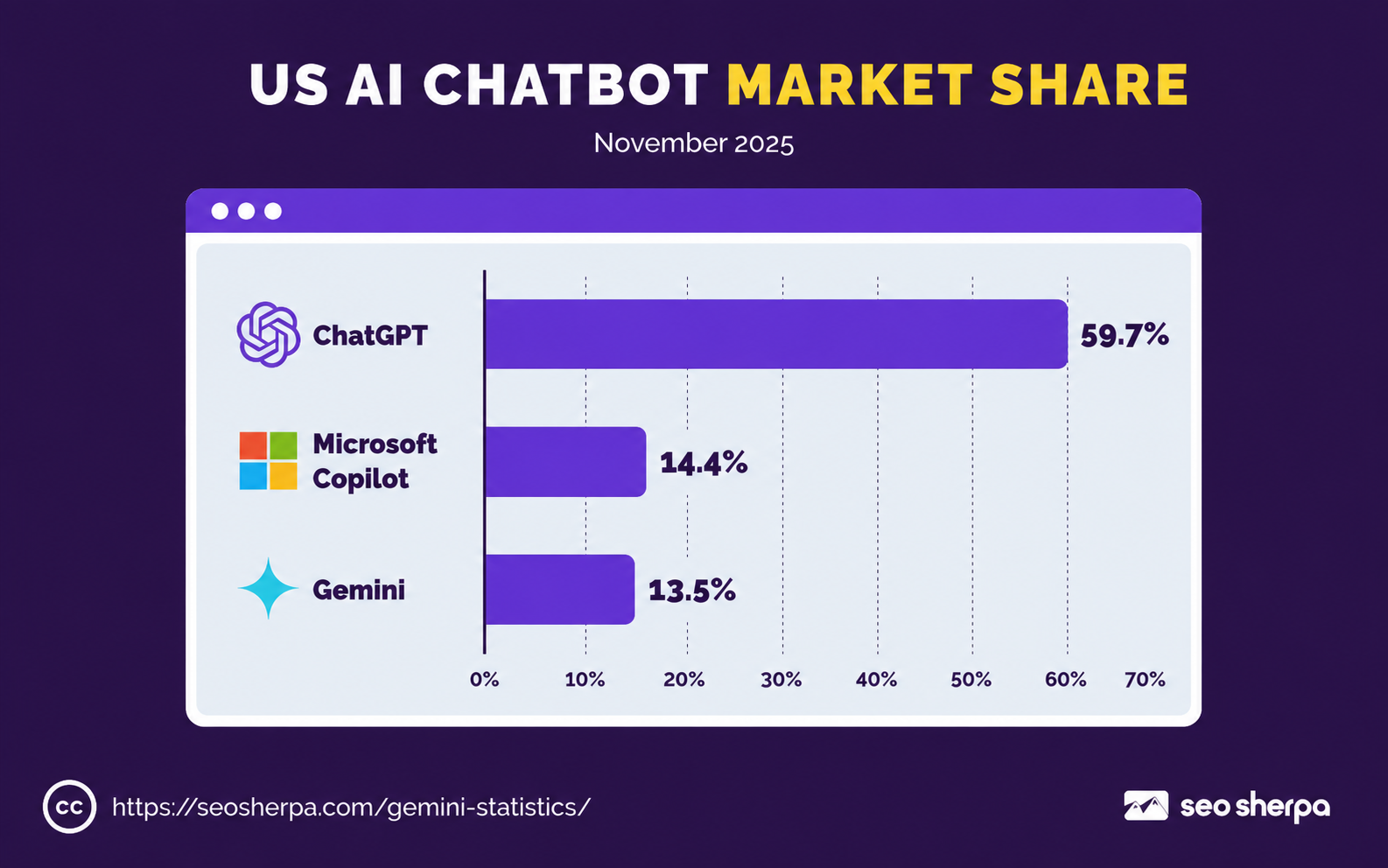
Google Gemini has rapidly closed the gap with established AI assistants, although ChatGPT remains the market leader. As of November 2025, according to data shared by Alphabet with Wells Fargo, ChatGPT holds 59.7% market share in the United States, followed by Microsoft Copilot (14.4%) and Gemini (13.5%).
Gemini’s share of the global AI chatbot market increased from 13% to around 22% in early 2026. This indicates more user interactions and an expanding presence across the Google ecosystem.
In terms of monthly active users, TechCrunch revealed Meta AI has around 1 billion users, while ChatGPT had 810 million in the latter part of 2025. As mentioned, Google Gemini currently has 900 million monthly users, which indicates it is catching up to Meta AI.
It is important to note that these figures measure different metrics, including chatbot market share and monthly active users, so they shouldn’t be compared directly.
Developer and API Growth
Google Gemini’s growth extends well beyond its chatbot and into Google developer tools. According to Quantumrun, Google’s developer ecosystem has expanded rapidly, with Gemini API processing around 85 billion requests per month as of January 2026, up 142% from 35 billion in March 2025.
Based on the same report from Quantumrun, active developers have also more than doubled year over year to 2.4 million. In total, 13 million developers have built applications using Google’s generative models, and they get full access to the same model versions that power the consumer app.
The infrastructure supporting this growth is also significant, with SQ Magazine reporting that Google’s first-party generative models now process over 16 billion tokens every minute via the direct Gemini API.
This demonstrates an increasing demand for artificial intelligence-powered applications, developer tools, workflows, and services built on the Gemini platform.
Gemini Business and Enterprise Adoption Statistics
Gemini’s momentum isn’t limited to consumers. Businesses are increasingly adopting Google AI tools to automate workflows, assist employees, and build new products and services. The latest enterprise data shows how quickly Gemini is gaining traction across Google Cloud and Google Workspace.
Enterprise Seats and Company Uptake
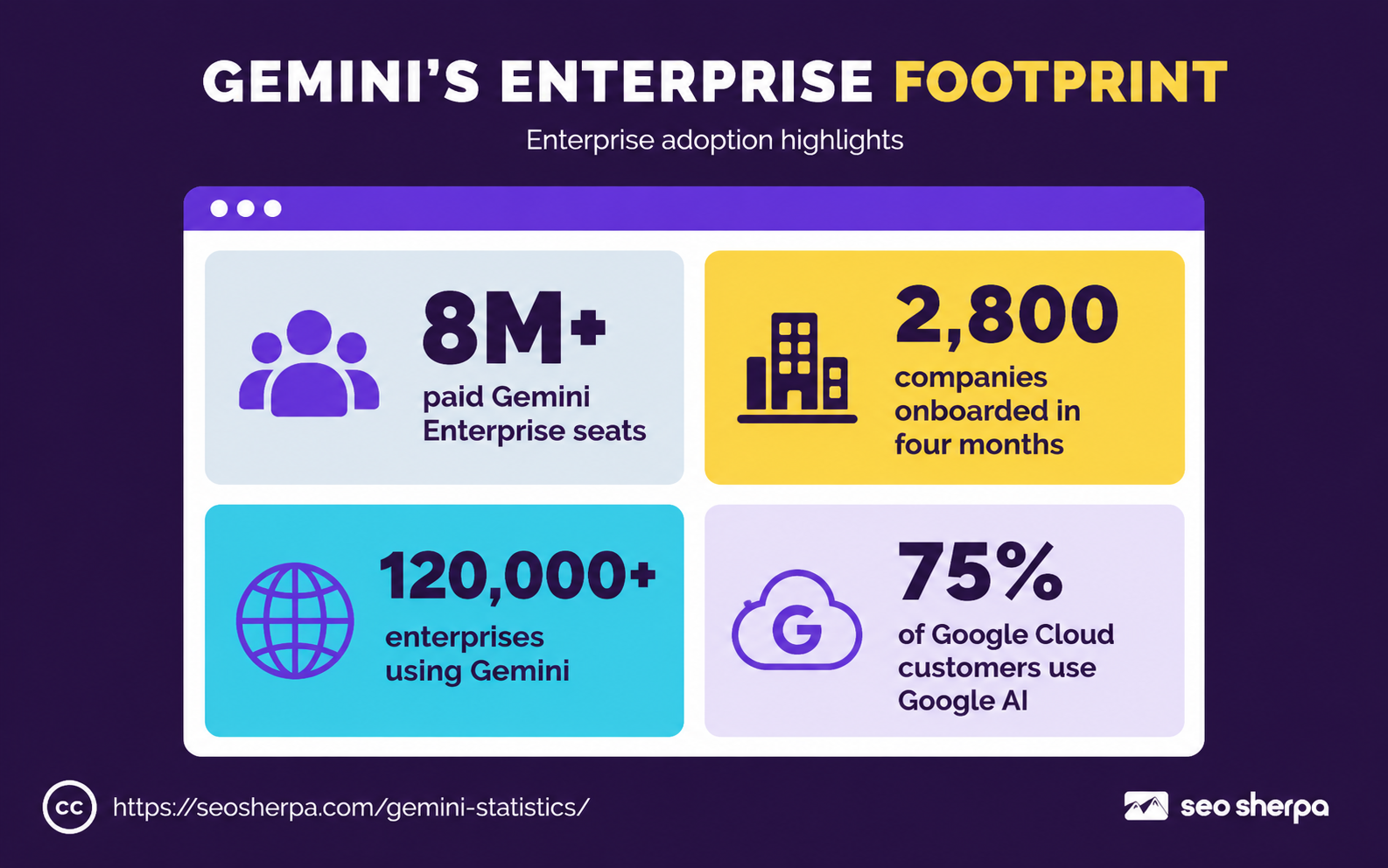
Google Gemini is seeing strong adoption among businesses worldwide. Alphabet reported in its 2025 Q4 earnings that businesses purchased more than 8 million Gemini Enterprise seats across 2,800 companies in roughly four months.
Paid adoption is climbing fast. Monthly active users rose 40% quarter over quarter in Q1 2026, and demand for paid seats keeps building as teams roll the assistant into their productivity stack.
That reach extends well beyond Google Cloud and its own productivity suite. AI Business Weekly reports that more than 120,000 enterprises now use Gemini, including 95% of the world’s 20 largest SaaS companies.
Much of that adoption comes through Gemini Enterprise, which integrates the assistant into Google Workspace apps such as Google Docs, Google Sheets, and Gmail while providing access to Google’s most capable AI models.
The same report notes that roughly three-quarters of Google Cloud customers have built Google AI capabilities into their operations.
This makes Google Cloud one of the primary channels bringing Gemini into large organizations.
Many businesses are not just experimenting with Gemini; they are paying to use it at scale. According to Business of Apps, Gemini subscriptions generated approximately $1.2 billion in 2025.
With companies continuing to renew licenses and expand access across Google Workspace, demand appears to extend well beyond the initial wave of AI enthusiasm.
Gemini and the Marketing Landscape
Google Gemini’s growth story extends beyond daily active users and market share. For marketers, the bigger shift lies in how the brand’s generative AI models are changing the way people discover information, interact with brands, and create content online.
Google’s tools are increasingly integrated into search, advertising, and other areas through product integrations that transform the customer journey in various ways. As such, visibility increasingly depends on earning a place in AI-generated responses, not simply ranking at the top of the page.
AI Search and the Zero-Click Shift
AI Overviews are quickly changing how people interact with search results. Powered by Google Gemini, the feature now reaches roughly 2 billion monthly users and appears in nearly half of all Google searches.
Google is pushing further with AI Mode, its conversational search experience. AI Mode in search lets people ask follow-up questions inside the Google app and get synthesized answers directly.
Early rollouts of AI mode in search suggest Google wants this to become the default way many queries are handled across the app.
This change is already affecting website traffic. An Ahrefs analysis of 300,000 keywords found that the click-through rate for the top organic result falls by about 58% when an AI Overview appears.
Pew Research reported a similar trend, with organic clicks dropping from 15% to 8% of visits.
However, visibility still plays an important role. Research from Seer Interactive found that pages cited in AI-generated answers receive about 35% more clicks than those that are omitted. This citation gap is likely to widen as AI Mode and AI Overviews expand.
For marketers, ranking is no longer enough. Earning citations inside AI Mode answers and AI Overviews is now just as important as a top-10 position.
Generative AI Adoption Among Marketers
What are the latest Gemini statistics for marketers? One of the most important figures to know is that, according to HubSpot, 80% of marketers now use AI in at least one part of their workflow, a sharp increase from roughly half of marketers in 2024.
Speed remains the biggest draw, with an Adobe report stating that 93% of creators say generative artificial intelligence helps them produce content faster.
AI’s role is also expanding: according to The CMO Survey, generative models now account for 15.1% of marketing activities, more than doubling year over year.
According to HubSpot, marketers save over 10 hours per week on average by using generative AI technology.
Still, the return on investment varies across industries. Ecommerce brands often use AI’s multimodal abilities to scale product descriptions, customer support, and merchandising.
B2B teams, on the other hand, use it to create AI-powered workflows, conduct research, generate leads, and plan campaigns.
The productivity gains are clear, but the commercial impact depends on how each organization integrates AI into its marketing operations.
Market Size and Consumer Reach
AI’s influence on marketing is expected to grow over the next few years, and the market size numbers make that plain.
According to Statista, global revenue from AI-powered marketing tools reached approximately $47 billion in 2025, and that market size is projected to pass $107 billion by 2028.
Consumer adoption is accelerating alongside that growth. EMARKETER estimates that 133 million Americans, or roughly 39% of the U.S. population, will use generative AI in 2026.
As AI tools become part of everyday life, marketers will need to adapt to changing search habits, content formats, and customer expectations. The opportunity is substantial, but success will depend on how effectively brands incorporate AI into their existing strategies.
What Gemini’s Growth Means for Your Marketing Strategy
Google Gemini’s rapid adoption points to a broader change in digital marketing. Brands can no longer focus solely on traditional rankings. As AI Overviews, chatbots, and LLM SEO become more common, earning citations inside AI-generated answers is increasingly important.
If you’re a digital marketer, Gemini’s popularity underscores the importance of building audiences outside Google’s search results. You can do this by investing in different marketing channels such as email, communities, video, and social media. As such, a single change to personalized search or ranking never sinks your visibility.
You also need to rethink your content strategy. Large language models favor well-structured pages with clear headings and original insights, which means you need to focus on quality and expertise.
Moreover, teams should begin tracking AI-driven traffic alongside organic search and paid campaigns to understand how users discover their content.
Teams should also track AI-driven traffic alongside organic search and paid campaigns to see how users actually find their content. Recent Gemini reports make one thing clear: the brands that show up inside Google AI answers will own the next phase of search.
As AI changes how people find and consume information, explore our search everywhere optimization services to discover how your brand can remain visible across search engines and other channels.
What Gemini’s Growth Means for Your Search Strategy
The Gemini statistics tell a clear story: Google is not treating generative AI as a side project. It is steadily embedding Gemini across Search, Workspace, Android, advertising, and the wider Google ecosystem, changing how people discover information, compare brands, and make decisions online.
For businesses, the opportunity goes beyond appearing in a Gemini response. Your brand needs to be understood as a credible entity, supported by authoritative content, consistent information, strong technical foundations, and visibility across the platforms your audience uses. Traditional SEO still matters, but it now forms part of a much broader search landscape.
The brands that adapt early will be better positioned to earn visibility across Google Search, AI-generated answers, and the recommendation systems shaping the next generation of online discovery.
Want to understand how visible your brand is across traditional and AI-powered search? Book a free discovery call with SEO Sherpa, and we’ll explore where you currently stand, where opportunities are being missed, and how a Search Everywhere strategy can help your brand stay discoverable as Gemini continues to evolve.

















Leave a Reply