

Summarize This Article With AI
 Try with ChatGPT
 Try with Claude
 Try with AI Mode

Picture this.
You’ve built a genuinely brilliant fintech product. The UX is slick, the compliance team is happy, the investors are excited. You launch. You wait.
And then… crickets.
No organic traffic. No qualified leads. No one showing up to the party you’ve been planning for months.
Here’s what happened: Your competitors figured out something you didn’t. The ones raking in qualified leads every month aren’t just running better ads or throwing more money at Google Ads. They’ve built something stickier. They’ve invested in fintech SEO, and now organic search is doing the heavy lifting for them 24 hours a day.
The problem is that most fintech companies treat search engine optimization like any other industry. They drop a few blog posts on the site, tick the content marketing box and wonder why nothing’s moving. But financial services are a completely different game. YMYL rules apply. E-E-A-T is non-negotiable. Regulatory compliance is a real constraint. And Google’s algorithm updates are scrutinizing everything with a skeptical eye.
The good news? Once you understand what fintech SEO actually requires, you can build a content and technical engine that generates compounding returns. One that leaves your paid search budget with a lot more breathing room.
This guide covers everything: the strategy, the tactics and the mistakes you genuinely cannot afford to make.
Article Summary
- Fintech SEO is a specialized discipline sitting at the intersection of financial compliance, E-E-A-T and technical optimization.
- Google classifies financial content as YMYL (Your Money Your Life), meaning the bar for trust signals and authority is significantly higher than in other industries.
- Keyword strategy must map to the full buying cycle, from educational queries to high-intent transactional terms.
- Content strategy must prioritize expert-led, compliance-friendly material that builds authority over time.
- Technical SEO, including site speed, Core Web Vitals, structured data and schema markup, is critical for both search rankings and user trust.
- Link building in fintech must prioritize credibility and relevance over volume.
- Generative engine optimization is becoming essential as AI search reshapes how people discover financial products.
What Is FinTech SEO?
FinTech SEO is the practice of optimizing financial technology websites and digital products to rank in search engines, attract qualified organic traffic, and build the trust signals required to convert visitors in a highly regulated industry.
But that definition only scratches the surface.
Financial services occupy a category that Google treats with exceptional scrutiny. Your content doesn’t just need to be accurate. It needs to demonstrate real-world expertise, editorial accountability and institutional credibility — and that’s before you even start thinking about keyword research.
Fintech companies operate across a sprawling range of verticals: digital banking, payment APIs, investment platforms, buy-now-pay-later services, crypto exchanges, trading software, DeFi, embedded finance, lending software platforms and insurance technology. Each carries its own regulatory frameworks, its own audience behavior patterns and its own competitive dynamics in search.
The global fintech market was valued at approximately $394.88 billion in 2025 and is projected to exceed $1.76 trillion by 2034.
More companies. More content. More competition. Higher stakes for every single ranking position.
Here’s the thing: SEO for fintech companies isn’t just about digital presence. It’s about building the kind of credible, authoritative presence that makes a skeptical customer trust you with their money.

Why SEO Is Critical for FinTech Companies
SEO isn’t optional for fintech. It’s the most sustainable lead channel in a space where every other option is brutally expensive.
Consider the math. Organic search CAC in financial services comes in at roughly $644, while paid media costs average around $1,202 for the same customer. For fintech SaaS startups targeting enterprise buyers, that gap widens even further. The average enterprise fintech CAC sits at $14,772.
That’s a number that makes organic content investment look like the bargain of the century.
And that’s before you factor in the long-term compounding effect. Paid search resets to zero every month. A well-optimized content library keeps working indefinitely.
High Competition in Financial Niches
The financial services SERP is one of the most punishing competitive environments in search.
You’re not just competing against other SaaS startups. You’re competing against established banks, comparison aggregators, regulatory bodies, major publishers and platforms like PensionBee, Wise and Monzo that have been building domain authority for years.
Keywords like “best business account,” “instant money transfer” or “interest calculator” carry massive search volume. But SERP competition is fierce enough to make grown marketers weep quietly into their keyword research spreadsheets.
The brands that win aren’t the ones with the biggest Google Ads spend. They’re the ones with the most authoritative, comprehensive and consistently updated content ecosystems.
Trust and Authority as Ranking Factors
Google’s E-E-A-T guidelines cover Experience, Expertise, Authoritativeness and Trustworthiness. They carry particular weight in financial content because what’s at stake is real money and real financial decisions.
For fintech companies, E-E-A-T isn’t just a ranking consideration. It’s a conversion consideration too.
A prospective customer who lands on your site and can’t verify who wrote the content, what their credentials are, or whether the claims are backed by reliable sources will leave. Customer trust issues directly translate into lost organic traffic and lower conversion rates. And Google notices that behavior every single time.
Key Challenges in FinTech SEO
Several factors make fintech SEO genuinely harder than SEO in most other sectors. Understanding them up front saves a significant amount of wasted effort.
Regulatory and Compliance Constraints
Regulated fintech companies operate under a dense web of financial regulation. KYC, AML, FCA guidelines, SEC rules, MAS regulations and the growing landscape around smart contracts, open banking APIs and DeFi all shape what you can and cannot say in published content.
This creates real tension in digital marketing.
Bold, persuasive copy converts well. But in financial services, overclaiming, misleading language, or unsubstantiated performance promises don’t just hurt conversion rates. They create regulatory trouble and genuine legal liability.
Every piece of content touching investment outcomes, lending terms or financial returns needs compliance sign-off. The regulatory complexities here are real. Build the review process into your content creation workflow from the start, not as an afterthought.
YMYL and Google Quality Guidelines
Your Money Your Life is Google’s classification for content that can materially impact a reader’s financial stability, health or safety. Fintech content sits squarely in this category.
What does that mean in practice? Google applies its highest quality standards to YMYL pages. Thin content, anonymous authorship, missing citations and low E-E-A-T signals are penalized more harshly here than in almost any other category. A lifestyle blog can get away with a 500-word opinion piece. A regulated fintech brand publishing search-optimized content cannot.
Pro Tip: Every YMYL page should carry a clearly identified author with verifiable credentials, a published and last-updated date, citations linked to authoritative primary sources and any relevant financial disclaimers. These aren’t optional extras. They’re table stakes for appearing in competitive financial SERPs.
Building Trust in a Skeptical Market
The fintech space has had its share of high-profile collapses, data breaches and compliance failures. Customers know this. They arrive skeptical. They need more than a slick web design and a friendly chatbot to feel comfortable handing over their financial details.
Trust signals matter enormously here: verified third-party reviews on platforms like Trustpilot or G2, industry accreditations, press coverage from credible financial media and transparent communication about data handling. These aren’t just brand-building exercises. They directly influence how Google evaluates your site’s authority and how your audience decides whether to trust you at all.
Core FinTech SEO Strategies
The following sections break down the key pillars of an effective fintech SEO strategy. Each one is interconnected. Skip any of them, and you’ll hit a ceiling that limits how far the others can take you.
Keyword Strategy for FinTech
Fintech keyword research isn’t just about finding terms with high volume. It’s about mapping search intent to the buyer journey in a sector where the decision-making process can take weeks or months.
Start with tools like Google Keyword Planner, Ahrefs or Semrush to build a keyword map across your full product or service offering. That means going well beyond brand-obvious terms. Get into the specifics: the problem the user is trying to solve, the alternatives they’re comparing and the questions they’re asking before they’re ready to buy. Your keyword mapping should reflect every stage of your GTM motion.
Transactional vs Informational Keywords
Both types of keywords have a role to play, and you need both working together.
Transactional keywords are high-intent queries where the user is close to a decision: “best business payment app for startups,” “open a digital business account,” “crypto exchange low fees.” Highly competitive. Strong converters when you earn the ranking.
Informational keywords reflect the research phase: “how does open banking work,” “what is embedded finance,” “smart contracts explained,” “DeFi statistics 2026.” Less competitive. The perfect opportunity to build trust and authority before the user is anywhere near ready to buy.
Now, this is where it gets interesting.
A user who discovers your explainer on open banking APIs, trusts the source and clicks through to your product page is a far warmer lead than someone arriving cold from a paid ad. Connect the two content types deliberately, and your keyword strategy starts to build something that compounds.
Long-Tail Keywords for Trust Building
Long-tail keywords are where fintech SEO can really accelerate.
Terms like “how to choose a lending software platform for international payroll” or “is my money safe in a digital bank UK” have lower search volume but dramatically higher conversion intent. They’re also exactly the kinds of questions that AI tools like ChatGPT and Perplexity pull from when generating answers about financial products.
Side Note: LLM keyword research is an increasingly important layer for fintech brands. Frame informational content around how an AI assistant would answer the question, not just how a search engine would index it. Clear, authoritative, direct answers at the top of the page earn citations from AI search systems. Answers buried in paragraph four do not.
Content Strategy for FinTech SEO
Content is the engine of fintech SEO.
But not any content. The kind that earns trust, demonstrates genuine expertise and covers topics with the depth that Google and AI systems both demand from financial brands.
Creating E-E-A-T Content
E-E-A-T content creation in fintech requires real humans with real credentials. Articles should be written or reviewed by qualified financial professionals, cited with sources from authoritative institutions and structured to show the reasoning behind every claim.
In practice, this looks like:
- Bylines from named authors with demonstrable expertise in financial services
- Expert quotes from third-party practitioners or regulators
- Citations linked to original sources — government regulatory bodies, academic research, established financial data providers, not blog aggregators
- Consistent updating to reflect regulatory changes and market shifts
The days of publishing AI-generated thought leadership and calling it a content strategy are over. In YMYL content, Google’s quality raters actively assess whether the author would be trusted in real life to give the advice they’re giving.
Would a stranger trust this person with their pension? That’s the bar.
Topic Clusters and Content Themes for Financial Authority
Topic cluster architecture is how fintech brands build the kind of deep topical authority that commands trust in competitive SERPs.
The principle: Build a comprehensive pillar page on a broad financial topic — say, “Digital Business Banking”, then create a cluster of supporting articles drilling into every related content theme (business account fees, international transfer limits, multi-currency accounts, corporate card features, and so on).
Each supporting piece links back to the pillar. The pillar links out to the cluster. Google reads this interlinked architecture as genuine topical depth, not keyword targeting.
This is the same approach we use at SEO Sherpa across our content marketing engagements, and it works as effectively in fintech as in any other high-competition vertical.
Compliance-Friendly Content Creation
Writing compliant content for regulated fintech doesn’t mean writing boring content. It means being precise where precision is required and creative everywhere else.
Clear rules to follow:
- Avoid absolute performance claims (“guarantee,” “always,” “100% safe”) unless they’re legally defensible.
- Include appropriate financial disclaimers on any content discussing investment, lending or insurance products.
- Distinguish clearly between general information and regulated financial advice.
- Route all content touching on regulated products through legal and compliance review before publication.
This process adds time. Build it into your editorial calendar from the start. A piece pulled post-publication for compliance reasons creates far more damage than a slightly slower production cycle ever would.
On-Page Optimization for Financial Websites
On-page optimization fundamentals apply to fintech just as they do anywhere, but the YMYL context makes precision especially important.
Every key page needs a well-optimized title tag that includes the primary keyword and communicates trustworthiness. Meta optimizations — titles, meta descriptions and canonical tags should be treated as marketing copy, not admin tasks. H1 through H3 heading hierarchy should mirror the logical structure of the content.
Internal linking deserves particular attention in fintech. Users researching financial products often need to navigate between related topics: understanding a product before evaluating a service, or reading regulatory context before trusting a claim. Well-placed internal links serve both user experience optimization and search engine crawlers simultaneously.
And then there’s structured data.
This is where many fintech brands leave significant ranking value on the table. FAQ schema on educational pages helps capture rich results. Article schema with author information reinforces E-E-A-T. Review schema on testimonial pages can surface star ratings directly in the SERP. Schema markup done properly turns your listing into a more compelling, trust-signaling result before the user has even clicked through.
Technical SEO for FinTech
Technical SEO is foundational for fintech, and not just for performance reasons.
Technical health directly affects user trust. And in financial services, trust is the product.
A slow site, a crawl error on a key product page, or indexation issues affecting your most important landing pages don’t just hurt search rankings. They actively signal to potential customers that your platform might not be reliable enough to trust with their money. A full technical audit should be the starting point of any serious fintech SEO engagement.
Site Speed and Core Web Vitals
Core Web Vitals are Google’s user experience metrics: Largest Contentful Paint, Interaction to Next Paint and Cumulative Layout Shift. Fintech sites often struggle with all three, thanks to heavy compliance disclaimers, complex UI components and third-party scripts for KYC verification, fraud monitoring and live chat.
Use Google PageSpeed Insights or a dedicated technical SEO tool to audit page speed. Prioritize technical optimization on your highest-value pages first: product landing pages, account signup flows and any pages driving significant organic website traffic.
Target LCP under 2.5 seconds, INP under 200 milliseconds and CLS below 0.1.
These aren’t aspirational benchmarks. They’re the floor for a site that wants to compete in financial SERPs.
HTTPS, Security and Trust Signals
HTTPS is non-negotiable for any website in 2026. For fintech, it’s not even a discussion. It’s a prerequisite.
But security signals go beyond the padlock in the browser bar. Display trust badges from relevant regulatory bodies, payment certification logos (PCI DSS, for example) and third-party security audit results where applicable. These are conversion rate optimizers as much as they are SEO signals.
Pro Tip: Check that HTTPS is implemented consistently across every subdomain and that it redirects properly from HTTP. Mixed content warnings, where a secure page loads insecure resources, undermine trust signals even when the main site appears secure. It’s one of the most common technical issues we find in SEO audits for financial services clients.
Structured Data for Financial Content
Schema markup helps search engines understand the structure and purpose of your content. It also helps AI search systems extract clean answers from your pages for inclusion in generative results.
For fintech, the highest-impact schema types are:
- Article schema with author, datePublished and dateModified to reinforce E-E-A-T
- Organization schema to establish brand identity and contact information in the knowledge graph
- Review schema to surface ratings from verified customer testimonials in SERP listings
Implement structured data carefully. Google penalizes spammy or misleading schema markup, and in YMYL categories, it pays particularly close attention to accuracy and relevance.
Site Structure and Mobile-First Solutions
Site structure determines how effectively search engine crawlers can discover, interpret and index your content.
For fintech companies with complex product hierarchies — multiple financial products, regional variants, compliance-specific landing pages — a flat, logical site structure prevents indexation issues and ensures link equity flows to your most important pages.
Mobile-first solutions are non-negotiable. Google indexes the mobile version of your site first, and the majority of financial product research now happens on smartphones. A desktop-only experience isn’t just a usability problem. It’s a significant ranking liability.
Link Building in FinTech
Backlink strategy is one of the highest-leverage and most difficult aspects of fintech SEO. Financial services attract more spam and low-quality link schemes than almost any other industry, which is precisely why Google is so selective about which links it actually values here.
One link from a credible financial publication delivers more authority than a hundred links from generic business directories.
Quality, relevance and editorial credibility are the only metrics that matter in your off-page optimization strategy.
Digital PR for Financial Brands
Digital PR is the most effective link-building approach available to fintech companies. The strategy: Create genuinely newsworthy content — original market research, proprietary data studies, expert analysis on regulatory changes — and pitch it to financial journalists who cover fintech, banking and investment.
Outlets like the Financial Times, Bloomberg, TechCrunch’s fintech coverage, Sifted and national business press all carry strong domain authority and real editorial credibility. A mention or link from any of these moves the needle in ways that most other off-page optimization tactics simply cannot replicate.
This is also the link-building approach that compounds best over time. Financial journalists build source relationships. A brand that consistently delivers valuable data and expert commentary gets cited repeatedly. Each citation makes the next one slightly easier to earn.

Earning Links from Trusted Sources
Beyond media coverage, fintech brands should actively pursue links from:
- Industry associations and regulatory bodies that list licensed or accredited members
- Academic and policy research institutions citing original market data you’ve published
- Partner integrations and technology ecosystems (many fintech platforms cross-link within partner networks)
- Finance-focused publications and communities: Finextra, The Finanser, PYMNTS and sector-specific blogs
Avoid link farms, guest post networks, paid link schemes and anything that prioritizes volume over relevance. Google’s financial sector quality systems know the difference. And they’re not forgiving about it.
FinTech SEO in Action: The Al Ansari Exchange Case Study
Numbers on a page are one thing. Seeing what fintech SEO actually delivers for a major financial services brand is something else entirely.
Al Ansari Exchange is the UAE’s largest money exchange company, with the biggest branch network in the region. They came to SEO Sherpa with a clear mandate: grow organic website traffic, improve search rankings and drive app downloads. Ambitious targets in one of the most competitive financial services markets in the world.
This is where SEO for fintech companies gets real.
Our approach was built around three interconnected pillars: technical optimization, strategic content creation and authority-building link building.
On the technical side, we identified and resolved critical issues with the internal linking structure and tackled Core Web Vitals performance. Both were limiting how effectively search engine crawlers could index and prioritize the site’s most important pages.
On content, we went beyond brand keywords. Because Al Ansari already ranked well for its branded terms, we focused on high-volume generic and use-case keywords, including geo-targeted content like “send money to India,” and optimized pages in both English and Arabic for full regional reach. We also surfaced customer pain points from sales and service conversations — competitor fee transparency was a major one — and built content that addressed them directly. The result was a 35% increase in traffic and a 22% increase in registrations from informational content alone.
On link building, we diversified the backlink profile, drove authority to the highest-potential pages and earned links from high-authority referring domains across the financial sector.
The results within six months:
- 110% increase in organic sessions from 238,000 to 472,000
- 209% increase in app downloads from 11,000 to 35,000
- 40% increase in top 3 ranking keywords from 915 to 1,237
- 57,216% ROI on SEO investment within the campaign period
This campaign won SEO Sherpa the “Best Use of Search, Finance (SEO), Large Agency” award at the Global Search Awards 2023, alongside “Best MENA SEO Campaign” and “Best Global Large SEO Agency.” The highest recognition available in the industry.
The Al Ansari results demonstrate something important about fintech SEO: It’s not a brand awareness exercise. It’s a revenue engine. When the strategy is right, search rankings translate directly into qualified traffic, app installs and measurable ROI.
SEO Sherpa has delivered this same caliber of results for financial services institutions including Citibank and HSBC — brands whose trust standards are among the highest in the world, and whose digital marketing requirements demand exactly the depth of expertise that YMYL search demands.
Programmatic SEO for FinTech
Programmatic SEO represents one of the biggest untapped opportunities for fintech companies operating at scale.
The concept is straightforward. Instead of manually creating individual pages for every product variant, location or use case, you build a templated system that generates hundreds or thousands of search-optimized landing pages from a structured data source.
For fintech, the applications are significant.
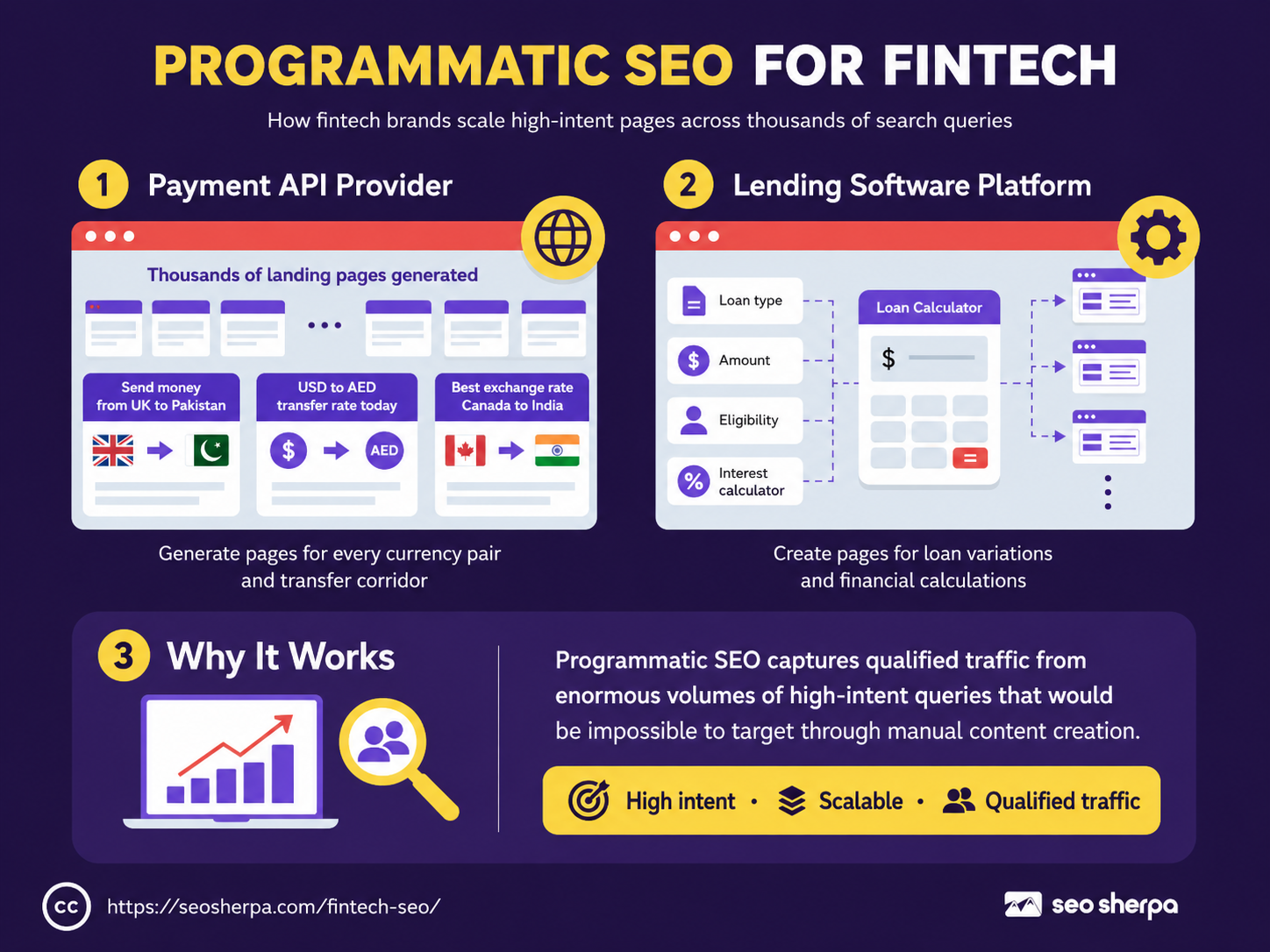
A payment API provider can generate individual pages for every currency pair and transfer corridor: “send money from UK to Pakistan,” “USD to AED transfer rate today,” “best exchange rate Canada to India.”
A lending software platform can create pages for every loan type, amount and eligibility variation. An interest calculator tool can power an entire hub of long-tail keyword pages targeting specific financial calculations.
Done correctly, programmatic SEO captures qualified traffic from enormous volumes of high-intent queries that would be impossible to target through manual content creation.
Done badly (with thin, duplicative content that provides no real value), it creates indexation issues and potential quality penalties.
In fintech, the guardrails are tighter than in most sectors. Every template must produce content that meets YMYL standards, data must be accurate and current, and compliance language must be applied consistently across every generated page.
Get this right, and it becomes one of the most scalable sources of organic website traffic available to a fintech brand. Get it wrong, and you’ll be cleaning up a mess for months.
Local SEO for FinTech
Local SEO is more relevant to fintech than most brands realize — particularly for companies with physical touchpoints or regional product offerings.
For fintech brands with branch networks, physical collection points or in-person onboarding (as with Al Ansari Exchange and its hundreds of UAE branches), Google Maps listings are a significant discovery channel. Optimizing Google Business Profile, maintaining consistent NAP data across all locations and earning local reviews all contribute to visibility in geo-specific searches.
For digital-first fintech products with a regional focus, location-specific landing pages with a locally relevant keyword strategy can capture high-intent searches that generic national pages miss entirely.
The Middle East, Southeast Asia and African markets deserve particular attention here. Mobile-first digital banking adoption is accelerating rapidly in these regions, local search behavior differs from Western markets, and competition for geo-specific fintech keywords is often significantly lower than in the US and UK. That’s a genuine opportunity for fintech brands already operating in these markets.

International SEO for FinTech
FinTech is inherently global but regulated locally. That combination creates both real opportunity and real complexity.
For fintech brands operating across multiple markets, international SEO is essential. Hreflang tags tell Google which version of a page to serve in which country or language. Without them, you risk serving UK-regulated content to US users or English content to French-speaking audiences. Both outcomes harm user experience optimization and can create regulatory trouble.
Regulatory language matters enormously here, too. A money transfer service operating in both the UAE and the UK cannot use identical regulatory disclaimers and product language for both markets. The regulatory frameworks differ. Content needs to reflect that, and URL structure or subdomain architecture must signal market targeting clearly to Google.
For crypto exchanges, DeFi platforms and trading software providers in particular, this international complexity is acute. Securities law, crypto regulation and AML requirements vary dramatically by jurisdiction. International SEO architecture and content strategy need to account for this from day one — not as a retrofit six months after launch.

Generative Engine Optimization for FinTech
Generative engine optimization (GEO) is the emerging practice of optimizing content for visibility in AI-generated search results. For fintech brands, it’s becoming as important as traditional SEO.
Here’s why this matters right now.
When someone asks ChatGPT, “What’s the best payment API for e-commerce startups?” or queries Perplexity, “How do I compare neobank accounts?” these AI tools generate synthesized answers drawn from web content they’ve indexed and evaluated for authority. The brands appearing in those answers aren’t there by accident. They’ve structured their content to be extractable, authoritative and clearly relevant to the query.
Here’s what Search Everywhere Optimization looks like for fintech in practice:
- Write clear, BLUF-structured answers at the top of every section, so AI tools can extract them cleanly.
- Include explicit entity information — company names, product names, regulatory certifications — so LLMs can correctly attribute claims.
- Build topical depth and breadth across your content ecosystem, so AI systems recognize you as a genuine authority on financial topics.
- Earn citations from the kinds of authoritative financial sources that AI training data draws from: major financial media, regulatory publications and academic research.
AI search referrals to financial services websites are growing significantly. The fintech brands that invest in GEO now will hold a meaningful visibility advantage as this channel matures.
Side Note: Voice search is worth building into your GEO strategy, too. As smart speakers and voice assistants become more common tools for quick financial queries — exchange rates, account balances, transfer options — fintech content structured around conversational, question-and-answer formats performs better in voice results than dense, long-form prose.
Measuring FinTech SEO Success
SEO performance in fintech needs to be tracked against metrics that connect to business outcomes. Not vanity numbers.
Google Analytics (GA4) is your core measurement platform. Use it alongside Search Console and your preferred rank tracker to build a complete picture across all your key performance indicators.
Organic website traffic by segment. Not just total sessions. Traffic to product pages, educational content and conversion pages separately. Growth in the right segments matters far more than aggregate traffic growth.
Keyword rankings across your full target set. Pay particular attention to high-intent terms at the bottom of the funnel. Featured snippet ownership for key informational queries is worth tracking, too, given its growing impact on AI search visibility.
Organic conversion rate by page type. Fintech conversion events might include account sign-ups, demo requests, content upgrade downloads or contact form submissions. User behavior analysis, through tools like GA4, Hotjar or Microsoft Clarity, tells you which organic pages are driving conversions and where friction is costing you qualified leads.
Share of Search. It refers to your brand’s share of total search volume in your category versus competitors. This is a leading indicator of brand authority and a useful competitive proxy that paid metrics don’t capture.
Customer acquisition cost from organic versus paid media costs. Organic CAC in financial services runs roughly half the cost of paid acquisition. Track this comparison regularly and use it to make the internal business case for sustained SEO investment.
Common FinTech SEO Mistakes to Avoid
The mistakes that hold most fintech companies back aren’t obscure. They’re the same errors repeated across the industry, over and over again.
Publishing Thin Content at Scale
Financial services SERPs are drowning in 800-word explainers that say nothing new. Google’s quality systems evaluate fintech content against the standard of expert human judgment. Thin, generic content fails that test every time, and YMYL penalties can undo months of work in one algorithm update.
Ignoring E-E-A-T Signals
Anonymous content on a financial website is a red flag. Every piece touching regulated topics needs a named, credentialed author and appropriate sourcing.
Treating Compliance as an Afterthought
Content pulled or edited post-publication for compliance reasons creates messy URL histories, inconsistent messaging, and potential regulatory trouble. Build the review process before you publish, not after.
Skipping the Technical Audit
A beautiful fintech site with slow page speed, broken site structure and missing schema markup is leaving significant ranking potential on the table. Technical health is the foundation on which everything else sits.
Letting Indexation Issues Slide
Fintech sites — especially those with complex product hierarchies, international variants and programmatic SEO at scale — often accumulate significant indexation problems over time. Regular SEO audits are essential.
Chasing Competitor Keywords Without Matching Their Authority
New fintech brands often target the same high-volume terms as established players without the domain authority to compete for them. Start with longer-tail terms. Build authority systematically. Then go after the big keywords.
Over-Relying on Paid Search
Google Ads and paid media costs in financial services are among the highest of any industry. Brands that use paid channels as their primary digital marketing strategy without building organic infrastructure are permanently exposed to CPC inflation and algorithm changes. SEO is the hedge.
Overlooking Search Everywhere Optimization™
In 2026, fintech SEO isn’t just about Google. Potential customers are asking AI tools which payment processor to use, getting neobank recommendations from Perplexity and finding comparison content on LinkedIn. A Google-only strategy misses a growing portion of the discovery journey.
The Future of FinTech SEO
Three converging forces are shaping the direction of fintech SEO over the next three years: the rise of AI search, accelerating regulatory change and the growing sophistication of financial consumers.
AI search is changing how people research financial products. Instead of clicking through comparison sites, users increasingly ask conversational questions and receive synthesized answers. The fintech brands structuring content for generative engine optimization now will hold a compounding visibility advantage as this shift accelerates.
Regulatory change creates ongoing content opportunities. Open banking API legislation, crypto regulation, ESG reporting requirements and data privacy law all generate keyword demand for brands with the expertise to cover them credibly and compliantly. Each regulatory development is a ranking opportunity for fintech brands that move quickly.
Voice search is growing as a discovery channel for quick financial queries: rates, conversions and account options. Fintech content structured around natural, conversational question-and-answer formats will perform better in voice results than traditional dense long-form content.
Enterprise SEO — the systematic management of large-scale fintech sites with thousands of pages, multiple international variants and complex technical architectures — is becoming a specialization in its own right. The fintech brands investing in enterprise-grade technical optimization now will be significantly harder to displace in search rankings as competition intensifies.
The brands that win in fintech SEO over the next three years won’t be the ones chasing algorithm updates. They’ll be the ones building genuine authority in their niche, consistently, over time.
Do You Need a FinTech SEO Agency?
Here’s a question worth asking honestly: Is fintech SEO something your in-house team can execute at the level the market demands?
The answer depends on your resources, your market position, and your competitive set. But the reality is that most fintech companies — from SaaS startups to established digital banking platforms — are competing against brands with dedicated SEO investment, specialist B2B marketing agency support, and years of domain authority already banked.
A specialist digital marketing agency that understands YMYL compliance, financial services E-E-A-T requirements, technical SEO at scale, and the specific competitive dynamics of fintech SERPs isn’t a luxury. For brands serious about organic growth, it’s a structural advantage.
When evaluating an SEO agency partner for fintech, look for:
- Demonstrable case studies in financial services, not just general SEO
- A track record with regulated fintech content and compliance-aware content creation
- Technical SEO capabilities that go beyond surface-level audits
- Transparent reporting tied to business outcomes, not just search rankings
- Recognition from credible industry bodies that validates the quality of their work
SEO Sherpa has delivered award-winning results for financial services clients across the MENA region and globally, including the Al Ansari Exchange campaign that achieved 57,216% ROI and earned recognition as the world’s best finance SEO campaign. Our client roster includes Citibank, HSBC and leading regional fintech brands across digital payments, money exchange and financial technology.
The fintech companies dominating organic search right now didn’t get there overnight. They committed to a strategy, executed it consistently, and built something that paid compounding dividends month after month.
If you’re ready to build that kind of organic growth engine for your fintech brand, the best next step is a conversation with people who’ve done it before — and won multiple global awards for it.
Book a free discovery call with SEO Sherpa and let’s map out what a fintech SEO strategy looks like for your specific market, product and competitive position.






















Leave a Reply