

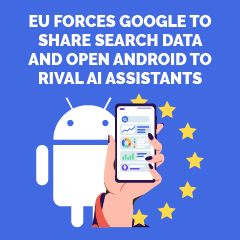
The European Commission has finalized measures requiring Google to share certain anonymized search data with eligible competitors and give rival AI assistants greater access to Android.
The rules are designed to prevent Google from using control over Search and Android to give its own AI products an unbeatable head start.
Or, phrased less politely: the EU has looked at Google owning the operating system, search engine, browser, app store, assistant, advertising platform, and AI model and asked whether anyone else was planning to receive a turn.
The measures form part of the Digital Markets Act and are expected to take full effect in January 2027.
Article Summary
- The European Commission has issued two binding measures under the Digital Markets Act.
- Google must share anonymized search data with qualifying rival search engines and AI chatbots.
- Rival AI services must receive greater interoperability with Android.
- Competing assistants may gain access to functions such as voice activation and background execution.
- The requirements are due to take full effect from January 2027.
- Google argues that the measures could create privacy and security risks.
Google Must Share Search Data With Eligible Rivals
The European Commission’s first measure concerns access to Google Search data.
Google will be required to provide eligible rival search engines and qualifying AI chatbots with anonymized data intended to help them improve their own search services. The Commission says the aim is to create fairer conditions for companies competing with a platform that has accumulated search behavior data over decades.
This data is extraordinarily valuable.
Search queries reveal how people describe problems, refine questions, respond to trends, and move through information journeys. Large-scale interaction data also helps search engines evaluate result quality and improve ranking systems.
A new search company may have an excellent model but lack the years of behavioral feedback available to Google.
Without comparable data, it is trying to build a competitive search product while wearing noise-canceling headphones and a blindfold.
The EU’s position is that Google’s gatekeeper status means certain data should be made accessible under regulated conditions rather than remaining an unrepeatable competitive advantage.

AI Chatbots Are Included in the Search Rules
The measure is not limited to conventional search engines.
AI chatbots with search functionality may also qualify for access, recognizing that the competitive market now includes answer engines and generative assistants rather than only Google-style results pages.
That is an important regulatory acknowledgment.
The EU is effectively treating AI chatbots as part of the search market, not as a completely separate category of software.
This reflects how users already behave. People may use an AI assistant to conduct research, compare products, find current information, or answer questions that would previously have been handled through a search engine.
Giving rival AI systems access to search data could help them improve freshness, relevance, query understanding, and result evaluation.
It could also make the AI search market significantly more competitive if smaller providers gain access to signals they could never collect at Google’s scale.
Android Must Open Up to Rival AI Assistants
The second measure requires Google to provide greater interoperability for third-party AI services on Android.
According to the Commission, competing assistants should be able to access functions necessary to operate more effectively, including forms of voice activation and background task execution.
This addresses a familiar platform problem.
A rival assistant may be available as an app, but Google controls the operating system and can integrate Gemini more deeply into core Android functions.
If Gemini can be activated seamlessly, interact with system features, and carry out actions that a competing assistant cannot, users are far more likely to choose the default.
Not necessarily because Gemini is better, but because nobody wants to open four settings menus and perform a minor software engineering project simply to ask another assistant about the weather.
The EU wants rival AI providers to compete on capability rather than being limited by their position outside Google’s ecosystem.
Google Says the Rules Create Risks
Google has opposed the measures and raised concerns about privacy, security, and the potential exposure of sensitive search information.
The company argues that sharing data or granting deeper system access to third parties could introduce risks for users.
Those concerns are not imaginary.
Search data can be highly sensitive, even when anonymized. Android integrations can involve permissions, personal information, microphone access, and system-level actions.
The challenge for the Commission will be ensuring that competition requirements do not create new security vulnerabilities or allow supposedly anonymous data to be reidentified.
This is where regulation becomes less satisfying than the headline.
“Google must share” sounds wonderfully simple. The actual implementation requires detailed standards, eligibility checks, auditing, safeguards, and ongoing arguments between lawyers who will all use the phrase “proportionate measure” several hundred times.
The Rules Could Reshape AI Competition
If implemented effectively, the measures could reduce two of Google’s biggest structural advantages.
The first is data. Google has decades of query and interaction information that can improve search quality.
The second is distribution. Android gives Google a direct path to billions of devices and allows its services to operate as defaults.
Competitors may now gain greater access to both.
That does not guarantee another provider will overtake Google. Data access is not the same as product quality, and Android interoperability does not force users to switch assistants.
But it could make meaningful competition possible.
The AI search race may then be influenced less by who owns the operating system and more by who provides the most useful experience.
A novel concept, apparently requiring legislation.
What This Means for Search Everywhere Optimization™
The immediate implication is that search discovery could become even more fragmented.
If rival AI assistants improve through shared data and gain deeper access to Android, more users may conduct searches and complete tasks without entering Google’s traditional interface.
Brands will need to be visible to multiple systems, each with different citation patterns, source preferences, and integrations.
This makes platform-neutral authority increasingly important.
A brand should not depend entirely on one Google ranking or one specific AI citation. It needs a consistent entity, accessible content, clear product or service information, trusted third-party references, and a presence across the channels AI systems use to verify recommendations.
The businesses that benefit will be those creating a BrandPRINT™ strong enough to survive whichever assistant the user chooses.
Search Everywhere Optimization™ is ultimately preparation for a world where Google remains powerful, but no longer controls every doorway into discovery.
Prepare for a More Competitive Search Ecosystem
The EU’s measures could give rival search engines and AI assistants access to resources that have historically reinforced Google’s dominance.
The results will depend on how the rules are implemented and whether competitors can turn that access into products people actually prefer.
For brands, the safest strategy is not to predict one winner. It is to build authority and visibility that travel across platforms.
SEO Sherpa helps brands prepare for fragmented discovery across Google, AI assistants, social search, and emerging platforms. Book a free discovery call to explore how we can make your brand visible wherever the next generation of search happens.






















Leave a Reply