
Summarize This Article With AI
 Try with ChatGPT
 Try with Claude
 Try with AI Mode
Picture this.
Instead of opening fifteen tabs to compare prices, read reviews, and debate whether you really need another pair of “performance” running shoes (you do not), you simply tell an AI agent what you want.
Budget.
Brand preference.
Shoe size that somehow varies depending on the manufacturer.
A few seconds later it returns with options, comparisons, and maybe even a completed checkout.
No scrolling.
No decision fatigue.
No suspiciously persuasive “limited time offer” banners.
Just the result.
That’s the future companies like Perplexity AI are racing toward: AI agents that browse, research, compare, and act on your behalf across the internet.
Convenient? Absolutely.
Uncontroversial? Not even slightly.
Because when an AI starts logging into platforms and interacting with accounts like a human would, things get complicated fast.
Which brings us to the latest development in the rapidly escalating tension between AI companies and the platforms that host most of the web’s commerce
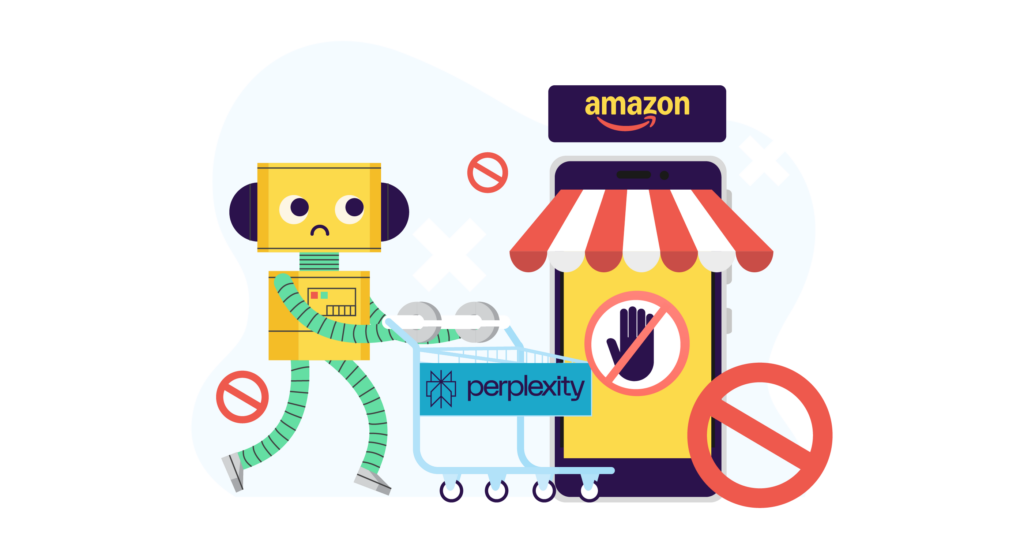
Last year, we reported that Amazon had told Perplexity to shut down its autonomous shopping agent. Since then, a federal court has ordered Perplexity to stop using a browser-based AI shopping agent to access password-protected Amazon accounts—and to delete the data it collected in the process.
At first glance, it might sound like a technical legal dispute.
It’s not.
It’s an early signal of a much larger fight over who controls the next era of online discovery and commerce.
And if you work in search, marketing, or digital strategy, you should be paying very close attention.
Article Summary
- A federal court has ordered Perplexity AI to stop using a browser agent to access password-protected Amazon accounts and delete the data it collected.
- The ruling highlights a growing tension between websites and AI agents that browse, scrape, and execute tasks on behalf of users.
- If courts begin restricting how AI systems access content and services, the entire AI search ecosystem may need to rethink how it gathers information.
- For marketers, the message is clear: visibility in AI search depends not only on your content but on where AI systems are allowed to access it.
Why Amazon Drew A Hard Line
For decades, Amazon has worked to control the entire customer journey.
Discovery.
Comparison.
Purchase.
Fulfillment.
The platform doesn’t just want to host the marketplace.
It wants to own the experience.
So the idea of an external AI agent logging into accounts, gathering information, and potentially making purchasing decisions inside that ecosystem?
That was never going to fly.
According to the court ruling, the concern centers around automated browser agents accessing password-protected areas of the platform and collecting data tied to user accounts.
Which is where things shift from “interesting AI experiment” to “legal red flag.”
Because once an AI system starts acting inside logged-in environments, the lines blur quickly.
Is the AI acting as the user?
Or as an independent system harvesting data?
Who owns the resulting insights?
And who ultimately controls the customer relationship?
In Amazon’s world, the answer to that last question is non-negotiable.
Amazon does.

The Bigger Battle Over How AI Accesses The Web
The Perplexity ruling is just one moment in what is quickly becoming a much larger industry conflict.
Because the next generation of AI systems isn’t just designed to retrieve information.
They’re designed to execute tasks.
Shopping.
Booking travel.
Managing subscriptions.
Comparing services.
To do that effectively, AI agents need access to environments far beyond publicly indexed web pages.
They need:
- Account-level access
- Real-time pricing and inventory
- Interactive services
- Transaction systems
In short, they need the ability to act across the web as if they were the user themselves.
But most websites—and their terms of service—were never built with autonomous AI agents in mind.
Which means courts and regulators are now stepping in to define the rules.
And the outcome could reshape how AI systems access information across the internet.
What This Means For The Future Of Search
For years, the search industry revolved around a relatively simple game.
Rank higher.
Get the click.
Win the traffic.
But AI search is rewriting the rules.
Platforms like Perplexity AI, AI assistants, and conversational interfaces are increasingly acting as intermediaries between users and the web.
Instead of visiting multiple websites, users ask a question and receive a synthesized answer.
Sometimes with sources cited.
Sometimes without.
And in the next phase, those systems won’t just answer questions.
They’ll complete tasks.
Which means AI systems will increasingly become the decision-makers in discovery journeys.
But here’s the catch.
Those systems can only surface information from the places they are allowed to access.
And if platforms begin restricting AI agents from interacting with their ecosystems, entire sections of the web could become invisible to AI-driven discovery.

The Search Everywhere Optimization™ Perspective
This is where traditional SEO thinking starts to feel a little outdated.
Because ranking on Google is no longer the only gateway to discovery.
Today, visibility happens across a rapidly expanding network of environments:
- AI assistants
- conversational search engines
- marketplaces
- social platforms
- recommendation systems
And each environment operates under its own rules for access, data, and visibility.
This is exactly why the concept of Search Everywhere Optimization™ is gaining traction.
It’s not just about optimizing web pages anymore.
It’s about ensuring your brand appears wherever modern discovery happens—whether that’s Google Search, AI answers, social algorithms, or product marketplaces.
Because if your brand isn’t present in those ecosystems…
You effectively disappear from the conversation.

The AI Agent Wars Are Just Getting Started
If this case feels like the opening scene of a much bigger story, that’s because it probably is.
AI agents are the logical next evolution of search.
Instead of researching everything ourselves, we delegate the work.
We ask.
The agent explores.
The agent returns with the answer—or completes the task entirely.
But that model only works if AI systems are allowed to interact with the platforms where those tasks happen.
And right now, those platforms are deciding how much access they’re willing to grant.
Some will embrace AI intermediaries.
Others will fight them.
Most will probably try to build their own.
The result?
A fragmented discovery landscape where access, partnerships, and platform permissions shape what AI systems can see.
And what they can’t.
The Real Takeaway For Marketers
The discovery ecosystem is expanding faster than most marketing strategies can keep up.
Search engines.
AI assistants.
Marketplaces.
Social platforms.
Recommendation systems.
They’re all becoming gateways to information and commerce.
The brands that win won’t just rank well in Google.
They’ll show up wherever their audience searches, asks, or explores.
That’s exactly the philosophy behind Search Everywhere Optimization™.
And if you want to understand how your brand can stay visible in an AI-driven discovery landscape, book a free discovery call with SEO Sherpa.
We’ll show you how to future-proof your search strategy before the next shift arrives.






















Leave a Reply