

Summarize This Article With AI
 Try with ChatGPT
 Try with Claude
 Try with AI Mode
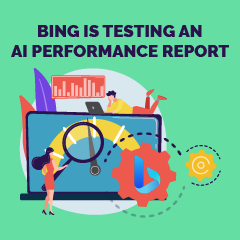
For years, SEOs have lived inside the same three metrics.
Impressions. Clicks. Positions.
Everything we do, optimize, and report on has been anchored to how visible a page is inside a list of results.
Bing just broke that model.
With Bing Webmaster Tools testing a new AI Performance report, Microsoft is officially acknowledging something the industry has been dancing around for months.
Visibility no longer only happens in SERPs.
It happens inside AI answers.
Article Summary
- Bing is testing an AI Performance report inside Webmaster Tools
- It tracks how content performs inside AI-generated responses
- This introduces reporting for “invisible” AI visibility
- SEO metrics shift from rankings to inclusion and influence
- This is the beginning of analytics for answer engines
The First Time Search Engines Admit the New Reality
This is the first time a major search engine has provided a tool that explicitly tracks AI exposure.
Not traffic. Not rankings. Not keywords.
AI presence.
That alone tells you how far things have moved.
Microsoft is effectively saying: “There is a layer of discovery happening that you cannot see in Analytics, and you need new tools to understand it.”
That is a massive philosophical shift.
Why Classic SEO Metrics Are Becoming Meaningless
In AI Mode, AI Overviews, Copilot, and assistants, users often never click.
They ask. They get an answer. They move on.
From a traditional analytics perspective, that interaction never happened.
But from a brand perspective, it absolutely did.
The user saw your brand. They heard your product mentioned. They internalized your positioning.
And your dashboards show zero.
The Bing AI Performance report is the first attempt to surface that invisible layer.

From Ranking Pages to Shaping Answers
This is where the SEO mental model has to evolve.
The old question was: “Where does my page rank for this keyword?”
The new question is: “Does the AI mention my brand when users ask about this topic?”
Those are completely different problems.
One is about page optimization. The other is about knowledge representation.

What Bing Is Really Measuring
Even though the feature is still in limited beta, the concept is already clear.
Bing is tracking:
- How often your content is used in AI responses
- Which queries trigger inclusion
- How your site contributes to AI-generated answers
That means SEO is officially becoming model-facing, not just user-facing.
Your audience is no longer just humans.
It is also machines.
Why This Is Bigger Than Bing
This is not a Bing feature.
This is a preview of how all search platforms will eventually operate.
Google will have to do this. OpenAI will have to do this. Every AI-driven discovery platform will need analytics for answer inclusion.
Because without it, brands are flying blind in the most important surface of modern search.
The Search Everywhere Implication
AI Performance reporting is the analytics layer for Search Everywhere Optimization™.
It acknowledges that discovery happens across:
- Search engines
- Assistants
- Browsers
- Commerce agents
- Workflows
And that performance must be measured where decisions are made, not where clicks happen.
This is not “SEO reporting 2.0”.
This is a completely new category of visibility.

Why This Changes How We Define Success
Historically, success meant:
- More traffic
- Better rankings
- Higher CTR
In AI-driven environments, success looks more like:
- Being cited
- Being referenced
- Being trusted
- Being chosen
And none of those metrics fit neatly into Google Analytics.
The Bing report is the first crack in that wall.
The Bottom Line
Bing is not just adding a feature.
It is rewriting what “performance” means in search.
The industry has spent decades optimizing for pages.
The next decade will be about optimizing for answers.
If you want to understand how visible your brand actually is inside AI systems today, book a free discovery call with SEO Sherpa. We will show you how to measure what the dashboards still cannot, and how to build influence in a world where clicks are no longer the goal.




















Leave a Reply