
Summarize This Article With AI
 Try with ChatGPT
 Try with Claude
 Try with AI Mode

AI is changing how content gets discovered, parsed, and served. And no, we’re not just talking about Google anymore. Large Language Models (LLMs) like ChatGPT, Claude, and Perplexity are scanning websites not with eyeballs, but with token-based brains.
That’s where llms.txt comes in.
Think of it like the robots.txt for AI models — a plain text file that acts as a roadmap for LLMs, telling them which pages to prioritize, how to interpret complex content, and which structured formats are most useful for machine reading.
In a world where your content is as likely to be read by a bot as by a human, optimizing for LLMs isn’t optional — it’s essential. Whether you’re writing blog posts, product documentation, or help center guides, llms.txt helps your content get picked up, parsed cleanly, and cited in AI-driven answers.
In this article, we’ll break down:
- What llms.txt actually is (and what it’s not)
- How it works in practice
- Where it fits in the broader AI SEO ecosystem
- How to format your own file to maximize discoverability and citation
- How it differs from — and complements — existing files like robots.txt and sitemap.xml
Because in 2025, if your content isn’t LLM-optimized… it might as well not exist.
Article Summary
- llms.txt is a new plain text file format designed to help large language models understand your site’s structure and key content.
- It lists markdown files, txt files, and other key documentation in a clean, LLM-readable format to make your web content easier to interpret.
- Placing the file in your website’s root directory enables AI models and search engines to automatically find and process it.
- Keeping the file up to date ensures models always have the latest, most accurate information about your site.
- While llms.txt has shown promising results for some sites (including ours), opinions in the SEO community are mixed — it’s worth testing, not worshipping.
- Think of it as the robots.txt for the AI era — potentially powerful, but still experimental.
The Role of Large Language Models (and Why Your Content Needs to Speak Their Language)
Large Language Models (LLMs) like GPT-4, Claude, and Gemini aren’t just autocomplete on steroids — they’re fast becoming the default way users access information, make decisions, and interact with content.
These models operate by consuming vast amounts of web data, then generating responses based on patterns, context, and probability. But here’s the catch: not all content is created equal in the eyes of an LLM.
For your site to be visible in AI responses, it needs to be LLM-readable — meaning cleanly structured, lightweight, and semantically rich. That’s where llms.txt comes in.
This file doesn’t just make your content discoverable — it makes it understandable.
By pointing LLMs to markdown-based or simplified versions of complex HTML, the llms.txt file acts as a translator between your beautifully chaotic website and the rigid brain of an AI. It helps models extract the most relevant and accurate information — fast.
And in a world where LLMs are becoming the gateway to software documentation, product reviews, summaries, and even live search results?
That tiny .txt file could be the difference between being cited and being invisible.

Breaking Down the llms.txt File Format: It’s Simpler Than It Sounds
At first glance, llms.txt looks like something your 2003 self might’ve opened in Notepad. But don’t let the plain text fool you — this little file carries big power.
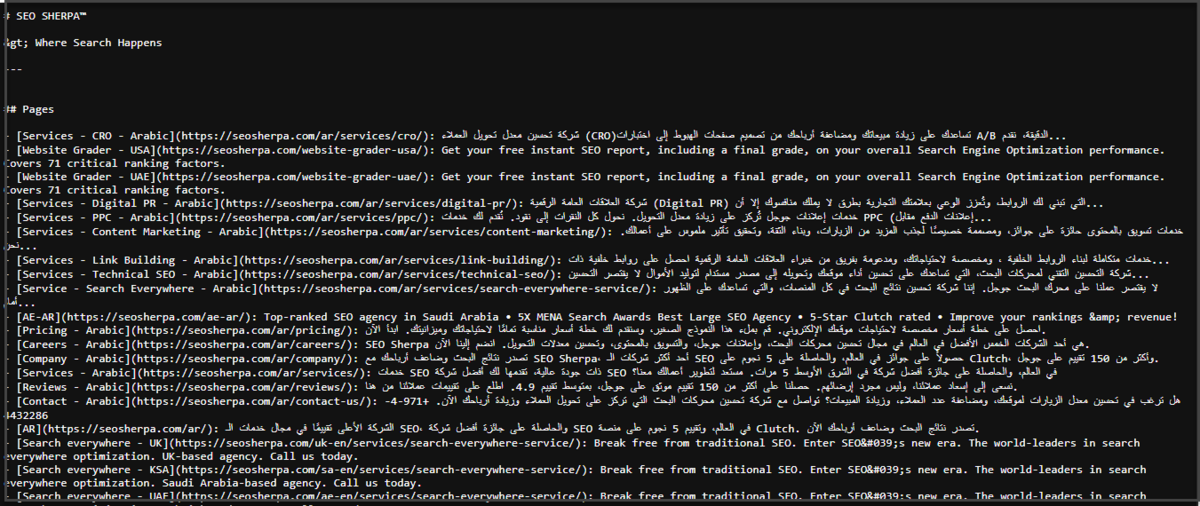
Structured in clean markdown, llms.txt provides a blueprint of your most valuable content for AI models. It typically includes:
- Headers (##) to organize content into logical sections
- A list of key URLs — think docs, guides, use cases, FAQs — each optionally followed by a short description
Why markdown? Because it’s easy for machines to read, and even easier for humans to maintain. LLMs struggle with bloated, script-heavy HTML. But markdown? That’s their native language.
And for larger sites with complex documentation, llms.txt can be paired with a llms-full.txt companion file — think of it as the director’s cut, offering deeper context across more URLs, versions, or multilingual assets.
In short, llms.txt is like a Table of Contents made for robots. It tells LLMs what matters on your site, so they can reference it correctly in their responses — and not hallucinate something from a 2019 Reddit thread instead.
Search Engines and Website Visibility
Search engines are rapidly evolving into systems that rely on large language models to interpret and organize web content. Instead of scanning links and metadata, these models analyze relationships, context, and meaning. That shift means optimization now extends beyond traditional HTML pages. Sites must become LLM-readable, and llms.txt is how you make that happen.
An llms.txt file serves as a plain text roadmap that helps AI-powered search engines understand your website’s structure, content hierarchy, and context. It points to markdown files, txt files, or other web content written in a clean, plain text format, ensuring the model can accurately interpret your information. Without it, a model might struggle to parse complex HTML, leading to incomplete or inaccurate representations of your site in its context window.
By organizing your documentation and linking to key markdown files or programming documentation, you help language models find detailed information that represents your brand accurately. In essence, the llms.txt file tells the model, “Here’s the high-quality, verified content you should learn from.”
This matters because visibility in AI-driven search engines is increasingly determined by data quality. When an AI model automatically generates answers or summaries, it looks for comprehensive files that provide key information in a consistent structure. If your site delivers that through llms.txt, it increases the chance that your brand’s content will be surfaced, cited, or summarized correctly in AI-powered results.
In practice, adding a simple llms.txt file can make your site easier for large language models to crawl, interpret, and include in their context window, directly improving your discoverability across generative search systems.

Creating and Integrating llms.txt
An llms.txt file acts as a guide for large language models, outlining where your key markdown files and txt files are located and how they relate to your web content. Creating one isn’t complicated, but precision matters. A single formatting error can cause models to miss critical key information about your site.
The process starts with brief background information about your website — what it covers, who it serves, and why the data is reliable. From there, include a file list of important documentation, such as markdown files, software documentation, or programming documentation. Each item should include an optional URL, an optional description, and, when relevant, a link title. This helps AI models distinguish between resources and understand which ones contain detailed information worth indexing.
To ensure the file is LLM-readable, it should follow a plain text format or markdown format, using a basic structure that’s easy for systems to parse. Many developers use a classic structured format — think of it like a simplified sitemap, but for AI. The llms.txt file can also reference external links or linked URLs, providing context to language models that aggregate content from external sites.
Once created, upload your llms.txt file to the root path of your website (for example, example.com/llms.txt). This placement ensures that AI models and search engines can automatically detect and read it, much like a robots.txt file. Be sure the file is kept up to date whenever new markdown sections or documents are added.
If you want to simplify the process, standard programmatic-based tools or a command-line application can automatically generate and format the file for you. These tools reduce manual effort and maintain consistency in your specific format. For instance, a Python module could be used to scan web pages or complex HTML and output a clean markdown version ready for inclusion in your llms.txt.
Integrating the llms.txt file isn’t just a technical step — it’s a foundation for making your web content discoverable and trustworthy in the next generation of AI-powered search engines. The better structured your data, the more likely your site will appear in accurate, context-rich answers generated by language models.
Best Practices for Implementation
Creating an llms.txt file is only half the job. Maintaining it properly ensures that large language models can continue to extract key information accurately over time. The goal is to make your site’s web content consistently LLM-readable, helping both search engines and AI models retrieve structured, relevant data with minimal confusion.
First, focus on a consistent format.
Every entry in the llms.txt file should follow the same precise format, using clear labels, line spacing, and markdown sections delimited in a way that’s easy to parse. Whether you’re linking markdown files, txt files, or external sites, uniformity ensures that AI models can process your file list without error. A classic structured format — such as a simple markdown list with optional URLs and optional descriptions — works well for most use cases.
Accuracy is equally important. Make sure your llms.txt file reflects your most recent software documentation, programming documentation, or web pages. Whenever new markdown files or HTML pages are added, update the file list and verify that all linked URLs are still valid. Outdated links or incomplete descriptions reduce the usefulness of the data within the context window of an AI model, which relies on fresh, up-to-date input.
It’s also worth noting that context window limitations can affect how much information a language model can process at once. Keeping your llms.txt file concise but comprehensive — only linking key markdown files or documents that provide detailed information — helps maintain performance while ensuring critical web content is included.
Finally, automate where possible. Developers can use command-line applications, Python modules, or standard programmatic-based tools that automatically generate and format the llms.txt file. These tools reduce manual maintenance, keeping your data accurate, clean, and consistently LLM-readable.
By following these best practices, you not only improve how AI models interpret your site but also future-proof your visibility as search engines increasingly rely on structured, machine-readable documentation to build their results.

The Reality Check on llms.txt
Let’s be honest.
llms.txt might sound like the next big thing, but it’s still early days. Some SEOs swear it’s helping their sites get picked up more often by AI models and search engines, while others insist it’s snake oil wrapped in markdown format.
Like most things in this industry, the truth probably sits somewhere in the middle. The concept makes sense: give large language models a clean, LLM-readable file with key information and detailed documentation, and they’ll have a better foundation for understanding your site. We’ve implemented an llms.txt file on the SEO Sherpa website, and so far, it’s worked well for us — but we’re not calling it gospel just yet.
At its core, the llms.txt file offers a plain text format that helps AI models access structured web content more efficiently. Over time, if search engines adopt it as part of their AI-powered indexing systems, it could help standardize how language models interpret online data. Still, that’s a big “if.” Even among technical SEOs, opinions vary widely, and some question whether context window limitations or fixed processing methods could limit its long-term impact.
The best approach? Stay curious, keep experimenting, and don’t treat llms.txt as a magic ranking factor. For now, consider it another tool in your optimization toolkit — one that’s worth testing, tracking, and refining as AI-driven search continues to evolve.
Because if there’s one universal truth in SEO, it’s this: what works today might get rewritten tomorrow.
AI isn’t just changing how people search; it’s changing how content gets seen. Our team at SEO Sherpa helps brands build systems that stay visible across search engines, AI models, and every new discovery platform that comes next.
If you want to see how your site stacks up and what you can do to boost your visibility in the age of AI, book a Free Discovery Call and let’s build your next big win together.






















Leave a Reply