

Summarize This Article With AI
 Try with ChatGPT
 Try with Claude
 Try with AI Mode
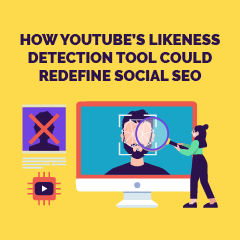
YouTube has officially joined the fight against digital doppelgängers.
Its new likeness detection tool gives creators the power to flag and remove videos that imitate their voice or face using AI. Think of it as a security system for your online identity; facial recognition meets copyright protection.
To enable it, creators verify their identity with a photo ID and short selfie video, creating a baseline of what “real you” looks and sounds like. Once approved, YouTube uses that data to scan the platform for impersonations, alerting the creator when it finds a match.
Initially, it’s limited to monetised channels in the Partner Program, but the rollout will expand. And make no mistake, this is a massive signal from YouTube about what the future of online identity looks like.
But here’s the kicker:
This isn’t just about protecting creators. It’s about protecting credibility, and that ties directly into social SEO.
Article Summary:
- YouTube just launched a likeness detection tool that lets creators spot and report AI-generated deepfakes using their face or voice.
- It’s starting with monetised creators in the YouTube Partner Program, with plans for a wider rollout soon.
- To access it, creators must verify their identity using a photo ID and selfie video.
- This isn’t just about deepfakes, it’s about authenticity as the next search signal.
- For brands and businesses venturing into video content, the message is clear: visibility now belongs to the human face behind the brand.
The New SEO Battleground: Authenticity
We’ve officially entered the “post-trust” internet era, a world where you can’t always believe your eyes or ears.
AI can clone your voice, mimic your face, and even script an eerily convincing replica of your on-camera energy. (Terrifying, right?)
So, as deepfakes multiply, YouTube is doing what Google’s been hinting at for years: prioritising authenticity as a signal of authority.
This tool is more than a safeguard, it’s an algorithmic handshake that says, “Yes, this is really them.”
And that’s a game-changer for visibility.
In traditional SEO, we’ve obsessed over backlinks and keywords. In social SEO, trust and identity are the new backlinks. The more platforms can verify that a real, credible person stands behind content, the more likely they are to promote it.
So, yes, YouTube’s likeness detection is about safety. But under the hood, it’s also about helping the algorithm tell who deserves to be seen.

Faceless Brands, Beware
Here’s where things get interesting.
While we at SEO Sherpa have been shouting from the rooftops about Search Everywhere Optimization, and yes, that includes creating more video content, there’s a caveat that too many businesses are missing.
They’re hearing “video ranks,” “AI Overviews are pulling YouTube clips,” and “video content is essential,” then rushing to pump out faceless, soulless videos with stock narration and B-roll.
And on paper, it seems harmless. But this new YouTube update proves it’s not just about showing up — it’s about showing up as you.
YouTube’s likeness detection tool is essentially rewarding genuine creators and pushing back against synthetic content.
So when brands try to sidestep the camera and publish generic, unbranded videos, even with the best metadata, they’re missing the entire point.
This new wave of social SEO isn’t about content volume; it’s about human validation.
The platforms are quietly saying: We don’t just want your keywords, we want your credibility.
If your current SEO progress feels slow because you are missing pieces of the ecosystem, our Search Everywhere service can fill those gaps. We combine technical SEO, content, PR, and social signals into one unified strategy that accelerates results.
See how Search Everywhere can grow your visibility.
The Algorithm Now Knows Who You Are
Let’s zoom out.
If YouTube can identify your face and voice, it can connect your videos, verify your authenticity, and confidently recommend your content across feeds and search results.
That means your verified identity becomes part of your discoverability score.
It’s like EEAT (Experience, Expertise, Authoritativeness, Trustworthiness) but for creators.
And while YouTube is leading this charge, others will follow. TikTok already labels AI-generated content. Instagram and Meta have been testing content authenticity disclosures. Even LinkedIn is experimenting with verification tags for experts and brands.
The message is universal: the internet is pivoting back to people.
The irony?
After years of automation, faceless branding, and AI content scaling, we’ve come full circle.
The strongest ranking signal is once again the human behind the brand.

What This Means for Social SEO
For social SEO practitioners, this changes the playbook entirely.
Every time a platform shifts toward identity verification, we see two major ripples:
- A boost for creators and experts who show up as themselves.
- A slow fade for faceless or unverified accounts relying solely on keyword targeting and hashtags.
So if your strategy involves faceless brand pages recycling trending sounds and stock voiceovers, you’re on borrowed time.
Because the next generation of search, across YouTube, TikTok, and even AI Overviews, is personalized, verified, and trust-driven.
When AI engines and platform algorithms choose which video to feature or cite, they’re not just asking, “Is this relevant?” They’re asking, “Is this real?”
And creators with proven identity data have a massive edge in that equation.
The Shift from “Brand Video” to “Expert Video”
For businesses, this evolution means a mindset shift.
Video content is no longer a “nice to have.” It’s becoming your search identity, the digital version of shaking someone’s hand and looking them in the eye.
But the days of faceless explainers are done.
Platforms want to know who’s speaking, who’s accountable, and why they’re worth trusting.
That’s why the most effective business videos moving forward won’t come from faceless channels. They’ll come from the people behind the brand—founders, specialists, consultants, subject-matter experts.
These are the videos that get embedded into AI Overviews, shared across social platforms, and cited by LLM-powered engines like Perplexity or ChatGPT.
So, while YouTube’s likeness detection tool fights the dark side of AI, it’s also shining a spotlight on genuine expertise.
Authenticity isn’t just ethical, it’s strategic.
How Brands Can Prepare
Here’s what every brand, creator, and marketer should be doing right now:
Audit Your Video Presence.
How much of your brand’s video content actually features you or your team?
If the answer is “none,” start small. Introduce human-led intros, voiceovers, or interviews. The goal is to make your brand recognisable by tone, personality, and presence—not just logo.
Verify your creators.
If you work with ambassadors, thought leaders, or spokespeople, ensure they’ve verified their identities where possible (especially on YouTube). Those signals will likely factor into algorithmic trust over time.
Build consistency.
Your brand’s visual and verbal identity—faces, voices, backgrounds, and taglines—should be consistent across all social platforms. This makes it easier for algorithms (and audiences) to connect the dots between your posts and your authority.
Update your brand protection policies.
Add clauses covering AI likeness, synthetic media, and content disclosure. Treat deepfake impersonation as seriously as IP infringement.
Create a content system that supports identity.
Pair your content creation workflows with SOPs that ensure every video, clip, or post carries the same recognizable brand imprint.
Why This Matters More Than Ever
This isn’t a niche update. It’s a turning point.
YouTube’s likeness detection tool shows us what’s next:
The rise of human-verified visibility.
As AI tools flood every platform, the ability to prove that your content — and your face — are real will become a major trust factor.
For brands that have avoided video, this is your wake-up call.
You can’t hide behind your logo anymore.
Because in a world where AI can mimic anything, the only truly original thing left… is you.
So when you’re planning your next campaign or pillar video, don’t ask, “What should we talk about?”
Ask, “Who should say it?”
That’s the future of social SEO and it’s coming faster than most marketers realise.
The Bottom Line
YouTube’s new likeness detection tool is more than a defensive feature.
It’s a preview of a future where authenticity becomes algorithmic.
The platforms that matter—YouTube, TikTok, Instagram, even AI Overviews—are building systems that favour real experts, verified creators, and human-led brands.
So, if you’ve been putting off video because “you hate being on camera,” now’s the time to rethink that.
The algorithm is learning to tell who’s real.
And real is about to rank.
Want to take you rankings to the next level? Get a free discovery call with SEO Sherpa today.





















Leave a Reply