

Summarize This Article With AI
 Try with ChatGPT
 Try with Claude
 Try with AI Mode
For years, self-ranked listicles quietly became one of the most common growth hacks in SaaS and affiliate-heavy industries.
You know the format.
“Best Tools for X,” written by a company that just happens to place its own product in position number one. Sometimes subtly. Sometimes hilariously obviously.
And for a while, it worked.
Many of these pages ranked extremely well because they targeted high-intent comparison keywords and captured users at the exact moment they were deciding what to buy. Traffic was strong, conversions were strong, and the tactic became so normalized that entire content strategies were built around it.
Now we are seeing what happens when that tactic becomes too widespread.
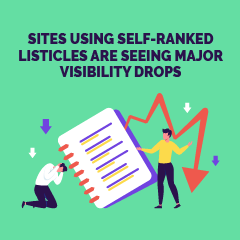
Recent industry reports suggest that sites heavily relying on self-ranking comparison listicles are experiencing significant visibility losses, in some cases dropping 30 to 50 percent across affected pages. The pattern is not universal, but it is widespread enough to signal a clear shift in how Google is evaluating credibility signals in commercial comparison content.
And frankly, this shift has been building for years.
Article Summary
- Sites using self-ranked “best tools” listicles are seeing notable visibility declines
- Google appears to be tightening credibility signals around commercial comparison content
- Pages that prioritize objectivity, external validation, and transparent evaluation criteria are performing more consistently
- Overly promotional comparison pages are becoming easier for algorithms to detect
- Brands must rethink comparison content strategies to align with evolving trust signals
The Real Issue Is Not Listicles. It Is Trust Signals
Listicles themselves are not the problem. Users still want comparison content. They still search for “best tools,” “top software,” and “alternatives” queries every single day. What has changed is how search systems evaluate the credibility of the source making those claims.
When a brand ranks itself number one on its own comparison page without transparent methodology, balanced evaluations, or independent supporting signals, the content begins to look less like guidance and more like disguised advertising. As algorithms improve at evaluating authorship, entity relationships, and promotional bias, these signals become increasingly visible.
In other words, what once slipped through ranking systems is now easier to detect.
That does not mean brands cannot create comparison content featuring their own products. It simply means that the content must now meet higher standards of transparency, expertise, and supporting authority signals if it wants to compete long term.

The SaaS Industry Is Feeling This First
SaaS companies, particularly those in highly competitive marketing, productivity, and technology categories, are experiencing this shift earlier than many other industries. These sectors relied heavily on “Best X Tools” strategies for years, and the sheer volume of near-identical comparison pages made the tactic increasingly saturated.
As Google continues refining how it evaluates product comparisons and commercial intent pages, we are seeing a natural correction. Pages that provide clear evaluation criteria, balanced pros and cons, original research, and third-party validation tend to hold visibility more consistently. Pages that read like thinly disguised sales pitches are seeing sharper fluctuations.
This is less about punishment and more about recalibration.
Search systems are simply becoming better at identifying which pages genuinely help users make decisions and which ones primarily exist to funnel traffic toward a specific product.
The Rise of Multi-Source Credibility
Another factor influencing these visibility shifts is the growing importance of off-page validation. In the AI search era, comparison credibility is not evaluated only on-page. Mentions across reviews, communities, digital PR placements, analyst reports, and third-party editorial sites increasingly contribute to how products are understood and surfaced in search ecosystems.
If every positive comparison exists only on a brand’s own website, the signal profile looks very different from a brand that is consistently evaluated across independent sources. This is particularly important as AI-driven search systems synthesize information from multiple data sources rather than relying solely on individual page signals.
Visibility is no longer just about what you say about yourself. It is about what the broader ecosystem says about you.
What This Means for Modern Content Strategies
The decline of self-ranked listicles does not mean comparison content is losing value. It means the bar has risen. Brands that continue publishing comparison pages should focus on transparency, genuine product evaluation, balanced positioning, and measurable testing frameworks. In many cases, involving subject matter experts, independent contributors, or real customer data can significantly strengthen credibility signals.
The broader lesson is strategic. Short-term content tactics that scale quickly often create long-term vulnerabilities once algorithms mature. Sustainable visibility increasingly depends on authority, reputation, and consistency across multiple platforms, not just tactical keyword targeting.
This is particularly important as discovery expands across AI-driven interfaces, conversational search experiences, and recommendation systems where credibility signals are evaluated holistically rather than page by page.

The Bottom Line
The visibility drops affecting self-ranked comparison listicles are not random fluctuations. They are part of a broader shift toward stronger credibility evaluation across commercial content. As search systems continue prioritizing trust, authority, and ecosystem-wide validation, brands relying heavily on self-promotional comparison tactics will need to evolve their strategies.
Comparison content still works. It just needs to work harder.
If your brand relies on comparison-driven acquisition, this is the time to reassess how those pages are structured, validated, and supported by broader authority signals. Book a free discovery call with SEO Sherpa to evaluate whether your current comparison content strategy is built for the next generation of search visibility.






















Leave a Reply