


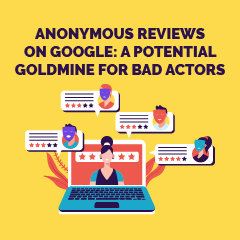
When Google quietly confirmed that it’s rolling out anonymous Google reviews, the SEO world split into two camps.
One side saw accessibility.
The other saw chaos.
And both are right.
This is one of those updates that sounds harmless at first. Even helpful. Even human. But the second you step back and look at how search actually works in 2025, you realize this isn’t just a feature change. It’s a trust change.
And trust is the entire foundation of local search.
Article Summary
- Google is rolling out anonymous reviews across Maps and local listings
- Users can now leave feedback without public identity attached
- This lowers the barrier to honest reviews in sensitive industries
- It also opens the door to more review manipulation and negative SEO abuse
- Trust signals are now easier to influence, both positively and negatively
- Businesses need stronger reputational defense than ever before
Why Google Is Really Doing This
This isn’t a random product decision.
Google’s review database is one of its most valuable assets. Not just because it helps users, but because it helps Google itself understand the world. Reviews train algorithms. They shape recommendations. They influence AI answers. They help systems understand trust.
But there’s a problem.
A lot of people don’t want to leave reviews tied to their real names.
Especially in sensitive sectors like healthcare, legal services, family law, financial struggles, or mental health. In those spaces, anonymity isn’t a luxury. It’s safety.
So yes, this move will unlock more honest, human feedback.
But it also changes the risk model completely.
The Problem Nobody Wants To Say Out Loud
Anonymous systems are always a double-edged sword.
When identity is removed, a certain type of behavior becomes… easier.
This is the part people in the industry are already quietly discussing, but not loudly enough:
- Negative SEO specialists.
- Reputation manipulators.
- Competitor sabotage campaigns.
- Coordinated review attacks.
They exist.
They’re active.
And they test boundaries fast.
When reviews are tied to real identities, the risk of accountability slows bad actors down. When identity is stripped away, the psychological and technical barrier drops.
That doesn’t mean Google is “allowing” abuse.
It means the stakes just got higher.
And pretending otherwise doesn’t protect businesses.
This Is A Search Everywhere Problem, Not Just A Local One
What makes this more serious is not local SEO.
It’s how reviews now influence everything.
Google reviews don’t just stay in Maps.
They are pulled into:
- Organic snippets
- Knowledge panels
- AI Overviews
- AI Mode answers
- Voice search
- Local packs
- Third-party platforms
Reviews have become training data for the internet’s “truth layer”.
So when reviews are compromised, it’s not just your map pin that suffers. It’s your visibility everywhere.
Search Everywhere runs on trust signals. Reviews are one of the strongest ones in the ecosystem.
Which makes this update… powerful.
If your brand’s visibility depends on reviews, trust signals, and how platforms interpret your reputation, you can’t afford to treat this as “just local SEO.”
Search happens everywhere now.
Trust is built everywhere now.
Our Search Everywhere services help brands protect, strengthen, and scale their visibility across Google, AI search, and every platform that influences buying decisions before the click.

The Brands That Are Safest Will Be The Ones Who Prepare Now
This is not a panic story.
This is a preparedness story.
The worst position a business can be in is reactive. Logging in one morning to see a flood of anonymous negativity and realizing you have no idea what to do next.
The brands that stay safest will be the ones who treat reputation as an asset, not a side effect.
That means monitoring patterns, not just ratings.
Watching sentiment shifts, not just star averages.
Understanding how reviews show up across AI results, not just Google Maps.
Treating trust like infrastructure, not decoration.
This is no longer optional.
This Is Not Fearmongering, It’s A Reality Check
This isn’t about assuming everyone is malicious.
It’s about acknowledging incentives.
Where there is competition, there are always people willing to cross lines. And where systems loosen identity, those people feel emboldened.
That doesn’t make the update bad. It makes awareness critical.Because the internet has never been purely good-faith.
The Bottom Line
Google’s anonymous reviews update isn’t evil. It isn’t reckless. And it will likely help a lot of real people feel safer sharing real experiences.
But it also fundamentally changes how trust is built and how trust can be attacked.
And in a Search Everywhere world, trust is everything.
Businesses don’t need to panic. They need to prepare.
Because the brands that understand how trust is built, defended, and reinforced across platforms will be the ones that survive the era of anonymous feedback.
The ones that don’t will learn the hard way.
If this update made you pause, that’s a good thing.
You don’t need to panic, but you do need a plan.
Book a free discovery call and let’s look at how your brand is currently showing up across search, AI, and trust-driven platforms. We’ll show you where you’re strong, where you’re exposed, and what you can do next.














Leave a Reply