


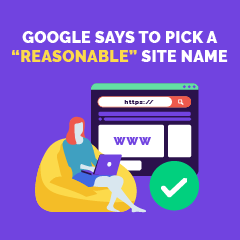
Every so often, Google gives advice that sounds so basic it’s easy to dismiss.
Pick a reasonable site name. Don’t overthink it. Make it clear what your site is about.
On the surface, this feels like beginner-level guidance. The kind of thing you nod at and move past because surely no serious business is getting this wrong.
Except plenty are.
And when John Mueller reiterated that site owners should choose a reasonable site name that they can realistically rank for, it wasn’t about technical SEO at all.
It was about how brands are understood, remembered, and trusted in a search landscape that no longer has room for ambiguity.
Article Summary
- Google recommends choosing a clear, reasonable site name
- Overly clever or keyword-stuffed names create confusion
- Site names influence trust, recognition, and AI interpretation
- Search systems increasingly rely on brand clarity
- Ambiguous branding weakens visibility across search environments
- This is a brand problem first, an SEO problem second
What Google Is Actually Saying
The original clarification, shared by Barry Schwartz via Search Engine Roundtable, came from a discussion around how Google understands and displays site names in search results.
The guidance itself is simple.
Pick a site name that:
- Accurately reflects your brand
- Is not misleading or over-optimized
- Is something you could realistically be recognized for
Google is not telling people to rename their businesses for SEO.
It is reminding site owners that clarity beats cleverness when machines and humans are trying to understand who you are.
Why This Advice Is Surfacing Now
If this guidance has always been true, why is Google repeating it now?
Because search systems have changed.
In traditional SERPs, confusion could be compensated for. A vague site name might still rank because the page content, backlinks, or on-page signals did the heavy lifting.
That safety net is disappearing.
AI-driven search, knowledge panels, AI Mode, Discover, and conversational interfaces all rely heavily on entity understanding. They need to know who you are before they decide how often to surface you.
If your brand name is unclear, overloaded with keywords, or misleading, systems struggle to place you.
And when systems struggle, visibility suffers quietly.
Site Names Are No Longer Just Labels
In 2026, your site name is not just a label in search results.
It is:
- A trust signal
- An entity identifier
- A shortcut for meaning
AI systems do not read your About page the way humans do. They infer meaning from consistency across signals.
If your site name implies one thing and your content delivers another, that inconsistency becomes a liability.
If your site name is stuffed with keywords or overly generic, it blends into noise.
And if your site name is clever but unclear, it forces both users and machines to work harder to understand you.
Search increasingly penalises friction.
Keyword-Stuffed Names Are Actively Working Against You
There was a time when naming your site something like BestCheapLoansOnline.com felt strategic.
That era is long gone.
Keyword-heavy names now trigger the opposite effect. They reduce trust. They look spammy. And more importantly, they confuse entity recognition.
AI systems are excellent at spotting intent. They are also excellent at spotting manipulation.
A site name that tries to rank for everything signals low confidence and low authority. It suggests the brand does not know what it actually wants to be known for.
Google’s advice to pick a reasonable site name is a polite way of saying: stop trying to game identity.
Clever Branding Can Backfire Too
This is the part many modern brands do not want to hear.
Being clever is not the same as being clear.
Abstract names, inside jokes, and metaphor-heavy branding can work beautifully in closed ecosystems where context is shared. They often fail in search environments where context must be inferred instantly.
If a user sees your name in a list of sources, can they tell what you do? If an AI system encounters your brand out of context, can it categorise you accurately?
If the answer is no, you have a discoverability problem.
That does not mean every brand needs to be literal. It does mean every brand needs supporting clarity.
Taglines, descriptors, and consistent positioning matter more than ever.
This Is About Trust, Not Just Ranking
Google’s systems are increasingly designed to surface sources users trust instinctively.
That trust is built through repetition and recognition.
A reasonable site name is one that users can:
- Remember
- Recognize
- Associate with a clear topic or expertise
When users see the same brand name repeatedly across search, AI answers, social platforms, and content recommendations, familiarity builds.
When the name itself is confusing, that familiarity never compounds.
Trust stalls.
AI Makes Brand Ambiguity a Bigger Risk
In AI-driven search experiences, your site name may appear without surrounding context.
No meta description. No supporting copy. Sometimes not even a visible URL.
Just the name.
In that environment, your name needs to carry meaning on its own.
If it does not, you are far less likely to be selected, cited, or recommended.
This is why Google’s advice intersects directly with Search Everywhere Optimization™. Your brand identity needs to hold up across environments, not just in a traditional SERP.
Reasonable Does Not Mean Boring
It is important to be clear about what Google is not saying.
Google is not encouraging generic branding. It is not telling businesses to strip out personality.It is not pushing everyone toward the same naming conventions.
“Reasonable” means defensible.
It means you can reasonably expect:
- Users to associate the name with your offering
- Search systems to categorise you correctly
- AI to understand your topical relevance
You can still be distinctive. You just cannot be obscure.
Why This Matters More for New Brands
Established brands can get away with more.
They have history. Coverage. Mentions. Cultural presence. Systems already understand them.
Newer brands do not have that luxury.
If you are building a brand in 2025, your site name plays a disproportionate role in early visibility. It shapes first impressions for users and machines alike.
A poor naming choice can slow growth in ways that are hard to diagnose later.
Google repeating this advice is a signal to founders and marketers alike: brand decisions now directly affect search outcomes.
Final Thoughts: Search Rewards Confidence
Google telling site owners to pick a reasonable site name is not pedantic advice.
It is a reflection of where search is heading.
Search systems increasingly reward brands that know who they are, communicate it clearly, and show up consistently across environments.
Ambiguity is expensive. Over-optimization is obvious. Clarity compounds.
In a world where discovery is mediated by AI as much as algorithms, your name needs to work harder than ever.
Not sure if your brand is helping or hurting your visibility?
If you’re questioning how your site name, brand positioning, or overall identity impacts search, AI discovery, and Search Everywhere Optimization™, book a free discovery call with SEO Sherpa.
We’ll help you assess whether your brand signals are clear, credible, and future-proof, and what to fix if they’re not.














Leave a Reply