


Are blogs still relevant in 2026? Yes. Blogging remains one of the most effective ways for businesses to build organic traffic, generate qualified leads, and establish authority. With over 600 million blogs worldwide and millions of posts published daily, understanding key blogging statistics helps content creators, marketers, and business owners optimize their strategies for maximum return on investment.
Article Summary
- Blogging remains highly competitive: There are over 600 million blogs worldwide, with approximately 7.5 million blog posts published daily.
- Blog readership is still strong: Around 83% of internet users read blogs, with 18% reading daily and 29% reading one to four times monthly.
- Blogging delivers measurable business results: Small businesses with active blogs reportedly experience 126% more lead growth, while B2B companies with blogs generate 67% more leads.
- Content production takes time and requires consistency: The average article contains 1,312 words and takes about three to four hours to write, with many bloggers publishing weekly.
- Quality and promotion are increasingly important: As competition grows and AI-powered search changes online discovery, businesses should prioritize useful content, regular updates, SEO, and effective promotion over publishing more articles.
Why Blogging Statistics Matter in 2026
Blog posts do more than fill a website with information. They help potential customers discover and trust your business and answer common questions.
Unlike short-lived promotional campaigns, well-written articles can attract readers long after publication. They also support search engine visibility and establish thought leadership. More importantly, they can encourage visitors to become qualified leads.
But publishing blog posts isn’t enough. You need reliable data to understand what’s working.
Current blogging statistics help marketers evaluate publishing frequency, audience behavior, and content marketing performance. They also provide realistic benchmarks for measuring traffic, engagement, and conversions.
With these insights, you can identify underperforming content and allocate resources more effectively. You can also make informed decisions that deliver stronger results over time.

How Big Is the Blogosphere: Scope and Readership Numbers
The blogging industry is still massive, and the numbers prove it. Content creators across diverse industries leverage blogs to build digital footprints, connect with niche audiences, and drive long-term organic discovery. Furthermore, as online publishing platforms continue to evolve, blogging has expanded beyond personal journals into essential content hubs for global brands and independent media alike.
Total Blogs and Content Volume
According to Tech Business News, the latest statistics show that there are over 600 million blogs worldwide in 2026. Master Blogging estimates that 7.5 million blog posts are published each day globally. That’s millions of articles competing for attention every year.
For businesses investing in content marketing, these figures highlight the importance of keyword research and a clear content strategy. Increasing your blogging frequency is not enough to stand out.
How Many People Still Read Blogs: Reach and Audience Size
Blogs still attract many internet users, even as social media and video marketing intensify competition.
Master Blogging reports that approximately 83% of internet users read blog posts, creating significant opportunities for brands across different blogging niches.
However, reading habits vary. Blogging Wizard states that 18% of internet users read blog posts daily. 16% read blog posts one to three times weekly, while 14% do so four to six times per week.
29% of internet users read blog posts one to four times every month.
Knowing what your readers care about and how they consume content makes a real difference. Posting regularly also gives them a reason to read your future posts and engage with you.

Blogging for Business: Adoption and ROI for Companies
Let’s take a look at why businesses continue to blog and the expected returns.
Corporate and Marketer Adoption
Businesses continue to invest in blogging because it delivers measurable results.
According to DemandSage, about 80% of businesses use blogs as a marketing tool, suggesting they publish articles regularly.
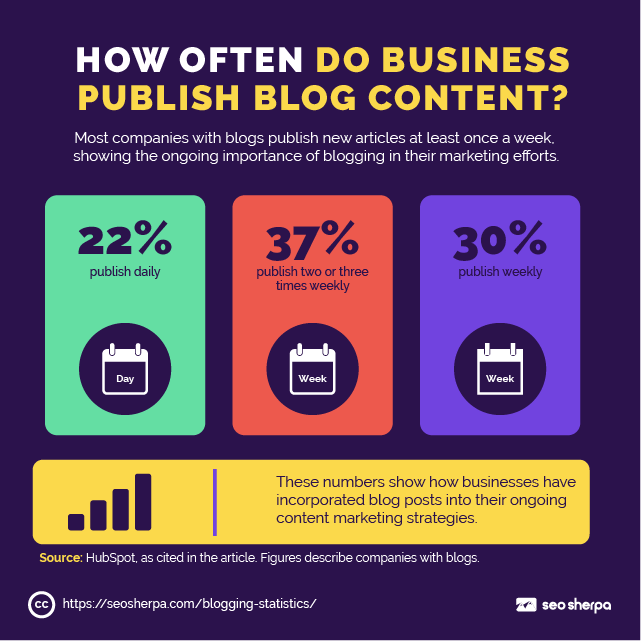
In another report published by HubSpot, 22% of companies with blogs publish daily, 37% publish two or three times weekly, and 30% publish weekly.
These numbers show how businesses have incorporated blog posts into their ongoing content marketing efforts.
Performance: Traffic, Leads, and ROI
The financial benefits of regularly publishing blog posts are equally compelling.
DemandSage reports that small businesses with active blogs experience 126% more lead growth than those without. B2B companies with blogs also generate 67% more leads.
For small business owners, these are great reasons to invest in content creation.
In addition to increasing website traffic, blogs support lead generation by introducing potential customers to products and services during their research. Well-placed offers and relevant inbound links can also support conversions.
However, success requires tracking more than page views. Tracking conversion rate and qualified leads helps businesses evaluate blogging ROI and spot opportunities for improvement.
Content Creation and Publishing Benchmarks
Let’s look at what the latest blogging statistics reveal about article length, publishing schedules, and content quality.
Typical Post Length, Frequency, and Time to Write
Businesses have different blogging strategies. But according to Orbit Media, the average blog post length is now 1,312 words, down from the average of 1,427 words in 2023.
Master Blogging estimates that writing one blog post takes around three to four hours, depending on the topic’s complexity, research, and editing.
Publishing schedules also vary. Blogging Wizard reports that 24% of bloggers publish new posts every week. 23% of bloggers release new articles several times a month, while only a few (3%) post daily.
With these benchmarks, you can smartly plan your schedule and balance content length with available resources.
Content Type, Quality, and Formats That Work
Longer articles aren’t automatically better. Blog posts that provide value to readers tend to be the most popular and widely read.
Research compiled by Originality.ai suggests that long-form, detailed, well-researched and well-structured blog posts tend to deliver stronger results, especially when compared with short or shallow content.
Articles with relevant visual elements, such as charts, screenshots, and infographics, also make information easier to understand.
Don’t ignore existing content as well. According to Orbit Media, bloggers who regularly update older articles often see better results because they contain more recent, useful information.
This strategy also helps extend the value of your best articles and increases the results they can achieve over time.
Moreover, updating statistics, improving keyword optimization, and adding more useful information can extend an article’s value without constantly creating new content.

Challenges and Market Trends in 2026
Blogging remains popular, but getting noticed is becoming more challenging. Here are the biggest challenges and market trends to watch in 2026.
Saturation and Competition in the Blogosphere
Millions of blog posts go live every day, making it harder for businesses to stand out. AI tools have only increased competition by making content creation faster and more accessible.
However, producing more articles doesn’t guarantee better results. To stand out, you need content that highlights quality, firsthand experience, distinct perspectives, and useful information that competitors have not covered.
Original research and guest blogging can also help establish your authority and reach new audiences.
Search and Traffic Challenges: The Changing SEO Landscape
Getting organic traffic is becoming a challenge in 2026, too.
Orbit Media’s Blogging Statistics reports that clickthrough rates dwindled across many websites. A Wix study supports this, with 53% of bloggers saying that attracting visitors from search engines is their biggest challenge.
52% of participating bloggers also said they struggle to get traffic and attract visitors.
One contributing factor is the rise of AI search engines, which can answer questions without requiring users to visit websites. The frequently changing search engine algorithms also make maintaining rankings increasingly difficult.
However, these challenges are not insurmountable. Focusing on strategic keyword optimization and relevant keyword clusters can give you a good start. Another valuable strategy to add to your arsenal is creating content that addresses specific audience needs.
Also, monitor your blog’s performance in Google Search Console to spot declining clicks and opportunities for improvement, and explore distribution channels beyond search engines.
Implications for Brands and Marketers: What to Do if You’re Blogging in 2026
Blogging can still drive growth this year and beyond. However, you need a well-thought-out strategy you can implement effectively to get more benefits.
Some steps and tips you should include in your strategy include the following:
- Focus on quality over quantity. Prioritize writing comprehensive articles that answer specific questions instead of publishing dozens of average blog posts. Include original research, expert opinions, and concrete examples that readers can’t easily find elsewhere.
- Maintain a realistic publishing schedule. Publishing two well-researched, well-written posts monthly can yield better results than posting rushed content daily to meet deadlines.
- Make SEO a key part of your writing process. Effective search everywhere optimization and internal linking can help improve your content’s visibility. Use a reliable plugin, such as Yoast SEO, to monitor performance as well. Don’t forget technical factors, such as Core Web Vitals, which influence page experience.
- Use different platforms to promote your content. Besides Google, use email and video marketing and other channels to promote your blog posts. Add social share buttons to make it easier for readers to recommend your articles to others.
- Track your blog’s performance regularly. Monitor traffic, rankings, and conversion rates to see which articles drive the most results, then use the data to make the necessary improvements.
Also, treat your blog as a long-term business asset rather than an occasional marketing activity. Successful bloggers invest considerable effort in creating, improving, and promoting their content.
Your goal should be to make every article contribute to your broader strategic objectives and deliver lasting value.

What to Watch Next: Emerging Blogging Trends
Blogging will continue to evolve as technology changes how people discover and access information.
One significant development is AI adoption. The Content Marketing Institute 2026 report states that 95% of B2B marketers use AI-powered tools, and 89% rely on them to create or optimize articles.
Content formats are evolving, too. HubSpot reports that short-form videos continue to deliver strong returns, with 29.18% of marketers saying it is the format they use the most and 21.02% mentioning that it delivers the highest ROI.
Brands should therefore explore short-form videos, visual storytelling, and interactive content in blog posts to create more engaging experiences.
Another development worth knowing is AI-powered search. A Pew Research Center study found that users clicked traditional search results in 8% of visits featuring AI summaries, compared with 15% without them.
As search behavior changes, you may need to invest more in additional content formats and promotion, audience relationships, and alternative discovery channels.
Frequently Asked Questions
Is the Number of Active Blogs Increasing or Decreasing?
The blogosphere remains large and is increasing rather than shrinking. Tech Business News reports over 600 million blogs worldwide in 2026, and Master Blogging estimates 7.5 million posts are published daily. AI tools have made publishing faster, so SEO and GEO strategies increasingly focus on quality over volume.
Is Blogging Still Profitable in 2026?
Yes, blogging is still a profitable marketing channel in 2026, especially when done strategically. DemandSage reports small businesses with active blogs see 126% more lead growth, and B2B companies generate 67% more leads. SEO and GEO-focused content that prioritizes quality and tracks conversions helps turn blog traffic into measurable revenue.
What is the Average ROI of Business Blogging?
There is no single average ROI for business blogging, but lead-generation benchmarks show strong returns. DemandSage reports 126% more lead growth for small businesses with active blogs and 67% more leads for B2B companies. Tracking conversion rate and qualified leads, not just pageviews, gives the most accurate ROI.
How Does Blogging Affect Website Traffic and Conversions?
Blogging can increase website traffic and conversions by attracting searchers and introducing them to your services during research. However, organic traffic is harder to earn, with 53% of bloggers citing search visibility as their biggest challenge.
Will AI Reduce Demand for Traditional Blog Articles?
AI is reducing clicks to some articles, but demand for useful, original content remains. Pew found users clicked traditional results in 8% of visits with AI summaries versus 15% without. Blogs offering firsthand experience and unique insights, optimized for SEO and GEO, are better positioned to earn citations.
Maximizing Your Blogging Success in 2026
Blogging remains a valuable marketing channel in 2026. You just need to know how to maximize its potential.
Successful content marketing requires useful information, consistent optimization, and a clear understanding of your audience. Also, take time to review your existing blog posts, identify improvement opportunities, and prioritize content that can help grow your brand.
Ready to get more out of your blogging efforts?
Book a free strategy call with SEO Sherpa and discover how to turn your blog into a reliable source of organic traffic and leads.























Leave a Reply