

Summarize This Article With AI
 Try with ChatGPT
 Try with Claude
 Try with AI Mode

Let’s not pretend that measuring SEO ROI is always straightforward.
Still, it’s absolutely doable and essential.
SEO has a reputation for being hard to quantify. It often gets dismissed as an “unmeasurable” channel.
But calculating the return on investment is how you prove SEO’s impact in real business terms.
This guide will explain how to model, track, and prove the value of SEO in clear, financial language that makes stakeholders nod in agreement.
Article Summary
- SEO ROI shows how much value your search optimization delivers compared to what it costs
- Measuring ROI connects your work to revenue, helping you earn buy-in and justify continued investment
- Use both direct revenue data and engagement metrics to track performance and forecast returns
- Attribution and timing challenges mean ROI often lags, but the compounding nature of SEO rewards consistency
- Tools like GA4, Looker Studio, and CRM integrations help connect SEO to actual business results
- Strong reporting should focus on business outcomes, not vanity metrics, and speak the language stakeholders understand
What Is SEO ROI?
SEO ROI measures the return generated by your search engine optimization efforts relative to what you spent.
In simple terms, it shows how much value your SEO produces compared to its cost.
That value includes “hard” ROI, like sales revenue and lead conversions. But it also includes “soft” ROI, such as increased brand visibility, improved trust, and audience growth that may not show up as revenue right away.
SEO ROI is usually expressed as a percentage or ratio, showing profit from organic search after expenses.
For example, if you spend $1,000 on SEO and earn $5,000 in revenue, your ROI would be 400%; a $4,000 net gain.
A strong SEO ROI means your campaign is working.
A negative one means you’re not profitable yet, and it’s time to evaluate what needs fixing.
It’s important to separate direct and indirect value when evaluating ROI.
- Direct (hard) ROI includes e-commerce transactions or leads that come from organic search.
- Indirect (soft) ROI includes benefits like brand equity, customer engagement, and long-term visibility.
These matter, but they don’t appear in the basic ROI formula.

Why Measuring SEO ROI Matters
Measuring SEO ROI is how you connect your work to business impact.
It’s the clearest way to show that SEO drives value, not just rankings or traffic, but real growth.
While clients and execs might not care about keyword positions, they care deeply about profit, cost, and return.
When you show the dollar impact of SEO, the conversation shifts.
Suddenly, SEO isn’t just a technical task; it’s a revenue-generating channel. And that makes it far easier to justify the budget, win buy-in, and align with business priorities.
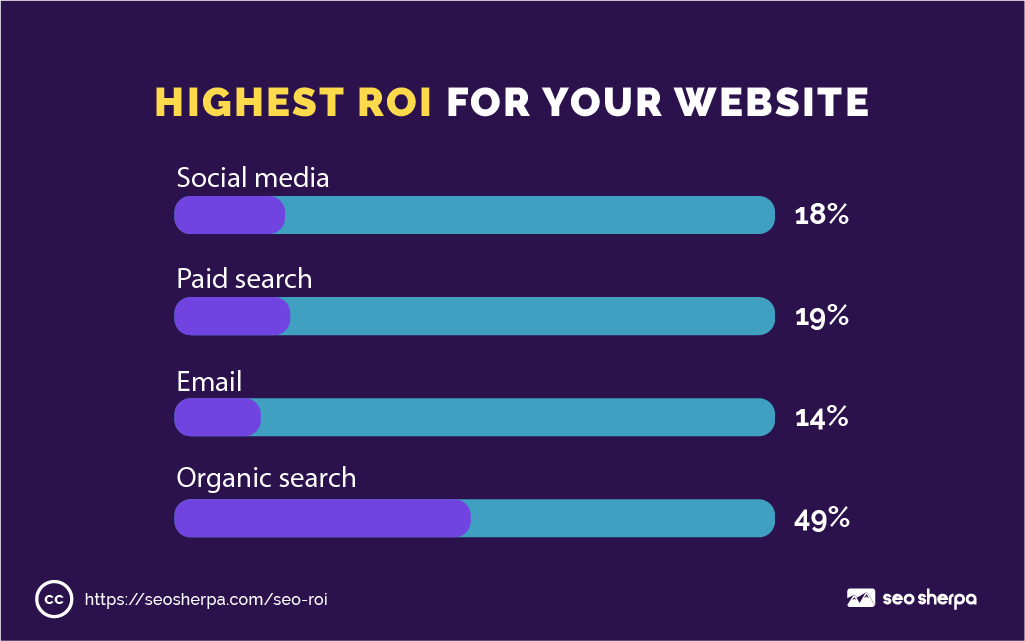
In fact, 49% of marketers say organic search delivers the highest ROI of any marketing channel. But to earn more resources, you need to prove your performance.
ROI also keeps your team focused on the right outcomes.
Instead of chasing vanity metrics, you start asking better questions. Did this initiative generate leads? Did it increase customer value? Did it move us closer to revenue?
Tracking ROI helps you double down on what works.
It makes every tactic, strategy, and report more strategic and, ultimately, more defensible to stakeholders.
How to Calculate SEO ROI (Formula + Example)
The SEO ROI Formula Explained
SEO ROI = (Revenue from SEO – Cost of SEO) ÷ Cost of SEO
That’s the formula. Simple, but powerful.
You subtract what you spent on SEO from what it earned, then divide by the cost to get a percentage or ratio.
It’s the same approach used for any ROI calculation; only here are the inputs SEO-specific.
- Revenue from SEO includes e-commerce transactions, lead conversions, or any measurable value driven by organic traffic.
- The cost of SEO includes everything you invest in getting there: in-house salaries, agency fees, tools, content, link building, and more.
To keep your numbers meaningful, use consistent timeframes.
If you’re measuring monthly SEO ROI, compare that month’s organic revenue to that month’s spend.
For a longer-term strategy, yearly ROI paints a more accurate picture, especially since SEO value compounds over time.
We’ll get deeper into that in a later section.

Example SEO ROI Calculation
Let’s say you spent $10,000 on SEO over the past 12 months. That work generated $50,000 in revenue from organic traffic.
Plug those numbers into the formula: (50,000 – 10,000) ÷ 10,000 = 4
That’s a 400% ROI
Put another way, you earned $5 for every $1 invested in SEO.
According to industry data, that kind of return is realistic.
Many small businesses see SEO ROI hit 400% or more within the first two years.
Just remember: ROI might start slow.
It can be negative at first while rankings build. But over time, as your content gains visibility and authority, the returns accelerate.
That’s the compounding nature of SEO.
What Metrics Help You Track SEO ROI?
Proving SEO ROI starts with knowing which metrics actually matter.
Some numbers tie directly to revenue.
Others highlight engagement or visibility, which are important signals that support future ROI.
To make this actionable, let’s group them into two categories:
Revenue-based metrics and engagement metrics that indicate value
Revenue-Based Metrics
These are the numbers that speak directly to profit. They show how SEO translates into leads, sales, and dollars earned.
With tools like Google Analytics (or GA4), you can segment performance by organic search to isolate revenue and conversions from SEO.
For ecommerce, that might mean tracking organic revenue or transactions from search.
For lead gen, it could be form fills, demo requests, or phone calls, with an assigned value per lead.
For example, if each qualified lead is worth $500 and SEO drives 20 leads, that’s $10,000 in attributed value.
Even if you don’t sell online, you can still quantify SEO’s financial impact by assigning value to key conversion points.
These revenue-based metrics form the core of your ROI calculation.
They’re the numbers you plug into the top of the formula.
Engagement Metrics That Indicate Value
Not all SEO wins show up as immediate revenue, but engagement metrics tell you whether your strategy is working.
Look at things like bounce rate, average time on page, and pages per session.
A lower bounce rate and longer session suggest visitors are finding your content useful, which increases the odds of conversion down the line.
Click-through rate (CTR) from search results also matters. If more people are clicking on your listings, it means your pages are showing up more often and appealing to searchers.
Visibility metrics, like impressions or average keyword rank, help paint the full picture.
They don’t generate revenue on their own, but they show your content is reaching more people and pulling in traffic that can convert over time.
Track both types of metrics.
Revenue numbers tell you what’s already paying off. Engagement numbers show what’s about to happen.
Challenges in Measuring SEO ROI
SEO ROI is real, but it’s not always easy to capture.
There are a few common obstacles that can blur the connection between SEO work and business results.
Attribution is the first big hurdle.
In most customer journeys, SEO doesn’t always get the final click. It often plays an assist role, introducing people to your brand, answering early questions, or bringing them back after they’ve browsed elsewhere.
Traditional analytics models tend to under-credit SEO for these early touches.
Even with GA4’s data-driven attribution, it’s still hard to assign full value when multiple channels contribute to a single conversion.
So, while SEO might have planted the seed, another channel (like paid or direct) often gets the credit for the sale.
The second challenge is timing.
SEO takes time to ramp up. You might spend months creating content, building links, and improving site structure before the payoff shows up.
That lag between investment and return makes it tricky to measure ROI month to month. Short-term reporting windows often make SEO look less effective than it really is.
This is where expectation setting matters.
Stakeholders need to understand that month one efforts might drive results in month six.
Comparing equal time windows, like Q1 spend vs. Q3 return, gives a more realistic picture.
Then there’s the issue of indirect value.
Not every benefit from SEO shows up as a tracked conversion. Someone might discover your brand through a blog post and return weeks later through a branded search or even offline.
That sale was influenced by SEO, but it won’t be attributed to SEO.
The same goes for brand equity, customer trust, or lower acquisition costs over time. These benefits are real. They just don’t fit neatly into the ROI formula.
That’s why part of your job is to explain what the numbers don’t show.
Tell the story behind the data so stakeholders understand the full picture.
Tools to Help You Track and Calculate SEO ROI
Tracking SEO ROI gets a lot easier with the right tools in place.
The foundation is Google Analytics, especially GA4.
It lets you track conversions from organic traffic, set up goals, and analyze assisted conversions using a data-driven attribution model.
With GA4 linked to Google Search Console, you get a clear view of how SEO impacts your bottom line.
But GA4 isn’t the only tool you’ll need.
For reporting and modeling, tools like Looker Studio (formerly Data Studio) let you blend SEO data with business outcomes.
You can combine organic revenue from GA4, keyword rankings from Semrush, and CRM data in one dashboard to show how SEO drives real growth.
Many agencies use Looker Studio templates or custom BI dashboards to monitor ROI over time, highlight trends, and forecast future performance.
These dashboards turn raw data into insights stakeholders can understand at a glance.
Some platforms even offer SEO ROI calculators.
These let you input organic traffic, conversion rates, and order values to project the financial impact of SEO changes.
That’s especially useful for pitching new initiatives or setting targets.
Want next-level attribution? Connect your SEO data to your CRM.
By linking organic leads from your site to closed deals in your CRM, you can track SEO performance through the full sales funnel.
This allows you to tie SEO to real revenue and customer lifetime value, not just lead volume.
When SEO touches are connected to sales outcomes, ROI becomes much easier to prove.
You move beyond traffic metrics and show SEO’s role in driving actual business.
How to Report SEO ROI to Stakeholders
If you want buy-in, speak in outcomes, not optimizations.
Most stakeholders don’t care about keyword rankings, bounce rate, or domain authority.
They care about revenue, cost, and growth.
So when you present SEO performance, frame it in business terms.
Don’t say, “We improved organic visibility by 12%.”
Say, “We generated $50,000 in revenue from organic search last quarter at a cost of $10,000, a 400% ROI.”
That’s the language decision-makers understand. That’s how you win their support.
Visuals help make the message stick.
Use clear charts or dashboards to compare dollars invested vs. dollars returned. Show before-and-after snapshots.
Present quarterly ROI growth or YoY improvements.
Make it obvious that SEO is not just working, it’s compounding.
And don’t bury the headline. Lead with the result, then back it up with supporting data.
Always tie SEO to business goals.
If your CMO wants to cut CAC, show how inbound leads from SEO are cheaper than paid ads.
If the CEO is focused on long-term growth, emphasize that SEO builds lasting visibility and brand equity, unlike short-term channels that stop performing the moment you stop spending.
If customer lifetime value (LTV) matters, highlight that SEO-acquired users often convert better and stick around longer, increasing long-term profitability.
Every SEO report is a chance to prove strategic value.
Don’t skip the storytelling either.
Add a short case study or anecdote to bring the numbers to life. For example:
“Our blog post on [Topic] brought in 5,000 new visitors, 50 leads, and $20,000 in revenue. That one piece paid for itself five times over.”
A concrete story plus clear ROI is a compelling combo.
It makes SEO feel real. Tangible. And worth betting bigger on next quarter.
When Can You Expect to See Positive ROI From SEO?
SEO works, but it takes time to show a return.
Unlike paid ads, which can deliver leads in hours, SEO is a long game. You’re building equity, not renting clicks. That means ROI typically lags behind effort.

In most cases, you’ll need to invest for several months before results kick in. Many experts suggest that it takes six to 12 months to see meaningful returns from SEO.
That’s supported by industry research showing that around 59% of SEO campaigns turn profitable within the first year.
But that also means 41% are still in the red after 12 months, so patience is essential.
The real growth curve often starts in year two.
That’s when your content has had time to rank, earn backlinks, and build topical authority.
As traffic compounds, your returns accelerate, often far surpassing early performance.
Think of it like planting trees. The first few months are all roots and setup. By year two, the growth becomes visible. By year three, it starts bearing serious fruit.
This is why SEO ROI tends to grow exponentially over time, assuming you stay consistent with your efforts.
Pausing SEO stalls that momentum.
Even if you see results for a while, stopping investment lets competitors catch up. Growth flattens. Rankings slide. Long-term ROI depends on keeping the engine running, even when early results are modest.
Timing also depends on your industry.
Low-competition niches may see positive ROI within months. In crowded spaces like finance or SaaS, it can take much longer.
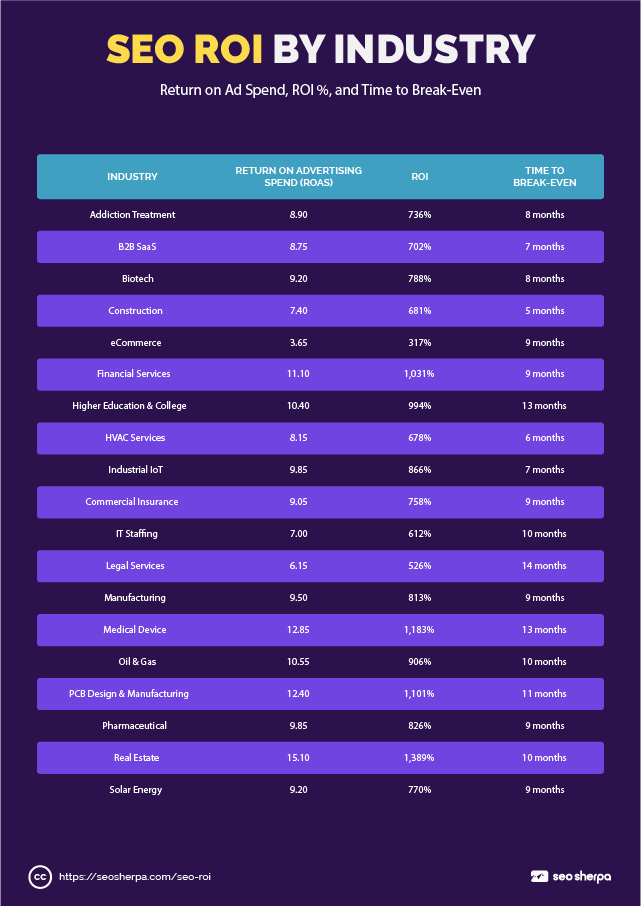
But when SEO pays off in high-value sectors, the return can be massive, hundreds or even thousands of percent ROI.
Set expectations early.
Let stakeholders know that early results might look slow, but SEO compounds like no other channel.
The longer you stick with it, the stronger and more sustainable your growth becomes.
Making the Case for SEO Investment
SEO isn’t a cost, it’s a compounding growth asset.
When done right, SEO delivers measurable returns that grow over time. But to get buy-in, you need to tie your work to outcomes that matter.
That means connecting traffic and rankings to leads, revenue, and long-term value. It means being transparent about the timeline, realistic about the challenges, and strategic in how you present results.
Proving SEO ROI isn’t about spinning a story; it’s about showing the numbers behind the narrative.
You’ve modeled the return. You’ve tracked the impact.
You’ve aligned SEO performance with business goals. That’s how you shift perception, from “nice to have” to “essential investment.”
Now it’s your turn to take action.
If you’re ready to scale your organic growth and prove the return, go beyond basic tracking.
Adopt a full Search Everywhere Optimization approach.
Make sure your brand shows up not just on Google, but on every channel where your audience is searching.
Want to See Your SEO ROI Before You Invest?
Curious how much revenue SEO could actually generate for your business?

Try Our Free Organic Revenue Estimator
In just a few clicks, you’ll get a data-backed projection of your potential ROI based on your current traffic and conversion rates.





















Leave a Reply